In the News: Radio FM4 (Austria) on Survivor-Centred Visual Narratives
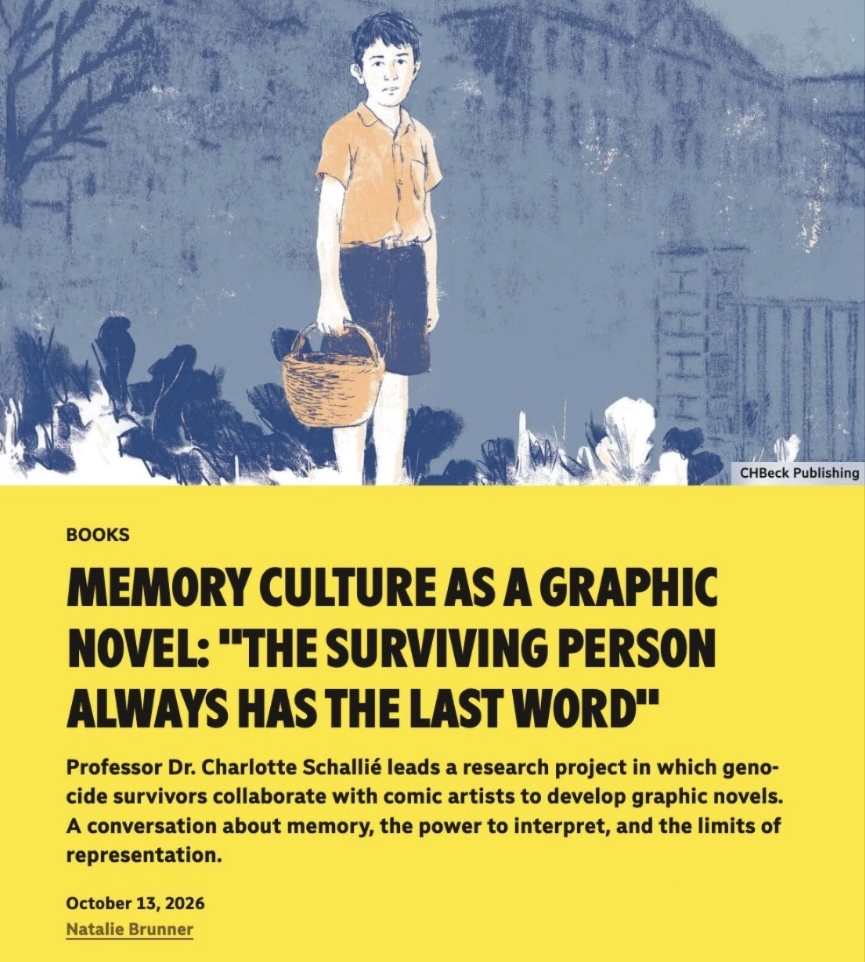
The Austrian radio station Radio FM4 (ORF) has published a feature on Survivor-Centred Visual Narratives (SCVN) and the graphic novels we create together with survivors of genocide and mass atrocity. Natalie Brunner‘s article, published on October 13, 2026, takes its headline from a principle at the heart of our work: the survivor always has the last word. It includes an interview with our project Lead and Co-Director Dr. Charlotte Schallié, and is written in German.
The feature reflects the range of survivor experiences that SCVN works with: the Holocaust; the genocide of the Yezidis; the wider violence in Iraq and Syria; Rwanda; the wars in the former Yugoslavia; and the genocide of Indigenous peoples on Turtle Island. These experiences are considered in relation to one another without being treated as equivalent.
Dr. Schallié describes the project as an “international, arts-based research project” in which survivors, eyewitnesses, comic artists, and partners from the affected communities collaborate to develop “new forms of remembrance work.”
The conversation brought up some of the questions at the heart of SCVN’s work: Who has the authority to retell and mediate survivors’ stories and lived experiences? What can visual storytelling make visible, and where must we acknowledge the limits of representation? How do we engage with traumatic memories responsibly without reducing people and their lives to experiences of violence and suffering? And what responsibilities do we have as artists, scholars, educators, archivists and readers when engaging with someone else’s life story?
These questions are a reminder of the importance of sharing authority, reciprocity and care, and of making visible in our work the relationships and collaborative processes through which all SCVN’s supported books are co-created.
In the feature, Charlotte describes what these books have in common. Survivors decide what is told and in what form, and the collaboration with an artist can take months or years. Images, colour and the gaps on the page can carry what words cannot, so each book aims for the form that is right for its survivor rather than for completeness. The making of the book is part of the work and this process is made visible within it. A graphic novel is a public medium, not a therapeutic one, so counselling is offered to everyone involved. Charlotte hopes readers will not try to identify with a survivor’s experience but will read these books slowly and attentively.
We are grateful to FM4 and Natalie Brunner for the space to share this work, and, above all, to the survivors who have trusted us with their stories.
Read the full story (in German): Erinnerungskultur als Graphic Novel – FM4
Learn more about SCVN’s graphic novels and where to order them here:
- Al-Faẓia’ الفظیع – the Horror: Surviving Syria’s Prisons co-created by Tobi Dahmen & Akram Al Saud
- As Long As We Are Together: A Childhood During the Srebrenica Genocide co-created by Anneli Furmark & Almasa Salihović
- Don’t Give Up! How a young Yezidi survived the genocide co-created by Birgit Weyhe & Jilan (pseudonym)
- Emmie Arbel. The Colour of Memory co-created by Barbara Yelin & Emmie Arbel
- The Secret of the Jewish Hospital co-created by Gilad Seliktar & Klaus Zwilsky
- Two Roses: A Story of Deception and Determination in Nazi Germany co-created by Miriam Libicki & Rose Lipszyc
These graphic novels were developed as part of the Survivor-Centred Visual Narratives Project funded by the Social Sciences and Humanities Research Council of Canada (SSHRC).