
Junge Kunsthalle features ‘Emmie Arbel. The Colour of Memory’ in the ‘Graphic Stories’ exhibit
We are pleased to share that Survivor-Centred Visual Narrative’s Emmie Arbel. The Colour of Memory is part of Graphic Stories: Telling Stories Despite It All, a special exhibition at the Junge Kunsthalle in Karlsruhe, Germany. The exhibition runs from October 17, 2026 until April 4, 2027. Emmie Arbel. The Colour of Memory was co-created by graphic artist Barbara Yelin and Holocaust survivor Emmie Arbel.
Graphic Stories brings together illustrators and artists who use images and text to tell stories that move them personally, politically, and socially. Many of the works explore family, identity, the body, the culture of remembrance, and the desire for justice. The show presents graphic novels as an accessible medium for complex subjects.
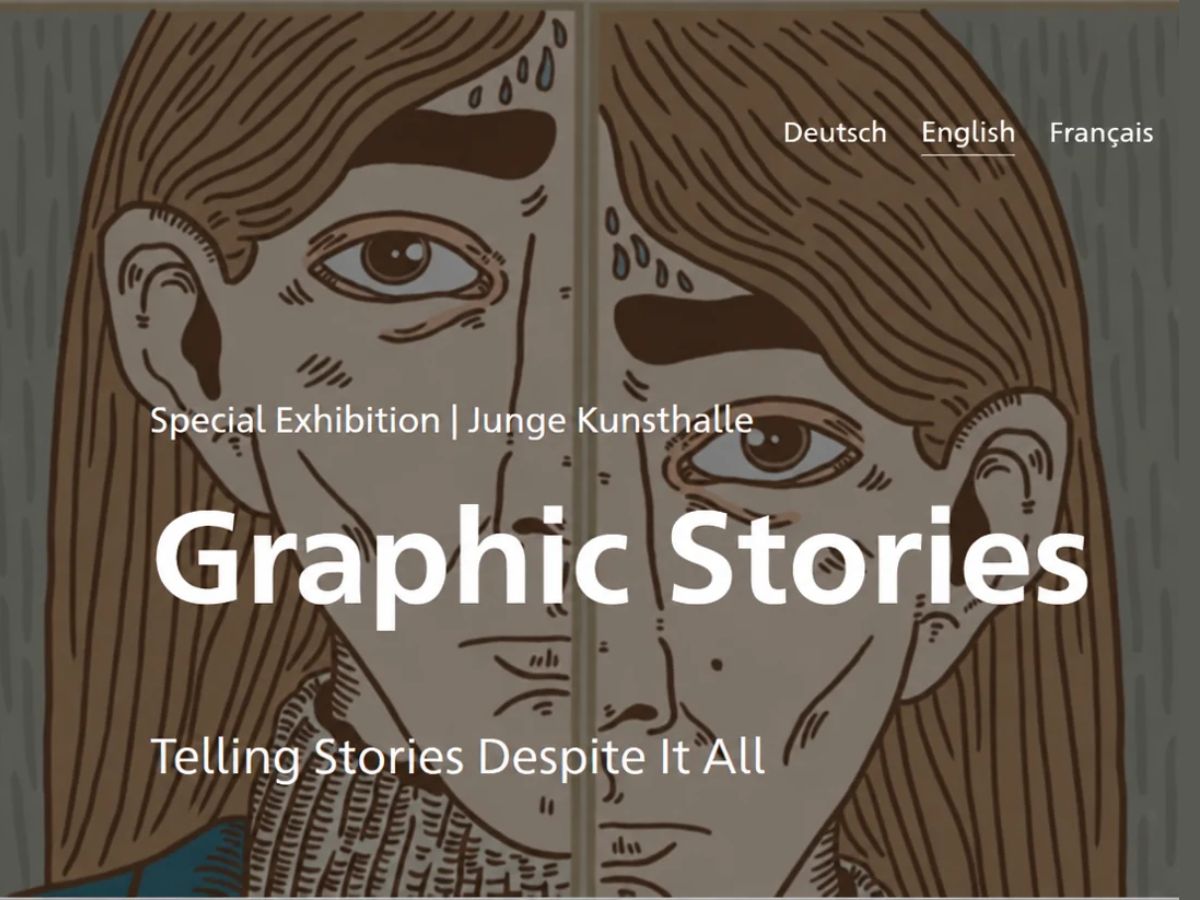
The Junge Kunsthalle’s event page for the Graphic Stories exhibit in Karlsruhe, Germany. Photo credit: Hannah Brinkmann, 2020, copyright: avant-verlag: https://www.karlsruhe-erleben.de/
Among the artists featured are Nora Krug, Hannah Brinkmann, Barbara Yelin, and more than a dozen others working across a wide range of drawing styles.
The Junge Kunsthalle is the Kunsthalle Karlsruhe’s space for young visitors. It invites teenagers to explore difficult histories through graphic narratives, a medium that many may find approachable and engaging. Graphic Stories is recommended for visitors aged 15 and older due to the sensitive nature of its content.
The personal perspectives explored in the Graphic Stories exhibit are in conversation with Nicolas Daubanes. Le feu intérieur, an exhibit which explores power, oppression, and resistance from a historical perspective. It is on view at the Kunsthalle’s Orangerie.
The story behind Emmie Arbel. The Colour of Memory
Emmie Arbel was born in The Hague in 1937. In 1942, she and her Jewish family were deported by the Nazis. As a young child she survived the Ravensbrück and Bergen-Belsen concentration camps. By the end of the war, her parents and grandparents had been murdered. Liberation did not bring safety. Emmie and her brothers were placed with a foster family in the Netherlands, and in 1949 the family emigrated to Israel, where she felt isolated on a kibbutz. Since then, she has made bearing witness her mission.
Barbara Yelin, a Munich-born artist whose earlier graphic novel Irmina was nominated for an Eisner Award, spent years in conversation with Emmie to create the book. The two built a relationship of trust, and Emmie’s daughters took part in many of the conversations. Yelin has described Emmie’s sentences as being like words etched into concrete, brief and weighty. That feeling carries into the book’s visual language. Rather than following a straight chronology, the narrative presents fragments sparked by recollection, and the art is deliberately blurred and elusive, with faces seldom sharply defined. This book reflects on how memory works. One reviewer has noted that Yelin’s work never sensationalises.

Emmie reviewing pages on Zoom with graphic artist Barbara Yelin. Photo credit: Marion Reis.
Emmie Arbel. The Colour of Memory was developed as part of the SCVN project, funded by the Social Sciences and Humanities Research Council of Canada (SSHRC). It was edited by Dr. Charlotte Schallié and Dr. Alexander Korb, and an English edition, translated by Helge R. Dascher, was recently published by SelfMadeHero in 2026. The graphic novel was also published in German in 2025 by Bundeszentrale für politische Bildung. An earlier 40-page version of Emmie’s story first appeared in SCVN’s But I Live: Three Stories of Child Survivors of the Holocaust (2022).
For our team, the book is a powerful example of what survivor-centred work can look like. Emmie is a collaborator who shapes how her story is told, and the artist’s process, slow and relational, is part of the work itself. Seeing it in a major European exhibition, alongside other graphic storytellers, shows that this approach can speak to audiences well beyond academia. It is also a good reminder that visual storytelling can reach younger audiences.
Visit and learn more
If you are in or near Karlsruhe this winter, the Junge Kunsthalle is at Hans-Thoma-Straße 4. It is open Tuesday to Friday from 9 am to 5 pm and Saturday and Sunday from 10 am to 6 pm. Note that the Kunsthalle’s main building is closed for renovation, so exhibitions are currently spread across the Junge Kunsthalle, the Orangerie, and ZKM | Center for Art and Media. Plan your visit here.
If you can’t make the trip, learn more about Emmie Arbel: The Colour of Memory here.
We are honoured that Emmie Arbel’s story, and Barbara Yelin’s careful work in telling it, is being shared with new audiences, and we are grateful to everyone who made this book possible.
This graphic novel was developed as part of the Survivor-Centred Visual Narratives Project funded by the Social Sciences and Humanities Research Council of Canada (SSHRC).