‘Storytelling is collaborative work’: Interview with Barbara Yelin discusses her relationship with Emmie Arbel and the SCVN project
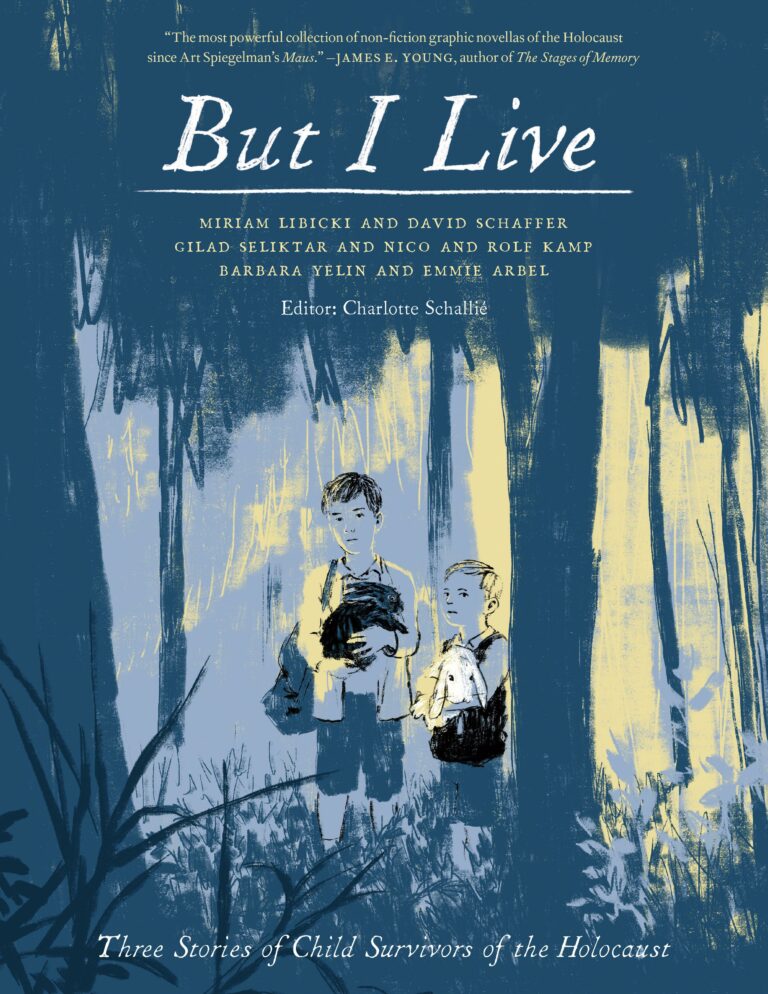
On July 22, Survivor-Centred Visual Narratives (SCVN) Research Assistant Lucie Kotesovska met with Barbara Yelin, an internationally acclaimed artist and author of several book-length visual narratives who was part of the original Partnership Development Grant ‘Narrative Art & Visual Storytelling In Holocaust & Human Rights Education’. This grant produced the graphic narrative But I Live: Three Stories of Child Survivors of the Holocaust, and sparked a five-year collaboration with survivor Emmie Arbel. In this interview, Barbara discusses the creation of her graphic novel, Emmie Arbel. The Colour of Memory, and reflects upon what has contributed to its notable critical acclaim and success with readers in several countries.
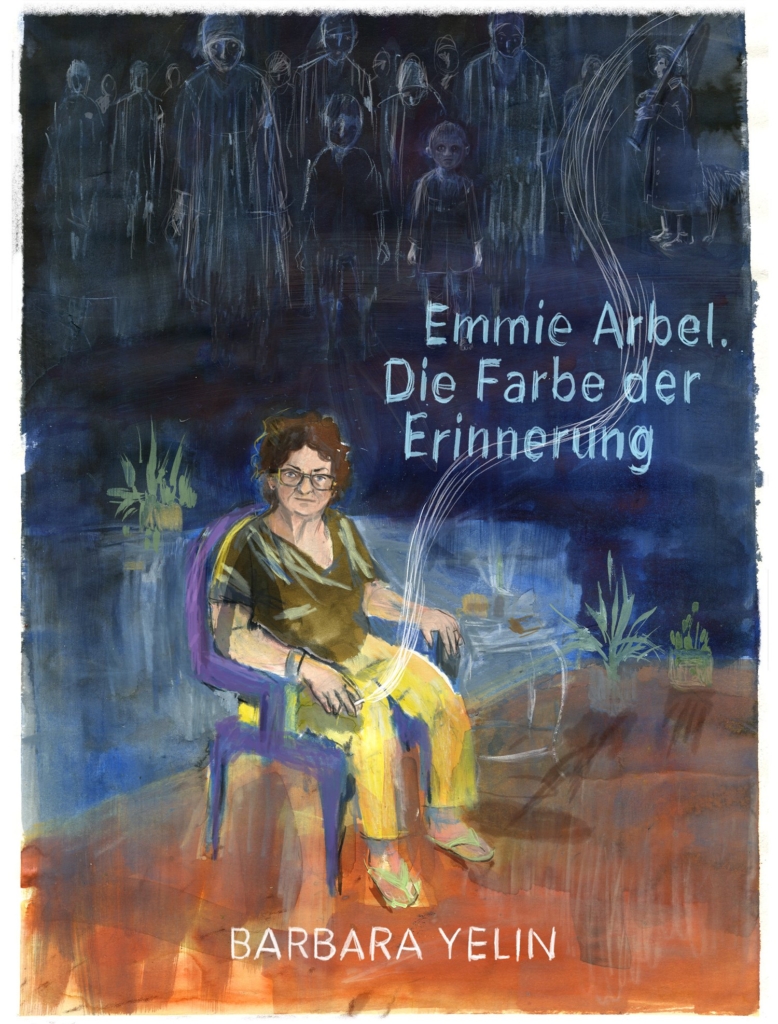
Lucie: In 2023, you published a graphic novel titled Emmie Arbel. The Colour of Memory. This book is an expansion of the story based on your conversations with Emmie, which was published in the 2022 collection But I Live. Since its release, The Colour of Memory has gained wide critical acclaim. It is now available in four languages. What do you think makes this book so well-received, and what factors might have contributed to its success?
Barbara: The most important factor is Emmie’s voice—her words and her story, which she told me so directly and frankly. These words connect not only with me but they get a direct connection to every reader. Then there’s everything she said without words: with silence, in the breaks between the words, or while smoking a cigarette…. While visually meeting her, her person, her character.
The second factor is me trying to transform all of that into a piece of narration within the format of a graphic novel and with its tools. This element is communicating in several layers, emotionally, and also unexpectedly with the reader.
Emmie’s story has a very strong connection with the present time. While it is, of course, located in the past, she is here today and she tells us about the connection between her memories and the present, and what this connection means to her. Our collaboration and my work was to make that accessible for the reader. Emmie’s story is very important from the historical point of view, and it is important to be heard because there are not many survivors alive anymore. Her voice also speaks for those who did not survive. It is an important voice.
Lucie: This leads me to my next question. In what ways was working on Emmie’s story special for you and different from your work on your other books? How has this collaboration between you and Emmie shaped and changed your approach to storytelling?
Barbara: It was the first time for me to speak directly with the person who told me her story—her childhood memories—in person. I didn’t only research her story in history books, or in archives, or in documents, or through other people who knew her. It was her herself. And she was so generous, giving me much of her time and of herself. She trusted me. I’m deeply grateful for that. Without this trust, the book would not have happened as it did.
It was a constant learning process to understand how strong and fragile Emmie is at the same time. For me personally, it was important to learn about how trauma forms, and how someone like Emmie is dealing with that until today. How violence of the perpetrators has consequences until today and, at the same time, how Emmie did succeed in not remaining a victim.
In this project I found out that drawing, and putting together images and sketches, is more than depicting a narration or depicting a story or depicting history. It is actually a process of memorizing.
We communicated, of course, with words, and Emmie told me her memories in many hours of conversations. After that—sometimes already during our conversations, but mostly after that—I tried to put what she told me into drawings. And by doing that, I found more questions. I understood that there was more to ask. And then I showed her the sketches and then I would ask her new questions. She could tell me, ‘This might be right like this. You can change it to be like this’, or ‘I do not remember that. Please ask the researchers. Ask the historians. They have to find out’. So, this kind of sketching was something that really enriched our dialogues and actually helped her memories become clearer.
Sometimes we included Charlotte [Schallié] or some of the historians on the team. So, it’s a mixture of ‘we’ and ‘I’. It’s a collective work. If we did not know, we had to decide. Maybe there was a memory gap or an empty space of memory or a traumatic space of memory. Sometimes, we tried to fill the gap with documentary knowledge that we could obtain from the historians. Other times, we actually left these… spaces transparently free and empty to show that there is something that is not catchable at the moment.
This was new ground. It changed my understanding not only of telling history or retelling history, but also of what to include in storytelling. This means anything that cannot be said in words but still needs to be shown to be there. The importance of showing what is absent and giving the space to it.
Lucie: We will get to the question of silence. But first, let me ask you another question. You described in detail your process of collaborating with Emmie on her story. How did this collaboration or collaborative relationship evolve? How did it change over time?
Barbara: There was a kind of a direct connection with Emmie from the beginning. And that worked both ways. We got to know each other better as we spent more time together, and a friendship began to grow. I think she knew she didn’t have to make anything lighter for me. She told me the difficult and sad things. But we could also speak about very normal things—we knew what kind of coffee the other liked to drink and things like that. It was important to spend time with each other, and it helped us during the long process.
And Emmie soon understood the medium of the graphic novel and its potential. She saw the results of my work, but she also listened to the reactions of others who read parts of the graphic novel before it was published. It was important for both of us to see what it does to the reader, and that her story gets a kind of accessibility to the reader. There were people deeply impressed by her story, telling her, ‘I didn’t know it like this before’, and that was important for her to trust the medium.
Emmie told me many times that some drawings of her weren’t accurate and she wanted me to change it—which I did. But she was absolutely generous in letting me decide about the dramaturgy—how I built the story and which parts I chose—and how I drew and told the heavy, traumatic memories. I learned that Emmie is someone who really knows about her limits. She told me when she wanted to have a break, she told me when she didn’t want something in the book, she let me know when something was missing, so I could absolutely rely on that. That was very helpful for me. She took on all responsibility for her side of the collaboration.
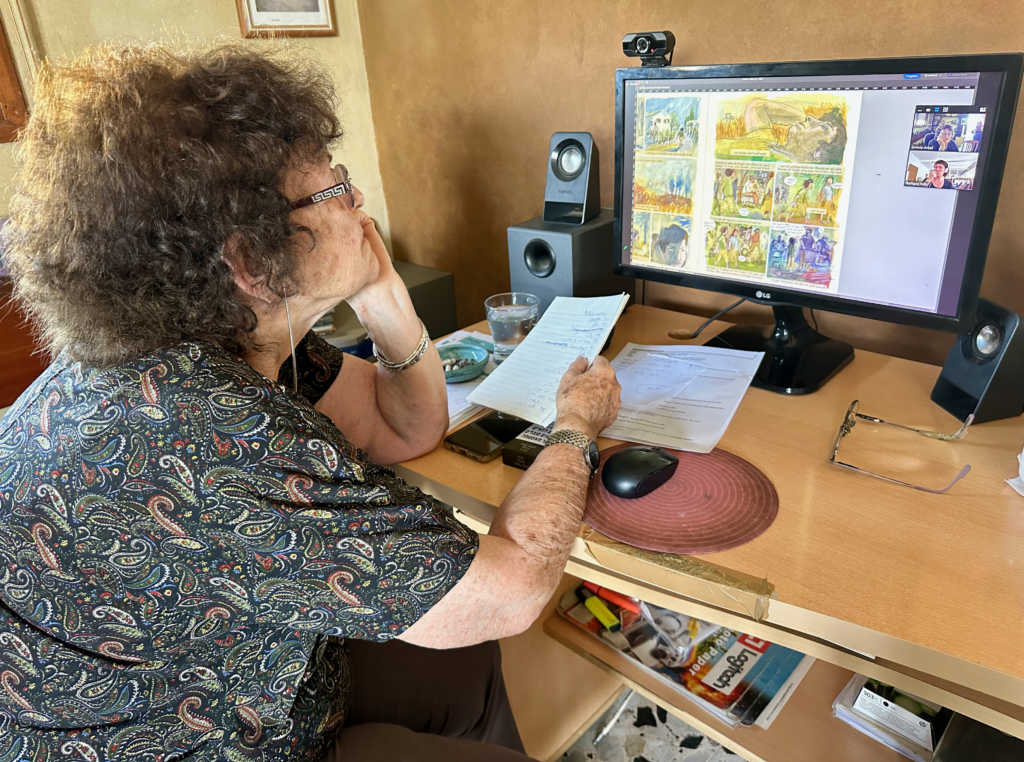
Emmie reviewing pages on Zoom with Barbara. Photo credit: Marion Reis.
Lucie: I notice that you even included these moments in the book when Emmie says, ‘Oh, I need a break’, and she turns to her computer. You made them an important part of the narrative.
Barbara: That was of course something that became relevant. I included these moments in the book because they are special. They were also important for the transparency of the narration and its documentary aspect.
I learned to be silent with Emmie. In the beginning, I remember, I often tried to fill the silence. But later, I did not do that anymore. Now, when I listen to the recordings, I heart it that we could actually be silent together for long minutes. This is even more special for me because normally I speak a lot! But with Emmie, we were able to be calm together.
Lucie: Speaking of silence, how do you work with it visually in the novel? I noticed that you incorporate it quite often. Sometimes, you even make it speak.
Barbara: Yes, I included the parts where Emmie would not speak or when she took a break. This is part of her testimony, and I found visual solutions to show that. There’s the panel, the square in the graphic novel. It is a kind of a frame. It might also hold a silent space. Like this, I can actually show silence, and we can see and feel that there’s silence in between words. I was also focusing on the rhythm of the words when I put parts of sentences in sequenced panels and then had a silent panel. We can, of course, listen to silence—in recordings, in movies, in documentaries. But I think that there is a special kind of significance in presenting it visually—the absence of words. Like this, I could really work with these renderings of silence. Another example: You have speech balloons in graphic novels, and normally you’d fill them with words, but you can also leave a speech balloon empty. It’s a way of showing that someone is not saying anything. And I could include silence in landscapes or in parts where we only see almost abstract forms. There’s nothing really to recognize, to identify, and still this drawing will ‘speak’ to you as a reader.
Lucie: Do you think that there were more moments like this in The Colour of Memory than in your previous visual stories?
Barbara: Yes. For example, I worked with almost black colour when Emmie told me what the colour of memory is. At first, it was a complete abstract drawing. I put black and blue colours on paper, and only afterwards I drew the face of Emmie digitally, her person surrounded by these shapes and forms of abstract colour. And then she speaks about humiliation, and we see that part by part her face, her expression gets invisible. In the end, we can see only the eyes. And only when she lights her cigarette is she visible again.

Page from Emmie Arbel. The Colour of Memory.
Lucie: In The Colour of Memory, Emmie speaks about some traumatic events in her life perhaps for the first time outside of her therapist’s office. You mentioned how she became open and shared things that are not light with you. Could you reflect on some of the challenges of this sharing for you? How did you take care of yourself during this process?
Barbara: When I met Emmie, she had already been working with her memories. She had a ten-year-long therapy in the middle of her life and had been speaking publicly about her memories and about history for decades. I was absolutely not the first one who listened to her, and I was not the first one who asked questions. I’m not an expert in psychology, I’m neither an academic expert in psychology, nor a historian, nor a trauma expert, so I tried to do my best there. I learned about oral history and how to ask questions without going too quick or too far, without doing any damage with my questions, and how not to retraumatize the other person. Then I found out that Emmie knew perfectly what she was doing—when she needed a break, when she did not want to answer, and what she told me in private. And still, of course, it was a very sensitive work that we did together.
Sometimes we cried—sometimes she cried, sometimes me…. I learned that this is part of the work… To memorize, to remember, is work. It’s memory work, like Charlotte said.
I did not only have to learn how much Emmie was affected by everything, but also that it affected me to listen to her story. I needed breaks, and I needed to reflect upon what she told me, and it brought up emotions. Sometimes we had to stop. Sometimes I was very exhausted. Sometimes, of course, she was very exhausted. So, I learned that this is part of this work.
On the other hand, I always wanted to find a way to create narration about her. We had always this book in sight as our future outcome. We had a mission. So we pushed through, and I learned about myself that I need a good balance between listening and really being open there, and then again to keep more distance and take time to process things.
I was glad that I had partners during this process like Charlotte Schallié. I could speak with her. I could speak also with Emmie and Charlotte, the three of us. There were some points when this was necessary. I had a historian, an expert, Alexander Korb and also Andrea Löw, who were amazingly helpful with details about the Holocaust.
I had Matthias Heyl, head of the Education Department at the Ravensbrück Memorial. He is the person who knows Emmie best, and the other way around, she knows him very well. So, it was collaborative work because there were many, many people who also had the interest to bring Emmie’s story into this graphic novel and who helped me. And there were Emmie’s daughters, who also took part in this dialogue several times and who could also read the graphic novel before we published it.
I had trauma experts, I had also my editor from my publishing house, who was helping me with the specifics of the graphic novel. It was a complex dialogue involving many people. I’m truly grateful. I could never have done this work without this support, and I think none of us could have done it without each other.
Lucie: Both But I Live and The Colour of Memory have been published with the support of the Survivor-Centred Visual Narratives project. How did the project help you more specifically as you worked on the two publications? And is there anything that might have been done differently in order to support you better?
Barbara: I think it was an amazing and special support from the start. We all worked on it together. I say ‘together’ now, but Charlotte and her team had already been working on this before I became part of the project. There was a conference at the beginning, even before I had the first longer conversations with Emmie, where I could meet historians and show them my initial approaches. That was incredibly supportive, helpful, and important. So, there was a lot of work done around us, which was very necessary.
And there were other aspects that I especially appreciate: connecting art and research. That is something I am incredibly interested in. What is historical research and what is artistic research? I’m not really sure if ‘artistic’ is the right word—art-related research. Sometimes, these two are actually similar, and it was mind-blowing to understand that and realize that we are enriching each other’s work.
Lucie: Do you feel that this realization is something that the project enabled?
Barbara: Absolutely. The project enabled that, and it also enabled the survivor-centred aspect—the understanding that the survivors do not work for a historical project, but it is the historians and the artists who work to understand the perspective of people like Emmie better.
It was already fixed in the contract that it would be always Emmie’s story, and if Emmie did not agree with what was happening with this graphic novel, then it wouldn’t be published. To really understand who owns the story was an important question that Charlotte asked us. Now we have not only the graphic novel, but there is also a new archive of all the conversations between Emmie and me, the archive of all the documents and all the sources we found and collected.
Who owns that? Who is the owner? Is it the university? Is it the artist? Is it the reader? Or is it Emmie in the end? Or is it the collective? There is no answer. I think the best answer would be Emmie, but it was collaborative work. So, absolutely, that widened my understanding of who’s owning a story. It is important to understand that storytelling is not a work of a solo genius of the past, mostly male, who owns the story. Storytelling like this is a collaborative work. This insight is something that I was really profiting from. In this sense, this project was successful the entire time. It’s not comparable to any other project I know.
And now, the project is expanding, producing more stories from different perspectives, from different times, and for more genocides. That is a truly deep approach.
Lucie: Let’s talk about the exhibition, or a series of exhibitions, based on But I Live that you helped to curate. How important was it for you to be able to take part in this process? Did you feel that you were able to communicate some aspects of Emmie’s story more clearly or effectively in this way?
Barbara: I was very glad that we could do the exhibition. I suggested it to the Comicsalon festival, and I asked Jakob Hoffmann to be my partner during the curation of it. I was strongly interested in showing the project not only as the result, but also in the process of development. We showed sketches, which are not in the book, sources, documents, and the original works, which you do not get to see as a reader of the book. These original paintings included Miriam’s wonderful aquarelles, or my multi-layered dark drawings, or Gilad’s amazing work that was partly analog and partly digital.


Photos from the exhibition at the Bergen-Belsen Memorial, May 11–June 30, 2025. Photo credit: Marion Reis.
Like in the book, we approached the story through all these parts of a memory puzzle. For me, it’s always like a kind of puzzle. You have pieces, and you show these pieces, and there are empty spaces. There are missing parts, and you can be sure that the visitor or the reader will do something with their own concept and imagination to fill these gaps or to think about these gaps. We showed it for the first time in 2022 in Erlangen, for the International Comics Festival, and it was so successful that they wanted the exhibition to travel. So, in the end, we had six locations including the Bergen-Belsen Memorial and the Ravensbrück Memorial. I was glad to accompany the exhibition to most of these locations and to bring the exhibition to these important places of learning about history, but also to locations like Erika Fuchs House, which is a museum specialized in comics, and to confront their visitors with the topic of the Holocaust. It got very positive resonance, and again, it grew out of collaboration with many different people in all these locations.


Photos from the exhibition at the Ravensbrück Memorial, April 13 to July 31, 2024. Photo credit: Eberhard Schorr.
Lucie: Last question for you. After the two books and the series of exhibitions, where do you think your steps will lead you now? What are your next plans?
Barbara: I just finished, some months ago, another biographical graphic novel, but it was much shorter this time. It tells the interesting life of Terese Giehse, an actress who lived in Munich. She had to flee the Nazis. She was Jewish and a very politically involved and strong woman. She came back after the war. Another biographical work, which was very interesting. Afterwards, I also felt strongly that I want to take a break and not to go on with further biographical works because repetition is not good. I want to approach history again with a fresh view.
But there will be a new book, and I want to work still with documentary material and do research, but this time I want to focus on present times. I also want to learn more about how I can connect words and images together in a new way. How can I embrace more artistic ways to do that, or poetic ways, or experimental ways? That is something that will always interest me.
SCVN is grateful to Barbara Yelin for her generous time and dedication, both in sharing this insightful conversation with us and in co-creating the phenomenal Emmie Arbel. The Colour of Memory. You can find more information about her project work here.