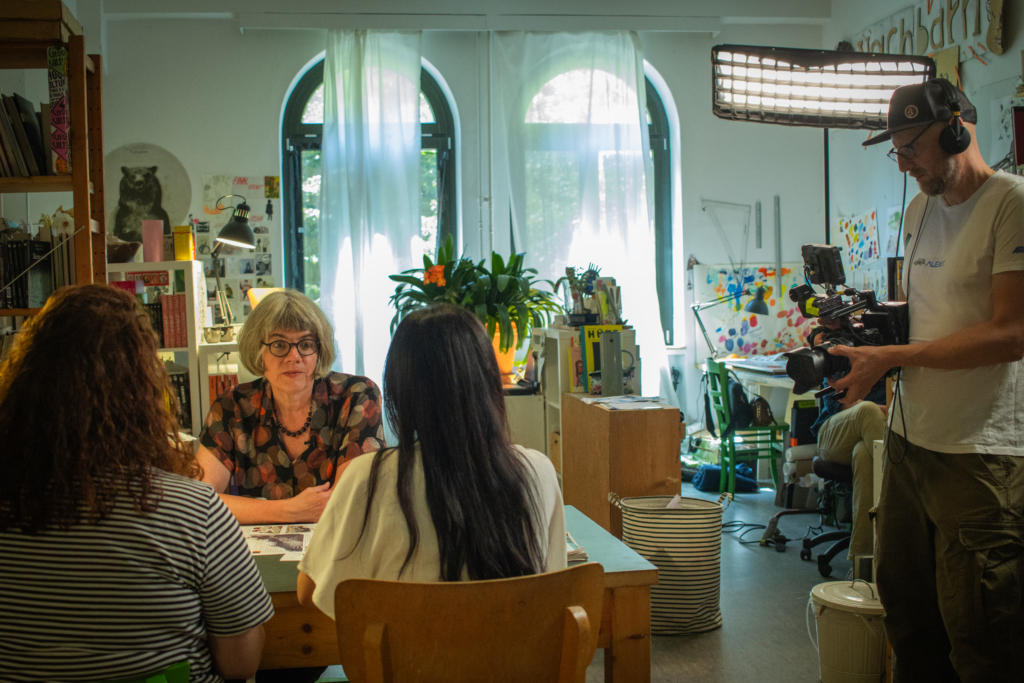
Survivor-Centred Visual Narratives

Category: interview

‘Storytelling is collaborative work’: Interview with Barbara Yelin discusses her relationship with Emmie Arbel and the SCVN project

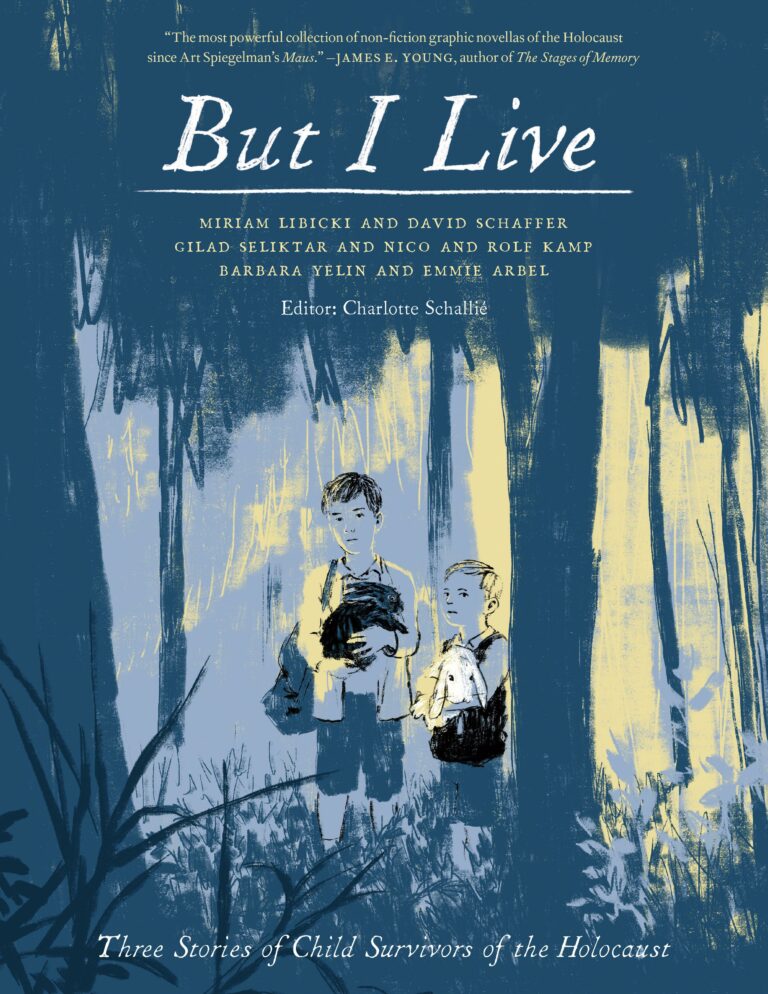
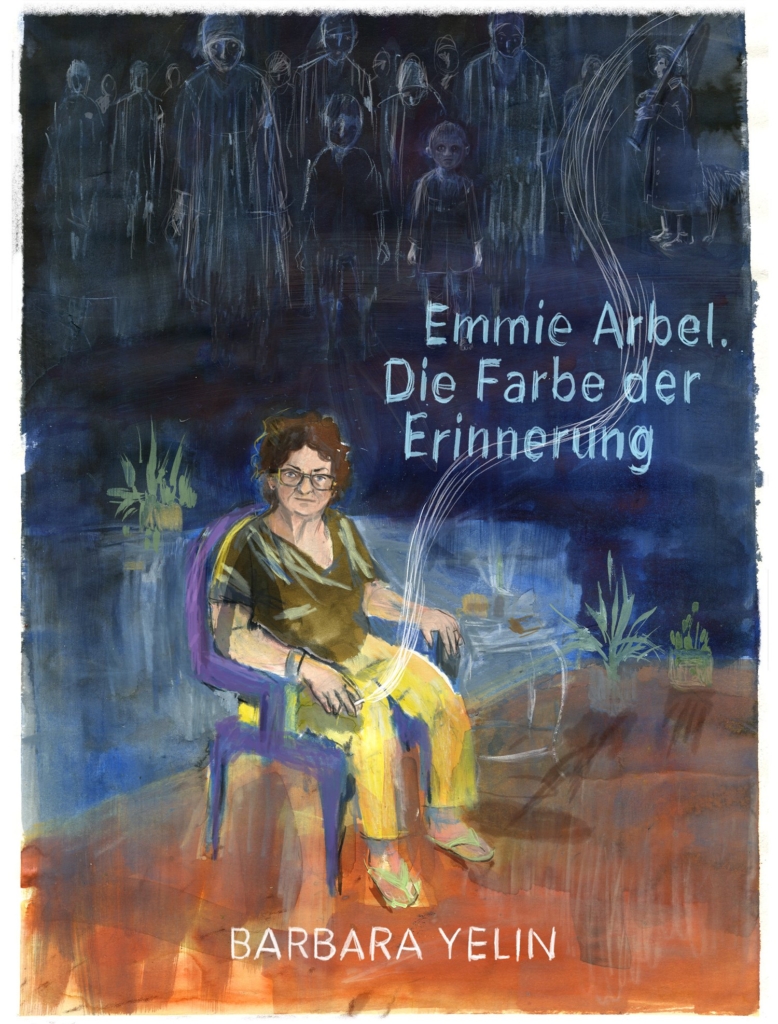
On July 22, Survivor-Centred Visual Narratives (SCVN) Research Assistant Lucie Kotesovska met with Barbara Yelin, an internationally acclaimed artist and author of several book-length visual narratives who was part of the original Partnership Development Grant ‘Narrative Art & Visual Storytelling In Holocaust & Human Rights Education’. This grant produced the graphic narrative But I Live: Three Stories of Child Survivors of the Holocaust, and sparked a five-year collaboration with survivor Emmie Arbel. In this interview, Barbara discusses the creation of her graphic novel, Emmie Arbel. The Colour of Memory, and reflects upon what has contributed to its notable critical acclaim and success with readers in several countries.

Lucie: In 2023, you published a graphic novel titled Emmie Arbel. The Colour of Memory. This book is an expansion of the story based on your conversations with Emmie, which was published in the 2022 collection But I Live. Since its release, The Colour of Memory has gained wide critical acclaim. It is now available in four languages. What do you think makes this book so well-received, and what factors might have contributed to its success?

Barbara: The most important factor is Emmie’s voice—her words and her story, which she told me so directly and frankly. These words connect not only with me but they get a direct connection to every reader. Then there’s everything she said without words: with silence, in the breaks between the words, or while smoking a cigarette…. While visually meeting her, her person, her character.

The second factor is me trying to transform all of that into a piece of narration within the format of a graphic novel and with its tools. This element is communicating in several layers, emotionally, and also unexpectedly with the reader.

Emmie’s story has a very strong connection with the present time. While it is, of course, located in the past, she is here today and she tells us about the connection between her memories and the present, and what this connection means to her. Our collaboration and my work was to make that accessible for the reader. Emmie’s story is very important from the historical point of view, and it is important to be heard because there are not many survivors alive anymore. Her voice also speaks for those who did not survive. It is an important voice.

Lucie: This leads me to my next question. In what ways was working on Emmie’s story special for you and different from your work on your other books? How has this collaboration between you and Emmie shaped and changed your approach to storytelling?

Barbara: It was the first time for me to speak directly with the person who told me her story—her childhood memories—in person. I didn’t only research her story in history books, or in archives, or in documents, or through other people who knew her. It was her herself. And she was so generous, giving me much of her time and of herself. She trusted me. I’m deeply grateful for that. Without this trust, the book would not have happened as it did.

It was a constant learning process to understand how strong and fragile Emmie is at the same time. For me personally, it was important to learn about how trauma forms, and how someone like Emmie is dealing with that until today. How violence of the perpetrators has consequences until today and, at the same time, how Emmie did succeed in not remaining a victim.

In this project I found out that drawing, and putting together images and sketches, is more than depicting a narration or depicting a story or depicting history. It is actually a process of memorizing.

We communicated, of course, with words, and Emmie told me her memories in many hours of conversations. After that—sometimes already during our conversations, but mostly after that—I tried to put what she told me into drawings. And by doing that, I found more questions. I understood that there was more to ask. And then I showed her the sketches and then I would ask her new questions. She could tell me, ‘This might be right like this. You can change it to be like this’, or ‘I do not remember that. Please ask the researchers. Ask the historians. They have to find out’. So, this kind of sketching was something that really enriched our dialogues and actually helped her memories become clearer.

Sometimes we included Charlotte [Schallié] or some of the historians on the team. So, it’s a mixture of ‘we’ and ‘I’. It’s a collective work. If we did not know, we had to decide. Maybe there was a memory gap or an empty space of memory or a traumatic space of memory. Sometimes, we tried to fill the gap with documentary knowledge that we could obtain from the historians. Other times, we actually left these… spaces transparently free and empty to show that there is something that is not catchable at the moment.

This was new ground. It changed my understanding not only of telling history or retelling history, but also of what to include in storytelling. This means anything that cannot be said in words but still needs to be shown to be there. The importance of showing what is absent and giving the space to it.

Lucie: We will get to the question of silence. But first, let me ask you another question. You described in detail your process of collaborating with Emmie on her story. How did this collaboration or collaborative relationship evolve? How did it change over time?

Barbara: There was a kind of a direct connection with Emmie from the beginning. And that worked both ways. We got to know each other better as we spent more time together, and a friendship began to grow. I think she knew she didn’t have to make anything lighter for me. She told me the difficult and sad things. But we could also speak about very normal things—we knew what kind of coffee the other liked to drink and things like that. It was important to spend time with each other, and it helped us during the long process.

And Emmie soon understood the medium of the graphic novel and its potential. She saw the results of my work, but she also listened to the reactions of others who read parts of the graphic novel before it was published. It was important for both of us to see what it does to the reader, and that her story gets a kind of accessibility to the reader. There were people deeply impressed by her story, telling her, ‘I didn’t know it like this before’, and that was important for her to trust the medium.

Emmie told me many times that some drawings of her weren’t accurate and she wanted me to change it—which I did. But she was absolutely generous in letting me decide about the dramaturgy—how I built the story and which parts I chose—and how I drew and told the heavy, traumatic memories. I learned that Emmie is someone who really knows about her limits. She told me when she wanted to have a break, she told me when she didn’t want something in the book, she let me know when something was missing, so I could absolutely rely on that. That was very helpful for me. She took on all responsibility for her side of the collaboration.


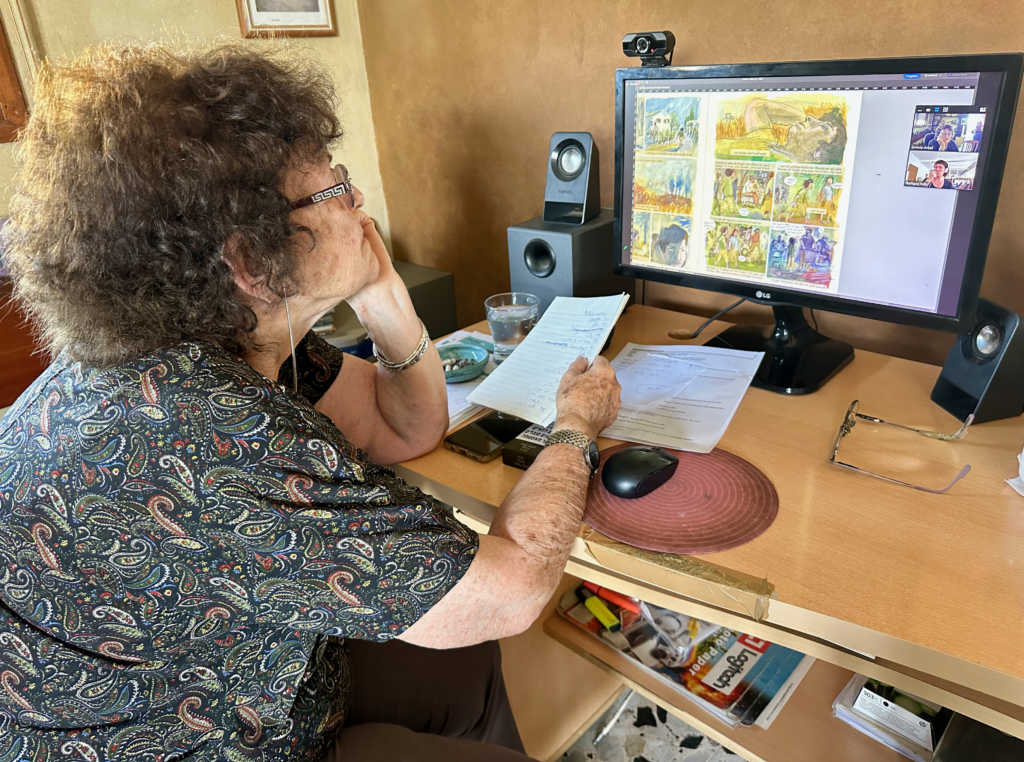
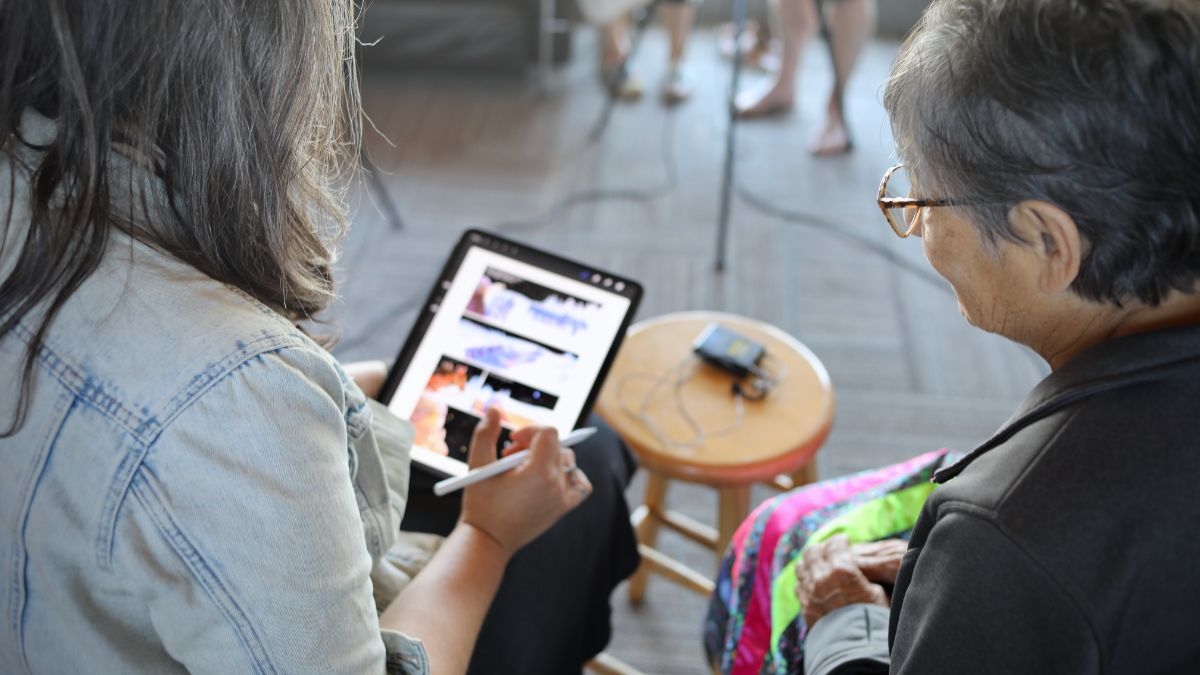
Emmie reviewing pages on Zoom with Barbara. Photo credit: Marion Reis.

Lucie: I notice that you even included these moments in the book when Emmie says, ‘Oh, I need a break’, and she turns to her computer. You made them an important part of the narrative.

Barbara: That was of course something that became relevant. I included these moments in the book because they are special. They were also important for the transparency of the narration and its documentary aspect.

I learned to be silent with Emmie. In the beginning, I remember, I often tried to fill the silence. But later, I did not do that anymore. Now, when I listen to the recordings, I heart it that we could actually be silent together for long minutes. This is even more special for me because normally I speak a lot! But with Emmie, we were able to be calm together.

Lucie: Speaking of silence, how do you work with it visually in the novel? I noticed that you incorporate it quite often. Sometimes, you even make it speak.

Barbara: Yes, I included the parts where Emmie would not speak or when she took a break. This is part of her testimony, and I found visual solutions to show that. There’s the panel, the square in the graphic novel. It is a kind of a frame. It might also hold a silent space. Like this, I can actually show silence, and we can see and feel that there’s silence in between words. I was also focusing on the rhythm of the words when I put parts of sentences in sequenced panels and then had a silent panel. We can, of course, listen to silence—in recordings, in movies, in documentaries. But I think that there is a special kind of significance in presenting it visually—the absence of words. Like this, I could really work with these renderings of silence. Another example: You have speech balloons in graphic novels, and normally you’d fill them with words, but you can also leave a speech balloon empty. It’s a way of showing that someone is not saying anything. And I could include silence in landscapes or in parts where we only see almost abstract forms. There’s nothing really to recognize, to identify, and still this drawing will ‘speak’ to you as a reader.

Lucie: Do you think that there were more moments like this in The Colour of Memory than in your previous visual stories?

Barbara: Yes. For example, I worked with almost black colour when Emmie told me what the colour of memory is. At first, it was a complete abstract drawing. I put black and blue colours on paper, and only afterwards I drew the face of Emmie digitally, her person surrounded by these shapes and forms of abstract colour. And then she speaks about humiliation, and we see that part by part her face, her expression gets invisible. In the end, we can see only the eyes. And only when she lights her cigarette is she visible again.


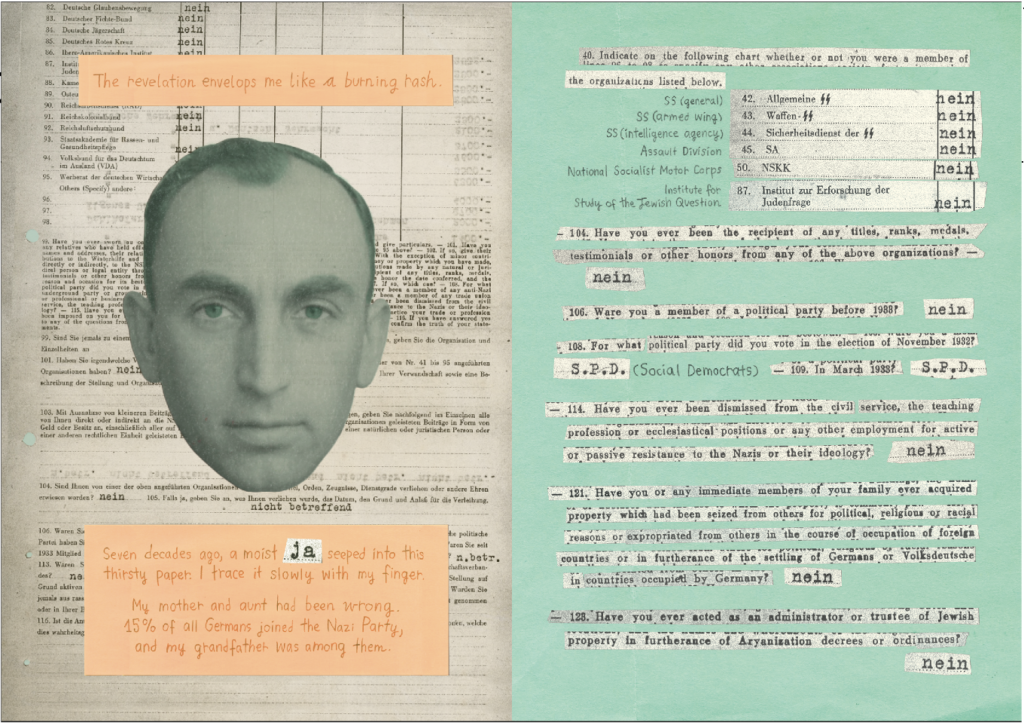
Page from Emmie Arbel. The Colour of Memory.

Lucie: In The Colour of Memory, Emmie speaks about some traumatic events in her life perhaps for the first time outside of her therapist’s office. You mentioned how she became open and shared things that are not light with you. Could you reflect on some of the challenges of this sharing for you? How did you take care of yourself during this process?

Barbara: When I met Emmie, she had already been working with her memories. She had a ten-year-long therapy in the middle of her life and had been speaking publicly about her memories and about history for decades. I was absolutely not the first one who listened to her, and I was not the first one who asked questions. I’m not an expert in psychology, I’m neither an academic expert in psychology, nor a historian, nor a trauma expert, so I tried to do my best there. I learned about oral history and how to ask questions without going too quick or too far, without doing any damage with my questions, and how not to retraumatize the other person. Then I found out that Emmie knew perfectly what she was doing—when she needed a break, when she did not want to answer, and what she told me in private. And still, of course, it was a very sensitive work that we did together.

Sometimes we cried—sometimes she cried, sometimes me…. I learned that this is part of the work… To memorize, to remember, is work. It’s memory work, like Charlotte said.

I did not only have to learn how much Emmie was affected by everything, but also that it affected me to listen to her story. I needed breaks, and I needed to reflect upon what she told me, and it brought up emotions. Sometimes we had to stop. Sometimes I was very exhausted. Sometimes, of course, she was very exhausted. So, I learned that this is part of this work.

On the other hand, I always wanted to find a way to create narration about her. We had always this book in sight as our future outcome. We had a mission. So we pushed through, and I learned about myself that I need a good balance between listening and really being open there, and then again to keep more distance and take time to process things.

I was glad that I had partners during this process like Charlotte Schallié. I could speak with her. I could speak also with Emmie and Charlotte, the three of us. There were some points when this was necessary. I had a historian, an expert, Alexander Korb and also Andrea Löw, who were amazingly helpful with details about the Holocaust.

I had Matthias Heyl, head of the Education Department at the Ravensbrück Memorial. He is the person who knows Emmie best, and the other way around, she knows him very well. So, it was collaborative work because there were many, many people who also had the interest to bring Emmie’s story into this graphic novel and who helped me. And there were Emmie’s daughters, who also took part in this dialogue several times and who could also read the graphic novel before we published it.

I had trauma experts, I had also my editor from my publishing house, who was helping me with the specifics of the graphic novel. It was a complex dialogue involving many people. I’m truly grateful. I could never have done this work without this support, and I think none of us could have done it without each other.

Lucie: Both But I Live and The Colour of Memory have been published with the support of the Survivor-Centred Visual Narratives project. How did the project help you more specifically as you worked on the two publications? And is there anything that might have been done differently in order to support you better?

Barbara: I think it was an amazing and special support from the start. We all worked on it together. I say ‘together’ now, but Charlotte and her team had already been working on this before I became part of the project. There was a conference at the beginning, even before I had the first longer conversations with Emmie, where I could meet historians and show them my initial approaches. That was incredibly supportive, helpful, and important. So, there was a lot of work done around us, which was very necessary.

And there were other aspects that I especially appreciate: connecting art and research. That is something I am incredibly interested in. What is historical research and what is artistic research? I’m not really sure if ‘artistic’ is the right word—art-related research. Sometimes, these two are actually similar, and it was mind-blowing to understand that and realize that we are enriching each other’s work.

Lucie: Do you feel that this realization is something that the project enabled?

Barbara: Absolutely. The project enabled that, and it also enabled the survivor-centred aspect—the understanding that the survivors do not work for a historical project, but it is the historians and the artists who work to understand the perspective of people like Emmie better.

It was already fixed in the contract that it would be always Emmie’s story, and if Emmie did not agree with what was happening with this graphic novel, then it wouldn’t be published. To really understand who owns the story was an important question that Charlotte asked us. Now we have not only the graphic novel, but there is also a new archive of all the conversations between Emmie and me, the archive of all the documents and all the sources we found and collected.

Who owns that? Who is the owner? Is it the university? Is it the artist? Is it the reader? Or is it Emmie in the end? Or is it the collective? There is no answer. I think the best answer would be Emmie, but it was collaborative work. So, absolutely, that widened my understanding of who’s owning a story. It is important to understand that storytelling is not a work of a solo genius of the past, mostly male, who owns the story. Storytelling like this is a collaborative work. This insight is something that I was really profiting from. In this sense, this project was successful the entire time. It’s not comparable to any other project I know.

And now, the project is expanding, producing more stories from different perspectives, from different times, and for more genocides. That is a truly deep approach.

Lucie: Let’s talk about the exhibition, or a series of exhibitions, based on But I Live that you helped to curate. How important was it for you to be able to take part in this process? Did you feel that you were able to communicate some aspects of Emmie’s story more clearly or effectively in this way?

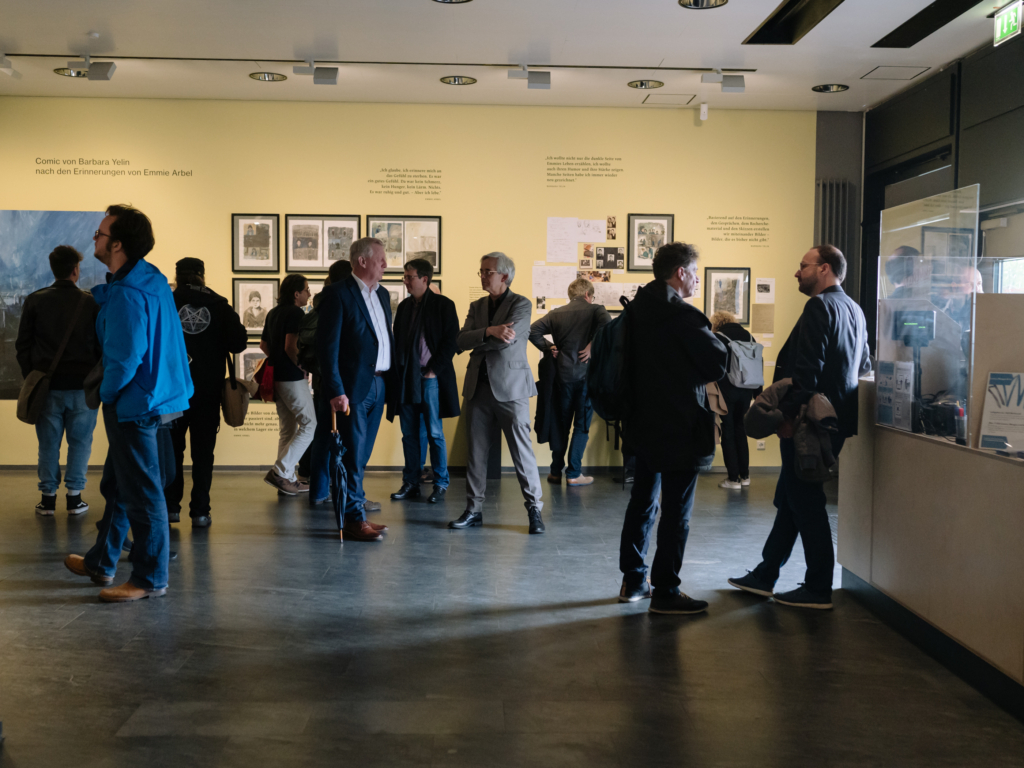
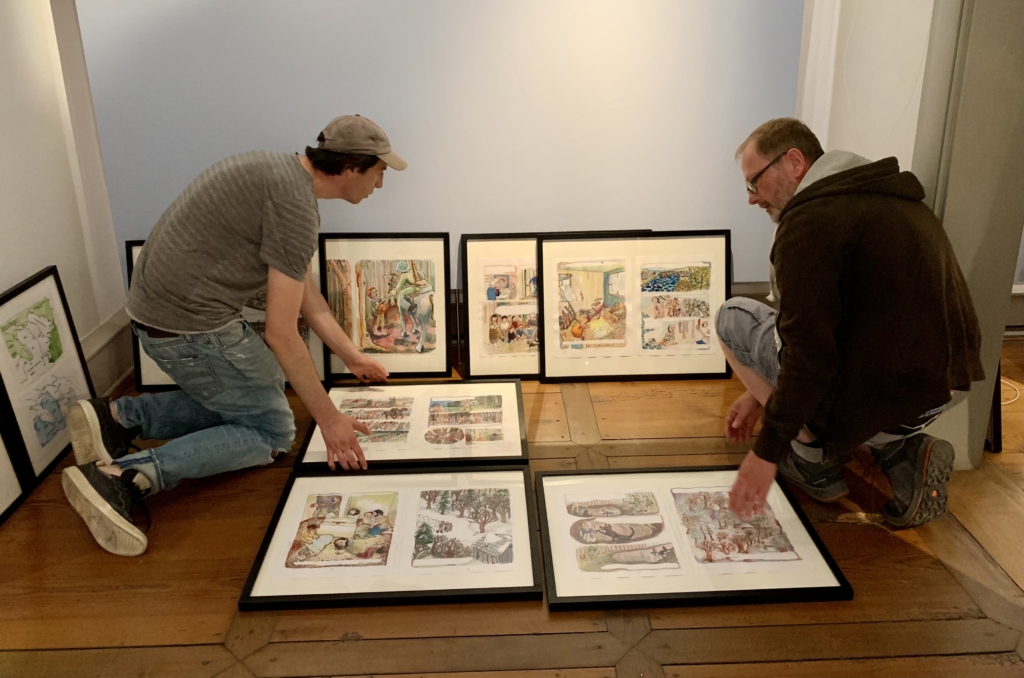
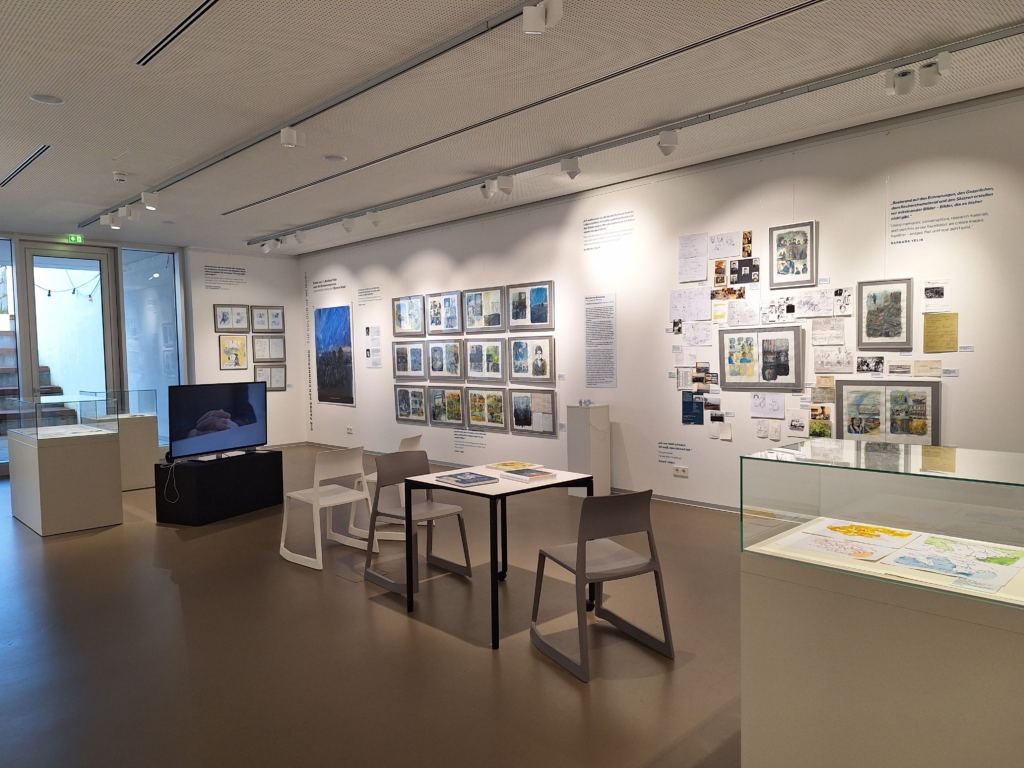
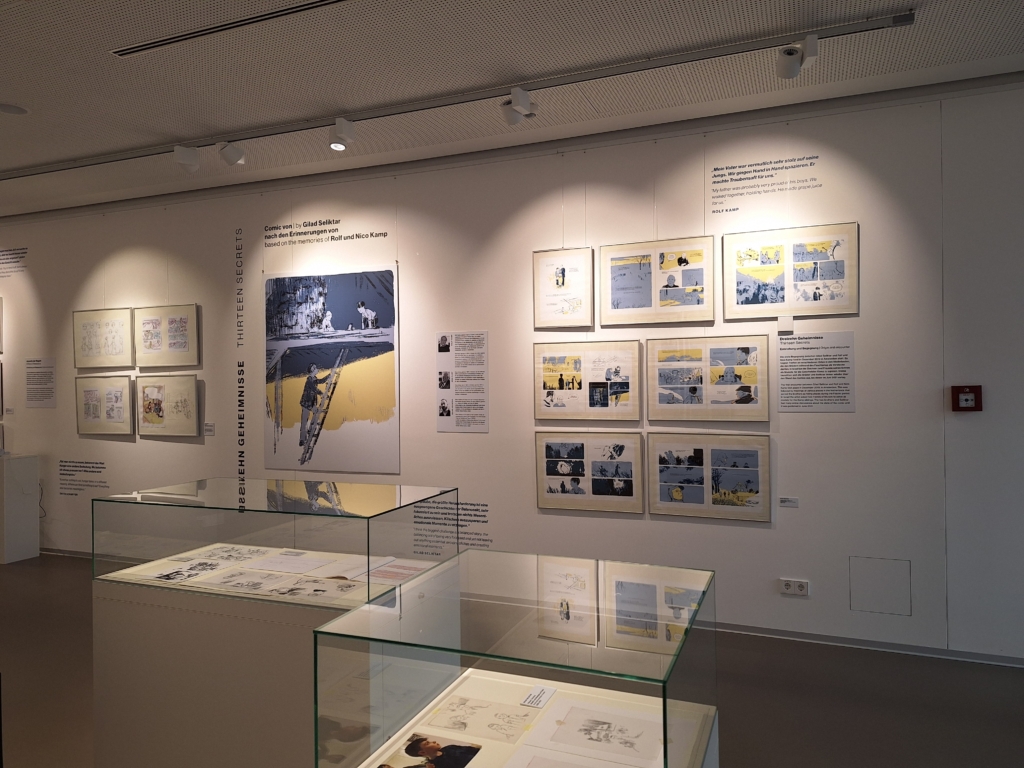
Barbara: I was very glad that we could do the exhibition. I suggested it to the Comicsalon festival, and I asked Jakob Hoffmann to be my partner during the curation of it. I was strongly interested in showing the project not only as the result, but also in the process of development. We showed sketches, which are not in the book, sources, documents, and the original works, which you do not get to see as a reader of the book. These original paintings included Miriam’s wonderful aquarelles, or my multi-layered dark drawings, or Gilad’s amazing work that was partly analog and partly digital.

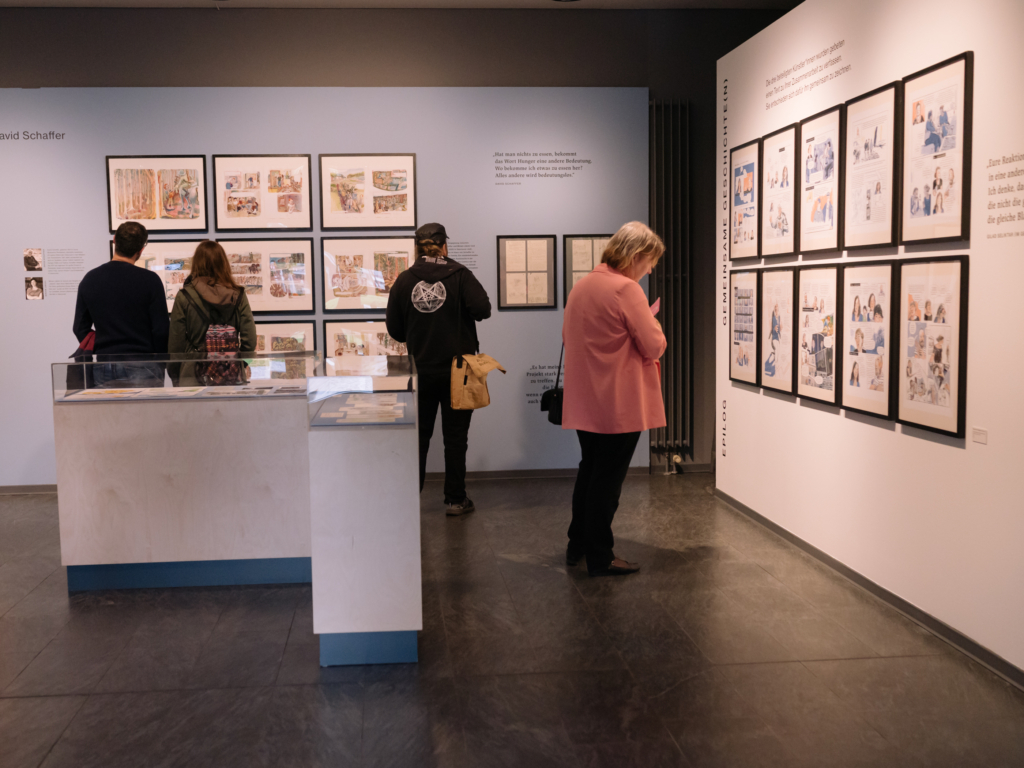
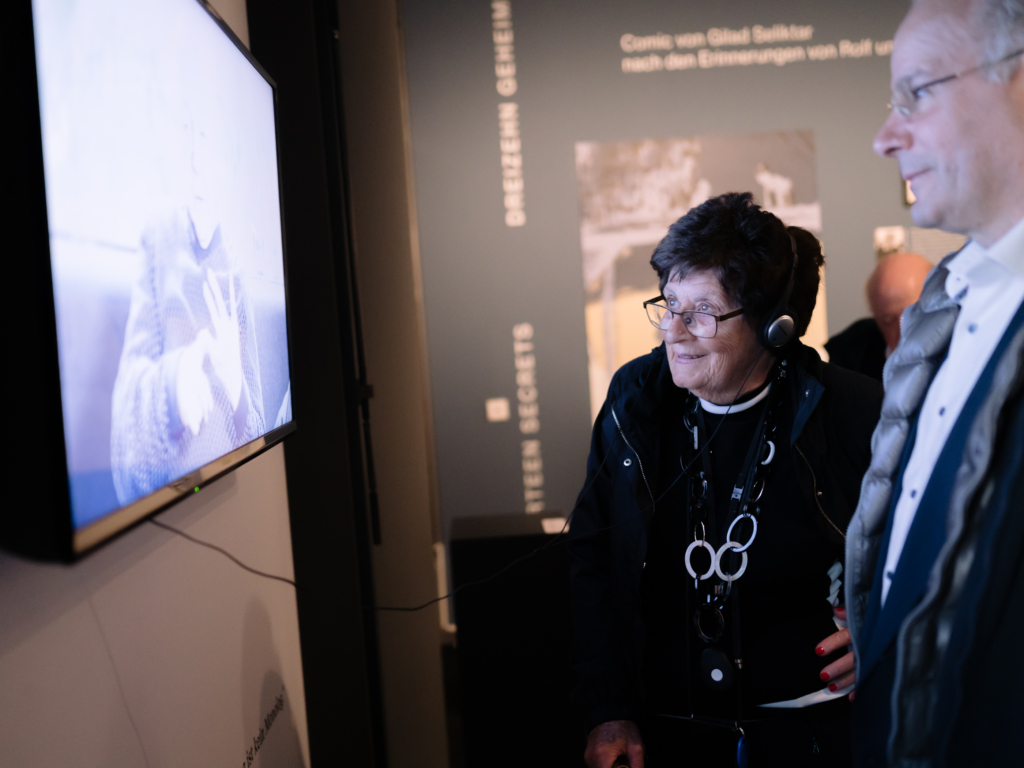
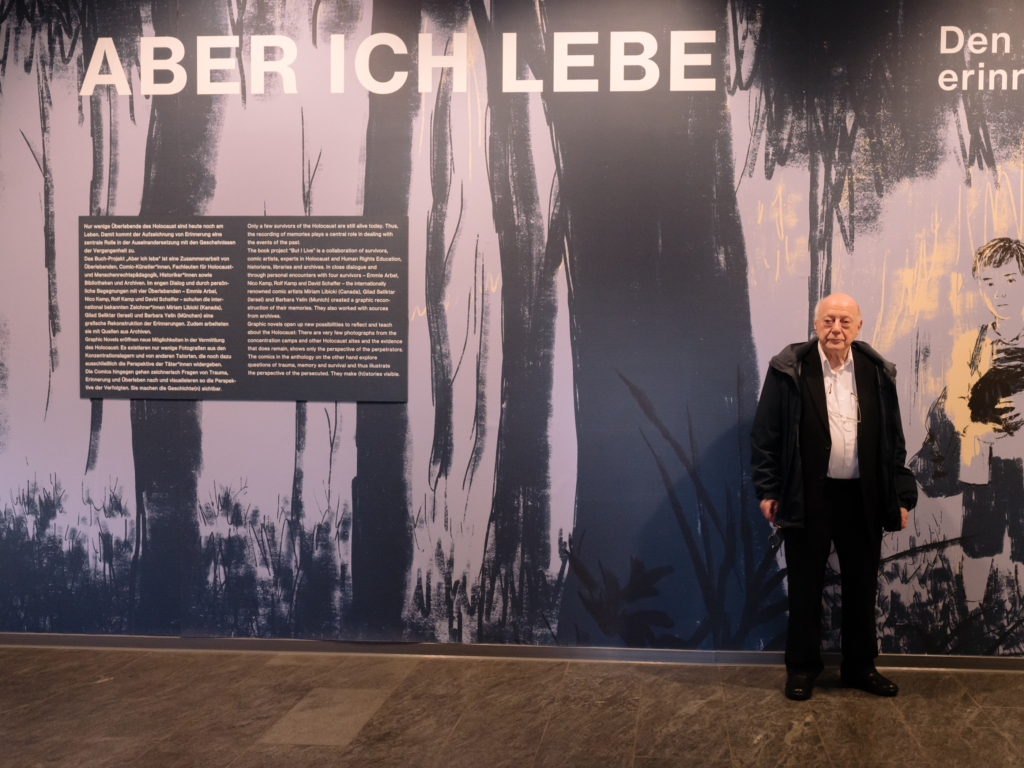
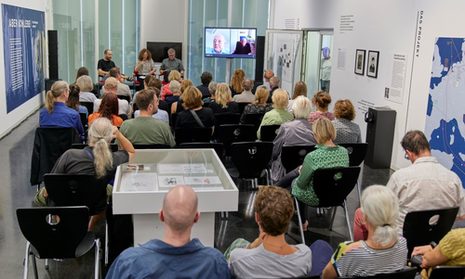
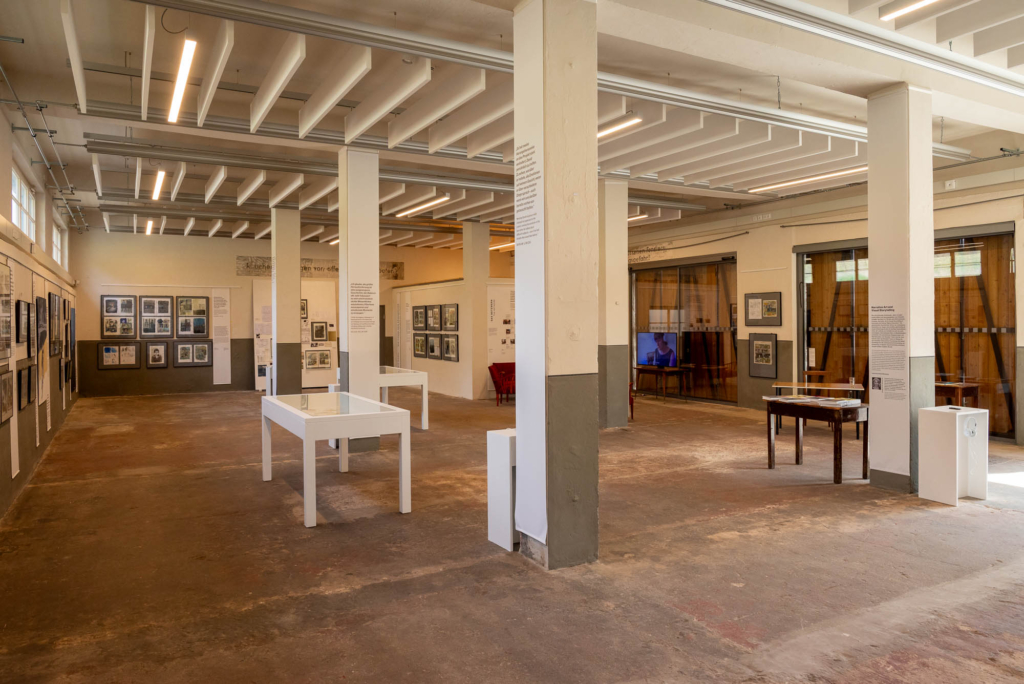
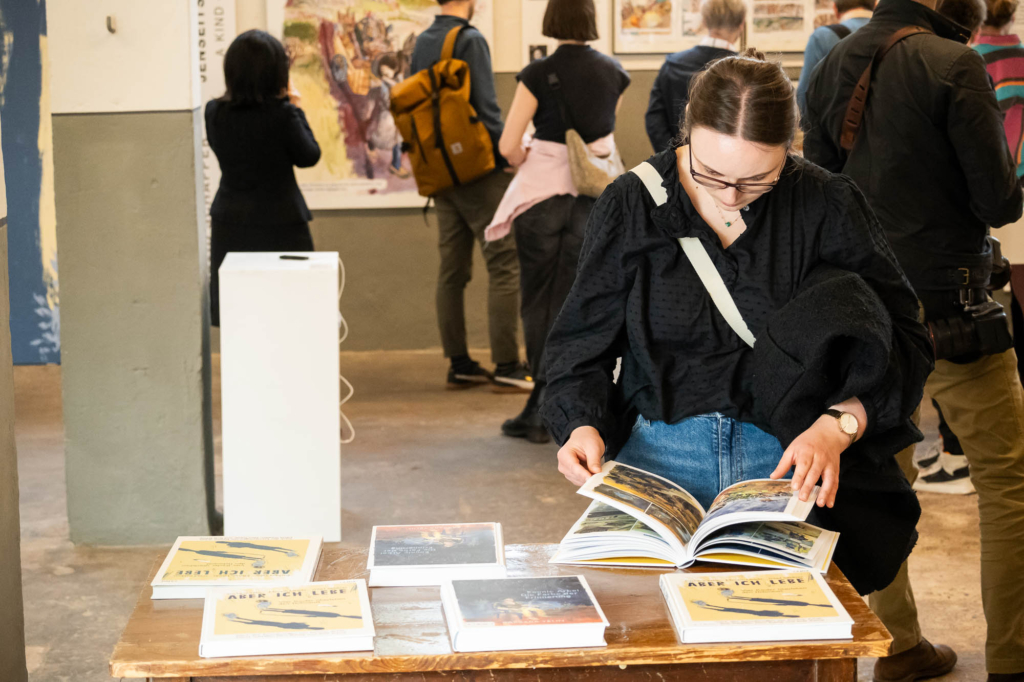
Photos from the exhibition at the Bergen-Belsen Memorial, May 11–June 30, 2025. Photo credit: Marion Reis.

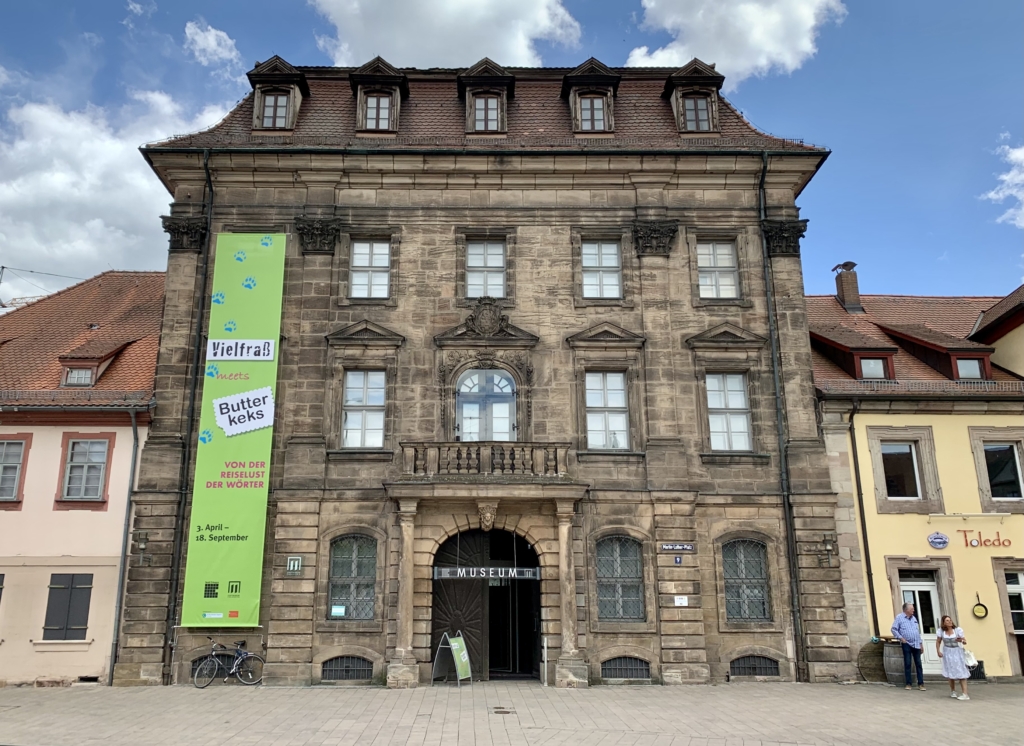
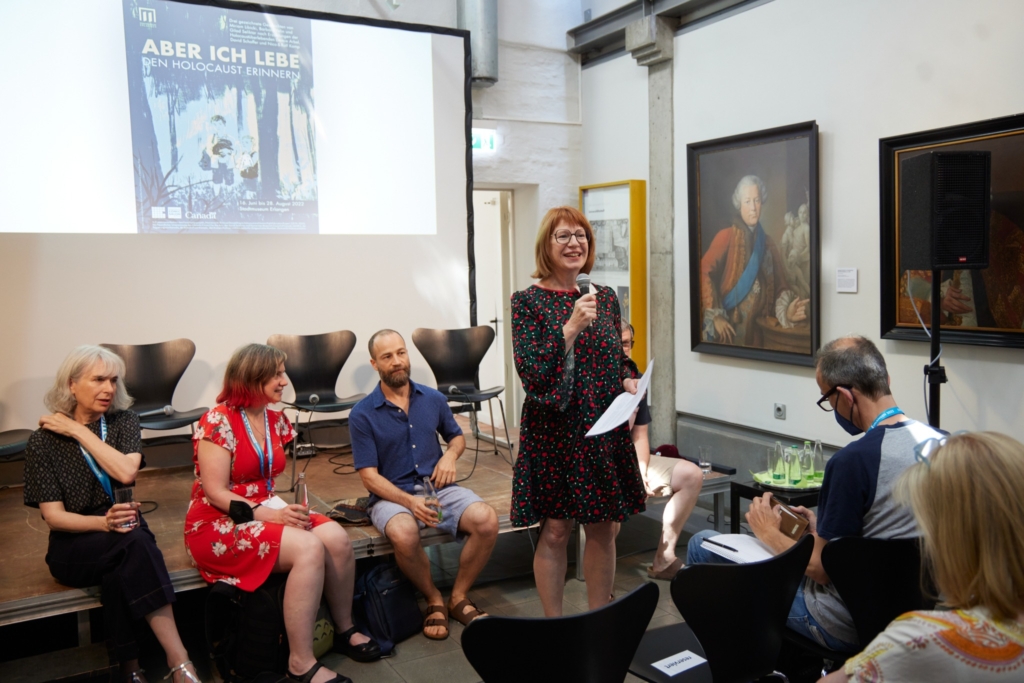
Like in the book, we approached the story through all these parts of a memory puzzle. For me, it’s always like a kind of puzzle. You have pieces, and you show these pieces, and there are empty spaces. There are missing parts, and you can be sure that the visitor or the reader will do something with their own concept and imagination to fill these gaps or to think about these gaps. We showed it for the first time in 2022 in Erlangen, for the International Comics Festival, and it was so successful that they wanted the exhibition to travel. So, in the end, we had six locations including the Bergen-Belsen Memorial and the Ravensbrück Memorial. I was glad to accompany the exhibition to most of these locations and to bring the exhibition to these important places of learning about history, but also to locations like Erika Fuchs House, which is a museum specialized in comics, and to confront their visitors with the topic of the Holocaust. It got very positive resonance, and again, it grew out of collaboration with many different people in all these locations.

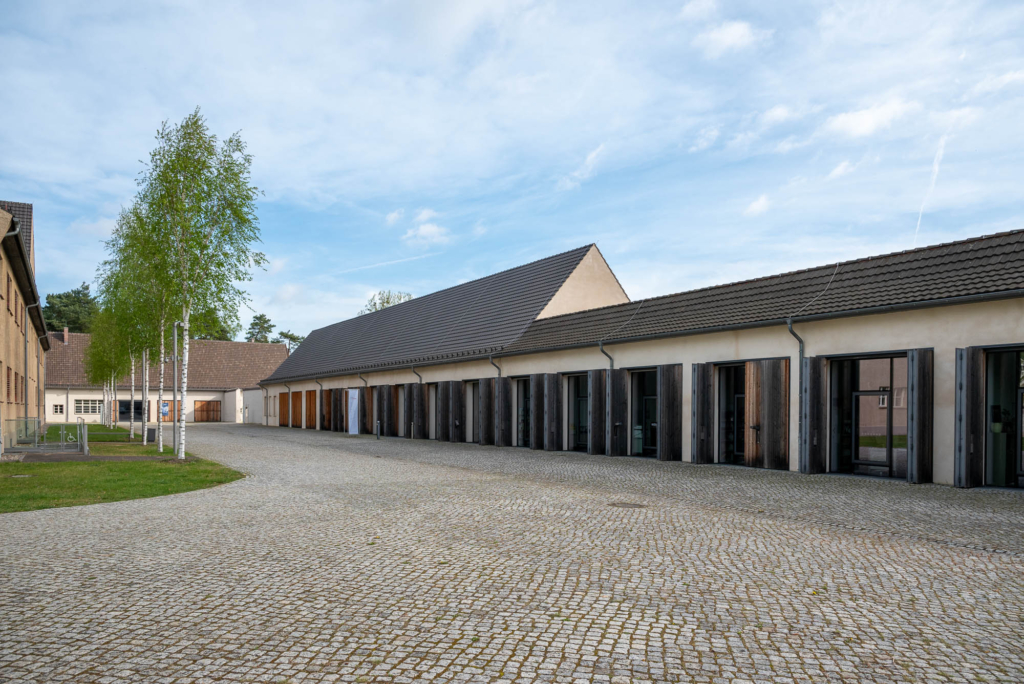
Photos from the exhibition at the Ravensbrück Memorial, April 13 to July 31, 2024. Photo credit: Eberhard Schorr.

Lucie: Last question for you. After the two books and the series of exhibitions, where do you think your steps will lead you now? What are your next plans?

Barbara: I just finished, some months ago, another biographical graphic novel, but it was much shorter this time. It tells the interesting life of Terese Giehse, an actress who lived in Munich. She had to flee the Nazis. She was Jewish and a very politically involved and strong woman. She came back after the war. Another biographical work, which was very interesting. Afterwards, I also felt strongly that I want to take a break and not to go on with further biographical works because repetition is not good. I want to approach history again with a fresh view.

But there will be a new book, and I want to work still with documentary material and do research, but this time I want to focus on present times. I also want to learn more about how I can connect words and images together in a new way. How can I embrace more artistic ways to do that, or poetic ways, or experimental ways? That is something that will always interest me.


SCVN is grateful to Barbara Yelin for her generous time and dedication, both in sharing this insightful conversation with us and in co-creating the phenomenal Emmie Arbel. The Colour of Memory. You can find more information about her project work here.

‘Our dignity grows through connection’: HUMA 180 students interview SCVN Research Assistant Lucie Kotesovska

On November 5, University of Victoria students Ananiah Bartsch and Lily Schaefer interviewed Survivor-Centred Visual Narratives (SCVN) research assistant Lucie Kotesovska. The interview took place online and was conducted as part of a practicum for HUMA 180: Encountering Humanities Research, one of the three courses that make up UVic’s Humanities Scholars program. This is the fourth time SCVN has had the pleasure of welcoming practicum students from HUMA 180. In this interview Lucie reflects on her involvement in the project, the realities of working with difficult stories, and the lessons she learned from her work as a research assistant.

Ananiah: We’ll just start with an easy question. Lucie, how did you become involved with this project and with Charlotte’s work?

Lucie: I was hired in summer 2024 as a research assistant for the project, and it happened through my home department, which is the English department at UVic. My official role was media communication and administration assistant. I think the team was specifically looking for somebody with strong editing and communication skills. They were seeking somebody to help them with the textual production and presentation of the project in textual terms. I was hired as a research assistant on these terms. Besides being an English major, I also had quite a rich previous experience with academic and professional writing, editing, copy editing, reviewing texts and translating. I forgot to mention that my first language is Czech, it’s not English. I’ve been moving between languages my whole life and it’s been a great passion and source of joy for me to be tinkering with words and learning new words and growing into new languages.  

Lily: What drew you to the work of this project?

Lucie: That’s a great question. As I said, I’m passionate about working with and through the written and spoken word. That’s my primary tool in exploring the world and making sense of it for myself and others. So, to have this chance to pursue that passion and bring use to a large project was very attractive and meaningful to me.  

Second, I was really excited about working as a part of a team, and supporting the team. I have to say that my PhD work was really lonely. It was quite an isolating experience because for a couple of years you’re just focused on this very niche area or super-specific subject. For me it was Irish poetry from the 1960s up to now. You start to miss human connection during this extensive research and writing project. Even though, of course you are connected with the selected poets quite deeply and intimately, but still … It’s natural for us as human beings, and also as humanists, to connect with people. So, I started to really, really miss that kind of interaction. And this was something which I found as a member of the project and this team. What also drew me to this teamwork was the appreciation of all kinds of talents and levels of expertise. The SCVN project hires junior researchers who just entered the field. So, there are team members like you and then senior researchers, professional scholars, who work in the field of trauma, genocide, history, human rights and so on. There’s this vast scale of various abilities and experiences. So, the team aspect was really a huge plus for me.  

And third, I could sense a very strong humanistic mission in this project. You probably talked about the 4 pillars of the humanities mission at UVic in HUMA 180? 

“Enrich human dignity” is the first one. And that’s very obvious with this project because of its focus on the survivors. It most emphatically contributes to making us feel and appreciate human dignity, especially in places and times when it was tread upon.  

“Provoke critical inquiry” is the second pillar. This project has consistently critiqued some of the traditional scholarly approaches to history and memory. It has brought a new perspective, and a new medium because it is primarily visually oriented. 

“Engaging myriad voices” the third pillar, is a very fitting one, because this project over a couple of years of its existence, has become global. Starting with Holocaust research, it has now spread to former Yugoslavia, Rwanda, Turtle Island and also Syria and Iraq. It comprises several research clusters while engaging many people globally – researchers, journalists, community members, and artists. 

And there’s the fourth pillar, “inspire innovative expression, including the full plurality of media”. This project is really a great example of that. Searching for new ways to communicate messages and research to the wide public, not just the academic community, but to the public worldwide, to people of various generations and ages and milieus. 

And I should not forget about the fourth reason that drew me to the project. I felt I could keep learning new things while being a part of it. That was a big one for me as well. I could just keep learning, and I was continually encouraged to do so as I was getting new tasks beyond my initial contract, but we’ll probably talk about that a bit later on. 

Ananiah: You’ve touched on this briefly already, but what did your work, and what has your work entailed with the project?  You’ve been working on a bunch of things, so could you tell us a little bit about what that’s looked like?

Lucie: As I said, it entailed various tasks, both short- and long-term ones. I think my major initial contribution and something I’m quite proud of still was the editing of transcripts from two webinar series which were organised by the project and the Public Humanities Hub at the UBC as a joint initiative. These were two series of talks with scholars, artists, journalists, and other professionals on the topics of trauma-informed research and art and testimony. 

And my main goal was to make these webinars accessible through these transcriptions. These texts were posted online, and I tried to make their formats standardized across all the different episodes, speakers and topics. 

Another major undertaking was working with students from HUMA 180 last academic year. Last fall, I was tasked with onboarding three HUMA students and with training them in transcribing while sharing my experience and some of the best practices. They each picked a webinar and transcribed the whole episode which is a substantial amount of work. Beside the transcription, they edited it all through making sure that all the names were spelled correctly, and all the places were correctly identified. It was a wonderful way of sharing what I learned on the project.  

I also created content for the project’s blog. I wrote blog posts covering various events like exhibitions and upcoming talks, award ceremonies for artists on the project, film releases, and other things as well. I updated content for three of the project’s research clusters: Rwanda cluster, Holocaust cluster, and former Yugoslavia cluster. 

It was my first time tinkering with website design. Speaking of learning things, I was really thrown into deep water here, but I enjoyed it immensely.

Ananiah: You wore all the hats!

Lily: Jack of all trades.

Lucie: Yes! Forrest Gump; that’s what I would say, Forrest Gump. But Jennifer Sauter, my supervisor, would say no, no, it’s like – think about it more like a Swiss knife: versatile and excellent in all circumstances.

Lily: What was something you found difficult while participating in the project?

Lucie: Sometimes it was prioritising, as I was often assigned several tasks at the same time. For instance, I felt very reluctant to break the blog-writing rhythm in order to go and fill in a travel reimbursement form or go and copy edit somebody else’s work, somebody else’s style while drafting my text. As a graduate student, I was constantly busy with other things as well. I tried my best to juggle several jobs at the same time. While I was working on this project as a research assistant, I was hired as a teaching assistant in the English department, and also as a tutor by the Academic Skills Centre, and during this whole time I kept working on my dissertation. Plus, I had a couple of kids at home. 

Also, speaking of difficulty, I think it’s quite obviously the sheer amount of human suffering you face working through various materials and media across the project. It’s even more difficult given the fact that violence and social division and victimisation keep going on and on in the world. I’m not the only one saying this regarding work on this project. This is an issue that I notice every team member has to deal with. Historically speaking, we live in a very difficult moment for our world right now. There seems to be no end to the trauma inflicted. Working on this project makes you painfully aware of this fact. 

Ananiah: Lucie, how is it that you take care of yourself when you’re involved in a project that has so much human suffering? How are you looking after yourself to make sure that you were not being crushed or consumed by the weight of the project?

Lucie: That’s such an important question. I talked to people on the project about this and it helped sharing these concerns. We were advised to take breaks from the materials, like those transcriptions. We are speaking of dozens of pages of text on very heavy things. We were encouraged to take breaks and talk to other team members or stop working for a week or two in order to process the feelings that were coming up as we needed to. I would say this is also something that I’ve been asking myself as a literary scholar for a long time, because I focus on Irish poetry that was written during the time of The Troubles in the second half of the 20th century.  

You’ve probably heard about this conflict in Northern Ireland. It was a very violent one, tearing up families and communities. It is still hard for me to believe that it went on in Europe during my childhood years. So I’ve been thinking a lot about this question and honestly, I came to the conclusion that while we can never completely escape these traumas, personal, generational or cultural ones and stay unharmed, it’s essential that we learn to be aware of our feelings, and also learn to be responsible for the way we handle them; how we express them as well as whether and how we communicate them further.  

As I mentioned, I grew up in the Czech Republic in a culture which, as a heritage of the forty years of Communist regime, was emotionally repressive to say the least. I realized this fact only years later in my early adulthood.  

To compensate for this, I actively made efforts to learn to feel–not just feel, because this is the part that comes to us naturally–but to be able to notice these feelings, to describe them to myself, label them, and express them safely and, when I am lucky, creatively. Literature has been a tremendous help in this sense. Being a literary scholar, I have been able to see what is going on inside other people and how they handle their emotions. It is not an exaggeration to say that literature helps us stay sane and stay alive.  

I’m trying now to share this vocabulary I learned with my kids. For example, we read books on this topic together. One of our favourites is called In My Heart and it’s about a girl naming her emotions and has beautiful illustrations that help children explore big feelings such as anger or sadness. It will say “I’m angry,” and explain visually what that means. I also plan to teach emotional literacy in one of my courses in spring, in the English department. 

For me, this is an essential skill for us as human beings, because we’re connected through and in the heart. So, coming back to your question, I think that this emotional self-awareness has helped me greatly when I was dealing with this sensitive and almost soul-crushing material. Another thing has been helpful besides taking long walks in Victoria, which is a great, great town for solitary walks, and that’s reading. While engaged on the project, I did some reading that was really helpful to me.  

I’ll mention just one title. I’m reading it right now, actually. I realised early on that there’s a link between my work on the project and how I felt about it, and this reading. The title of the book is Saved from Sacrifice: A Theology of the Cross and was written by S. Mark Heim. 

It has helped me to understand the sacrificial mechanism in practically all human civilizations, and also, how truly transformational and revolutionary it is when the victim can find a voice or can be given the voice and also has a name and is remembered through their narrative.  

Lily: Self-documentation.

Lucie: Yes, right. And this is exactly what the project has been trying to do all along. So yes, reading also helped me. I’m sorry if this answer was a bit long.

Ananiah: No, no, no, I appreciate it.

Lucie: Just to conclude, I think emotional awareness and self-awareness are super important. That’s the key. As I said, we cannot be safe from harm, [it will happen] probably just by living.

Ananiah: Yeah. Thank you. I appreciate that answer.

Lucie: Thank you for asking these questions. This topic is so important, and it resonates with people, but is not always communicated sufficiently and adequately. And we don’t realise sometimes, entering humanities especially, how big is the part of our own existence and experience we bring in.

Lily: Can you tell us about a moment or memory, positive or negative, that stands out to you?

Lucie: I have a great memory of the interview I did with a German artist, Barbara Yelin. Just to give you some quick information on who Barbara Yelin is and how she’s connected to the project–she did an interview with Emmie Arbel, a child Holocaust survivor, and from this interview came a story titled “But I Live” which was published in 2022. And then she developed this story, which was originally about 40 pages long, into a book-length line visual narratives, titled The Colour of Memory. Emmy Arbel. I interviewed with her in July for the project blog… We talked about the various techniques she uses and the philosophy behind her art. And we also talked about her relationship with Emmie and how it evolved and how in turn this evolution affected Barbara’s approach to visual storytelling. For me, it was really fascinating to listen to how she talked about the limits of verbal expression and verbal memory, about moments where only our body knows the truth of what happened to us. We sometimes lack words to talk about these things, and we might be resisting them because we don’t want to go in there. But something or someone makes us visit them. So how do you do that? How do you recreate it in pictures when you don’t have the words? These questions were immensely interesting. 

Barbara said that sometimes she had only colour to work with, she didn’t even have the shapes. That was really fascinating. And there was a moment when she talked about Emmie’s face fading from the page in the book. It was the moment when Emmy tried to remember, I think, the last moment with her mom. 

Emmie’s face is fading from the picture. It is lost in this painful remembering, and the visual panel or square is only blue and black. That is all there is on the page. And at that time, Barbara was on the screen because we were on Zoom, and she herself almost became just the mouth and the eyes. And it was dark because it was noon in Victoria and late evening in Munich where she was. 

And moments like this would always bring home the essential truth of the project regarding connecting as human beings. It is the undeniable and universal fact that our dignity grows and flourishes through connection, through cultivating relationships, and through genuine curiosity in one another. And, on the contrary, it is endangered and destroyed when these connections are broken as happens in wars and conflicts of all kinds. So that is still my favourite and fond memory. 

Ananiah: What is a lesson or an idea that you learned from this project that you’ve carried forward in your career?

Lucie: I would like to mention two things I learned while working on the project. First, I came to feel that there’s hope for humanities in the world today. As long as they are willing to embrace new ways of research, engage new voices, and provide testimonies to untold stories. And the second thing: I believe there’s some hope for humanity in the world today as well. There’s ongoing violence and conflicts escalating all over the world, all around the globe. At the same time, there are distinct voices heard that clearly understand the cost and the damage that’s being done and that’s affecting whole generations. And I think this project is a voice of this hope. It’s a voice that promotes survivors’ and also personal and interpersonal healing.

Ananiah: Thank you, I appreciate that. A lot of the narratives in the world are counter to hope, so I appreciate that insight and that perspective.

Lucie: So true. Yeah, I know. Sometimes it seems like a lost cause altogether. Doing this kind of work, doing this research, and being in the humanities. So many people will be dissuading you, and challenging you and doubting you, but it’s so immensely important, because we’re now wielding various technologies, but who’s going to reflect upon this development? Who’s going to draw the bigger picture here? Humanities bring this wholeness in terms of contextualizing things, and that’s so important. That’s the only way we can really restore hope and faith in anything. So, yeah. Thank you guys for your great questions. I really enjoyed reflecting upon my time on this project. It’s been quite exceptional. 

Ananiah: Absolutely. Thank you. Thank you so much. It has been so wonderful to hear from you. And again, I appreciate you making the time with your busy schedule and your international excursions.


SCVN would like to thank Ananiah and Lily for their work planning, conducting, and transcribing this interview. Our blog post about last year’s HUMA 180 practicum can be found here.

Interview with Miriam Libicki for the GraphicMemoirBlog: The art of translating Holocaust survivor stories into comics

In September 2025, Jonathan Sandler, host of the GraphicMemoirBlog and author of The English GI (2022), interviewed SCVN graphic artist Miriam Libicki in a blog feature titled ‘A Conversation with Miriam Libicki: WWII Graphic Memoirs’. They discussed her previous SCVN collaboration with Barbara Yelin, Gilad Seliktar, and Dr. Charlotte Schallié in But I Live: Three Stories of Child Survivors of the Holocaust (2022), and her forthcoming publication Two Roses: A Story of Deception and Determination in Nazi Germany (2026).

Jonathan and Miriam discussed the ways in which graphic novels can be used as research and storytelling tools for Holocaust education and to honour the voices of survivors. As Jonathan highlighted, Miriam worked from transcripts and shaped narratives that stay faithful to the survivors’ words, such as David Schaffer, where “every word in that book is his… the story is his voice.” Through comics, the stories convey information about survivor experiences while providing a safe and supportive learning environment.

In this interview, Miriam also shared her experience working closely with Holocaust survivors and the impact of the narratives on her art, describing her collaborations as “transformative.” To her, David’s story felt like “something out of dark fairy tales”, leading her to develop a watercolour style that would “evoke the living, threatening natural world.”

Inspired by early 20th-century children’s illustrations, she used watercolours “to set apart from the monochrome charcoal styles often associated with Holocaust art.” The illustrations in her SCVN graphic narratives also reflect different influences, ranging from Will Eisner to Japanese manga and Canadian comics, that supported her journey in both projects.

In her narratives, she has been drawn to first-person stories and particular points of view, and believes:

Comics are a powerful tool for empathy. Even if you disagree, you can still be compelled by the perspective.

Thank you to Jonathan for interviewing with Miriam and sharing insights into her artistic process and collaboration with SCVN!

Read the full interview here.

Drawing on History: An Interview with Rwanda Research Cluster artists Michel Kichka and Joëlle Epée Mandengue

This interview introduces Michel Kichka and Joëlle Epée Mandengue, the two artists working on the survivor-centered graphic novels within the Rwanda Research Cluster of the SCVN project. In April 2025, they met online for a conversation facilitated by Dr. Anna Ball, an Advanced Research Fellow supporting the Rwanda team based at the University of Aberdeen. Together, they discussed their experiences of working on the project so far; how they are grappling with the weight of history and of their responsibility to the survivors’ experiences they are representing; as well as the personal and professional journeys that have guided them to this work.

Joëlle Epée Mandengue is a Cameroonian comic book artist based in Guinea Conakry. Working under the penname of ‘Elyon’s’, she is the author of the successful series, The Diary of Ebene Duta, and a number of comic works describing, with humour and a pinch of tragedy, slices of the lives of black characters who are living in other territories and experiencing different cultures. She is also the creator and director of the Bilili BD comic festival in Congo Brazzaville, which has branched out to other countries across the African continent, including Rwanda. Joëlle is working with an anonymous survivor of the 1994 genocide against the Tutsi in Rwanda, who was a mother to several young children at the time of the genocide. In its wake, she became the mother of several more orphaned nephews and nieces, who are also represented in the graphic novel.

Michel Kichka is an Israeli graphic novelist of Belgian origin based in Jerusalem, where he studied graphic design and taught at the Bezalel Academy of Fine Arts until his retirement in 2025. Alongside a longstanding international career as political cartoonist and member of Cartooning for Peace, he is the author of several graphic novels, including Second Generation: The Things I Didn’t Tell My Father, about his experience as the son of a Holocaust survivor. Michel is working with genocide survivor Jerome Irankunda, who was just six years old when the 1994 genocide against the Tutsi overwhelmed Rwanda. Michel’s work is also supported by the contributions of Jerome’s wife, Nina Uwera.

Anna: The project that you are working on is concerned with representing the stories of survivors of the 1994 genocide against the Tutsi through the graphic novel form. But I would like to begin by understanding a little more about your own personal histories, and what brought you to find your voice in graphic novels.

Michel: I was born in Belgium 70 years ago to a family of Holocaust survivors. My father lost all his family and was in different camps for three years and survived. And my mother’s family were refugees in Switzerland, but originally they had all come from Poland. My grandparents had emigrated from Poland after the First World War because for the Jewish population the situation there was worse than anywhere else in Europe.

I was born with a talent for drawing. My father wanted to be an artist, and he was very talented, but he was arrested when he was 16 and liberated when he was 19 from the camps in Buchenwald, so he could not accomplish his dream to be an artist. But I could, because I was a baby boomer born after the Second World War. And I was born in Belgium: a kingdom of comics. Here, I grew up on the classic Franco-Belgian comics: Tintin; The Smurfs… These were my heroes when I was a kid. And this is what I wanted to do, and I knew it from the age of six.

In 1986, I first read Art Spiegelman’s graphic novel, Maus. He won the Pulitzer Prize for this work, and it was the first time this had been awarded to a comic. The work was also unique in its way of addressing adult readers, not kids. It was not funny, and there were no heroes. That was real life. I remember when I first read Maus the positive shock that I had. I said to myself – well, if he did it, it means that it’s possible to tell people about your life in comics.


Michel Kichka (Photo credit: Elie Max Kichka).

Joëlle: I was also passionate about comics from a very tender age. I was born in Cameroon, and I grew up there. My parents used to tell me that I was already so caught up with animated features when I was something like four or six months old. You know, for people of African descent, it can be very painful to comb the hair. So, I would sit and watch animations while I had my hair braided, and I would be completely numb to what was going on around me. I knew from a very, very young age that I wanted to tell stories, and to convey messages through drawings. So, I made my first comic book at the age of 7 and even learned how to sew the book together when I was 9. And from then on, I pursued that dream.

I grew up as the first born in my family and as the only girl, it was really difficult for my parents to admit that this could be my full-time job. Both of them were like, “why can’t you find, you know, a decent job?” They both worked in banking and finance. So, I took my degree in English and French, and after that, started working in a French cultural centre. I had to show my family that I could earn money and be independent. But also, I could not miss out on my dream. And so, when I reached the age of 25, a bell really rang in my head, and I realized it’d been a quarter of a century in which I’d done things that were not my core passion in life. I told my parents that I wanted to spend the rest of my life messing it up on my own terms and conditions.

So that’s when I went to study Fine and Graphic Arts in Belgium. And after that, I started to get some jobs, and my parents saw that I could be paid $300 per page as a comic artist. I was invited for a residency in the Caribbean. And so, at that point, my parents told me that I had their blessing because I’d proven to them that there was not just one way of succeeding. And this was really a milestone in my quest as an artist. It has helped me a lot to know that I can dream big and I have my family behind me.

Joëlle Epée Mandengue – Elyon’s (Photo credit: Joëlle Epée Mandengue – Elyon’s)

Michel: I also had a moment when I realized that I needed to take my life in my hands. When I was 19, I decided to emigrate, and I moved from Belgium to Israel. I understood at this age that being born talented is not enough. I needed to study and develop my skills to improve what I had learned by copying comics as a child. So, I was admitted to the Art School of Jerusalem. And I’ve been teaching illustration and comics for 40 years in the same academy in which I studied.

Anna: I’m interested to learn more about your decision to get involved in this project. Neither of you are from Rwanda, yet you have both made a significant commitment to grapple with its history through the stories of survivors of the 1994 genocide against the Tutsi. How do you relate to the content and context of these stories?

Michel: I was invited to Rwanda four years ago by the Israeli Embassy for the commemoration of World Holocaust Day on 27th January.

The Rwandans I met were asking me a lot of questions about the Holocaust because they had a very deep need for their genocide against the Tutsi to be known, to be written about, to have creation around it. And I felt that my personal experience offered something.

So, when this project was proposed to me, it was like a call. I knew very little about Rwandan history, but I can see the connections. And now that Tutsi and Hutu are living together, they are both part of their reconciliation program. There is much to learn at this moment. So, the fact that this project is now on the table is something very special.

Joëlle: My own relationship to this project has obviously been very different from Michel’s. But I have other issues that connect me to it – like the fact that Cameroon has had the same president since I was born. As Cameroonians, we have a history of colonial violence and postcolonial pressure that are still denied. We have archives that we still don’t have access to.

There is a huge part of our hurtful memories that we don’t have access to. I’ve been growing up as a Cameroonian by birth, but my culture is not at peace with its past. So, working on a project like this, where a country is looking at the horror of its past, facing it, trying to work from it, trying to build from it, is really something that resonates at a personal level for me too.

But I feel my link to Rwanda in another way, too. When I was living in Congo, we used to fly with RwandAir to Cameroon, Douala, where I am originally from and where my parents were living. And when I was travelling on these planes, I was flabbergasted, overwhelmed by the quality of the service. I’m really uncomfortable in planes, but these were wonderful. And the Head of Staff began to notice me because I was among the regular clients on that line. So we’d get chatting. And at one point I summoned up the courage to ask one of the Stewards – what happened after 1994? You guys seem like you are thriving. I read about how you’re aiming to be the Singapore of Africa. So our discussions started. And it was that Air Steward who gave me so many stories about what Rwanda is as a society – how complex it is. He explained the difficulties of, you know, having a crush on a girl, then discovering that girl is from the family that murdered your neighbour. How will you reconcile that? I was fascinated. So, when Fransiska wrote to me and asked me to consider embarking on this journey, I didn’t even know how to express it in words. Having the right to work on this project really meant a lot to me.

But I am also aware I’m not from Rwanda. There are so many things I won’t be able to understand. We are all Africans, but we have varied histories. I talked with Erin and Fransiska about this – wondering if I am legitimate enough to work on this subject. But what has really given me peace and focus is the fact that I also have my own unique lens that I bring to the project, as a foreigner – someone who has not had to live that history for 30 years. And it is the following thing that was really emphasized about the project by Fransiska and Erin.

This project is about building dialogue across cultures, and how we search for understanding by connecting with others, as well as through our own experiences.

Anna: What has it been like working with the survivors on this project? What have been the most challenging and enriching aspects of this collaborative process?

Joëlle: The person I am working with was already an adult at the time of the 1994 genocide against the Tutsi. And when I first started to encounter her stories, it was really brutal. Watching documentaries, reading materials on the subject, going to a memorial is something; but having this encounter with her was something else.

During our interviews, we were working with her son, who was also the translator, creating a linguistic triangle in our conversation. That time of translation was very difficult to handle for me because my mind had to process the information that it just got. Then you are awaiting the next translation, and you have this silence where you’re facing the survivor. So, you can have this physical connection in the presence of the survivor, but then there are spaces of disconnection in which you are left to process the deep, horrible information. So, one day during the interview, I asked for permission to digest the information, and I felt really guilty for this. I felt – this is her life; her memory; she went through it. But in this case, it’s the artist who needs a break.

Yet at the same time, I felt really privileged to have this access to things that are so traumatic, but that still need to be told for history not to repeat itself.

Michel: I identify with lots of things that you have just said, Joëlle. You know, Jerome, when you meet him, you can’t understand what he has passed through. He’s so optimistic and full of life and action and positive thinking. And this is the lesson that I would like the reader to learn: how he has rebuilt himself.

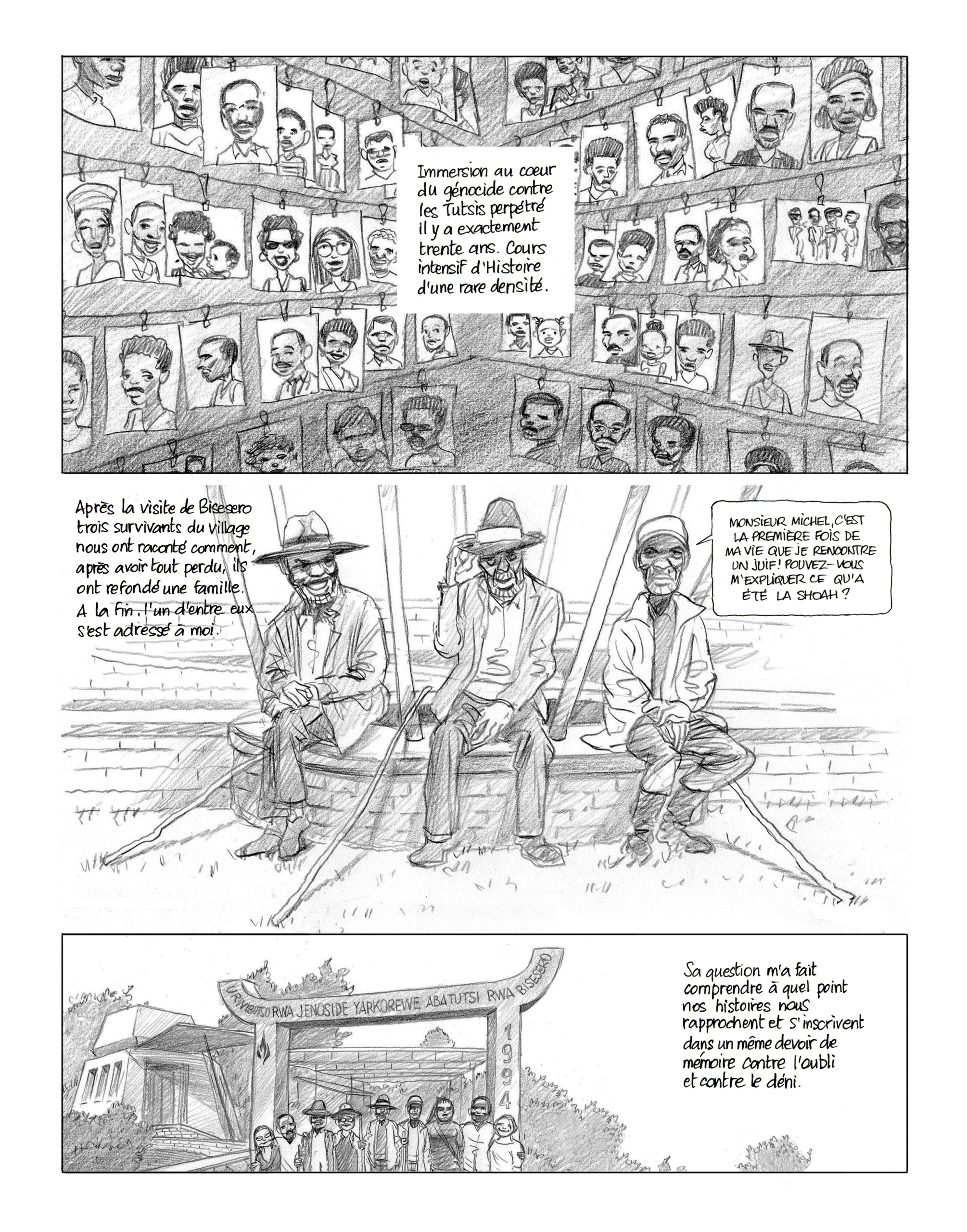
A challenging aspect of working on Jerome’s story is that there are a lot of things in his history that have no visual references. They were all lost. You know, when I visited the memorial in Kigali, there’s a room where photographs are hung, like clothes. Jerome told me he goes there very often to look at the photos because people who find documents bring them to the memorial, and he wonders if one day he will find a photo of a man and woman who could be his own parents. So, during our interview, I asked a lot of questions about what the house was like, the village where he lived, how he dressed at school because he had no photos to show me.

Draft artwork by Michel Kichka, responding to the memorial in Kigali that he visited during his trip to Rwanda, and conversations he had with local Rwandans. Photo credit: Michel Kichka.

Anna: So far, you have both visited Rwanda and interviewed the survivors whose stories you are drawing. In these early stages of contemplating and developing the graphic novels, what ideas, images, and decisions are emerging for you?

Joëlle: So, in my head at the moment, there is this idea of the seed. The survivor with whom I am working has strong faith in God. I too am a Christian – and that gave me the idea of the seed in the Christian faith. We learn that Christ died, and he was buried and resurrected, and brought with him a new way of living. And this lady, she also created life, she had many children. So, there’s this image of the seed getting into the soil and producing a family tree. And that’s why, when we had our interviews, I sketched a tree. She really went through death and came back to life.

And it is also an image of what you produce from your suffering – because you could decide just to feel vengeful. You could fall into a depression. But you can also find a way for something to come of your suffering – to move from the seed to the tree. That is something that has really formed part of my translation of the survivor’s story. It’s also important from a Rwandan cultural point of view, as it highlights the role of the umuko tree. I am also exploring the way I can present graphic imagery, through the umuko flower. The heart shaped leaves, thorns, reddish flower, make the umuko tree a very special element that can be used all through the story.

Draft sketch by Joëlle Epée Mandengue – Elyon’s, showing the motif of the umuko flower that bears symbolic significance in her graphic novel. Photo credit: Joëlle Epée Mandengue – Elyon’s.

Michel: For me, personal history is the best way to access history. So, I find in Jerome’s narrative the possibility to tell people about a big history through his personal history, to better understand people who pass through deep traumas and to better understand humanity and probably themselves in the process. I don’t want to offer simply a lesson in history; I want to tell a personal life experience of someone real who exists.

Anna: It’s clear that both of you feel a tremendous sense of responsibility towards the people whose stories you are collaboratively creating, and to the graphic novels that are emerging because of this collaborative process. What do you hope your work will achieve?

Joëlle: I hope to bring my reader to see the many layers of history and experience there are within the story of my survivor. This is something I always work to create. On the surface, my drawings are very cute and nice, with lots of colours. When people come to my drawings, they do so thinking the work is light – but the more they really get into it, the more they realise this is just a way to get you closer to many more hidden layers. The idea is really to work through contrast. They may think they see the story in the drawings immediately, but they have deeper layers of messaging. There is much more beneath the surface.

Michel: It strikes me that there are many things we can learn from what has come after the 1994 genocide against the Tutsi. You know, Jerome was so young, he was six, when he found himself an orphan. He was brought up as a son by his uncle and aunt. And what is also very interesting is that when he went back to school, “artificial families” of people were created to support one another. It was part of the experience in the classroom. This reconciliation program is unique in the story of the world, and so this will be part of the story that I tell. It will emphasize the process of rebuilding resilience that has taken place in Rwanda.

Recently I saw the short video that Marc [Ellison] shot when we were in Belgium and in Rwanda [‘Why We Dance’]. And at the end of that film, he showed Jerome and his wife Nina dancing, and I watched it with a huge smile.

This is what I would like the reader to experience. I want to bring Jerome to life; I want to show that those who committed the genocide failed in ways that matter. This is the lesson I would like people to remember. 

Many thanks, Joëlle and Michel, for so generously sharing your time and experience with us. It will be wonderful to see how these thoughts emerge in your graphic novels.

To learn more about Joëlle and Michel’s ongoing collaborations with survivors in the Rwanda Research Cluster, check out their page here.

Into the Archives with Nora Krug: The Fortunoff Video Archive for Holocaust Testimonies

On November 14, SCVN Research Assistant Lucie Kotesovska met with Nora Krug, an internationally acclaimed artist and illustrator and author of several book-length visual narratives. Nora is currently an artist-in-residence at Yale’s Fortunoff Video Archive for Holocaust Testimonies, where she is conducting research of the survivors’ video and written testimonies. Her aim is to produce a graphic novel based on her engagement with these archival sources.

In this interview, Nora spoke about her current research and how she envisions the form of her next book. She also shared her thoughts on the unique potential of the visual narrative when communicating survivors’ experience and whether it is ever possible to overcome the trauma of war.

Lucie: Can you tell us a little bit about your current research and your research method as you work with the materials at Yale’s Fortunoff Video Archives, and also, how do you envision the final product at this point?

Nora: I’m only just embarking on the research for the book. I haven’t fully figured out the themes yet, but roughly speaking, I think it will be about the question of resistance and forgiveness, and whether we can ever overcome political trauma, personal trauma, and retaliation, all of these aspects. I’m researching the testimonies of survivors that were recorded in the 70s and 80s that touch on these subjects. I’m watching the interviews and I’m looking for certain keywords. I’m finding it difficult to find certain information, especially when it comes to description of violence. It’s a taboo, for instance, to talk about violent acts that you might have been involved with during the resistance. That’s an interesting component, but also something that’s hard to track down at least based on what I’ve encountered so far. I’m eager to look at both men’s and women’s testimonies from various different countries. I’ve watched some in Hebrew—there’s often a transcription in English—some in German, some in Polish, some in English. It’s interesting to observe how differently people dealt with the legacy of trauma, of experiencing trauma. People experienced it in different ways and had different modes of survival. I’m interested in that too—what makes us respond to certain traumas in different ways. And while I’m doing this, I’m also doing some research outside.

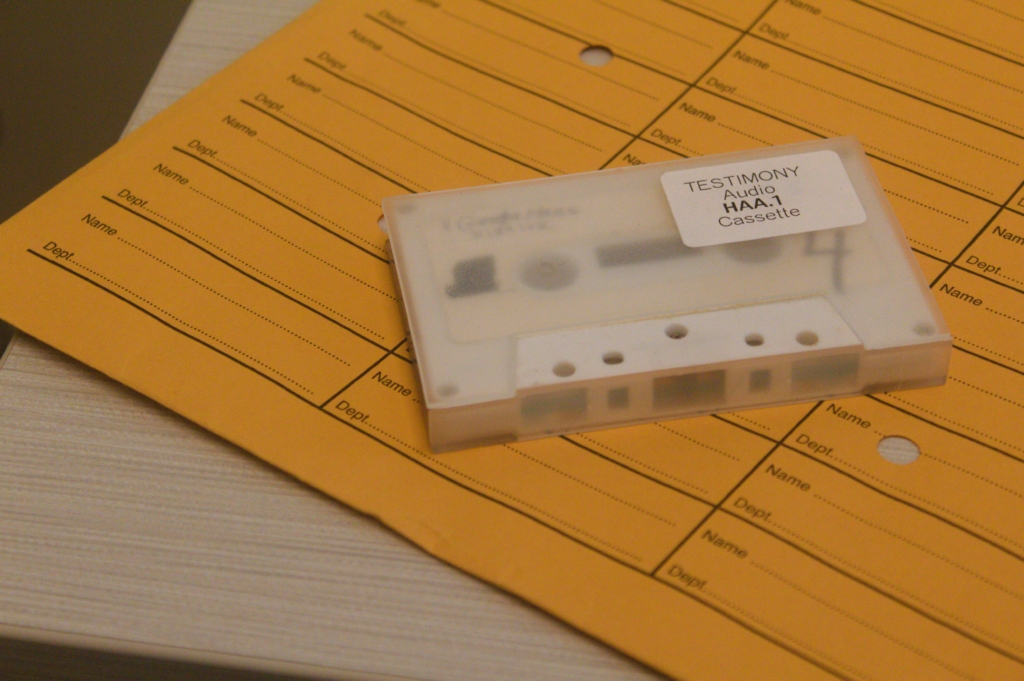
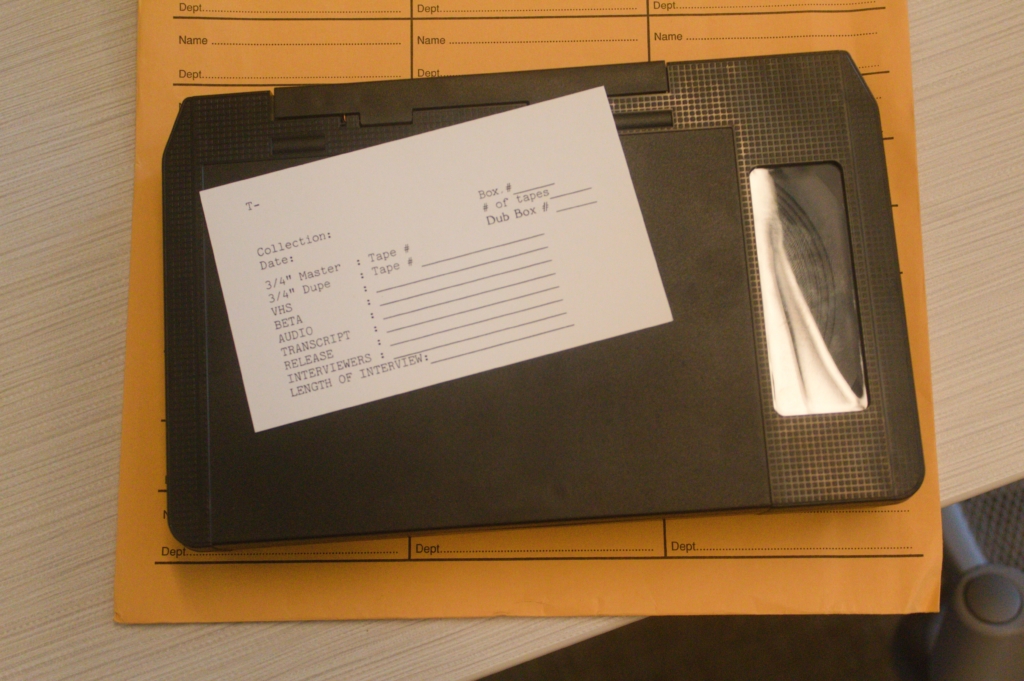
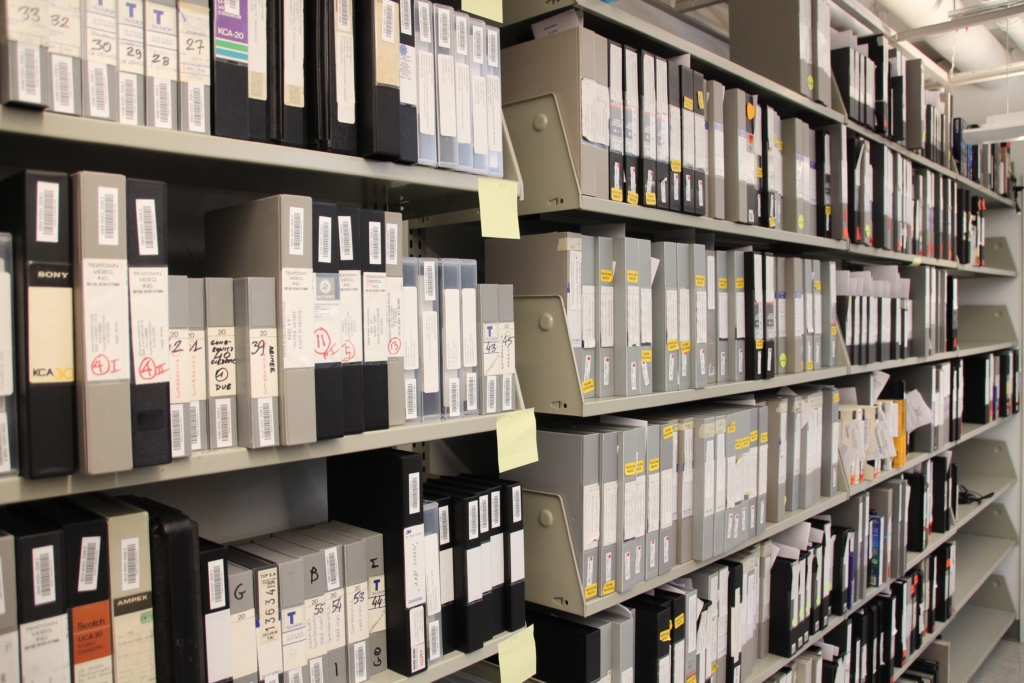
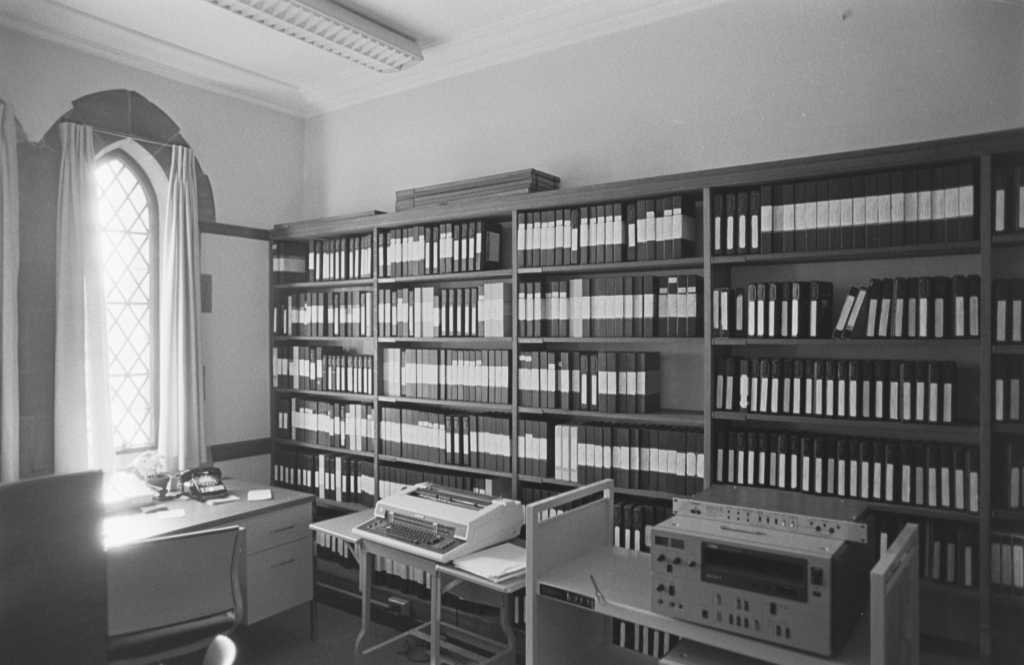
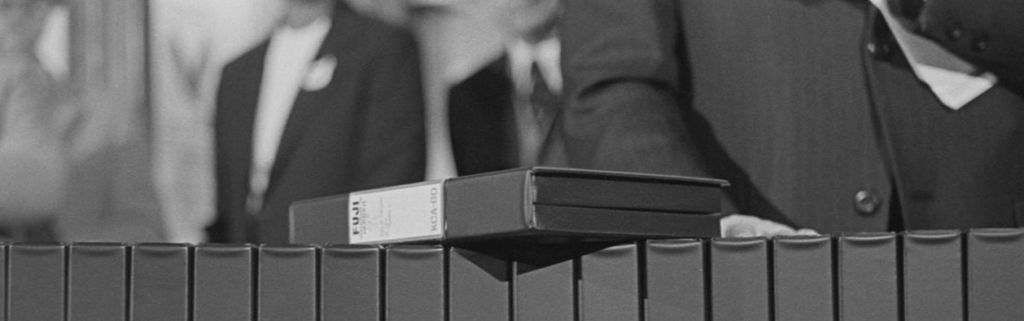
From top left: Cassette tape, files, and VHS tapes from the Fortunoff Video Archive for Holocaust Testimonies. Photos courtesy of Stephen Naron and Nick Porter.

I would say when I embark on research, I’m not extremely systematic, I’m rather very broad. And I try to articulate the basic underlying questions that I’m asking myself for a new book project. I’m not interested in telling a story chronologically, you know, the story of one person’s life. While the testimonies are very gripping and emotional, I’ve decided not to focus on one person’s life, and not to tell a chronological story but rather approach universal themes that I find in the interviews and create a sort of collage of my own thoughts on that subject that will include individual narratives. For instance, my book Belonging was structured in this way:  I interwove several different narratives in a kaleidoscopic way. So, I think that’s what I’m envisioning at the moment—including different voices. I would also like to branch out after this year at Yale to other crimes, other wars, other cultures, and other religions, so that the subject of the book won’t entirely focus on the Holocaust, but also on how we deal with these experiences universally.

I’m not interested in telling a story chronologically, you know, the story of one person’s life. While the testimonies are very gripping and emotional, I’ve decided not to focus on one person’s life, and not to tell a chronological story but rather approach universal themes that I find in the interviews and create a sort of collage of my own thoughts on that subject that will include individual narratives. 

Now that I’m at Yale, I’ve been connecting with professors from different departments including the Visual Arts Library, the Beinecke Library, and the Psychiatry Department, to get different people’s input into these questions. I also found a photo album at a flea market in Berlin some years ago that belonged to a German soldier. He documented an atrocity committed by the German Wehrmacht in Poland in 1939. I had this album lying around for many years thinking about what I could do with it, how to make those important photographs accessible to the public. And I would like to find a way of integrating it into the narrative of this new project. So, I’ve been reaching out to historians in Poland, the United States, Germany and Austria, to get more information about the historic events surrounding the atrocity depicted in this album, and to try to find out who the people depicted in the photographs are.

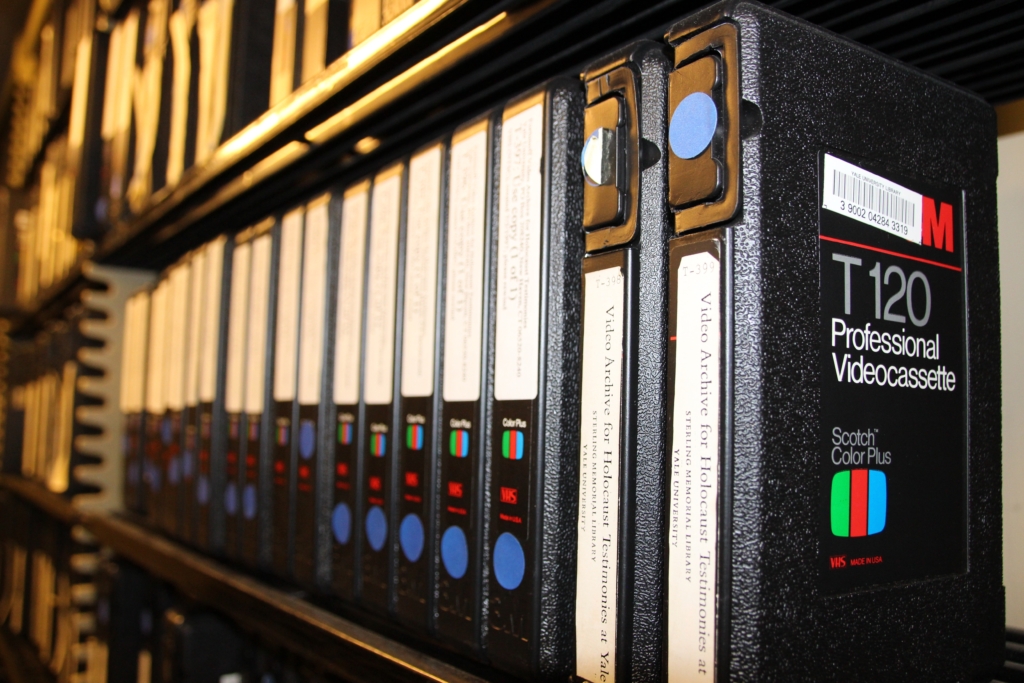
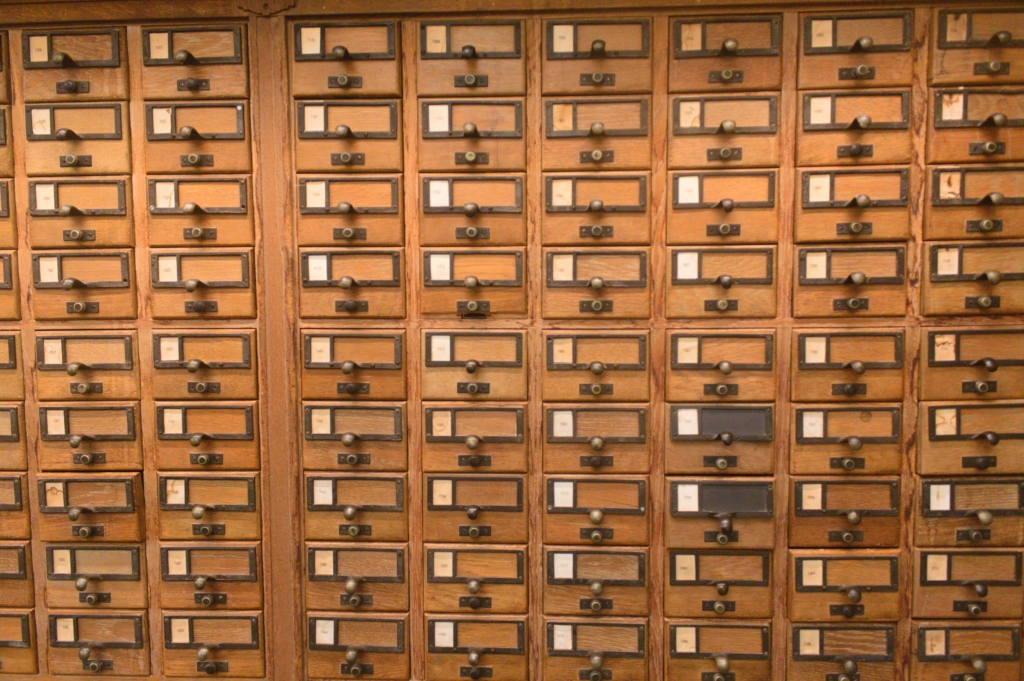
From Left to right: Card catalog cabinets, video library and VHS tape from the Fortunoff Video Archive for Holocaust Testimonies. Photos courtesy of Stephen Naron and Nick Porter.

Lucie: It sounds as if you anticipated my next question and, in a way, already answered it. In the SCVN team, we have been wondering whether you plan to focus on one main story or several of them in your next book project. Could you talk a bit more about how you envision working with multiple narratives?

Nora: Yes, I’m trying to look at my work less as illustrated biography and more as a philosophical reflection on themes that could include multiple narratives, also contradicting ones. This was the case in my last book, Diaries of War, about Ukraine and Russia, where I portrayed the voices of a Ukrainian woman and a Russian man, and even though the Russian man was anti-Putin, it is a contradictory narrative, and it clashes with the perspective of the Ukrainian protagonist. What I’m interested in as an artist and a writer is to bring out the complexities and the subtleties and focus on narratives that can be difficult to confront, because they’re uncomfortable or because they don’t fit into our conventional understanding of war or of the Holocaust.

What I’m interested in as an artist and a writer is to bring out the complexities and the subtleties and focus on narratives that can be difficult to confront, because they’re uncomfortable or because they don’t fit into our conventional understanding of war or of the Holocaust.

Lucie: This leads me to another question. In your understanding and in your practice, what do you see as particular strengths of the visual narrative when dealing with trauma and the topics that you mention?

Nora: For me, it’s very important to recognize the whole political history of illustration as a medium. It’s always been a political medium. It was the only visual medium that communicated political and social ideas before the advent of photography. We tend to forget that now. It is a political tool that shapes the way we think and feel or that hopefully opens up new perspectives because it is so visceral and so direct. And it can provide a very direct emotional entry point into narratives about war and memory and history in a way that I think classic textbooks aren’t able to. We understand that with movies—with movies, there’s no question. I mean, fiction films about the Second World War are very emotionally gripping, but with illustrated narratives, the general population wouldn’t necessarily recognize that medium as a powerful tool in the same way. I don’t know why that is given that for centuries it was such an important tool. I mean, if you think about illustrated church manuscripts, but also illustrated representations in other religions and cultures—illustrations were always used to inform the way we think about the world, but also to propagate, for instance, stereotypical ideas like antisemitic depictions in the Middle Ages.

So, while I really appreciate the political strength of the medium, I’m also aware that you have to treat the medium very sensitively and responsibly as an artist. I thought about that a lot when it comes to the depiction of violence. I’m somebody who really feels that it’s important to not avoid violence in images because we need to know what happened, for instance, during the Holocaust. If there hadn’t been any photographs taken at the time when the camps were liberated, our understanding of the Holocaust would be so much more limited. So, I think I’m really a proponent of showing images, of witnessing historical events, even if they’re hard to look at. But at the same time, there are many different ways of representing violence as an illustrator. It’s more a question of how rather than if you should show violence. But that is a component I think about a lot—what’s my responsibility as an illustrator to illuminate these subjects without being voyeuristic or sentimental. It’s sometimes a very fine line.

Illustrations from ‘On Tyranny Graphic Edition: Twenty Lessons from the Twentieth Century’ by Nora Krug and Timothy Snyder, 2021.

But at the same time, there are many different ways of representing violence as an illustrator. It’s more a question of how rather than if you should show violence. But that is a component I think about a lot—what’s my responsibility as an illustrator to illuminate these subjects without being voyeuristic or sentimental. It’s sometimes a very fine line.

Lucie: You mentioned that as a researcher and illustrator working with the trauma of war and mass atrocities can be extremely challenging. Can you speak a little bit about how this might affect you, and also how do you take care of yourself during this process?

Nora: Unfortunately, I don’t reflect enough on how I should take care of myself, because I always focus on my sense of responsibility of dealing with these subjects rather than on how my research will make me feel. I think my curiosity is what drives me forward despite the difficulty of the subject matter. When I wrote Belonging, a lot of people said, oh, that was so brave. I never thought of it as brave. I always felt like I simply had to find out what happened. I had such a burning desire to understand war and why people fight wars and how we live with the trauma of war that everything else was pushed into the background. I know that’s problematic because I also do a lot of visual research and looking at those photos probably impacts me emotionally on some deep level.

As illustrators, we have to do a lot of visual research, which means you look at photographs of the Warsaw ghetto or other atrocities throughout history. I try to switch into a professional mode when I do that, but it probably weighs on me in ways that I’m not always aware of. At the same time, making books on these subjects is my way of dealing with all the terrible things that are happening in the world. It’s my way of staying sane because there’s a lot of anger, a lot of anxiety about what’s going on. And I feel like confronting this directly is my preferred way of handling those feelings. So, it’s in a way therapeutic, even though it can be challenging. But I probably should find better ways of dealing with the emotional repercussions.

Lucie: The archival work, which you engage in at the moment, is quite unique within the Survivor-Centered Visual Narrative project. Is archival work also new to you? And what differences do you see between this kind of work and listening to survivors face to face?

Nora: I’ve done a lot of archival work. I did a lot of archival research for Belonging when I was looking for my grandparents’ files from the time of the Nazi regime. I went to the local archive in my father’s village and looked at the police documents from between 1933 and 1945. I looked at some of the letters that were written after 1945 by Jewish emigres who wanted to know what happened to their houses and their property. So, I’ve done a lot of research in archives, not academic research, but research to look for personal narratives. I love that. I find it so exciting to stumble across these voices that would otherwise remain unheard and then bring them back to life. One thing that I find a bit challenging is that the interviews I’m watching are with people who have already passed away, so I can’t ask follow-up questions. Sometimes I have very different questions than the ones that the interviewers ask. That’s a challenge that I’m experiencing because I’m not the one asking the questions.

Pages from Nora Krug’s ‘Belonging: A German Reckons with History and Home’, 2018.

A lot of the questions that are asked in these interviews are about the chronology of what happened where they were born, how they experienced anti-Semitism as a child, when they had to flee or hide or what camp they were in, how they escaped or how they survived. All of that is very important. But I would also want to know more about the emotional aspects. What did they go through emotionally at various points during the process, not only what happened to them.

Lucie: When we communicated prior to this interview, you mentioned that one of the central questions you’re exploring is whether it is ever possible to overcome the trauma of war. Do you feel any closer to reaching an answer after working for several months in the archives?

Nora: No. I mean, it’s also so individual. Like I said earlier, I think that everybody deals with it very differently. Some people, as you know, committed suicide. Some people were deeply depressed. One woman whose interview I watched was very interesting. She talked about how after the war she had a child, her first son, and how detached she felt. She felt basically incapable of showing anybody love. And that capacity to love seemed to have died the moment when she was separated from her family in the ghetto, and that was a moment when she basically became incapable of loving or expressing her love for anybody. After the war, she had a son, and she realized that she couldn’t give him what a mother under normal circumstances could give a child.

Thank you so much for your time, Nora, and for sharing your research and artistic experience with me. We are very excited to have you as part of our project and I am looking forward to hearing more about your book in 2026.

From Page to Gallery: The Exhibition Journey of ‘But I Live. Remembering the Holocaust’ with co-curator Jakob Hoffmann

On February 27, SCVN research assistant Ghada met with curator Jakob Hoffmann to discuss the exhibition journey of But I Live. Remembering the Holocaust. The exhibition, co-curated by Jakob Hoffmann and Barbara Yelin, features the process of co-creation and original artwork by artists Barbara Yelin, Miriam Libicki, and Gilad Seliktar, produced for the graphic novel But I Live: Three Stories of Child Survivors of the Holocaust, edited by Dr. Charlotte Schallié and based on interviews with Holocaust survivors Emmie Arbel, David Schaffer, and Nico and Rolf Kamp. Displaying original drawings, sketches, archival materials, and interviews with participants, the exhibition illuminates the process by which the book came into existence.

The interview with Jakob offers a closer look into his life and work, while inviting reflection on the concepts and challenges that arise at the intersection of first, artistic media such as graphic novels and film; second, social phenomena such as collective memory and mass atrocities; and third, human experience, particularly through the lens of survivors.

Ghada: Hello Jakob, thank you for taking the time to have this conversation today. Before getting into the details of the project, can you tell us a little bit more about yourself? What do you do? Where are you based? What is the scope of your work?

Jakob: Yes, what can I say about myself? Well, I live here in Frankfurt am Main. I’m 60 years old, and I’ve got a proper regular job, which is working in the Scout movement. This is maybe a little bit unique, because most of the people who are involved in Scout are volunteers and young people. And I’m an old man, and I’m doing it as a job, but you could say I’m kind of a trainer doing projects with young people in the area around Frankfurt. This is my steady job that brings me some income and a lot of joy.

Jakob Hoffmann during the exhibition of ‘But I Live: Remembering the Holocaust’ exhibition in Dortmund, Germany, May 6, 2023. Photo credit: Max Mann.

My job does not have really anything to do with how I’m involved in SCVN, but maybe there are some parallels, because I’m always thinking about how to transfer certain political or cultural topics to young people and students.

I don’t know how exactly that happened, but maybe ten or fifteen years ago, I started getting interested in comics and graphic novels. And since I’m definitely not an artist or someone who can draw a straight line, it was very clear to me that if I want to get involved in this scene, I can do it by organizing things. So, I created a little series of events where I invited comic artists from all over the world.

I’m also into curating exhibitions. I started with a side project for contemporary art and then got the chance to do a bigger exhibition with Art for Children in the Museum of Modern Art in Frankfurt. This was a huge step forward, because, as a non-professional, it’s quite unique to get this chance. But I got it, and it was great, and I worked together with illustrators. Since then, I have done it from time to time.

I don’t know exactly when it was, but I did some exhibitions with comic artists, and that’s how Barbara asked me one day if I wanted to curate an exhibition on But I Live.

Ghada: I will use your last point to ask you to elaborate a little bit on your contribution to SCVN. Between 2022 and 2024, you co-curated and toured an exhibition of But I Live: Remembering the Holocaust. How did you first connect with the project? What inspired the creation of this exhibition?

Jakob: The comic scene in Germany, maybe the comics scene in most of the countries in the world except for perhaps France or Japan, is very well-connected and everybody knows each other. You don’t need an agent to get in contact with somebody else, and there is a strong interest in each other’s work. I’m not a comic artist, but since I invited a lot of people and published a comic magazine for kids, I’m in contact with many people, so it’s very hard to say when some things get started, because you always talk about projects, “Oh, let’s do this, let’s do that”.

In this case, I was talking quite frequently to Barbara Yelin. We had several events together , we met at festivals, and through our private friends. I don’t know exactly when she first told me about this project, about the life of Emmie Arbel, but I remember it was in the middle of COVID, when she called me in January 2022… No, no. It should be before then, maybe 2020, if it was at the beginning of COVID. No, it was 2022. But there was no COVID anymore. Well, you see, I’m very bad at remembering things.

Ghada: Maybe that’s why we need exhibitions, novels, and tangible materials? Because we need better memories? I’m just like you, it’s so hard for me to remember dates and names of people!

Jakob: Yeah, 2022. It was in January 2022, because we had a very short time to prepare this exhibition, so maybe I mixed things up. But Barbara called me—it was five or six months before that one big comic festival in Germany—and asked me: what do you think about offering an exhibition about But I Live for the Erlangen International Comic Salon? And I said, yeah, send me a PDF.

Then I saw the story, and other stories by Miriam and Gilad, and I was overwhelmed. We called Katja Rausch, from the festival in Erlangen, who gave us one of the best spots we could have there. However, we said let’s not limit it to the short exhibition during the festival. Let’s make it a little bigger, a little more durable, so that we have three months to show this beautiful artwork. This was the start. Then everything went very quickly from there.

Ghada: Can you give us a quick brief of what the exhibition consisted of content-wise for our readers who might not necessarily be familiar with previous posts and information that we’ve shared?

Jakob: Yeah, that’s a very good question, because, you know, it’s always the question, What? What would you show if you were doing an exhibition about a comic? What would you display? Because a comic is happy with itself as a book, and it doesn’t need an exhibition.

We first considered a traditional approach of showing original artwork. Yet, this is another tricky thing, because original artwork is not necessarily something that is done analog by hand. We got a beautiful mix in But I Live, because Gilad works strictly digitally, but Miriam and Barbara do analog studies. They work nearly completely with analog techniques, including watercolours, which is special. So, it was clear from the beginning that the exhibition had different components, but the main thing was to show original artwork that would give the visitor a strong impression regarding the three stories of the child survivors of the Holocaust.

We also decided to display studies, scribbles, sketchbooks, interviews, and research materials. At the time, the project had already produced three wonderful short films about the artists, and so the films were also shown. Of course, it’s very important to offer the audience some comics as well, a place where they can encounter the book, because it’s all about the book. The aim of the show is that people buy this book, take it home, and read it whole with all its strong components, especially since it’s not a traditional comic book. It also features very interesting essays from historians and so on.

Ghada: You mentioned the audience, and that’s precisely what I have been thinking about as well! Knowing that the exhibition has been in multiple cities, and I will not attempt to say their names because I will not pronounce them correctly. My question is, were there different conceptions for the different exhibits as they went to different places? Did you encounter any differences in public engagement? And finally, did you make any changes or specific adjustments?

Jakob: Yeah, I can tell there’s a lot to say about that, but I will try to keep it short. When we started planning for the exhibition, it was absolutely customized to the museum in Erlangen, which is a very special but limited place in a 200- or 300-year-old building. We had six very small rooms, and, in total, the space was not more than sixty square meters, which is very small for such an amount of material. But we grabbed the opportunity to classify the different materials accordingly: three rooms went to showcasing the three stories, one for introduction and orientation, another hosted screens to showcase portraits of artists and witnesses along a big map that displayed the itineraries of the survivors, and the last room displayed the network of the project, the epilogue and physical copies of the book.

And at that moment, we still hadn’t even thought about taking the exhibition to another place. But there was an important journalist from Germany, Andreas Platthaus, who wrote about it and said, “This is really something, this exhibition should travel”.

As such, before we even finished the first exhibition, we got two really good requests to show it in other places, and that’s what we did. We showed it in a small comic museum in Dortmund, then in Wiesbaden, which is close to Frankfurt, in a classical museum site. Later, we were asked to display the exhibition at the Gedenkstätte Ravensbrück, a former concentration camp and the very place where Emmie Arbel was imprisoned. This was really something. Then the exhibition was displayed in another comic museum in Bavaria, Erika- Fuchs-Haus in Schwarzenbach.

And now, sharing new information, it will go to Bergen Belsen, the place where Emmie Arbel was liberated. This was the concentration camp where her mother died, and they decided to show it as well. So, as you can imagine, these are two totally different situations—showing the exhibition in a comic museum in the middle of a town with no certain historical background, versus a former concentration camp that was the setting of one of the stories in the book.

Ghada: Very interesting, it somehow gains a new meaning, doesn’t it? When you put the place in the context of the story, you feel that it takes on a new dimension.

Jakob: Absolutely. The opening in Ravensbrück, the former concentration camp, was on the liberation day of the concentration camp. There were hundreds of people, including former prisoners. It was really frightening in a good way. The context is totally different, but we also try to adapt the exhibition to the exhibitions spaces that are quite different as well. You have a classic white cube in Wiesbaden, which is very easy to play with. And then you have very small old rooms in Erlangen. And then you have the memorial space in Ravensbrűck, where you’re not allowed to put anything on walls, and you must hang everything. These are technical challenges that force us to find new solutions which is very interesting. In “Aber ich lebe” [But I Live] in Ravensbrück, Emmie Arbel was there. In Dortmund and Wiesbaden, we had interviews with the twins [Nico and Rolf Kamp] from the Netherlands whose story was told by Gilad. It keeps changing all the time. We also invite other comic artists, because it’s now a very big thing, doing comics in this way about historical issues.

Ghada: This is a beautiful transition to my question on how you envision the role of art and graphic storytelling in preserving and conveying memories of mass atrocities. What goals do you believe we achieve when we use art to address big issues such as social memory, history, group identity, and mass atrocities?

Jakob: It’s a big question, a philosophical one, and my opinion about it changes every day. Sometimes I think it’s the perfect medium to carry things that must be remembered—things that would be lost if we didn’t use art to preserve them. Yet, sometimes I think, no, it did not work. It’s always a process full of doubts. But we got very good responses to these exhibitions.

I guess comics have the advantage of allowing people to reflect on a story at their own pace, at their own speed. This is a difference from film, for example. When you watch a film, you’re totally passive.

Another challenging aspect of But I Live is the fact that it creates pictures of the concentration camps that do not exist yet, because we only have the official pictures by the Nazis, and they don’t show people in gas chambers, or all the killing and the atrocities. The pictures we have are only those taken by the perpetrators.

Comics, and maybe art, offer the chance to show what happened, while making it totally clear that this is not the exact way it happened, but that it could. Comics don’t pretend to present historical truth. Rather, they highlight that history always needs reconstruction, and this means there is nothing like objective truth about what happened.

I think that’s what art can do—bring the audience, like the visitors of an exhibition, to engage with the pictures and the story, but they must play their own role in the process. There is always a relation between the visitor and the objects we display.

Ghada: I may have not mentioned, but I am doing my PhD in philosophy, so these kinds of questions are at the core of my interests in participating in and contributing to this project!

Jakob: Yeah, like this idea for example, is informed by Walter Benjamin, who said that history is always in construction, not reconstruction, but construction. I guess art can make that very clear. Another important idea, which is a common notion about art, and especially comics, is that art makes the process easier, more accessible, when you approach history through pictures.

Ghada: I like to reflect on this informational dimension of art, focusing on the difference between getting information from art versus, for example, news or other formats. I tend to think that art speaks to us in the totality of our existence, that is in thinking, but also in feeling, in imagination and creativity. It taps into different aspects of us all at once.

Jakob: That is true on the one hand, but it’s also dangerous to use art to just put some emotion in a material or issue. Of course, this is something one must be careful about. Among the quality points of these comics in But I Live, is that they keep their distance, because the project is survivor-centered, not about manipulating the audience. It’s about keeping everything centered around the survivor, and how we can stay genuine and authentic about that.

Ghada: Beautiful. You spoke earlier about your work with Barbara, and I understand that there was a lot of collaborative work. I am curious about the role of collaboration in the making of projects like this exhibition. How does the collaborative nature of this work help advance the project?

Jakob: It is absolutely necessary. It’s something that can never be enough, because in such projects, there are tons of information you haven’t read or worked with. And it’s the same with the connections to the artists, or with other people who are involved in the project. There you always have the feeling it’s not enough, but it’s absolutely necessary to get in touch with them, to talk to them and to understand what they do on a personal level as well.

What we did for this exhibition—something I will also do in my upcoming exhibition that involves some people from SCVN— is doing interviews with the artists and bringing them into the exhibition so that you hear from them about their processes and struggles, and how they make their decisions. There are a lot of decisions to make as an artist when it comes to showing things, and this is what I’m interested in.

We work together with some graphic designers, so we always have a digital version of the exhibition. We show it to the artists, discuss it with Charlotte, and eventually we must make the final decision as curators. This is a very democratic way to bring in a lot of perspectives. The collaboration is very close, beautiful, and it’s the most interesting thing about the process.

Ghada: Wrapping up our conversation and looking forward, what is next for SCVN in terms of exhibitions? I know that you will be creating an exhibition for the new SCVN project, which moves beyond the Holocaust and includes other genocides and mass atrocities from Rwanda, Iraq, Syria, Canada, Bosnia, and Kosovo. Can you speak about any plans for the next exhibits?

Jakob: An upcoming exhibit will take place in Wiesbaden again, opening on May 21. We open this exhibition with four comic artists, three of whom are involved in the SCVN project: Tobi Dahmen, who worked on Akram’s story from Syria and whose work will be shown for the first time; Nora Krug, who’s working on a project about archives in Yale’s Fortunoff Video Archive, and we will display some work from her book; and there is Birgit Weyhe, who is in the working process for an upcoming comic about a young woman from Iraq. Charlotte will also be invited.

In November, the exhibit is set to travel to another museum in Constance, in the very south of Germany. We have a current discussion about whether it will also go to Erlangen in 2026.

In general, there are eight or nine artists working now on graphic novels about genocides worldwide [on the project]. Fantastic artists dealing with shocking issues. The question is, what will happen to these stories? Will there be anything beyond the fact that they will be published, hopefully in different languages and in different countries? So, Charlotte and the team came up with the idea of creating not a digital exhibition, but a portfolio which can be easily adapted in different places all over the world. Something like a core set of pictures, information, and layouts which can be printed, for example, on location, but in a certain, outstanding quality. The concept aims to, on the one hand, guarantee that there will be a high-profile exhibition or a good-quality exhibition, and on the other hand—the charming argument of course—to enable people and institutions, for example schools which don’t have much money, to display exhibitions in a way that is possible.

I’m very much into organizing events, public readings, and exhibitions, because I love bringing this fantastic artwork to people in a very direct way, to invite the artists and show original artwork. But I also understand the need to make the material more accessible to institutions.

Ghada: My last question is from a research process perspective. I am wondering how you approach the weight of the material at hand. Despite that we are dealing with comics and artistic material, the content is heavy. How do you deal with this aspect of the project?

Jakob: Oh, that’s hard to say. I usually don’t do it twenty-four hours a day. I have my job, my family, and my nonsense stuff like watching Netflix series or soccer on TV. I also have a lot of friends and family I can talk to throughout the process. This is helpful. I think comics, as I already said, offer you the chance to keep a distance. And the artists I worked with are very considerate not to overwhelm the people they are working with. But to be honest, I cannot answer completely because I don’t know how much impact it [this work] has on me. And I think there is some kind of professional distance I try to keep. Sometimes I distract myself and do other things. Actually, there is a beautiful picture about this in But I Live, in the story of Emmy Arbel, who worked with Barbara. After telling her the most horrible stuff you can think of, she says: “Now it’s time to stop, and I must go to the computer and play my solitaire game.” So, the question is much more an issue for the victims of these tough stories. We are in a comfortable position in not having experienced what they did.

Ghada: These were the questions that I had. Did I miss any question that you wanted to address?

Jakob: Not now. Thank you for these questions. It has been a pleasure. As I already said, it’s not so easy for me to answer in English, because sometimes some words are missing, and you try to paraphrase in an awkward way.

Ghada: It’s also my everyday struggle, so I understand!

Jakob: What is your first language?

Ghada: It’s Lebanese Arabic, which is my first language. Then we learn French as a second language, and English as a third. You can imagine me trying to phrase all those philosophical ideas in English but getting the words in Arabic first. Then I have to translate, but that is not always a practical thing to do.

Jakob: Well, you are into at least two other beautiful languages. I always envy people who can speak French. It’s very hard for me not to be able to speak French, because France is really the best country for comics. Yeah, and Arabic. I don’t understand Arabic, but it sounds very nice. Is it complicated?

Ghada: It is… It is usually considered harder to learn than some other languages, especially let’s say English, French, and Spanish, which share some vocabulary and grammatical structures, whereas Arabic has a completely different structure and a different alphabet. But that’s the beauty of diversity among people and languages!

Jakob: That’s a very good last word, I guess, that beauty of diversity.

Thank you so much for sharing your time and expertise, Jakob, and we look forward to your next exhibit with the project!

The Ackerman Center Podcast: Interview with Dr. Charlotte Schallié

In April 2024, SCVN co-director Dr. Charlotte Schallié met with Belofsky Fellow Katie Fisher for a conversation about the importance of arts-based research. Focusing on the publication ‘But I Live: Three Stories of Child Survivors of the Holocaust’ this interview provides insight into the SCVN methodology which centres a collaborative approach to testimony. Charlotte and Katie also discuss the ways that graphic novels can be used to teach about the Holocaust, balancing the need to provide true information about survivor experiences while still providing a safe and supportive learning environment.

Find the full conversation here.

Listening time 44 minutes.

The Pivotal Role of Community Liaisons in Survivor-Centred Work

On October 11, SCVN Media Director Raey Costain met with Ajnura Akbaš who is supporting the Yugoslav Wars Research Cluster as a community liaison. Ajnura works at the Muzej Ratnog Djetinjstva/War Childhood Museum in Sarajevo, an institution focused on the stories of children who have experienced wars and their enduring impact worldwide.

Ajnura spoke about her academic background and her work as a research coordinator for the War Childhood Museum, providing insight into how the museum works with survivors and their stories. As a firsthand witness to the SCVN research process as it has unfolded in the Yugoslav Wars Research Cluster, Ajnura was also able to share her perspective on visual methodologies, the importance of gathering in spaces where atrocities occurred, and what she has learned by working with survivors.

Ajnura has been supporting Almasa’s story with graphic artist Anneli Furmark and Research Cluster Co-Leads Sabine Rutar and Franziska Zaugg.

Raey: Thank you for meeting with me today. Can you give me a little bit of background on your role with the War Childhood Museum in connection to the work that you’re doing with Anneli and her recent trip to Sarajevo?

Ajnura: I work as a research coordinator at the War Childhood Museum. I’ve been with the Museum since 2019. I started working there just after getting my Master’s in history at Royal Holloway in London. My plan was to go back to Sarajevo and do a little bit of volunteering or an internship before starting my PhD. And then I just really fell in love with the mission of the museum and what they were doing. And so I started there on this very short term plan working with visitors, and then I basically never left after 2019.

My role changed a little bit over the years but what I do now is mostly coordinating research projects that the museum is conducting all around the world, documenting stories, objects, and oral history interviews with people who have experienced war childhood globally. So that’s the museum part.

I did eventually start my PhD, so I’m currently travelling between London and Sarajevo. I’m in my final year right now and I’m doing that at LSE in the Department of Gender Studies.

I started working with Anneli recently, and Almasa is our museum participant. She became part of the collection in, I think, 2020, and yeah, this last year we’ve started working with the SCVN team and Anneli, Franziska, and Sabine. We all met in person in Sarajevo last year. And so that was kind of the initial stage of us beginning to plan the project in terms of getting Anneli and Almasa together, having them get to know each other, and most of all for Almasa to start telling her story.

Raey: When you say Almasa became part of your collection, what does that mean?

Ajnura: It means that she donated her personal story to the museum. Her story, accompanied by the memory of an object, is part of our collection, and we have used it in our exhibitions and in our educational workshops. She also recorded an oral history interview for the museum, as part of a joint project between our museum and the Srebrenica Memorial Centre. We exhibit excerpts from those interviews in our permanent exhibition, but also sometimes in our traveling exhibitions as well.

Exterior of the War Childhood Museum. Image credit War Childhood Museum.

Raey: You mentioned that you were part of getting Anneli and Almasa together, can you expand on your specific role with the SCVN project?

Ajnura: So from the very beginning, our role was (when I say our I mean the museum, and I am acting on behalf of the War Childhood Museum), there was a role of liaison and research support. Almasa being our contributor and our collection participant, we already had very good relationships established with her and so we kind of made sure that Almasa had all the necessary information she needs about the SCVN project, about the methodology, and I think it’s really important that someone is there present who speaks the local language so that she feels more comfortable.

Last year, when Anneli and Franziska and Sabine came to Sarajevo, we made sure to go to Srebrenica with them, to introduce them to Almasa. I also coordinate meetings between Anneli and Almasa and have been doing that for about a year. They initially met in person and then continued online, I think we’ve had about seven or eight interviews so far over Zoom. And then on Anneli’s last visit to Sarajevo we worked with the film crew, coordinating everything regarding the trip in terms of getting the date set and accommodation and all the logistical things but also making sure that Almasa can communicate her boundaries to me and that I can then make sure that the team is aware of what we can or cannot ask or do, or what location Almasa feels the most comfortable recording in, or what the options are in terms of what’s possible with filming and so on.

So that’s the main part of what I’ve been doing with the project, making sure that Almasa as a survivor has the support she needs, and that she can check in with me about any kind of concerns she might have about the process or about the interviews themselves and that means I was there for her as a support. But we haven’t had any kind of issues with the team, and Anneli and Almasa, in particular, have been wonderful to work with.

That’s something I feel very privileged to have witnessed, is how their relationship developed over time. From that first meeting, when Anneli came to Srebrenica to this last meeting in person where you could really see how that relationship blossomed and now they’ve become really good friends in that time span.

Raey: You said that one of the things you were facilitating was ensuring that Almasa understands the SCVN methodology, creating the graphic novel and film. Are these kinds of methods something you were familiar with already?

Ajnura: I haven’t worked with the graphic novel method before, but I have worked with different kinds of visual methodologies and alternative archival methodologies through the museum. Our main method is childhood material culture, storytelling, and oral history but we have had a number of projects where the group of people we worked with was specific and we knew that we needed to adjust our methodology and offer an alternative language for people to communicate their life stories in a way that is not straightforward. We have experimented with embodied methodologies, with body mapping, with collages, with different kinds of artistic workshops and ways for people to express or illustrate their memories without having to sit in a studio and record a two hour long interview. And so I already had a kind of affinity, but also I guess a feeling of closeness, to alternative methodologies for documenting people’s life stories. And one thing I really appreciated, just from the position that I was in during this project, is witnessing Almasa’s reaction to the first drawings, seeing how important it is to her, and what it brings out of her. I think there is a value in these drawings being Anneli’s interpretation of Almasa’s words on the one hand, but also in Almasa to see their symbolic value, seeing a visual representation of her very, very earliest childhood memories of playing with her friends or of important moments in her story later on.

But it was really a special moment for me seeing her light up at some of those drawings.

Sketches by Anneli Furmark. Image credit Anneli Furmark.

Raey: That’s wonderful. I think one of the things that comes up a lot in talking about this project is that it really does depend on those relationships. And while we do, of course, have institutional relationships that help set those up, there’s no predicting if people are going to become friends or friendly or not. And so it sounds like you really had a close up view of that kind of research relationship unfolding in this project.

Ajnura: Yes, definitely, and we as a team, I feel that we were quite careful and cautious from the very beginning, in terms of whether Almasa would feel comfortable enough to share her story in full. This is not the first time for her to share her story. It was about whether we would be able to develop that level of trust between the two of them. I appreciate that the entire team were careful and that they wanted to respect the process of Almasa getting to know Anneli. And you can really see the difference in how Almasa narrates her story in the first interview and then in the last, because she feels more comfortable. It’s a kind of familiarity that comes with time.

And I also really appreciate how Anneli didn’t come into the project with preconceived notions of what she would hear. But she is hearing it all from Almasa and narrating it as such. And I think this work is really valuable. Especially from the perspective of the museum, because we work with war childhood history, it’s really important to see people whose stories are not normally included in histories and to have them writing themselves back in. And especially when it comes to the Bosnian war and the Srebrenica genocide, which is the topic of Almasa’s story, official stories are often about, you know, statistics and numbers, or they are about the militaries and politicians and journalists. They are rarely about children, who obviously had no say in whether the war would start or not but suffered multiple consequences of it. And so I think it’s really important that Almasa’s story is being documented, and that it will stay as important archival material.

Raey: You said that a big moment for this project was the team all coming together and meeting with Almasa. But you were also meeting in the place where the story unfolds. What do you see as the need or impact of gathering at the location where the story is set?

Ajnura: On the one hand, I think physical places, landscapes, those memorials that we visited, they hold stories as well. And especially for Almasa, who narrated part of her story that happened in that place, and she was speaking about the events while standing there, I think it encapsulates more than just Almasa’s personal story, but also the story of the place. That’s one part. But the other, of course, was that I think it adds another emotional element to the story because I know, having been there, it was a lot more emotionally laborious for Almasa to narrate some parts of the story while being there. And so I think there should be a recognition of that as well, that being in that physical space brings additional memories, and that we are triggered by our senses, by seeing things, touching things. So I think the value is in having those different kinds of historical materials added to the story, while at the same time not being the easiest task for the survivor, considering that it is the space where a lot of difficult things happened.

Raey: In terms of emotional labour, it can be very challenging to recount an experience, but it is also challenging to be on the other side of that conversation, to be somebody receiving that. Can you speak a little bit about how you take care of yourself? Or how the museum supports people who work there to care for themselves when engaging with these kinds of stories?

Ajnura: All museum staff who work with survivors are trained by psychologists to learn about techniques on how to protect ourselves, what kinds of practices we need to include in our daily lives, so that we can take care of our mental health. And we know to set some boundaries, even when it is difficult to do so.

I personally don’t really like talking about how it affects me, because I think it can never measure up to the emotional labour it takes for the participants to narrate or recall certain memories. I feel just incredibly privileged to be able to work at a museum where people entrust us with their memories and personal histories, but also with some of their most precious objects from their war childhoods.

What comes to mind when you ask that question is Almasa, because Almasa works at the Srebrenica Memorial Center in an area where she, as a child, survived genocide. And we’ve had some conversations about this, and I was really inspired by what she said. She said, and obviously we are aware of this as well, that you never really overcome trauma. You just learn how to live with it. And through her work at the memorial, through education, through advocacy, through different kinds of constructive ways of how to speak about the past, she’s able to reframe it so as to highlight positive aspects of it, or to imagine a possibility of a future in a place where atrocities happened. So I think there is an element of hope there, that being in those places, or working in or around those locations where atrocities happened, that you are reframing it through different kinds of activities you do there, and we hope to do that at the War Childhood Museum as well. But I think it’s even more relevant to what Almasa is doing at the Srebrenica Memorial.

Raey: Thank you for speaking on that. You mentioned that you’re finishing your PhD now. Do you plan on continuing with this kind of work after your degree?

Ajnura: My academic work has always been kind of inspired by the things I’m curious about. So through just my own research and experiences, and so on. And it has been kind of always tied to history and to Bosnia as a place where I grew up and the work at the museum really encapsulates all these elements that I really like about research. We are still very much embedded in the community. The museum is actually a place that exists to gather and to serve the community, so I never feel that I am out of touch with the world. You are always kind of embedded in it, but at the same time, there is this research side of things that allows me to develop methodologies, to meet other academics and researchers, to learn from them, or for me to teach them about what we do at the museum.

I would hope that in the next steps I continue working for the museum. We are still a relatively young institution. The museum opened in 2017, and there are a lot of things that we haven’t explored yet when it comes to the potentials of the work. A lot of interesting and bigger projects are yet to come. I’m just looking forward to being part of that, and hopefully advancing in my academic side of things as well.