
Iraq/Syria
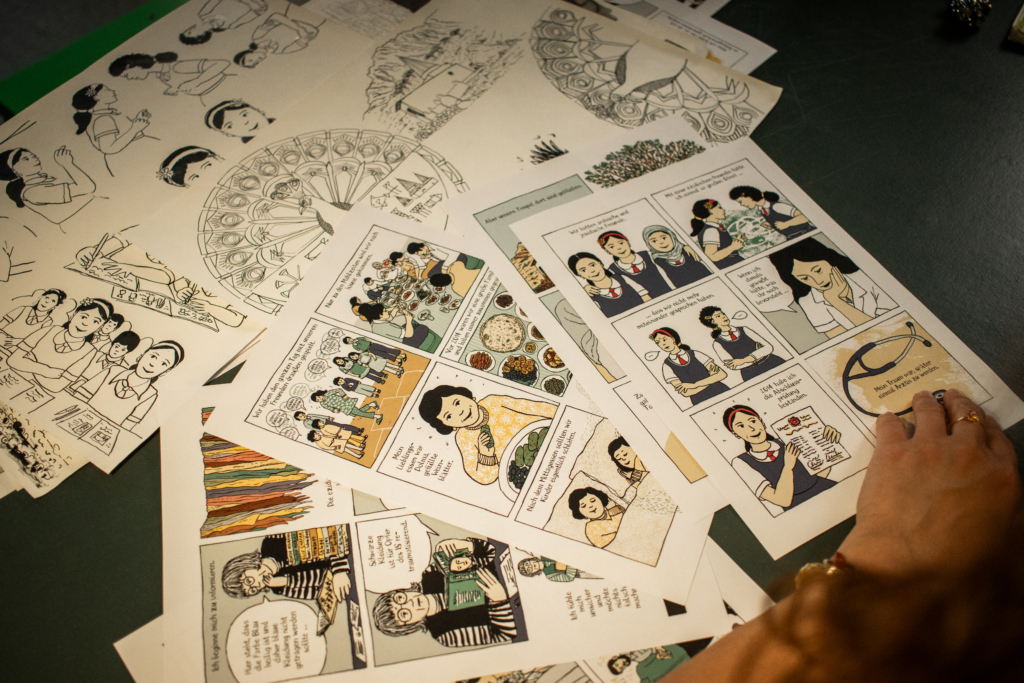
This graphic novel brings to life the story of an anonymous Yezidi woman, Jilan, who survived ISIS’s genocide in Sinjar, northern Iraq. Work on the graphic novel began in earnest in November 2024, when she met graphic novelist Birgit Weyhe in Germany—an encounter facilitated by researcher and community liaison Dr. Leyla Ferman. The collaboration has unfolded through intimate conversations, evolving sketches, and transnational dialogue in collaboration with research cluster co-lead, Dr. Kjell Anderson. The creative process continues, with the graphic novel slated for completion in early 2026—a testament to survivor agency, transnational collaboration, and the power of visual storytelling.
Getting to Know Jilan
Jilan grew up in Sinjar—known as Şingal or Şengal in Kurdish—in a large, loving Yezidi family. Her childhood was filled with laughter and friendship. She dreamt of one day becoming a doctor, and played with Yezidi, Kurdish, and Arab classmates after school, unaware that her world would soon be shattered.
On August 3, 2014, ISIS attacked Sinjar. She was abducted and held captive for nearly three months. Torn from her family, she was enslaved alongside another young woman from her hometown. Domestic servitude and fear became her daily reality. She was separated from her parents and siblings, sold from one captor to another, and made to serve the household of an ISIS fighter.
Today, she lives in Germany. Her name remains hidden—many of her family members are still missing or in captivity—but her voice refuses to be erased. Through this graphic novel, she shares her story so that the world will remember what happened to her and her community.
Community Engagement
Two trees for Yezidis at Millerntor
In November 2024, Leyla Ferman met with Birgit Weyhe in Hamburg at the Millerntor Stadium, where Women for Justice e.V. planted two elm trees to remember 10 Years of Yezidi Genocide. Among others, the vice president of the first division club FC St. Pauli, Luise Gottberg, was present.
1tree4Sinjar in Hamburg
In April 2025, Birgit Weyhe took on the sponsorship of a tree for Fux eG, which was handed over by Women for Justice under the motto “1tree4Sinjar in Hamburg“. It was part of a series of events in Hamburg in remembrance of ten years of Yezidi Genocide.
Team Reflections
“Since this is the first time I’m telling my story in its entirety, I was very nervous and still reserved at first. However, through meetings with Birgit, Kjell, Leyla, and my Canadian colleagues, I quickly gained trust and noticed how I’m opening up to my story and telling it more freely than I did at the beginning. I realize how good it is for me personally and how wonderful it is to have people who don’t want to forget, just like me.”
Jilan
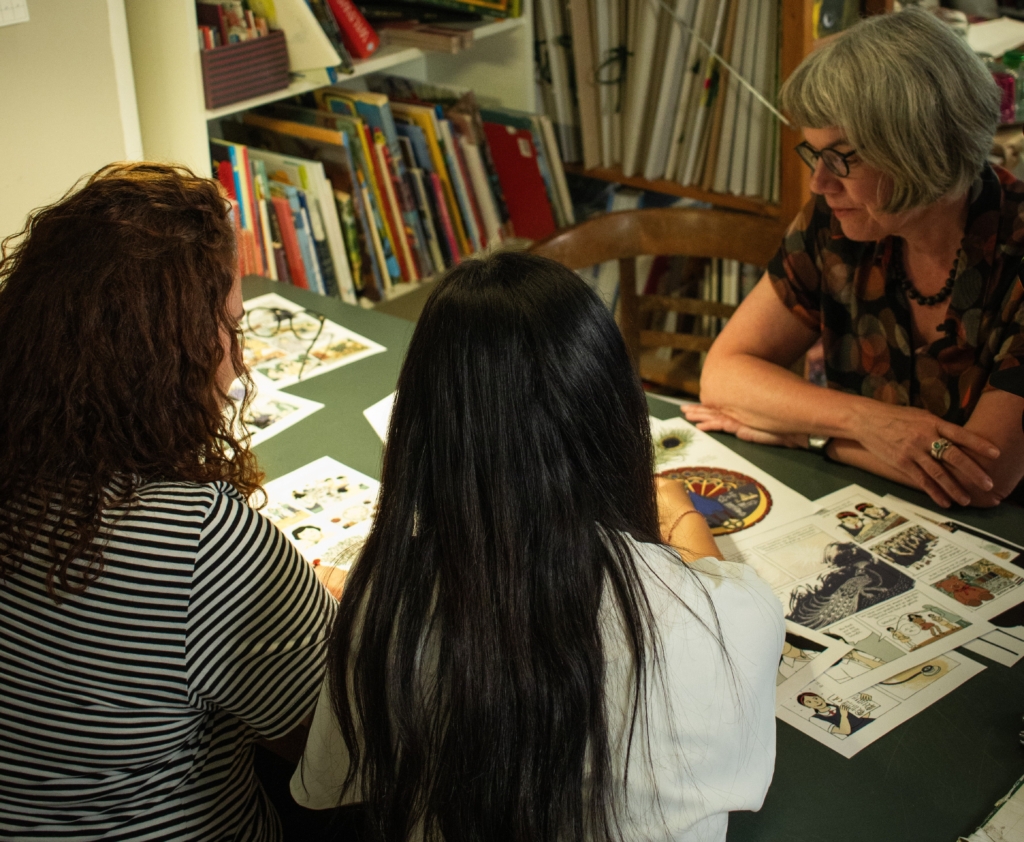
“When I was offered this project, I hesitated for a while, wondering whether I was up to the task. I was unfamiliar with the region or the culture Jilan came from. After meeting Jilan and Leyla, I felt reassured. Jilan’s strength and friendly nature, coupled with Leyla’s profound knowledge and helpfulness, made this collaboration possible. We met regularly for several months and were able to get to know each other before I began drawing. We still meet regularly via Zoom and discuss the pages I’ve drawn. Leyla also provides me with background information and images so I can properly address Jilan’s story.”
Birgit
“I always look forward to meeting Birgit and Jilan. It feels like being with people who think and feel very similarly. I am incredibly captivated by all of Birgit’s new pictures and notice how Jilan’s story becomes very tangible. The steps towards a sustainable and scientific use of our archive, the graphic novel, the documentary film, and potential collaborative events are progressing well in online exchanges with Kjell. We’re all getting to know each other better as a team and our role in the overall project.”
Leyla
“This project is deeply meaningful to me, personally. When I visited Sinjar in 2016, I was struck by both the total devastation of the city and the desperate need of Yezidi victims to be heard. Genocide seeks not only to destroy, but to erase. Listening to survivors is an act of restoration and affirmation. I’ve been moved by the courage of Jilan—her willingness to revisit painful memories so that the story of the Yezidi people is not forgotten. Her strength in seeking joy and meaning after such devastation is humbling. We want to honour her story not only by telling it faithfully, but by creating it in a good way—with kindness, care, and shared respect.”
Kjell
The Collaboration
Like many Yezidi, Jilan fled Iraq as a refugee and has since found refuge and a new life in Germany. She lives amid a vibrant Yezidi community striving to maintain their rich religious and cultural traditions in the aftermath of genocide. The graphic novel project thus found its creative home in the Hamburg area, where three of the key collaborators – Jilan, Birgit Wehye, and Leyla Ferman live.
Meetings for this project take place in a variety of settings, chosen with care. When conversations are less sensitive, the team gathers in cafés or restaurants, or connects remotely. For more private discussions, a quiet room is found near Jilan’s or Birgit’s home to ensure safety and comfort.
Between meetings, Leyla supports Birgit by gathering visual materials – photos and videos from Shingal and Yezidi cultural events – and preparing background documents. She also meets with Jilan to explain the next steps and seek her feedback on creative decisions.
Leyla and Kjell hold regular online meetings to coordinate the project’s progress, support the creative team, and explore future partnerships. Together, they’ve also begun building the Research Cluster’s archive – a resource for survivor-centered storytelling.
As the project moves into its next phase, the graphic novel, film, and accompanying materials will be shared with the public through educational programs, exhibitions, and community events—bringing survivor stories to wider audiences and sparking vital conversations.
Documentary Film
I Just Keep Going (2026)
In June 2025, the team partnered with filmmaker Olaf Markmann to shoot a short documentary in and around Hamburg. One of the locations selected was the Bergen-Belsen Memorial for its historical resonance as a former concentration camp from the Holocaust. While the Yezidi genocide unfolded in a different manner than the Holocaust, there are parallels in its systematic persecution, its dehumanization of victims, and its ideological extremism. The film will be available in early 2026.
The Yezidi Genocide
On August 3, 2014, the Islamic State (IS) launched a brutal attack on Sinjar province, a region near the Syrian border predominantly inhabited by Yezidis. At the time, large parts of neighboring Syria were already under IS control. Sinjar was not only home to a religious minority long targeted by extremist ideologies—it was also a strategic corridor between the two capitals of IS’s self-declared caliphate: Raqqa in Syria and Mosul in Iraq.
IS adherents, drawing on a radical interpretation of Islam, labeled Yezidis as apostates. This ideological framework fueled the genocidal violence that followed.
During the attack, over 6,400 Yezidis were abducted, and thousands were killed.[1] Approximately 50,000 fled to the Sinjar Mountains, where they were trapped for seven days in blistering summer heat without food or water.[2] Hundreds of elderly people and young children died of thirst. Their escape was made possible only when Kurdish forces from northern Syria—the People’s Protection Units (YPG) and Women’s Protection Units (YPJ)—alongside fighters from the Kurdistan Workers’ Party (PKK), opened a humanitarian corridor into Rojava.
Sinjar now holds over 70 mass graves.[1] Numerous Yezidi holy shrines were destroyed, though many have since been rebuilt following the return of roughly 100,000 Yezidis to the region. Still, more than 200,000 remain displaced in camps across the Kurdistan Region of Iraq.[2] Security concerns, lack of infrastructure, and limited economic opportunities continue to prevent their return. Over 2,600 Yezidis remain missing, many still in captivity.[2]
The village of Kocho (Koco), in Sinjar province, became a symbol of the genocide. On August 15, 2014, nearly all the men were executed, and the women, girls, and children were abducted and enslaved.[3] The partially identified remains of those killed have been buried in a newly established cemetery.
This pattern was emblematic of the genocide: Yezidis were deliberately targeted, with men and boys forced to choose between conversion or execution—those who converted were often conscripted into IS ranks. Women and girls were enslaved, often subjected to systematic sexual violence, and coerced into forced marriages with IS fighters.
The attack on Sinjar has been recognized as genocide by numerous states and international organizations. Trials in Germany, the Netherlands, and Sweden have included charges of genocide against IS members. For Yezidis, August 3 is commemorated globally as “a black day”—a day of mourning and remembrance. In their collective memory, the 2014 genocide marks the 74th Ferman, an Ottoman-era term for imperial decrees that sanctioned mass killings. Yezidis recall surviving 72 such genocides under the Ottoman Empire, making Sinjar not just a site of tragedy, but a continuation of historical trauma.
Sources:
[1] Valeria Cetorelli et al., “Mortality and Kidnapping Estimates for the Yazidi Population in the Area of Mount Sinjar, Iraq, in August 2014: A Retrospective Household Survey,” PLOS Medicine 14, no. 5 (May 2017): e1002297, https://doi.org/10.1371/journal.pmed.1002297.
[2] “10 Years After the Sinjar Massacre: Yazidis Still Waiting for Justice,” The New Arab, August 3, 2024, https://www.newarab.com/analysis/iraq-report-10-years-after-sinjar-massacre-yazidis.
[3] Fazil Moradi and Kjell Anderson, “The Islamic State’s Êzîdî Genocide in Iraq: The Sinjār Operations,” Genocide Studies International 10, no. 2 (Fall 2016): 121–138. https://doi.org/10.3138/gsi.10.2.02.