Filming Indigenous Narratives: Interview with Andy Rutter
Filmmaker Andy Rutter recently discussed making his documentary Kokum Dorothy’s Story: We Can Still Sing and Dance with Ghada Youssef, UVic PhD student and fellow documentary filmmaker. This film is part of SCVN’s Turtle Island Research Cluster and features conversations between residential school survivor Dorothy Visser and Métis illustrator Natasha Donovan as they discuss their upcoming graphic novel, We Can Still Sing and Dance: Kokum Dorothy’s Story. Below is the interview between Andy and Ghada, adapted by Laura Oakley. The trailer is available to view here, and the film will be released in early 2027.

Ghada: Maybe I can start with getting to know a little bit more about you. How did you end up on the SCVN project?
Andy: My partner Shannon Leddy brought me onto the project right from the very start of 2024. We did five interviews with Dorothy Visser and I turned them into a short documentary film.
Ghada: Yes, to put things in context, the SCVN project commemorates stories of survival, working with genocide and mass atrocity survivors and turning their testimonies into graphic novels and short documentary films. And your film, as you mentioned, revolves around the story of Dorothy, who is a survivor of the residential schools in Turtle Island. Working with personal experiences, and especially where trauma and memory and personal experiences are involved, requires careful navigation, at the very least, in how these stories are handled, represented, and shared. My question to you: Can we start with your relationship to Dorothy? How did you create a space that was emotionally safe for Dorothy to share her experiences, from trust to privacy to boundaries? I’m curious about your relationship to Dorothy.
Andy: Luckily for us, Shannon already had a relationship with Dorothy. Shannon had been going to Dorothy’s Cree language lessons. So, they did have a relationship or a bond already through the Cree lessons. But it was quite easy actually to create that space. In the beginning, of course, it was a trauma-informed environment. And so, we took it very slowly. But then we started to find that Dorothy was actually very funny and told a lot of really, really funny jokes. There was a good balance between some of the traumatic events that she’d experienced as well as some of the funny ones that she had as well. So that really helped us move on.
Dorothy, because she’s almost 90 years old, she couldn’t do long interviews. So, whatever we captured at the time was in one take. There was no, “Please stop. Can you go back and say that again?”
Ghada: Focusing on you as a filmmaker in this experience, I’m wondering if you felt a bigger responsibility as a filmmaker in comparison to making other films that are about a lighter topic. Did you feel that you have some ethical considerations that you needed to put front and centre, when you don’t usually need to do that?
Andy: I would argue that you need to do that all the time with every project that you work on. Every day was emergent. Every interview that we did, it started off with a few essential questions, but then it took on a life of its own. My job as the storyteller was to find the cohesion between the stories that were being told and the way we were trying to tell it. I focused less on the atrocities of residential school survivors had experienced and more on the resilience of Dorothy.
Every day was emergent. Every interview that we did, it started off with a few essential questions, but then it took on a life of its own.
The idea that we can say that we can work together, that there is two-eyed seeing, as a residential school survivor Dorothy would like to tell us about her resilience: bring it on. How do we fit into this? Because we as social beings, we all work together, so, the survivor side of it was the catalyst. The real story that I tried to tell was how we can work together.
And, so, the big part is with these kinds of videos is talking about why is it important to understand that there are three sides to every story and there isn’t just good and bad: there’s lots of grey area.
…it important for people to understand that there are three sides to every story and there isn’t just good and bad: there’s lots of gray area.
Knowing about some of these stories is a good way of beginning the reconciliation process. It’s a good way to try and get those who aren’t in communication with Indigenous communities and who don’t know the stories of residential schools, who only hear what their echo chambers give them, to let them hear another side of the story. Even if we only change that one mind, just ten percent, we’ve still done something. It is an educational process. You have to want to learn.
Ghada: That’s beautiful. Thank you for sharing that. Yes, the film centres around the collaboration between the survivor and the artist in the process of developing the graphic novel. I like to think of this as already having one layer of visualization done by the artist and then you contribute with yet another layer of visualization. Did the visuals or the content of the graphic novels influence the development of the film for you? Did they make your visualization easier, or it did not have that big an influence?
Andy: Well, at the time that I was making the actual short documentary film there were only around four or five coloured images, and they were still in the rough versions. Natasha Donovan was working as diligently as she possibly could, but I was moving faster. The whole project was moving faster than Natasha’s working on the actual illustrations. By the time we got to the end, she had around 50 frames, but I hadn’t seen them. All I had seen was the rough copies, which I incorporated into the video. And it’s also because the actual developing of the animations or the illustrations gave Natasha her energy to go on and do more.
I focused on collaboration instead of focusing on the actual product. We talk about the product as the overarching reason why we’re doing this together. It is the story. It is a story about people who are telling stories so they can turn those stories into illustrations.
Ghada: How did you approach the story building process through editing? Were there any moments that you had to give up? Or moments that you wished you had but did not. What did you do? Can you walk me through your editing process?
Andy: After doing five different interviews with Dorothy, each interview being approximately an hour and a half each, the parts that I tended to focus the most on were where there was a positive aspect to it or there was a talking about progress. There was a talk about something that had happened which has brought Dorothy to this thinking or that Natasha heard and brought into her illustration.
Working with somebody who just has a vast treasure trove of good stories that they can tell, like Dorothy, means she wants to tell the story, but then she’s reminded of another story that gives her joy. So, then she’ll start talking about that story that gives her joy, and then that will segue onto another story that brings her joy, and in the end, all we can do as audience is smile with her, is listen, is to understand. As the editor, I have to come back into the editing studio and go, okay, where did that story begin? Where did it end? It didn’t.
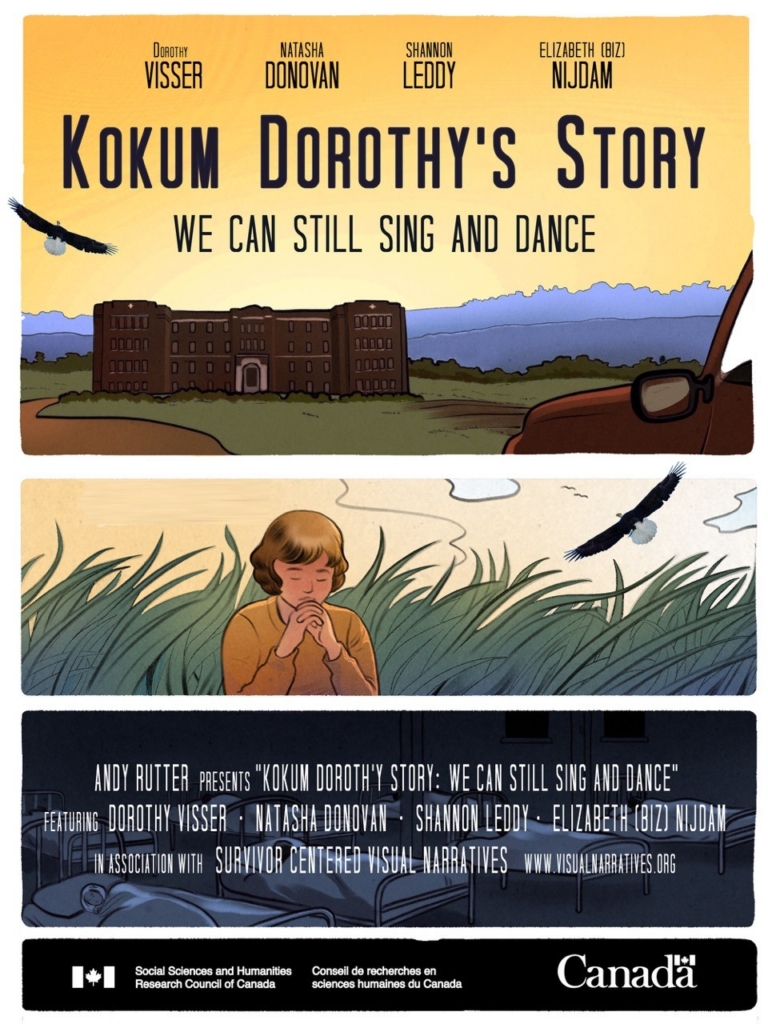
The story of We Can Still Sing and Dance, that was a story that Dorothy was telling about some injured eagles that she once used to look at the Langley Zoo. One flew down from the north, one flew from the south, and then one from the east and the west, and they stood in a circle singing and dancing to each other. Injured eagles. And she watched this and she said, that is like my people. That is like what’s happened with the Indigenous of Canadian residential school survivors. But I couldn’t get that whole story in one seating. Maybe one day we will sit down with Dorothy in another time, in another place.
Dorothy was not a seasoned celebrity, so every time the camera was turned on and the microphone was going, then she felt that this was a production, and now she should perform as if this were a production. We’d say, no, you don’t need to perform like it’s a production. Just tell us a story as you normally would if we were just sitting having a cup of coffee.
Ghada: Thank you for sharing this. This is very grounding. And it’s really what to expect in those situations where the essence is someone sharing stories, but in a very organic way. What is some advice you can give to filmmakers who want to do films like this, with this approach?
Andy: My advice to filmmakers that would like to take on these kind of trauma-informed stories or these survivor stories is to be patient with your subjects because if you tell them that you’re doing a survivor story or a survivor narrative, they automatically go to what do people want to hear about the struggles. Be patient with your subjects because chances are their survival techniques or the survival that they learned is actually what’s kept them resilient and has helped them live to where they are today with their positive attitude.
…be patient with your subjects because if you tell them that you’re doing a survivor story or a survivor narrative, they automatically go to ‘what do people want to hear about the struggles’.
So, it’s less about the trauma and more about what happened afterwards or how the living continued. There’s not going to be any straight line unless of course your subject is somebody who has worked in media or, for example, has done multiple lectures or TED talks about the topic. And this is where you’ll have to just listen, because that story will change. At least, we hope it will change. A good piece of advice: it takes a lot of listening, it takes a lot of patience, and it takes a lot of understanding of what it means to have two ears and one mouth.
Ghada: The idea of expectations—not that you’ll receive a particular story in a specific format, but that you’ll be open to the many different ways stories can take shape. Do I read you correctly?
Andy: Allow for the story to be emergent. And if you don’t have all the equipment on the first day, look at your footage afterwards, look at your dailies and say, what could be better for the next interview? You might not always get the location that you want, but you deal with what you have. You deal with the situation that you’re in. And that’s everything. That is having your subject, for example, show up 45 minutes late, for example, and knowing that you have a deadline, you’ve only got the room for two hours. You have to take things like that into consideration that your subject might not always be at their best on the day of the shoot.
Get what you can with your patience and quiet and calm. And of course, from the director’s side, you have to be able to be patient yourself with the other people in the room. The ones who might be nattering in the back while you’re trying to listen to an interview. Leave it there.
Ghada: Thank you so much, Andy. I think it’s very inspirational, realistic, and very, very useful to any filmmaker. I usually ask the filmmakers about how they themselves handle the emotional weight when dealing with stories that are emotionally heavy. What can you share with me about this? Now, I do get the sense that Dorothy had this humorous side, and so maybe that kind of released this emotional pressure. But in the big picture, when you are reflecting on yourself that you are a filmmaker doing a story of this kind, how did you deal with this?
Andy: In Dorothy’s family, there would be times something happened, or she didn’t get enough sleep because there was a trauma. We would do a smudge. And then we’d clear out our minds ready for the shoot. We would have the lead up which was just a quick normal chit chat about life, about everything. And while we’re doing that chit chat, that’s when I turn the cameras on. As a filmmaker who’s done lots of interviews with people who aren’t used to being on camera, who are shy on camera, who don’t have that interviewing gene, what I’ve learned to do is don’t bring any attention to the equipment. Obviously, you have to set up your lights and your cameras and your microphones, but don’t draw attention to them. Don’t tell your subject, I am now going to turn the camera on, because then they say, I’m not prepared for that. If you never have to tell them that you’re turning the camera on, then the camera is always on.
And feel the room. I can’t push my subject to be bubbly and bright if I inside myself feel that they didn’t get enough sleep last night or if they have something emotional going on in their head. Or they’re dealing with something. I can’t try and pull that character out as if this were a Hollywood actor who can switch on a dime. This is a human being.
Ghada: Beautiful. SCVN films will be used in genocide and human rights education, so they will be shown at exhibits, in the classroom, online for a general public, so in very different ways and formats. What kind of response do you hope to receive from the diversity of audiences?
Andy: I hope that the response that I get from my short documentary encourages people to learn more. Those who have not yet experienced or don’t have knowledge of what happened in residential schools may have heard, at some point in time, was that residential schools weren’t so bad. What I would like to say to them is you only know a portion of the story. They’re sure the residential schools did have some good things and Dorothy talks about those. But for the most part, they were traumatic, traumatic, for many generations. And that is the story that I would like for people to look deeper into. And I hope that my documentary film allows people to say, oh, I didn’t know that. I need to know more.
Ghada: Is there anything in particular that you wanted to share with us? Any experience that I may have not asked you about?
Andy: Since working on Dorothy’s story and listening to the narratives, it has, in my own learning, taken me to UBC Indigenous Gardens, where now I am doing documentaries for the people who run the gardens. And I’m hearing about Indigenous medicines and about Indigenous storytelling. I’m learning about bees, which I never thought that I’d learn about before, about how to turn nettles into fishing nets, and about pickling. Once you start learning about Indigenous knowledge or incorporate this into your understanding, your worldview, it opens up so many more doors to more learning.
Once you start learning about Indigenous knowledge or incorporate this into your understanding, your worldview, it opens up so many more doors to more learning.
And, as a video editor, I’ve listened to stories 1,000 times, as a video editor does. When a video editor is editing a piece of work, he might listen to one person speak 100 times about the same thing. It is a whole different learning curve when you edit videos. And you start to learn about things that you never thought you’d ever be interested in, but then you hold on to that knowledge and you take it into your next project and say, I’m so happy that I learned that because now it makes this more understandable. So, my advice is, as a lifelong learner, never stop being interested in the topics because they always lead you to the next topic.
Ghada: There is never one thread that is in isolation to any other thread. It’s always all interconnected. It’s always going to lead you to other threads. It always has more than one outcome. As a student in philosophy, I think one of my biggest lessons is accepting that most of the times phenomena and experiences are so multifaceted, much more than we think. And it’s so nice to cultivate the sense of curiosity: to want to learn more and as much as we can.
Andy: That is right, and in stoic understanding, there are things that you have control over and there’s some things you don’t have control over. How do you identify these and which hill do you die on? When it comes to working towards the wrong and rights, is there anything called wrong and right? I don’t know: philosophy.
Ghada: Well, thank you so much for these very valuable insights. I really enjoyed this conversation.
Andy: It was a pleasure discussing them with you.