‘Risk in the Archive’: Webinar with UBC’s Public Humanities Hub – Mar 24, 2026
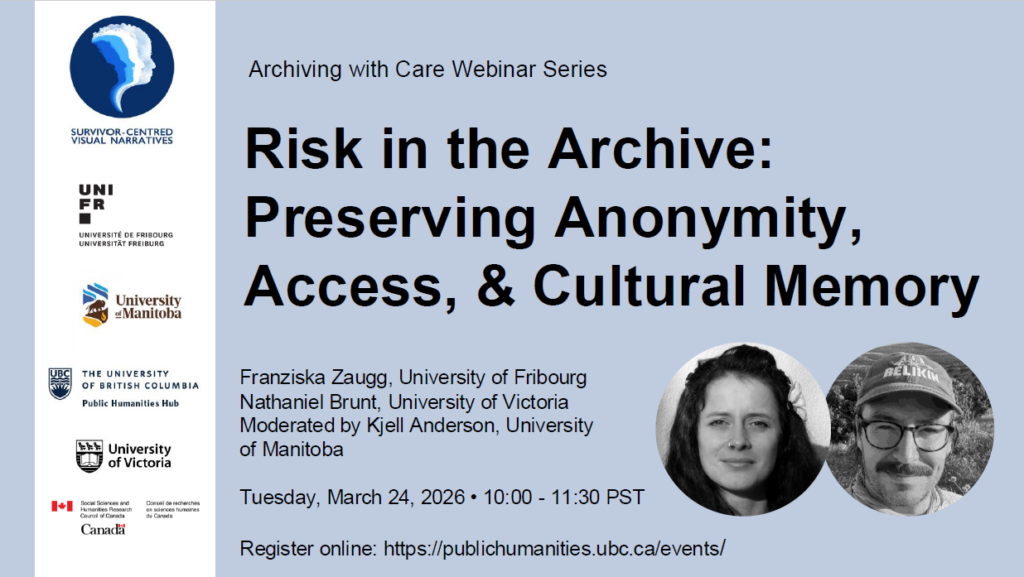
This week, SCVN is collaborating with UBC’s Public Humanities Hub to host the second webinar in the Archiving with Care Series. The webinar is titled “Risk in the Archive: Preserving Anonymity, Access, & Cultural Memory” and will host Drs. Franziska Zaugg from the University of Fribourg, Nathaniel Brunt from the University of Victoria, and Kjell Anderson from the University of Manitoba. Drawing on each speaker’s background in specific forms of archival research and curation, the webinar will pursue ethical approaches to archival material, anonymity, and care.
The event will take place over Zoom on Tuesday March 24th from 10:00 – 11:30 am PST. More information about the event as well as speaker bios are available on PHH’s website here. Registration is required and accessible via the link.
How can an archive at risk be supported to ensure its significant cultural, historical, or evidentiary value is preserved?
What if the risk is in the process of creating the archive? Or in the decisions of what to include or exclude? How are identities protected and who has access to the anonymous records? These questions and more are critical to developing and maintaining archives at risk with care.
Risk in the Archive: Preserving Anonymity, Access & Cultural Memory
Tuesday, March 24
10:00 – 11:30 am PST
Webinar Info: https://publichumanities.ubc.ca/events/event/risk-in-the-archives-preserving-anonymity-access-and-cultural-memory/
Registration Link: https://ubc.ca1.qualtrics.com/jfe/form/SV_bHq0y8TrqYopDjE
Speaker Profiles
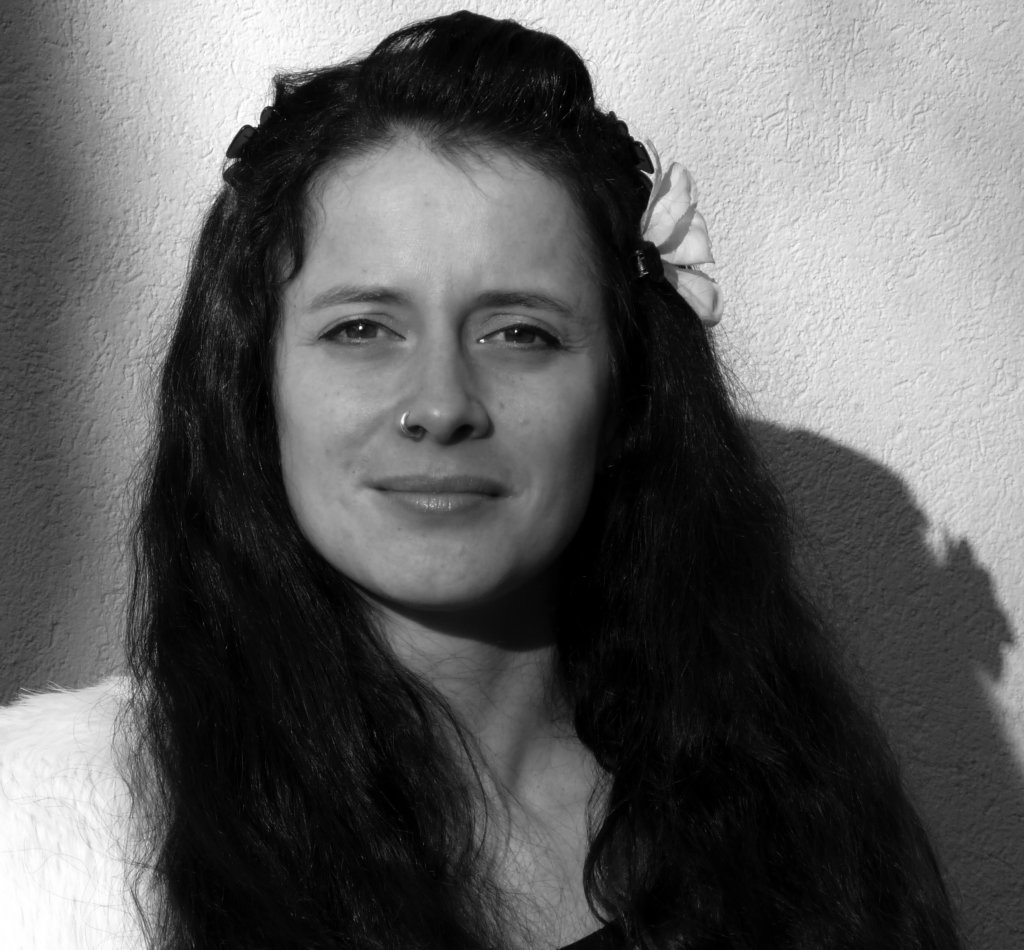
Franziska Zaugg is a lecturer at the Department of Contemporary History at the University of Fribourg. From 2018 to 2022 she was a postdoctoral researcher at the University of Bern, supported by the Swiss National Science Foundation/Ambizione. From 2015 to 2018, she held a postdoctoral fellowship at University College Dublin, Centre for War Studies, and from 2016 to 2018, she worked as an early career researcher in the “Transnational Resistance Project” at the University of Oxford. Her research focuses on conflict and war history, resistance and collaboration movements, youth cultures, and the dialectal relationship between archives and society. Franziska Zaugg is a co-founder of the working group “History-Society-Violence” (Geschichte-Gesellschaft-Gewalt). She is also the SCVN Yugoslav Wars Research Cluster Co-Lead, working with a survivor who is a Roma woman, sharing her life experiences in Serbia in the 1990s where the discrimination and violence of the Yugoslav Wars shaped her childhood and youth.
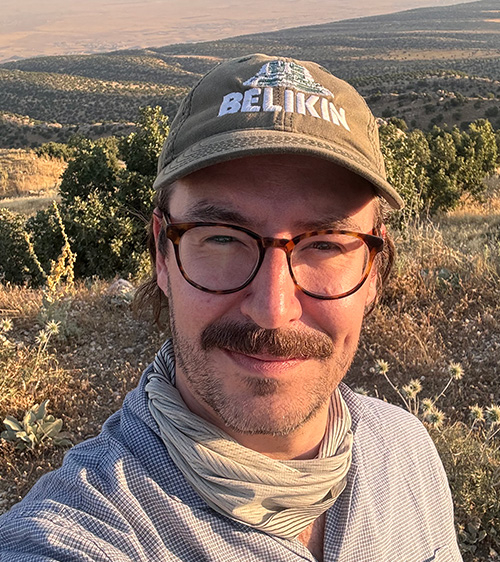
Nathaniel Brunt is a Canadian interdisciplinary scholar, documentarian, and educator whose work critically examines modern armed conflict and the ways it is, and has been, represented photographically. Trained as a cultural historian and documentary photographer, he studies how individuals, institutions, and communities interpret their worlds visually during wartime. He completed his PhD in the Communication and Culture joint program at Toronto Metropolitan University and York University, supported by SSHRC and the Pierre Elliott Trudeau Foundation. Brunt’s photographic work has been widely published and exhibited internationally. He is currently undertaking long-term documentary projects in Northern Iraq and Kashmir, is a postdoctoral fellow at the University of Victoria Libraries, and will be a Hannah Arendt Fellow in 2026. He joined the SCVN project in 2025 as a Research Advisor and will share his experience archiving in Iraq to support the Yezidi project archives.
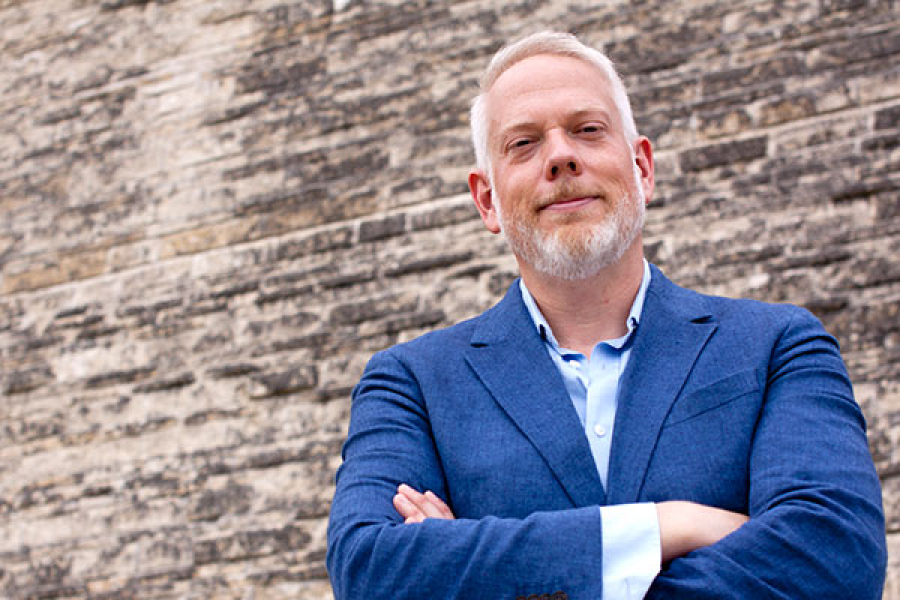
Kjell Anderson is an Associate Professor of Law at the University of Manitoba, specializing in genocide, perpetrator studies, international criminal law, and transitional justice. He is the author of Perpetrating Genocide: A Criminological Account (2017) and co-editor of Researching Perpetrators of Genocide (2020). His fieldwork spans Rwanda, Burundi, Uganda, Bosnia, Cambodia, Bangladesh, and northern Iraq, where he has investigated atrocity crimes, victim experiences, and perpetrator narratives. He has held academic positions at the University of Amsterdam, Leiden University, the University of the Fraser Valley, and the National University of Rwanda, and worked with NGOs, think tanks, and international organizations. His current projects include books on Dominic Ongwen, the Rohingya genocide, and epistemic justice and transitional justice. He is also the SCVN Iraq/Syria Research Cluster Co-Lead working with a Yezidi survivor, ‘Jilan’ (not her real name) and graphic artist Birgit Weyhe to develop a graphic novel about Jilan’s experiences during the Yezidi Genocide. His interdisciplinary research integrates legal, criminological, and social science approaches to mass violence and post-conflict accountability.
Thank you to the UBC’s Public Humanities Hub team for co-hosting and facilitating this webinar!