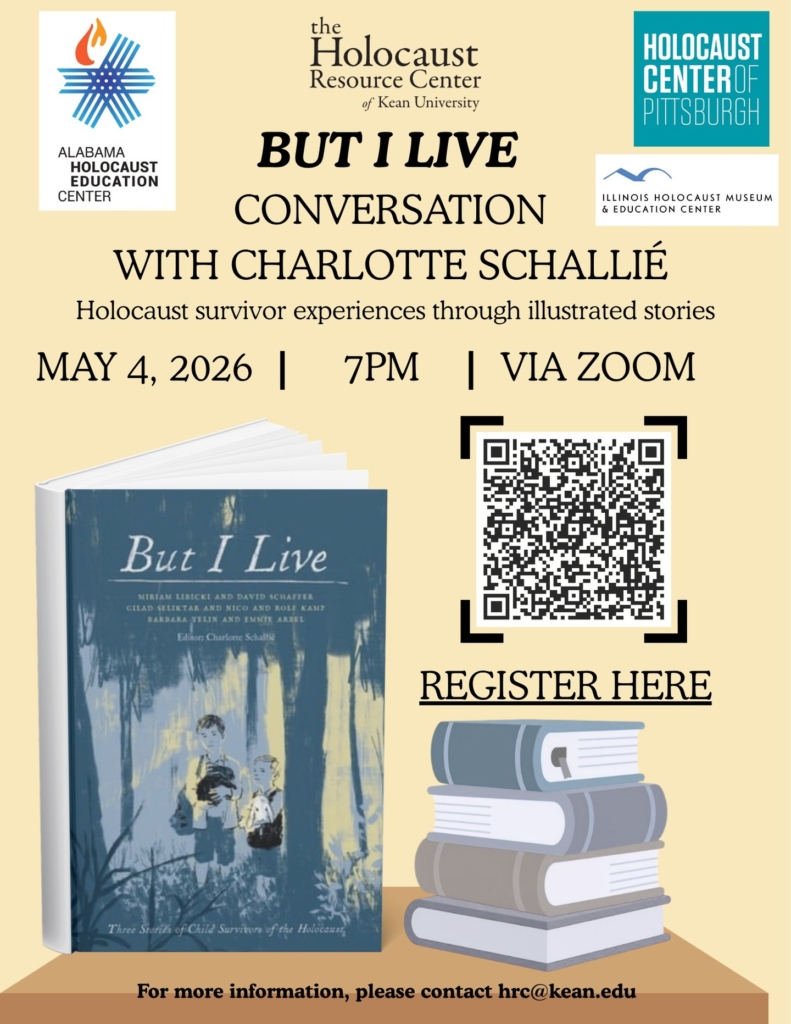
On Monday, May 4 at 7:00 pm EST, Kean University’s Holocaust Research Center will be hosting a public webinar on But I Live with SCVN co-director Dr. Charlotte Schallié.
But I Live: Three Stories of Child Survivors of the Holocaust is a collection of three graphic narratives edited by Dr. Schallié. Each of the graphic narratives is a collaboration between a graphic artist and one or more Holocaust survivors. Since its publication in 2022 by the University of Toronto Press, But I Live has won a number of prestigious awards and inspired the creation of additional graphic narrative collaborations, with more on the horizon. But I Live is available for purchase at this link.
The webinar is co-sponsored by the Holocaust Center of Pittsburgh, the Alabama Holocaust Education Center, and the Illinois Holocaust Museum & Education Center. Registration is free and we hope you’ll join us to learn about the creation of this important work!
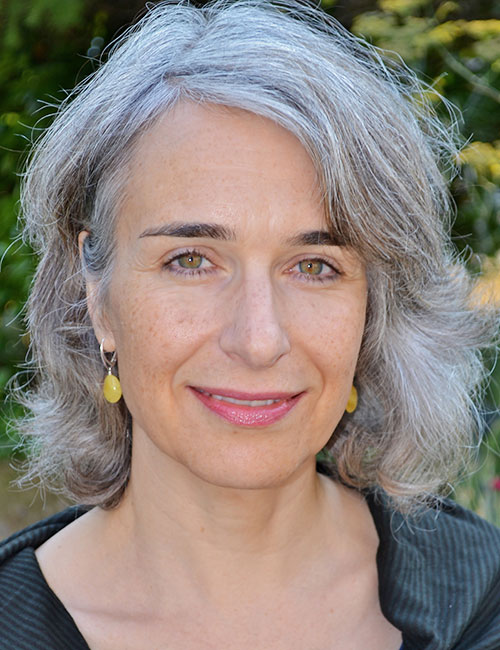
Dr. Charlotte Schallié is a professor of Germanic Studies in the School of Languages, Linguistics and Cultures at the University of Victoria. Her areas of interest include memory studies, visual culture studies, Holocaust education, care ethics, and arts-based research. She also edited the award-winning collection of graphic novels ‘But I Live. Three Stories of Child Survivors of the Holocaust.’
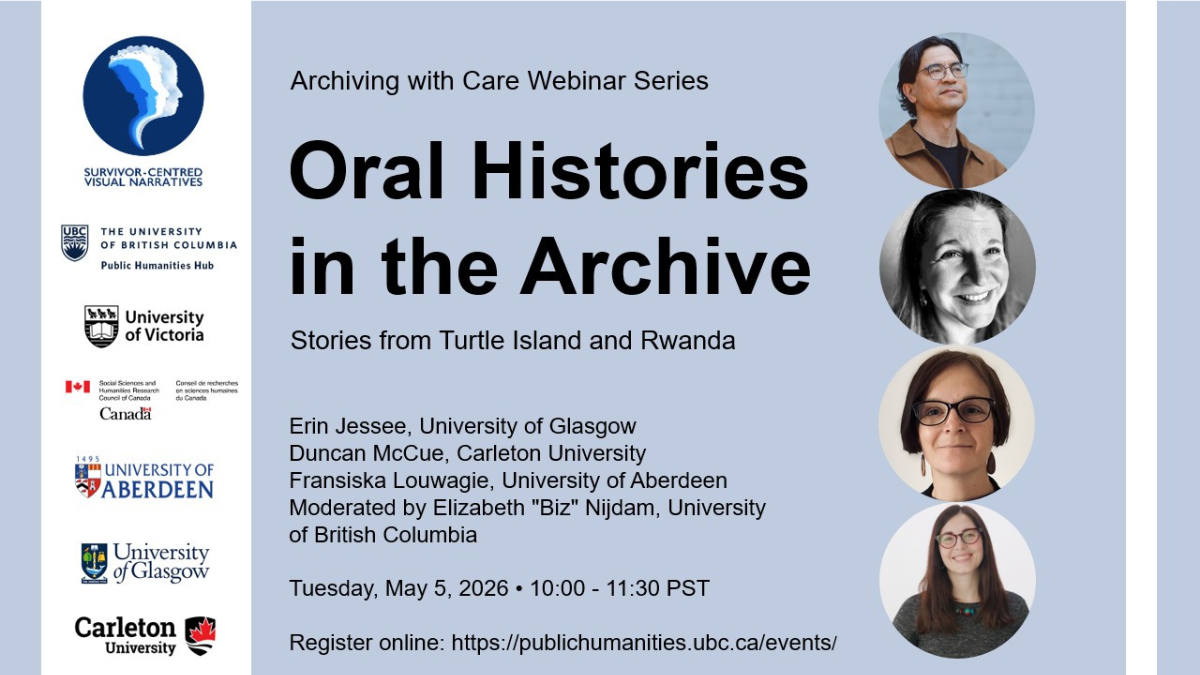
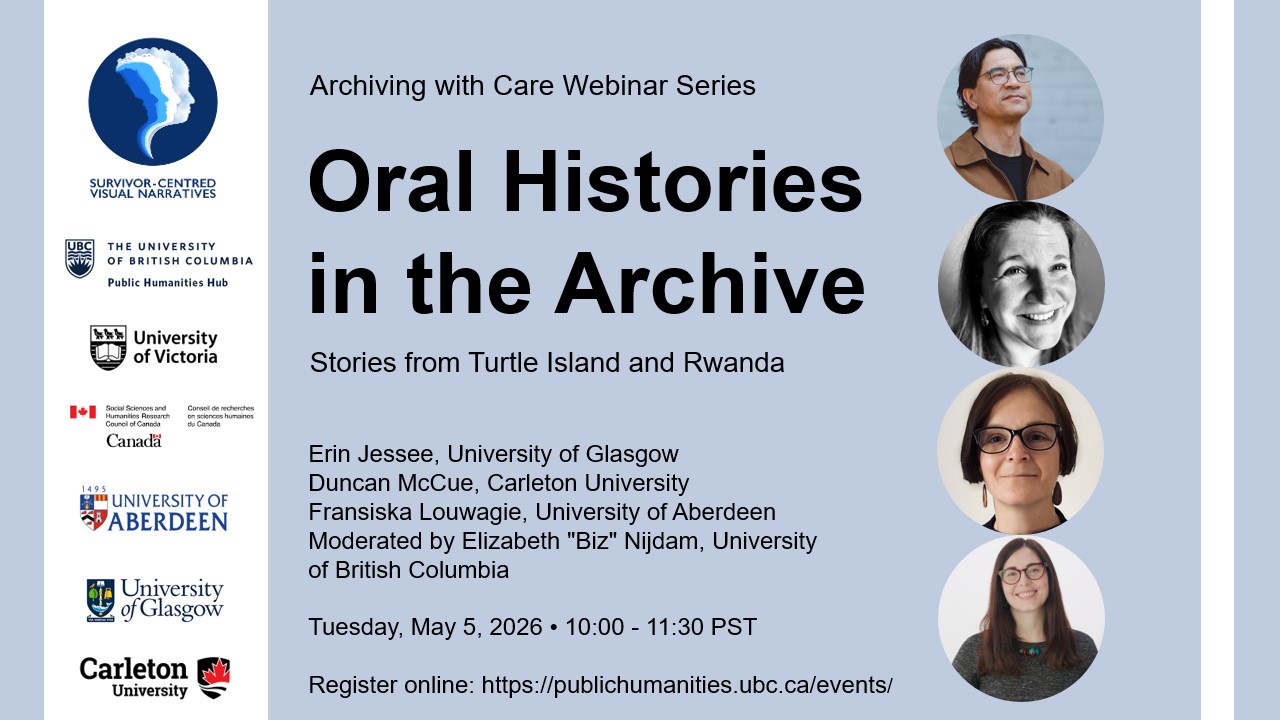
The fourth webinar in the Archiving with Care Series, a collaboration between SCVN and UBC’s Public Humanities Hub (PHH), will take place on May 5th at 10am PST. The webinar is titled “Oral Histories in the Archive: Stories from Turtle Island and Rwanda” and will feature Duncan McCue and Elizabeth Nijdam from SCVN’s Turtle Island Research Cluster as well as and Erin Jessee and Fransiska Louwagie from the Rwanda Research Cluster. The webinar will explore different approaches to archiving with oral histories.
More information about the event as well as speaker bios are available below and on PHH’s website here. Registration is required and accessible via the link.
How are cultures with rich oral history traditions documented and archived with care? How are “living archives” trusted to engage and preserve experiences of survivors of genocides, such as the 1994 genocide against the Tutsi? Additionally, what the approaches to oral history archiving with Indigenous Elders and Knowledge Holders, or when working with residential school survivors? How do oral history archives challenge the traditional archives composed of only written materials?
Duncan McCue is an award-winning broadcaster and educator, and Associate Professor at Carleton University’s School of Journalism and Communication in Ottawa, ON. At Carleton, he launched the Certificate in Journalism in Indigenous Communities, a journalism skills program for learners in remote communities. He is the author of Decolonizing Journalism: A Guide to Reporting in Indigenous Communities and The Shoe Boy, a memoir of his time spent on a trapline with a Cree family in northern Quebec. Canadians know him well as a longtime CBC radio host and TV news correspondent, including host of Cross Country Checkup and the Kuper Island podcast. He previously taught journalism at the UBC Graduate School of Journalism and Toronto Metropolitan University. Duncan is a proud Anishinaabe from the Chippewas of Georgina Island First Nation in southern Ontario. He is the SCVN Turtle Island Research Cluster Co-Lead collaborating with Mangeshig Pawis-Steckly to share the experiences of residential school survivor George Kenny and his son Mike Auksi.
Dr. Elizabeth “Biz” Nijdam is an Assistant Professor of Teaching and settler scholar in the Department of Central, Eastern, and Northern European Studies at the University of British Columbia Vancouver. She is the SCVN Research Cluster Co-Lead of Turtle Island, working with Dr. Shannon Leddy in collaboration with residential school survivor Dorothy Visser and graphic artist Natasha Donovan.
Biz’s research and teaching are grounded in the belief that popular culture is capable of both reflecting social and political discourse and intervening in it. Biz’s scholarship examines the representation of complex histories in comics and digital and tabletop games, Tarot’s capacity for innovating classroom teaching, and the role of comics and arts-based research in preserving Indigenous knowledges, sharing Indigenous storytelling traditions, and revitalizing Indigenous languages. Biz established the UBC Comics Studies Cluster in 2023, where she continues to support community partners, local nonprofits, BC’s First Nations, and UBC faculty and students in making comics about the important issues facing society today. She is also the Director of the UBCPop Culture Cluster, which is home to the UBC Critical Play Lab, and sits on the Executive Committee of the International Comic Arts Forum.
Dr. Erin Jessee is a Senior Lecturer in History at the University of Glasgow in Scotland, where she works across the Gender History, Global History and War Studies research clusters. She has over 15 years of experience using oral historical, archival and ethnographic methods to elicit and bring into conversation people’s diverse experiences of genocide and related mass atrocities, especially in Rwanda and Bosnia. She is the author of Negotiating Genocide in Rwanda: The Politics of History and co-editor of Researching Perpetrators of Genocide and has published in Medical History, Memory Studies, Conflict and Society, History in Africa, Oral History Review and Forensic Science International, among others. She is co-leading the SCVN Rwanda Research Cluster with Dr. Fransiska Louwagie from the University of Aberdeen, working with artists Duta Ebene and Michel Kichka.
Dr. Fransiska Louwagie is a Senior Lecturer in French and Francophone Studies at the University of Aberdeen. She took up this position in August 2022 and was previously employed at the KULeuven, where she completed her PhD, and at the University of Leicester, where she held a post as Lecturer and then Associate Professor of French. She is the author of Témoignage et littérature d’après Auschwitz (2020) and has co-edited several volumes and thematic issues, including: Un ciel de sang et de cendres. Piotr Rawicz et la solitude du témoin (2013); Ego-histories of France and the Second World War: Writing Vichy (2018); Tradition and Innovation in Franco-Belgian bande dessinée (2021); Migration, Memory and the Visual Arts: Second-Generation (Jewish) Artists (2023), The Future of World War Two France in Academia (2026), and Henri Raczymow: sauver les noms (forthcoming). She led the AHRC-research project ‘Covid in Cartoons’, conducted in collaboration with Shout Out UK and Cartooning for Peace.
Thank you to the UBC’s Public Humanities Hub team for co-hostingand facilitating this webinar!
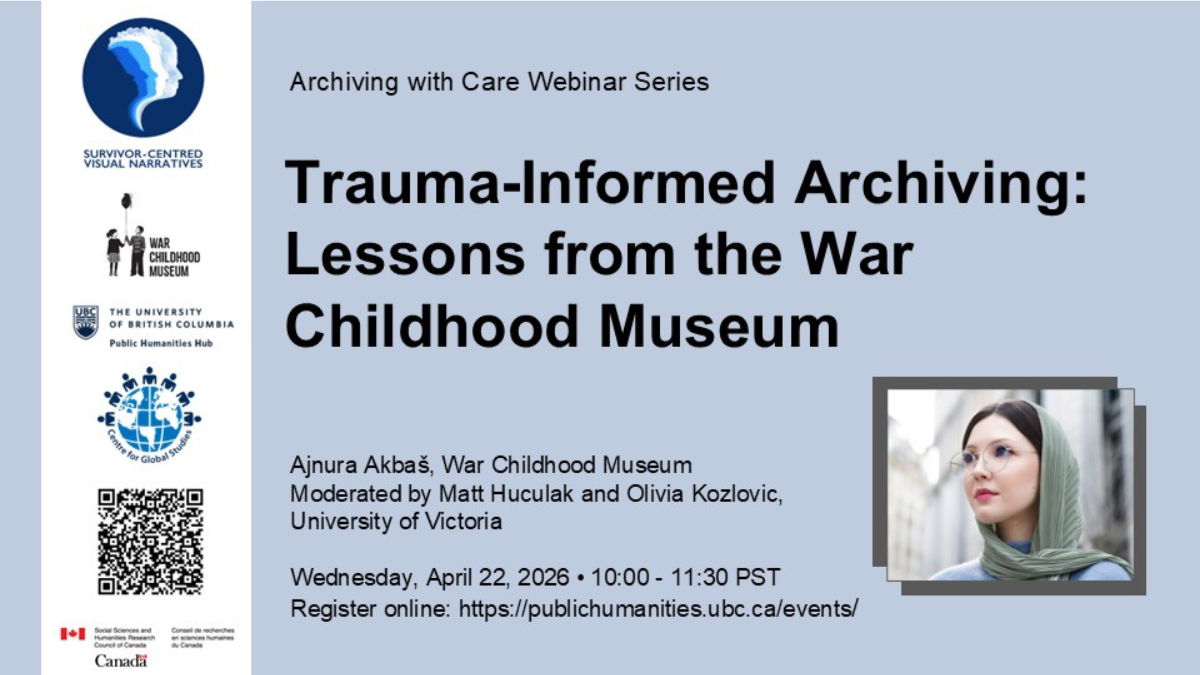
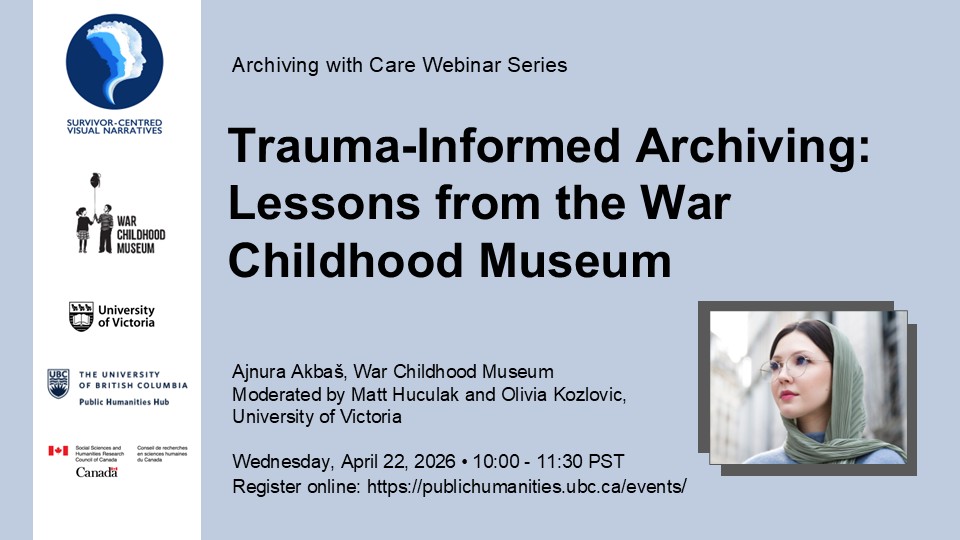
The third webinar in the Archiving with Care Series, a collaboration between SCVN and UBC’s Public Humanities Hub, will take place tomorrow on April 22 at 10:00 am PDT. The webinar is titled “Trauma-Informed Archiving: Lessons from the War Childhood Museum” and will feature Dr. Ajnura Akbaš from the War Childhood Museum in Sarajevo. The discussion will be moderated by Dr. Matt Huculak and MA student Olivia Kozlovic, both from the University of Victoria. The webinar will explore community-engaged approaches to documenting and archiving the 1992-1995 Bosnian War.
The event will take place over Zoom. More information about the event, as well as speaker bios, are available below and on PHH’s website here. Registration is required and accessible via the link.
How are archives developed for the Bosnian War of 1992-1995 when memories are contested, diverge, or remain politically charged? What is the responsibility of the archive when working with survivors’ testimony and objects? How has the War Childhood Museum approached archiving the war differently from other institutions?
Dr. Ajnura Akbaš is a Research Coordinator at the War Childhood Museum, where she leads research and documentation projects focused on the lived experiences of individuals whose childhoods are affected by armed conflict. She is also a PhD graduate from the London School of Economics and Political Science, specialising in Gender studies. Her research examines women’s military service during the Bosnian war, with a focus on gender, militarisation, and post-war memory. Ajnura’s work is grounded in creative, trauma-sensitive and survivor-centred methodologies, including collage-making, body mapping, and collaborative documentary practices. She also supports the SCVN Yugoslav Wars Research Cluster as community liaison and primary contact with the War Childhood Museum, as well as developing an Archiving Toolkit specific to the Bosnian War.
Dr. Matt Huculak is Director of the Kula: Library Futures Academy at the University of Victoria Libraries. A Library Journal “Mover and Shaker,” he was recognized for his work as a digital scholarship innovator during his tenure as Head of Advanced Research Services at UVic Libraries, where he led initiatives in digital asset management, grant-supported scholarship, and digital exhibitions connecting faculty, students, and communities. His research and leadership focus on transdisciplinary knowledge creation, positioning libraries as incubators for emerging technologies and collaborative inquiry across disciplines. He holds a PhD in English from the University of Tulsa and an MLIS from San Jose State University, with graduate study at McGill University and UC Davis — a formation that reflects his grounding in both the humanities and information science. He also serves as Data Director for the Survivor-Centred Visual Narratives (SCVN) project, overseeing the development of the project’s archival infrastructure.
Olivia Kozlovic is an MA student in the Holocaust Studies stream in the University of Victoria’s Germanic and Slavic Studies department. Her research examines the entangled memories of the Holocaust and the Yugoslav Wars in the Balkans, focusing on sites of memory as physical manifestations of this entangled memory in Croatia, Serbia, and Bosnia. Her aim is to understand how the memories of these two events impact one another in the public memory landscape of the Yugoslav successor states. She is supporting the SCVN project as a research assistant archiving the artistic materials, beginning with the Holocaust and Yugoslav Wars Research Clusters.
Thank you to the UBC’s Public Humanities Hub team for co-hostingand facilitating this webinar!
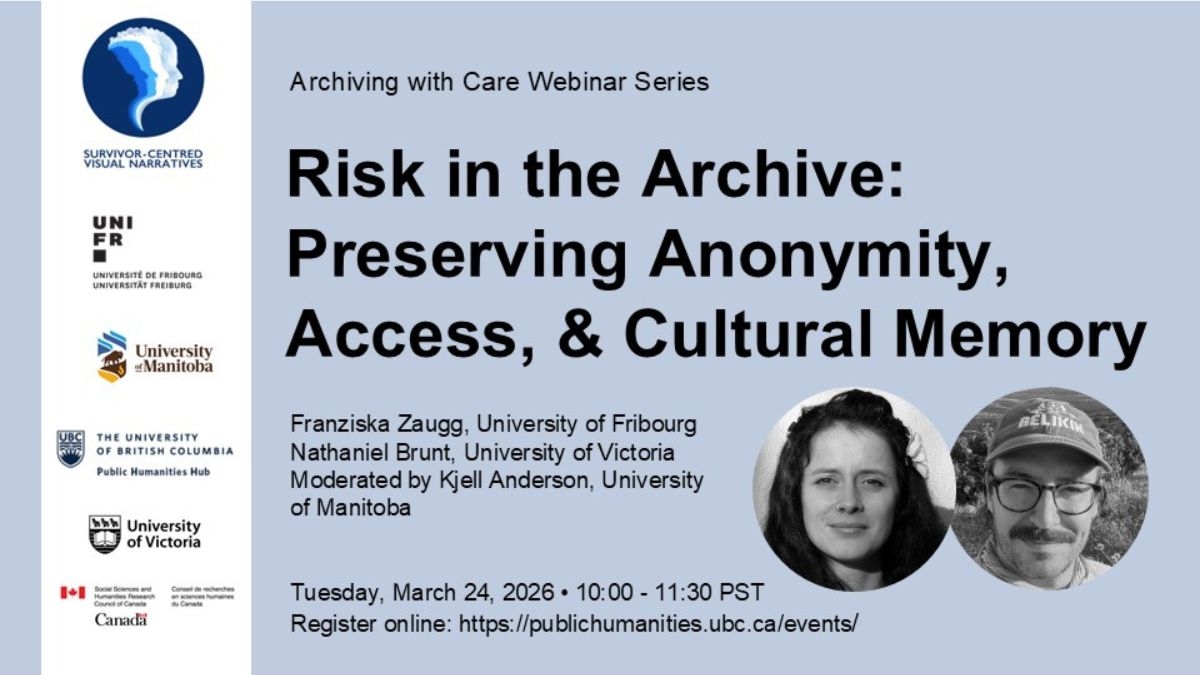
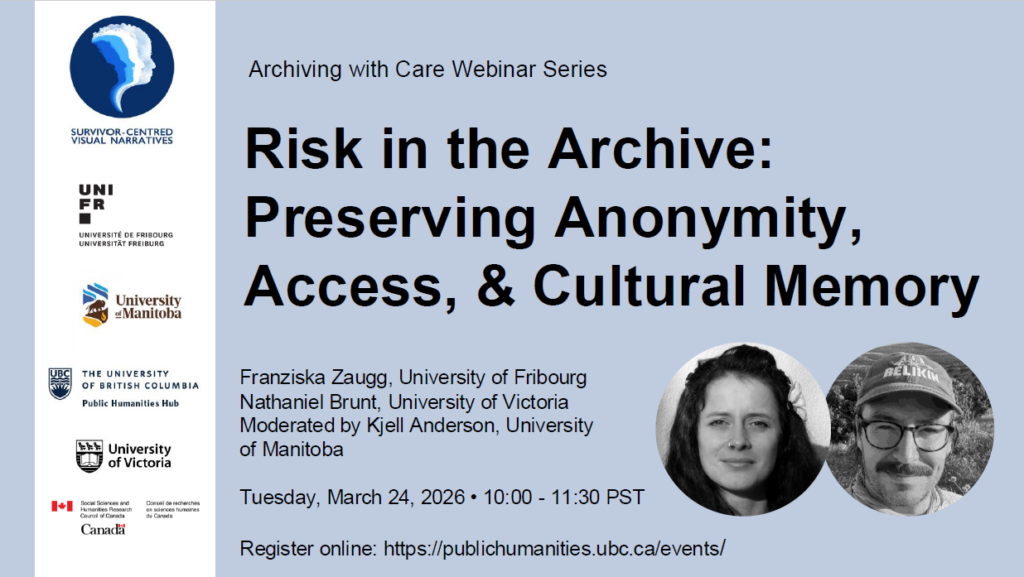
This week, SCVN is collaborating with UBC’s Public Humanities Hub to host the second webinar in the Archiving with Care Series. The webinar is titled “Risk in the Archive: Preserving Anonymity, Access, & Cultural Memory” and will host Drs. Franziska Zaugg from the University of Fribourg, Nathaniel Brunt from the University of Victoria, and Kjell Anderson from the University of Manitoba. Drawing on each speaker’s background in specific forms of archival research and curation, the webinar will pursue ethical approaches to archival material, anonymity, and care.
The event will take place over Zoom on Tuesday March 24th from 10:00 – 11:30 am PST. More information about the event as well as speaker bios are available on PHH’s website here. Registration is required and accessible via the link.
How can an archive at risk be supported to ensure its significant cultural, historical, or evidentiary value is preserved?
What if the risk is in the process of creating the archive? Or in the decisions of what to include or exclude? How are identities protected and who has access to the anonymous records? These questions and more are critical to developing and maintaining archives at risk with care.
Franziska Zaugg is a lecturer at the Department of Contemporary History at the University of Fribourg. From 2018 to 2022 she was a postdoctoral researcher at the University of Bern, supported by the Swiss National Science Foundation/Ambizione. From 2015 to 2018, she held a postdoctoral fellowship at University College Dublin, Centre for War Studies, and from 2016 to 2018, she worked as an early career researcher in the “Transnational Resistance Project” at the University of Oxford. Her research focuses on conflict and war history, resistance and collaboration movements, youth cultures, and the dialectal relationship between archives and society. Franziska Zaugg is a co-founder of the working group “History-Society-Violence” (Geschichte-Gesellschaft-Gewalt). She is also the SCVN Yugoslav Wars Research Cluster Co-Lead, working with a survivor who is a Roma woman, sharing her life experiences in Serbia in the 1990s where the discrimination and violence of the Yugoslav Wars shaped her childhood and youth.
Nathaniel Brunt is a Canadian interdisciplinary scholar, documentarian, and educator whose work critically examines modern armed conflict and the ways it is, and has been, represented photographically. Trained as a cultural historian and documentary photographer, he studies how individuals, institutions, and communities interpret their worlds visually during wartime. He completed his PhD in the Communication and Culture joint program at Toronto Metropolitan University and York University, supported by SSHRC and the Pierre Elliott Trudeau Foundation. Brunt’s photographic work has been widely published and exhibited internationally. He is currently undertaking long-term documentary projects in Northern Iraq and Kashmir, is a postdoctoral fellow at the University of Victoria Libraries, and will be a Hannah Arendt Fellow in 2026. He joined the SCVN project in 2025 as a Research Advisor and will share his experience archiving in Iraq to support the Yezidi project archives.
Kjell Anderson is an Associate Professor of Law at the University of Manitoba, specializing in genocide, perpetrator studies, international criminal law, and transitional justice. He is the author of Perpetrating Genocide: A Criminological Account (2017) and co-editor of Researching Perpetrators of Genocide (2020). His fieldwork spans Rwanda, Burundi, Uganda, Bosnia, Cambodia, Bangladesh, and northern Iraq, where he has investigated atrocity crimes, victim experiences, and perpetrator narratives. He has held academic positions at the University of Amsterdam, Leiden University, the University of the Fraser Valley, and the National University of Rwanda, and worked with NGOs, think tanks, and international organizations. His current projects include books on Dominic Ongwen, the Rohingya genocide, and epistemic justice and transitional justice. He is also the SCVN Iraq/Syria Research Cluster Co-Lead working with a Yezidi survivor, ‘Jilan’ (not her real name) and graphic artist Birgit Weyhe to develop a graphic novel about Jilan’s experiences during the Yezidi Genocide. His interdisciplinary research integrates legal, criminological, and social science approaches to mass violence and post-conflict accountability.
Thank you to the UBC’s Public Humanities Hub team for co-hostingand facilitating this webinar!
On February 9, Dr. Charlotte Schallié, co-director of SCVN, will take part in a roundtable discussion focused on the ethical considerations and protocols of arts-based research with trauma survivors.
Organized by the Emily Carr University Research Ethics Board (ECU-REB), the event will take place in person at the Emily Carr University, Boardroom (D2315) and online via Microsoft Teams (registration required).
Charlotte will be joined by Dr. Alla Gadassik, an animation scholar and curator whose work focuses on media materiality, creative labour, and animation exhibition practices. You can find more details about the speakers here.
Aubrey Pomerance working with objects from the Zwilsky collection at the Jewish Museum Berlin.Photo credit Charlotte Schallié.
What happens when family history becomes part of the public archive?
Join us for a presentation and discussion with Aubrey Pomerance, Head Archivist of the Jewish Museum Berlin; Klaus Zwilsky, Holocaust survivor; and Dr. Charlotte Schallié, SCVN project director and professor of Germanic Studies at the University of Victoria, as they examine how archives with personal histories can be developed with care.
As a curator, Aubrey Pomerance worked with the Zwilsky family’s documents, photographs and objects relating to their experiences in Berlin, Germany, where they survived the Holocaust at the Jewish Hospital. This webinar will explore Aubrey’s archiving of the Zwilsky Collection in conversation with Dr. Charlotte Schallié. They will be joined by Klaus to reflect upon his collaboration with Aubrey and the complexity of having personal family history become part of the public archives. The discussion will be followed by a question and answer period for attendees.
Left: Klaus Max Zwilsky, middle: Aubrey Pomerance, and right: Dr. Charlotte Schallié.
Aubrey Pomerance is the Head of Archives at the Jewish Museum Berlin. Born in Calgary, Canada, he studies Jewish Studies and History at the Freie Universität Berlin. There he was a research assistant at the Institut für Judaistik in 1995 and 1996 and thereafter at the Salomon Ludwig Steinheim Institut for German Jewish history in Duisburg. In April 2001, he took up his position at the Jewish Museum Berlin, being responsible for the establishment of a branch of the Archives of the Leo Baeck Institute and for the museum’s archival collection. He is the community liaison overseeing the Zwilsky Collection working with Klaus Zwilsky and his family, which connected him with the Survivor-Centred Visual Narratives (SCVN) Project.
Klaus Max Zwilsky was born in Berlin, Germany, on August 16, 1932. He and his parents survived the Nazi regime in the Berlin Jewish Hospital, where his father was an administrator, while his mother did forced labor at Siemens. Following the end of the war, Klaus became the first boy to celebrate a Bar Mitzvah in Berlin. In 1946, he and his parents emigrated to the United States. After obtaining his Doctor of Science degree from MIT, Klaus pursued a career in Materials Science and Engineering.
In 2000, he began organizing an extensive collection of papers left by his parents, detailing the fate of his extended family who perished during the war. He organized his family’s personal papers from the war period and donated these documents to the Jewish Museum in Berlin. Klaus has frequently returned to Berlin to participate in Holocaust workshops for German high school students and other educational programs organized by the Jewish Museum Berlin. He has also spoken extensively to share his personal experiences with high school and middle school students as well as social and professional groups in the United States.
Charlotte Schallié is a Professor of Germanic Studies at the University of Victoria. Her teaching and research interests include memory studies, visual culture studies & graphic narratives, teaching and learning about the Holocaust, genocide and human rights education, community-engaged participatory research and arts-based action research. Together with Dr. Andrea Webb (UBC), she is the co-director of the Survivor-Centred Visual Narratives Project (www.visualnarratives.org), funded by a 7-year SSHRC Partnership Grant.
Thank you to the UBC’s Public Humanities Hub team for co-hosting and facilitating this webinar!
As noted above, on July 15, the Friends of Simon Wisenthal Center for Holocaust Studies will host a webinar titled “The ‘Two Roses’ Project: Arts-Based Storytelling and the Holocaust”, introducing the forthcoming graphic novel sharing the extraordinary story of Toronto-based Holocaust survivor Rose Lipszyc to the public.
The program will open with an introduction to the Survivor-Centred Visual Narratives project, highlighting its ethics of care framework that centres the voices, agency, and emotional well-being of Holocaust survivors. This will be followed by an overview of Two Roses, including a brief reflection on Rose Lipszyc’s biography and lived experience.
Miriam Libicki will then read selected pages from Two Roses and join Dr. Charlotte Schallié and Dr. Mark Celinscak in a conversation about their collaborative work with Rose. They will discuss the unique potential of comics to convey survivor testimony with emotional depth and visual impact.
The event will conclude with a Q&A session, during which we are honoured to invite Rose to take part in the discussion.
How Can Visual Narratives Disrupt Traditional Conceptions of Testimony?
From January to November 2024, the University of British Columbia’s Public Humanities Hub co-hosted the Art and Testimony webinar series with the University of Victoria’s Survivor-Centered Visual Narratives project. The series brought together researchers, artists, historians, non-profit directors and other professionals to discuss how different mediums of artistic production can function as a form of testimony.
Building on the conversations, practices, and resources shared during the six webinars, SCVN is excited to announce the Art and Testimony Toolkit based on the webinar series. The toolkit includes recordings and transcripts of each of the six webinars categorized by three thematic clusters: 1) Performance as Testimony; 2) Videotaped Interviews, Graphic Novels and Comics as Testimony; and 3) Teaching through Visual Testimony. The toolkit also includes notes, commentary, illustrations, references and quotes that complement each webinar.
The toolkit is available on the UBC Public Humanities Hub website here.
Art and Testimony Webinar Series
The webinar series explored a wide range of artistic forms from live performance to graphic novels to newspaper comics, the series sought to highlight the power of testimony to tell stories in a unique way. For instance, Dr. Henry “Hank” Greenspan in the webinar ‘Listening, Telling, Showing (and Back)’ underlines how he sought to resist the ‘conventional’ testimonial approach by engaging in dialogue rather than extraction. By returning to the same survivors over months and even years, Hank sought to reconnect and develop the survivors’ stories as they pieced together parts of their memories, often evolving their own narratives.
In a similar vein, several webinars touched on how drawn narratives leave space for imagination and creation, both for those giving the testimonies and the researchers working with them. Barbara Yelin’s collaboration with Holocaust survivor Emmie Arbel demonstrates how drawn narratives function as a tool for engaging with memories that defy easy articulation. Developed initially from just seven pages of notes, their book, Emmie Arbel: Die Farbe der Erinnerung, grew out of what they called “puzzle memory work,” where they sought to hold space for the linearity of memory.
The webinar series emphasized how visual narratives have the potential to disrupt traditional testimony collection practices, which often favour language over image. In response, the toolkit builds upon our expert speakers’ knowledge and resources, and suggests various visual mediums and approaches to arts-based research methodologies for understanding survivor experiences.
SCVN would like to extend a warm thank you to all those who contributed to developing the toolkit. Special thanks to the author, Serikbolsyn Tastanbek; advisors, Heather Joan Tam, Jennifer Sauter, Charlotte Schallié, and Andrea Webb; technical support, Stanley Chia; illustrator, Raey Costain; and transcribers, Lucie Kotesovska, Kate Kristianson, Henri Jefferis, and Claire Fenton. The toolkit would have never come together without the hard work and dedication of the team.
To view the Art and Testimony Webinar Series, please click here.
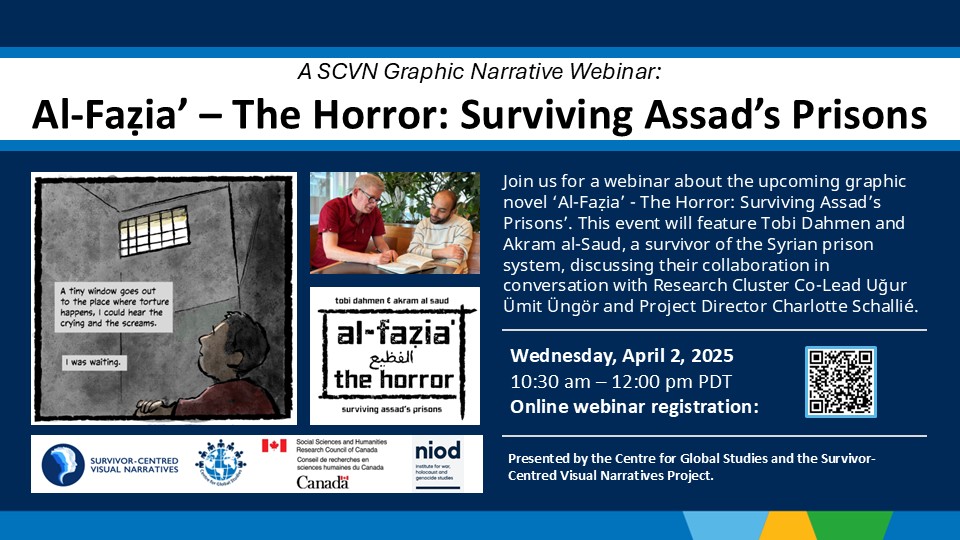
In February 2023, graphic artist Tobi Dahmen was introduced to Syrian survivor Akram al-Saud by Dr. Uğur Ümit Üngör, the Research Cluster Co-Lead on the SSHRC Partnership Grant Survivor-Centred Visual Narratives Project. Based in The Netherlands, Tobi and Akram have been collaborating locally over two years in a series of interviews to share Akram’s unique story of surviving a series of Syrian prisons.
Since the fall of the Bashar al-Assad regime on December 8, 2024, Syria has opened up to the world again, and the international community has begun to learn more about the oppression and injustices of the regime. This webinar will feature Tobi Dahmen and Akram al-Saud discussing their collaboration, in conversation with Dr. Üngör and Project Director Dr. Charlotte Schallié. They will explore the difficulties of representing imprisonment and torture, and how graphic narratives can help survivors of mass violence find a voice.
Tobi Dahmen Tobi Dahmen, born in 1971 in Frankfurt/Main, is a German illustrator and comic artist. He has published several comic books, including Fahrradmod (2015). Dahmen has received numerous awards for his work and is currently working on a new graphic novel with a Syrian survivor as part of the Survivor-Centred Visual Narratives Project. The graphic novel Columbusstrasse: Eine Familiengeschichte 1935-1945, was released on May 29, 2024, and is available to order online here.
Akram al-Saud Akram al-Saud is from Deir Ez-Zor and now lives in the Netherlands. He has been arrested four times before fleeing from Syria. His longest detention began on March 28th, 2010—before the revolution—and lasted for nine months. At the time, he was a student at the Faculty of Architecture in Aleppo, and was arrested by the intelligence services of the air force. After the 2011 revolution, he was arrested three more times. Dr. Uğur Ümit Üngör Uğur Ümit Üngör (PhD Amsterdam, 2009) is Professor of Holocaust and Genocide Studies at the University of Amsterdam and the NIOD Institute for War, Holocaust, and Genocide Studies. His main areas of interest are genocide and mass violence, with a particular focus on the modern and contemporary Middle East. He is an editor of the Journal of Perpetrator Research, and coordinator of the Syria Oral History Project. His publications include Confiscation and Destruction: The Young Turk Seizure of Armenian Property (Continuum, 2011), and the award-winning The Making of Modern Turkey: Nation and State in Eastern Anatolia, 1913-1950 (Oxford University Press, 2011). From 2014 to 2019, Üngör coordinated a Dutch Research Council-funded research project on paramilitarism, which led to the monograph Paramilitarism: Mass Violence in the Shadow of the State (Oxford University Press, 2020). He is currently working on its follow-up monograph Assad’s Militias and Mass Violence in Syria (forthcoming, 2025). He is also co-author of Syrian Gulag: Assad’s Prison System, 1970-2020 (I.B.Tauris, 2023).
Dr. Charlotte Schallié Charlotte Schallié is a Professor of Germanic Studies in the School of Languages, Linguistics and Culture at the University of Victoria (Canada). Her teaching and research interests include memory studies, visual culture studies & graphic narratives, teaching and learning about the Holocaust, genocide and human rights education, community-engaged participatory research, care ethics, and arts-based action research. Together with Dr. Andrea Webb (UBC), she is the Project Director of a 7-year SSHRC-funded Partnership Grant entitled Visual Storytelling and Graphic Art in Genocide and Human Rights Education.
Thank you to our project partner, the Centre for Global Studies at the University of Victoria, for hosting this webinar. A special thanks to Jodie Walsh, Operations Director and Research Coordinator, and Lia Lancaster, Events and Administration Assistant, for their invaluable support.