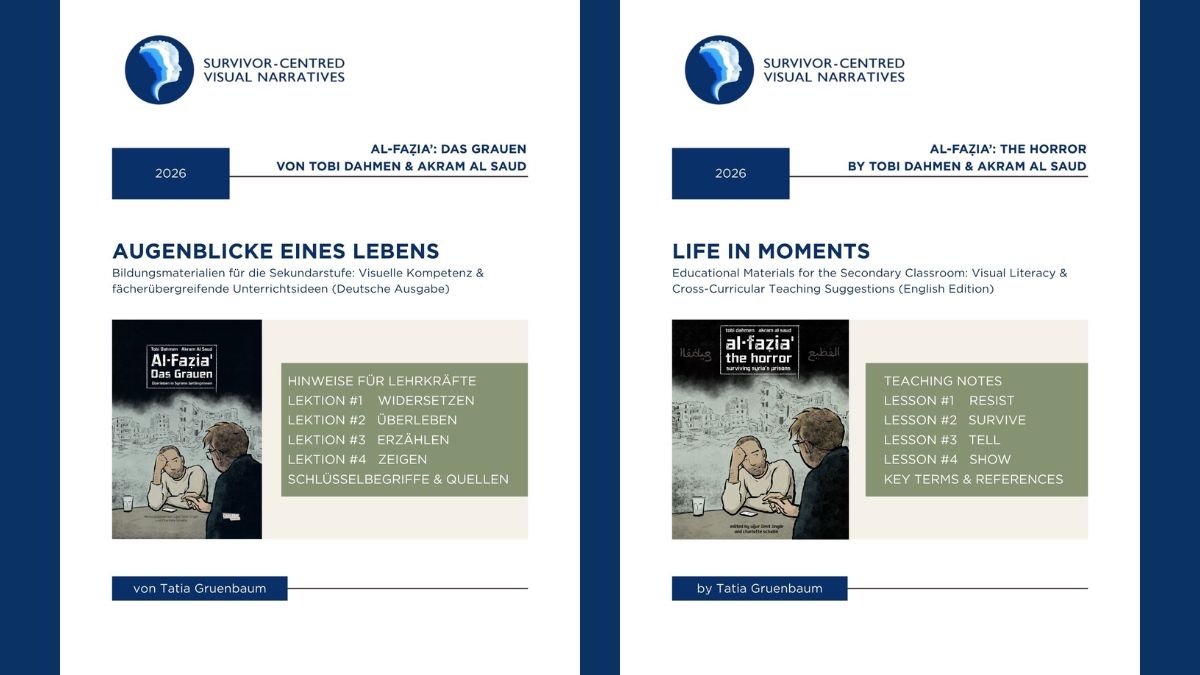
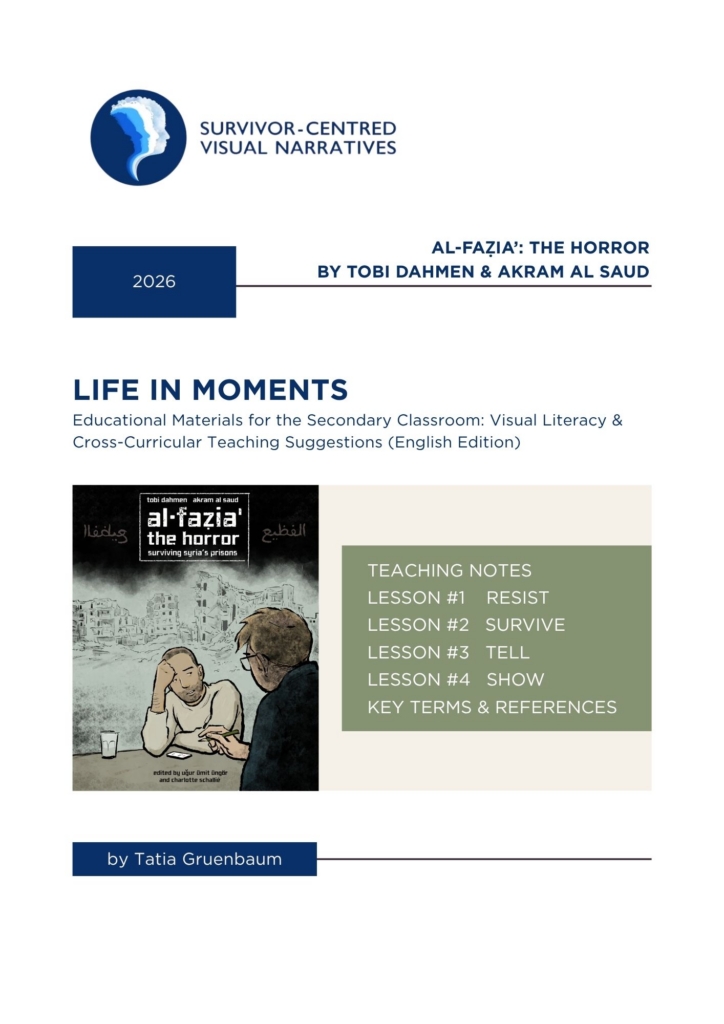
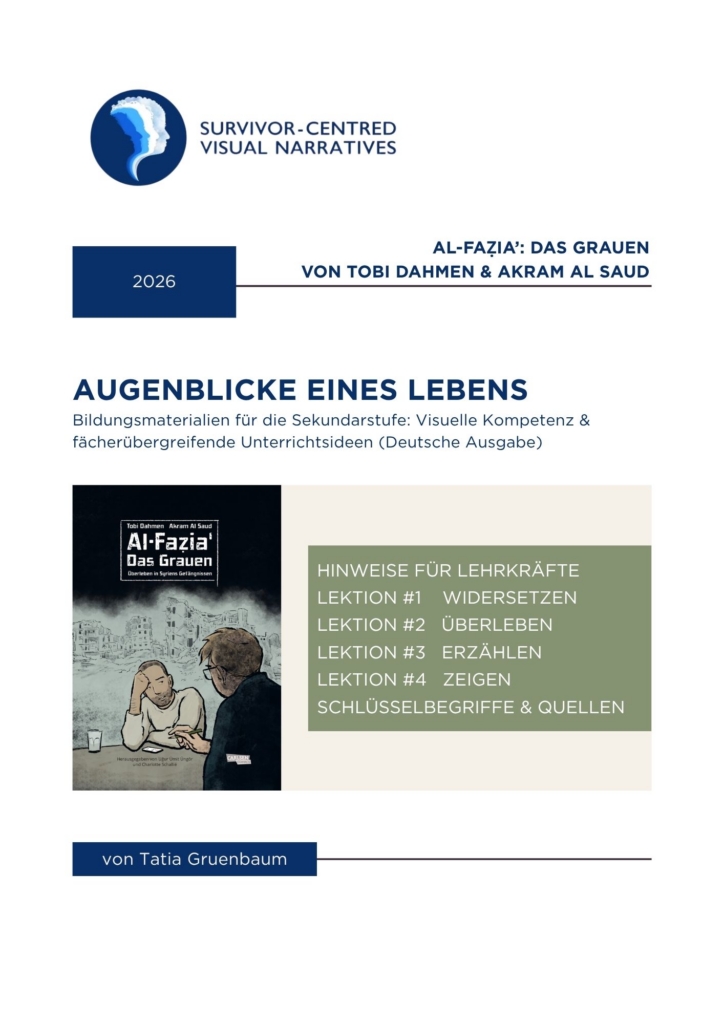
SCVN’s third graphic novel, Al-Faẓia’ الفظیع – The Horror: Surviving Syria’s Prisons, was published in German by Carlsen Verlag on May 26, 2026. Created through a collaboration between artist Tobi Dahmen and survivor Akram Al Saud, the book draws on extensive interviews and personal encounters to share Akram’s story. Arrested at the age nineteen while studying architecture at the University of Aleppo, and Akram endured the first of four detentions in Syrian prisons before eventually fleeing to Europe in 2016.
To support classroom engagement with this powerful work, SCVN is pleased to announce teaching resources for the German edition, developed by Dr Tatia Grünbaum, whose research focuses on using visual literature to advance Global Citizenship Education in schools.
The resources, titled ‘Life in Moments’, were developed for upper-secondary school students and designed to support teachers seeking materials to challenge their classes to think critically about violent authoritarian rule, survival, and resistance through the lens of Akram Al Saud’s experiences in Syria. The materials include four lessons with key terms and a reference list, and provide visual literacy and cross-curricular teaching suggestions.
Visit our Educational Resources page to download a free PDF copy of each, or click the German and English book covers below to view the online flipbooks:
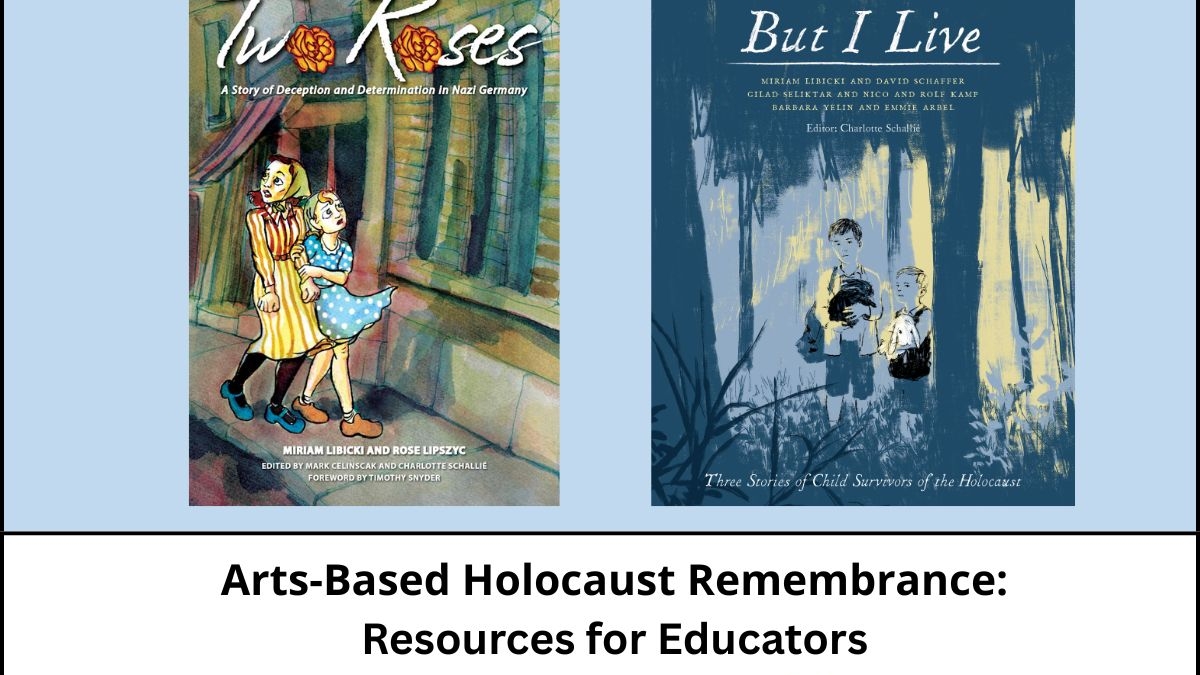
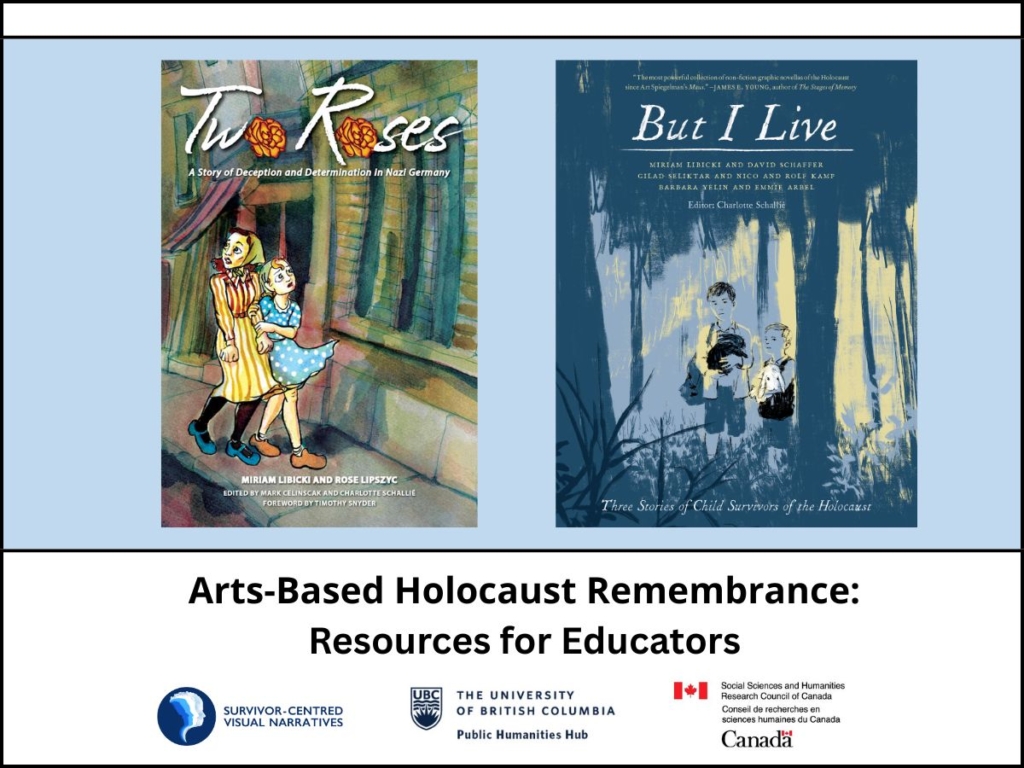
We are pleased to announce the release of ‘Arts-Based Holocaust Remembrance: Resources for Educators’, an open access educational resource based on our project-supported graphic narratives Two Roses and A Kind of Resistance. The resource was created by Dr. Andrea Webb, Alyssa Wood, and Cass Minkus. It draws on current classroom practices, pedagogy, and curriculum to give teachers the tools to bring Holocaust education into the classroom in an engaging, comprehensive, and respectful way.
Both Two Roses and A Kind of Resistance were created by artist Miriam Libicki and feature child survivors of the Holocaust. The graphic novel Two Roses was edited by Drs. Charlotte Schallié and Mark Celinscak, and tells the story of survivor Rose Lipszyc. The graphic narrative, A Kind of Resistance, is based on the life of David Schaffer and is part of the anthology But I Live: Three Stories of Child Survivors of the Holocaust edited by Dr. Schallié.
The resource will also be available in French, translated by SCVN research assistants Alemna Alurugo and Jacqueline Rutherford.
Teaching resources for But I Live are available in English and French.
Survivor-Centred Visual Narratives (SCVN) is excited to announce the publication of two articles focusing on methodology by project director Dr. Charlotte Schallié. In these articles, Dr. Schallié articulates the approach that lies at the heart of the SCVN project, underscoring relationality, participation, and ethics of care as key elements in the collaborative process:
The articles are featured on our newly launched Scholarly Resources page, where readers can stay up-to-date on new publications and download PDF versions when available. An introductory text sampled from each article are listed below:
Being in Relationship – A Case Study for Pursuing Creative Practice as Research with Holocaust Survivors
This article presents a case study for pursuing a relational approach to testimony gathering processes with Holocaust survivors. Drawing on insights gained from our multi-year sustained creative collaboration with four Holocaust child survivors and three comics artists, Dr. Schallié highlights how arts-based co-creation foregrounds critical aspects of life writing such as nonverbal communication cues, the lived experience of place, the shifting positionality of the narrator, competing memories, or embodied memories that cannot be expressed in words alone. In traditional eyewitness testimonies, such complex nonverbal representations of memory create significant obstacles resulting in partially rendered or incomplete oral history documents.
Slowing Down and Taking Time: A Proposal for Integrating Care Ethics into Visual Storytelling Research and Practice
This forum contribution discusses an arts-based research project that reconfigures survivor testimony within a relational ethics framework. Highlighting the creative partnership between Utrecht-based comics artist Tobi Dahmen and his research collaborator Akram, a young man who survived the Syrian prison system, the Dr. Schallié proposes to employ comic drawing as an inquiry-based tool and caring practice during collaborative life writing sessions. A commitment to relational storytelling—honouring relationships that are based on mutual trust and shared authority—also fosters a practice of mindful, reflective slow scholarship. Taking time is thus a critical pillar of collaborative storytelling work for the survivors and the artists, as well as members on the research team, as they mutually negotiate the flow, pace, and rhythm of co-narration.
Schallié, Charlotte. “Relational Memory, Shared Authority and Reciprocity in the Making of Barbara Yelin’s Emmie Arbel. The Colour of Memory.” Multidirektionales Erinnern im Comic. Paderborn: Brill/Fink, 2025.
Timm, Stephan. “Comic-Biografie einer KZ-Überlebenden.” Book review of ‘Emmie Arbel. Die Farbe der Erinnerung‘. Rolling Stone Magazine Germany, Feb. 2024.
Jesee, Erin and Fransiska Louwagie. “The Survivor-Centred Visual Narratives Project: Insights from the Rwanda Research Cluster’s Relational Oral History Methodology.” Whose Voices: 2025 Annual Conference of the Oral History Society, University of Strathclyde, 6 June 2025.
How Can Visual Narratives Disrupt Traditional Conceptions of Testimony?
From January to November 2024, the University of British Columbia’s Public Humanities Hub co-hosted the Art and Testimony webinar series with the University of Victoria’s Survivor-Centered Visual Narratives project. The series brought together researchers, artists, historians, non-profit directors and other professionals to discuss how different mediums of artistic production can function as a form of testimony.
Building on the conversations, practices, and resources shared during the six webinars, SCVN is excited to announce the Art and Testimony Toolkit based on the webinar series. The toolkit includes recordings and transcripts of each of the six webinars categorized by three thematic clusters: 1) Performance as Testimony; 2) Videotaped Interviews, Graphic Novels and Comics as Testimony; and 3) Teaching through Visual Testimony. The toolkit also includes notes, commentary, illustrations, references and quotes that complement each webinar.
The toolkit is available on the UBC Public Humanities Hub website here.
Art and Testimony Webinar Series
The webinar series explored a wide range of artistic forms from live performance to graphic novels to newspaper comics, the series sought to highlight the power of testimony to tell stories in a unique way. For instance, Dr. Henry “Hank” Greenspan in the webinar ‘Listening, Telling, Showing (and Back)’ underlines how he sought to resist the ‘conventional’ testimonial approach by engaging in dialogue rather than extraction. By returning to the same survivors over months and even years, Hank sought to reconnect and develop the survivors’ stories as they pieced together parts of their memories, often evolving their own narratives.
In a similar vein, several webinars touched on how drawn narratives leave space for imagination and creation, both for those giving the testimonies and the researchers working with them. Barbara Yelin’s collaboration with Holocaust survivor Emmie Arbel demonstrates how drawn narratives function as a tool for engaging with memories that defy easy articulation. Developed initially from just seven pages of notes, their book, Emmie Arbel: Die Farbe der Erinnerung, grew out of what they called “puzzle memory work,” where they sought to hold space for the linearity of memory.
The webinar series emphasized how visual narratives have the potential to disrupt traditional testimony collection practices, which often favour language over image. In response, the toolkit builds upon our expert speakers’ knowledge and resources, and suggests various visual mediums and approaches to arts-based research methodologies for understanding survivor experiences.
SCVN would like to extend a warm thank you to all those who contributed to developing the toolkit. Special thanks to the author, Serikbolsyn Tastanbek; advisors, Heather Joan Tam, Jennifer Sauter, Charlotte Schallié, and Andrea Webb; technical support, Stanley Chia; illustrator, Raey Costain; and transcribers, Lucie Kotesovska, Kate Kristianson, Henri Jefferis, and Claire Fenton. The toolkit would have never come together without the hard work and dedication of the team.
To view the Art and Testimony Webinar Series, please click here.
We are delighted to announce that Dr. Andrea Webb (University of British Columbia), SCVN Project Co-director, has won an Honourable Mention at the 2025 Open Scholarship Awards for creating the But I Live Educators’ Resource.
Recognized by the Canadian Social Knowledge Institute and its partners, including the Implementing New Knowledge Environments project, Open Scholarship Award recipients demonstrate exemplary open scholarship via research, projects, or initiatives. Open scholarship incorporates open access, open data, open education, and other related movements that have the potential to make scholarly work more efficient, more accessible, and more usable by those within and beyond the academy. By engaging with open practices for academic work, open scholarship shares that work more broadly and more publicly.
In collaboration with UBC’s Bachelor of Education Program teacher candidates, Dr. Andrea Webb developed the online educational resources to accompany the graphic novel But I Live: Three Stories of Child Survivors of the Holocaust.
This work was completed as part of their Community Field Experience (CFE) and was created by educators for educators. It draws on current classroom practices, pedagogy, and curriculum, and is designed for flexible implementation by teachers in a variety of classrooms.
For the complete list of 2025 Open Scholarship Awards recipients and honourable mentions, please click here.
On October 2 & 3, SCVN Co-Director Dr. Charlotte Schallié visited a ninth/tenth creative writing class at Victoria High School (Vic High). The students, guided by their creative writing teacher, Georgina Hope, participated in an interactive lesson that brought the testimonies from ‘But I Live: Three Stories of Child Survivors of the Holocaust’ into the classroom. Through discussion of the book, Charlotte introduced the students to the ways that graphic novels can support learning by creating an emotional connection to the material.
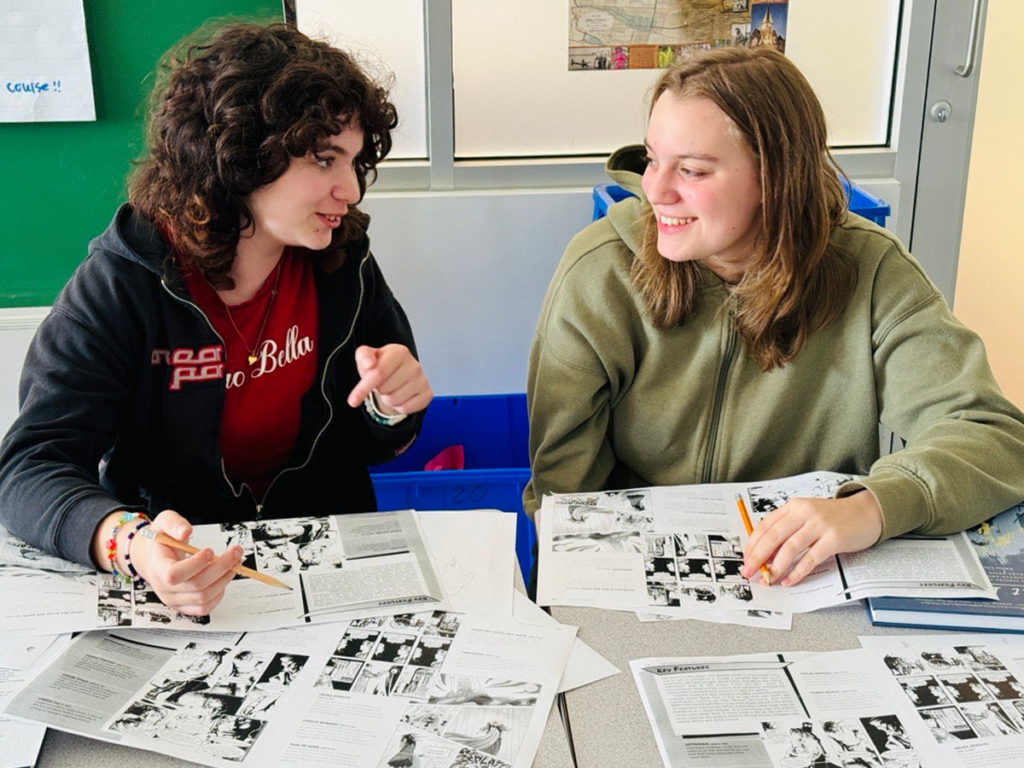
Students at Vic High participating in a graphic narrative exercise. Image credit Charlotte Schallié.
‘But I Live’ brings together three graphic narratives that share the personal life journeys of Holocaust child survivors. These stories provide young readers with accessible and emotional insights into historical events, illuminating what it meant to survive the Holocaust as a child. By connecting with individual experiences, students were encouraged to see beyond facts and figures and understand history on a personal level.
This visit also incorporated a lesson plan from the educator’s resource created by Dr. Andrea Webb. This resource package is designed to support teachers in engaging a difficult topic such as the Holocaust, using graphic narratives as an entry point to explore context, events, and the consequences of historical trauma. This approach doesn’t simply inform—it empowers students and teachers to reflect on history and develop critical skills, such as empathy and historical awareness, which remain relevant to current societal challenges.
Some of the students later shared what they learned in their own words.
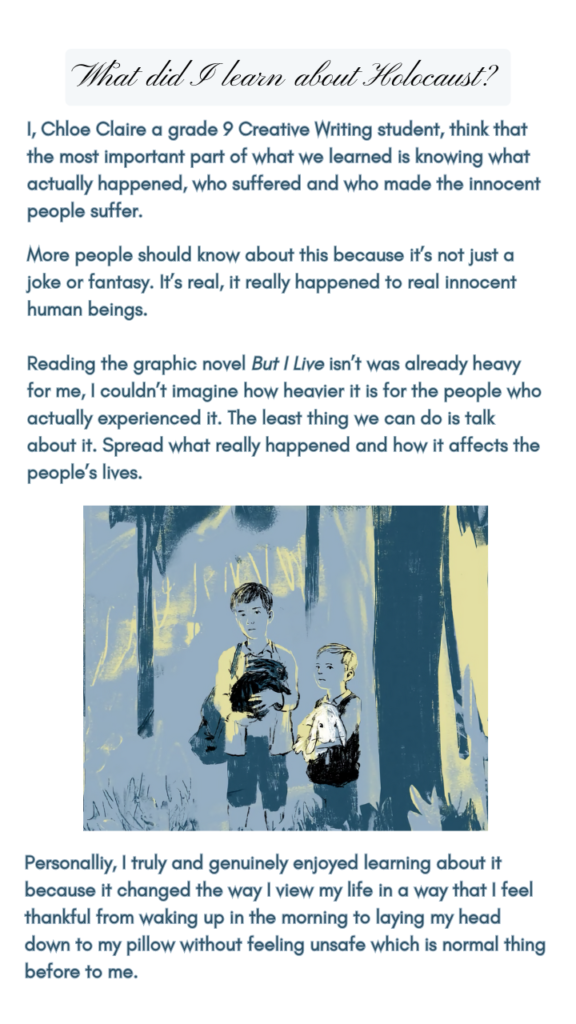
I think reading the book opened my eyes and I really felt the emotion of the book. The book was definitely a great read and I’m sure it broadened my understanding. The drawings were so well done, and the mute colours really make you feel the emotion in the book. I feel what Charlotte was talking about with the graphic novels is true. We definitely should be reading more graphic novels in high schools, because they’re easy to read, but get the point across right. I don’t feel graphic novels should be seen as childish most of the time because they carry deeper stories with good morals.
A person named Charlotte Schallié came to my class, she is a professor at UVic, and an author. She talked about how graphic novels are just as valuable as normal books. I would agree with this, I think that the pictures help portray a better story than words do. She also showed us some stuff on the holocaust. It was a graphic novel, and more specifically the process of making it. They talked to multiple holocaust survivors and had them tell their stories, in their own words and only what they wanted to say. I thought that was cool, because it seems more respectful to the holocaust survivor.
I have learned that the Holocaust has killed 6 million Jews. The injustices before, during, and after the Holocaust are innumerable. It’s sad to see such hate grow for so long and so intensely. I’ve had fun with the graphic novel project, and I enjoyed the Survivors theatre production. It’s awesome to see the Holocaust explained in a compelling way, in a way that encourages readers and viewers to be in the experiences of those we read about or watch.
I have never learned about the Holocaust until this project. I found it fascinating but also so emotional to learn about. I can’t imagine what it would have been like in that time. When Charlotte Schallié came into the classroom and told us more facts and stories about the Holocaust it was fascinating. My favourite part about this project though, was the play. I enjoyed watching the good acting, and it was a more fun way to learn about this devastating event in history. People need to know. I think that this should be learned about in class more and it was a good way to learn about it through graphic novels. The Anne Frank graphic novel, I found personally, is really hard to read, but it was good all the same.
The students participated actively, exploring graphic narratives as a storytelling medium and recognizing the power of personal narrative within historical contexts. Charlotte’s visit demonstrated how art and personal testimony can bridge generations, creating a meaningful connection to the past. Thank you to Georgina and class for your engagement with ‘But I Live.’ Experiences such as this class visit emphasize the potential wide-ranging impact of the graphic novels created by the SCVN project.
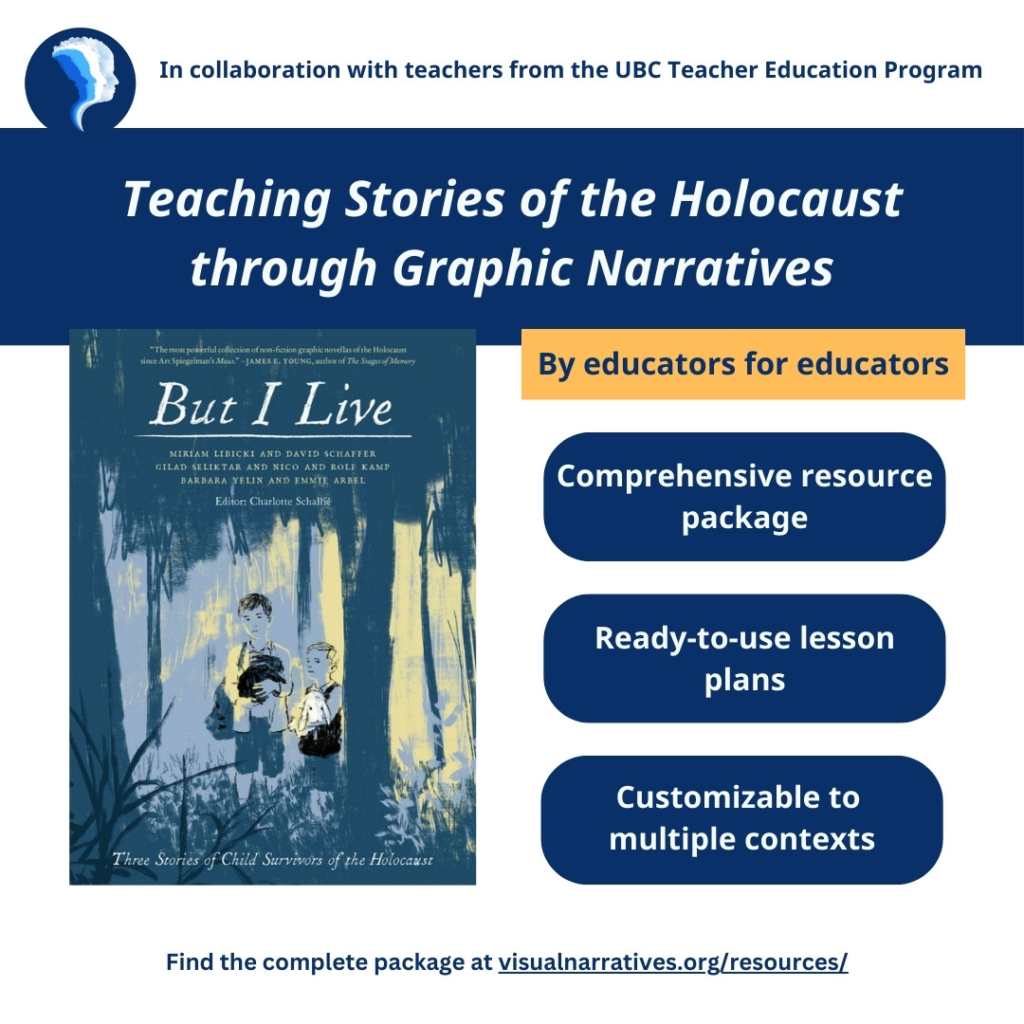
Teaching the Holocaust and other mass atrocities is one of the most important, yet challenging, responsibilities educators face. The weight of history, the complexity of events, and the emotional intensity surrounding the topic often leave teachers unsure of how best to approach it with their students. To support this challenge, Dr. Andrea Webb, co-director of the SCVN project, has collaborated with teachers from the UBC Teacher Education Program to develop a comprehensive resource package for Holocaust education.
This package is designed to empower educators with the confidence and knowledge they need to bring Holocaust education into their classrooms effectively. It centers around the publication ‘But I Live: Three Stories of Child Survivors of the Holocaust,’ a graphic narrative that recounts the real-life experiences of Holocaust child survivors. Through the medium of graphic storytelling, these resources make the historical trauma of the Holocaust accessible to students of various ages, encouraging empathy and deeper understanding.
Graphic Narratives as Educational Tools
The use of graphic narratives, such as those in ‘But I Live,’ provides a unique opportunity to engage students in Holocaust education. The visual storytelling medium and focus on individual survivors’ lives fosters a connection with the material in a way that text alone often cannot, making complex and emotional histories relatable and understandable. By integrating these narratives into lesson plans, educators can support students in navigating the challenging emotional landscape of Holocaust learning.
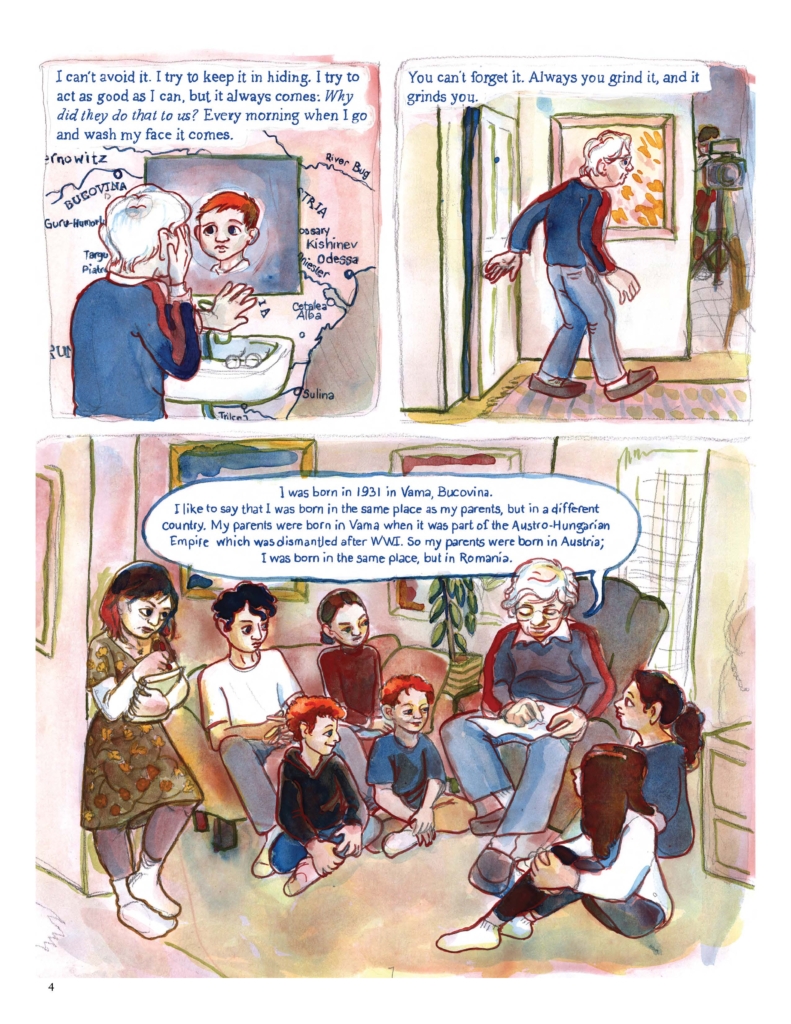
Page from ‘A Kind of Resistance’ by Miriam Libicki with Holocaust child survivor David Schaffer in ‘But I Live.’
Expanding Access with French Translation
To further extend the reach of this resource package, UVic student Jacqueline Rutherford is currently working on translating the materials into French under the supervision of Catherine Léger. This translation will ensure that French-speaking educators and students can also benefit from these tools.
As schools continue to prioritize critical and compassionate education around difficult histories, resources like these provide the support and guidance educators need to approach the subject with care, accuracy, and empathy.
Related News
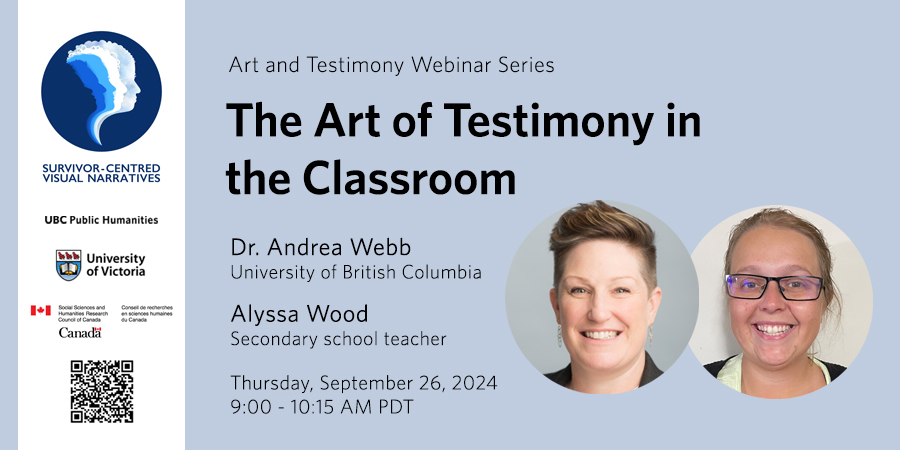
As part of our 2024 Art & Testimony webinar series, Dr. Andrea Webb joined secondary school teacher Alyssa Wood for a conversation about bringing survivor testimony into the classroom through graphic narratives. Watch the complete webinar series on the UBC-V Public Humanities Hub Youtube Channel.
From April to November 2023, the Public Humanities Hub at the University of British Columbia co-hosted with the University of Victoria’s Survivor-Centered Visual Narratives project a webinar series on the Ethics of Trauma-Informed Research. The series of zoom conversations featured researchers, educators, journalists, artists and other professionals focusing on trauma in their work. The toolkit is accessible on the UBC’s Public Humanities Hub website and builds on the experience, practice, and resources shared by these experts during the six webinars of the series.
The speakers’ experiences and perspectives regarding trauma in the aftermath of genocide, mass atrocities, war, and other events vary considerably, but, as this toolkit documents and emphasizes, the central focus remains the same. According to Ying Han and Sydney Lines, the authors of the toolkit, it is “overcoming the ‘trust’ gap between community and researchers, and approaching the research with ethics of care” which represents the main concern shared by all guests in the webinar series regardless the variable terminology they might use when they talk about their research and professional practice. ‘Survivor-centered approach’, ‘people-centered approach’, ‘grassroots approach’, ‘participatory research’, and ‘co-produced research’ are used in the toolkit to refer to the central concern and methodology.
The toolkit contains the recordings of the original webinars as well as the transcript of each of the sessions and is organized into four thematic clusters: Trauma-Informed Research as Witnessing, Trauma-Informed Research as Pedagogy, Trauma-Informed Methods of Public Scholarship, and Trauma-Informed Research and Arts-based Methods. Each of these clusters introduces and explores a particular method of trauma-informed research discussed in the webinar conversations via brief summaries of the key points and the experts’ own words. Further, each cluster points to resources available at the UBC and beyond that might be of help to those who wish to explore and apply the given methodology in their own trauma-informed research.
Infographics by Raey Costain.
Rather than “mapping out trauma on a diagnostic level”, the main focus and motivation of this toolkit is documenting the variety of experience-based research approaches to trauma. This emphasis allows its readers to consider how this type of research can help open up pathways to post-traumatic growth and resilience, and it also draws attention to the fact that this type of research often causes emotional or psychological discomfort or distress for subjects, participants, collaborators, and researchers alike. As the authors emphasize, “it is incumbent upon researchers and practitioners to build in ways to cultivate an awareness of the possible trauma responses that participants may experience, anticipate the risks of re-traumatization, and to learn how to hold space for recovery and care for all parties involved”. The Trauma-Informed Research Toolkit is exactly the place where to start when looking for possible guidance and inspiration.