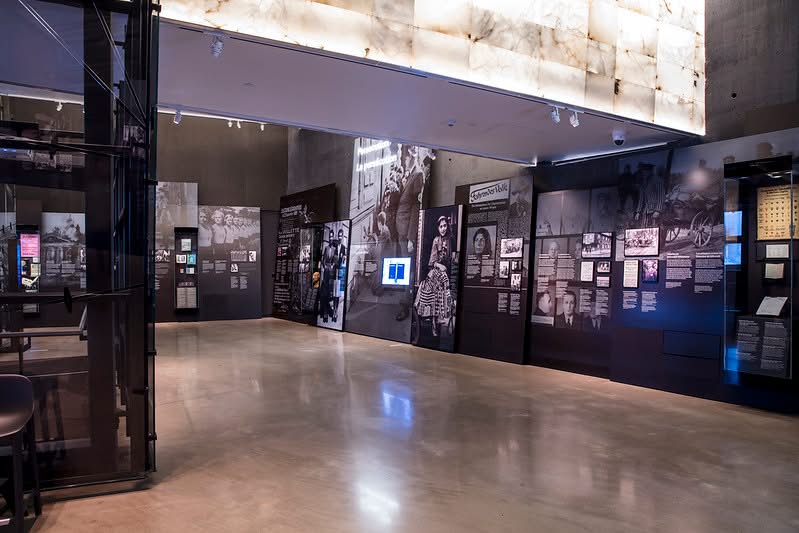
Gallery of ‘Examining the Holocaust’ exhibit at the Canadian Museum for Human Rights. Images courtesy of the Canadian Museum for Human Rights.
In an upcoming webinar on January 29, Co-Director Dr. Andrea Webb will be discussing ways that educators can bring Holocaust education into the classroom with respect and consideration. She is joined by Ashley Groff, Interpretive Program Developer from the Canadian Museum for Human Rights (CMHR), and institutional host of the webinar in collaboration with the Survivor‐Centred Visual Narratives Project. Webinar participants will be provided with resources that support Holocaust education, teaching about genocides, and teaching about human rights. They will also learn where to seek support and leave with tools to help them teach students Holocaust‐related content according to their provincial or territorial mandate.
“Supporting Educators in Holocaust Education” Wednesday, January 29, 2025 12:00 – 1:00 pm PST / 2:00 – 3:00 pm CST
In the SCVN webinar series, Art and Testimony, Ph.D. students Cal Smith and Raey Costain presented their research on how visual methods such as comic drawing have a unique capacity to explore and document human stories in the past and present. The webinar, The Art of Comics-Engaged Research, was moderated by Dr. Mary Chapman and involved active engagement by the attendees. The session began with a drawing exercise, lead by Raey, where they asked participants to doodle material related to what’s in front of them, what’s behind them, and where they’re sitting. The activity was designed to situate speakers and participants. Instructions for hosting or participating in the activity can be found below.
The webinar continued with Raey presenting on drawing as an artistic practice, both related to their personal drawings and the act of researching drawings done by others. After that, Cal shared part of his potential Ph.D. research on queer comics in Canada in the 1980s and 90s. He focused on the practice of research that has defined his early relationship with his Ph.D. Both speakers were intensely interested in what stories a doodle or a sketch can illuminate and the power of paying attention to the infinitesimally small details in such unassuming graphic narratives.
Raey’s activity is designed to situate speakers and participants. This activity is for everyone, no matter their drawing “talent” or experience! We would recommend underlining the sensations that go into drawing. Ask, “What does it feel like to pick up a pen and draw? What goes into finding inspiration? Where does your mind wander?” Mention that it’s ok to just breadth and reflect before putting the pen to the page.
Ask participants to grab something to draw with.
Draw three squares that are roughly the same size on a piece of paper. They can be vertical or horizontal.
In the first square, ask everyone to draw something ahead of you, i.e. something you can see in your environment. Maybe it’s the computer monitor or a coffee cup!
In the second square, ask everyone to draw something behind them. This can be physically behind them in their environment, or it can be understood more metaphorically as something behind them; something you’ve moved through, or someone, say, standing behind you.
In the final square, ask everyone to draw something related to where their feet are. This can also be taken literally or metaphorically. Maybe consider the territory you’re physically on, or, where your standing in life.
In a large group, the activity leader might say a few words reflecting on the activity. In a smaller group, you might invite others to reflect.
Finally, you may choose to invite people to share their work if they’re comfortable. There’s no pressure to do this, as the activity is principally a moment of personal reflection.
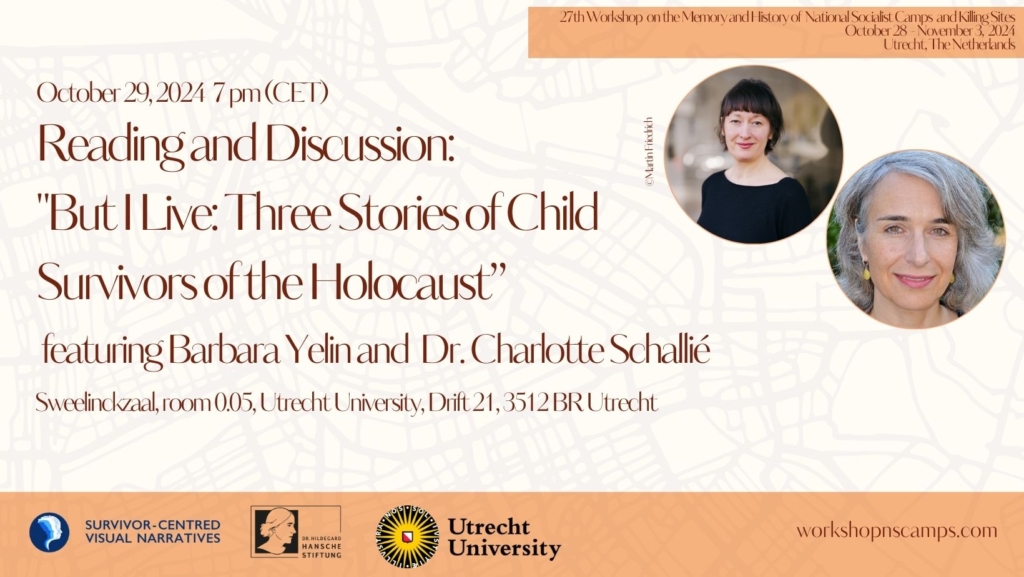
On October 29, graphic artist Barbara Yelin and SCVN Co-Director Dr. Charlotte Schallié will be featured in a public online webinar as part of the 27th Workshop on National Socialist Camps and Killing Sites. Barbara and Charlotte will be reading from the publication ‘But I Live: Three Stories of Child Survivors of the Holocaust.’ This webinar and the other workshop activities are geared towards young scholars who are interested in working with stories and histories of camps and killing sites associated with genocide and mass atrocity worldwide.
In addition to reading from ‘But I Live,’ Charlotte and Barbara will engage in a dialogue about trauma-informed storytelling and the compelling power of drawing as a language to communicate about stories of memory, trauma, and resilience. The visual testimony of Holocaust child survivor Emmie Arbel, collected in ‘But I Live’ by Barbara Yelin is one example of how visual arts can be engaged in Holocaust education and communication.
Event Details:
Tuesday, October 29, 2024
5:00 pm CET /11:00 am PDT
Sweelinckzaal, Room 0.05, Utrecht University, Drift 21, 3512 BR Utrecht or online via zoom
From April to November 2023, the Public Humanities Hub at the University of British Columbia co-hosted with the University of Victoria’s Survivor-Centered Visual Narratives project a webinar series on the Ethics of Trauma-Informed Research. The series of zoom conversations featured researchers, educators, journalists, artists and other professionals focusing on trauma in their work. The toolkit is accessible on the UBC’s Public Humanities Hub website and builds on the experience, practice, and resources shared by these experts during the six webinars of the series.
The speakers’ experiences and perspectives regarding trauma in the aftermath of genocide, mass atrocities, war, and other events vary considerably, but, as this toolkit documents and emphasizes, the central focus remains the same. According to Ying Han and Sydney Lines, the authors of the toolkit, it is “overcoming the ‘trust’ gap between community and researchers, and approaching the research with ethics of care” which represents the main concern shared by all guests in the webinar series regardless the variable terminology they might use when they talk about their research and professional practice. ‘Survivor-centered approach’, ‘people-centered approach’, ‘grassroots approach’, ‘participatory research’, and ‘co-produced research’ are used in the toolkit to refer to the central concern and methodology.
The toolkit contains the recordings of the original webinars as well as the transcript of each of the sessions and is organized into four thematic clusters: Trauma-Informed Research as Witnessing, Trauma-Informed Research as Pedagogy, Trauma-Informed Methods of Public Scholarship, and Trauma-Informed Research and Arts-based Methods. Each of these clusters introduces and explores a particular method of trauma-informed research discussed in the webinar conversations via brief summaries of the key points and the experts’ own words. Further, each cluster points to resources available at the UBC and beyond that might be of help to those who wish to explore and apply the given methodology in their own trauma-informed research.
Infographics by Raey Costain.
Rather than “mapping out trauma on a diagnostic level”, the main focus and motivation of this toolkit is documenting the variety of experience-based research approaches to trauma. This emphasis allows its readers to consider how this type of research can help open up pathways to post-traumatic growth and resilience, and it also draws attention to the fact that this type of research often causes emotional or psychological discomfort or distress for subjects, participants, collaborators, and researchers alike. As the authors emphasize, “it is incumbent upon researchers and practitioners to build in ways to cultivate an awareness of the possible trauma responses that participants may experience, anticipate the risks of re-traumatization, and to learn how to hold space for recovery and care for all parties involved”. The Trauma-Informed Research Toolkit is exactly the place where to start when looking for possible guidance and inspiration.
On March 20, 2024 join SCVN co-director Charlotte Schallié and illustrator Barbara Yelin for the next instalment of the Art & Testimony webinar series.
In this webinar session, Barbara Yelin will discuss her collaborative memory work with Holocaust child survivor Emmie Arbel for ‘But I Live’ (2022) and ‘Emmie Arbel. The Colour of Memory’ (2023). In conversation with Charlotte Schallié, Barbara Yelin will reflect on how drawing can be used as a language to gather memories in trauma-informed storytelling. Yelin and Schallié will explore how the relationships they have formed with Emmie and with the research team guide the work and yield many insights, including the importance of emotion and subjectivity in witnessing survivor-centred testimony sharing. Yelin will begin with a reading from select pages of ‘The Colour of Memory’, grounding the conversation in Emmie’s story and the visual arts-based methodology of the Survivor-Centred Visual Narratives (SCVN) project.
Hosted by Dr. Andrea Webb, Associate Professor of Teaching, UBC Curriculum & Pedagogy.
Wednesday, March 20, 2024 1:00-2:30 PM Pacific Time Online via Zoom
We are pleased to announce the launch of a new webinar series on the theme of Art and Testimony. In collaboration with UBC-V Public Humanities Hub this series has been developed as a critical exploration of contemporary arts-based research. The first webinar session with Dr Hank Greenspan will take place on January 25, 2024. Find the registration link below.*
This webinar series is an opportunity to engage with scholars of many backgrounds as they reflect on arts-based methods and relational processes of working with testimony.
In this first session, Dr Greenspan will discuss how his work as a theatre artist is interconnected with his decades-long research and teaching as a Holocaust scholar.
“Listening, Telling, Showing (and back): The Practice of a Holocaust scholar-teacher-playwright-actor”
Thursday, January 25, 2024 9:00-10:30 AM Pacific Time Online via Zoom
*Registration will not be confirmed via email. Simply fill out and submit the form to secure a spot. Email reminders are sent out ahead of the scheduled session.
Interested in our past webinars? Find the Ethics of Trauma-Informed Research webinar recordings here.