
Teaching workshop at the University of Fribourg, Switzerland – Nov 18, 2026
On November 18, Yugoslav Wars Research Cluster Co-lead Dr. Franziska Zaugg is hosting a 1-day workshop titled ‘(Gewalt-)Geschichte als Comic? Neue Möglichkeiten der Vermittlung’ / ‘(Violent) History as a Comic? New Possibilities for Communicating and Teaching’ for teachers at the University of Fribourg. It will provide an overview of graphic novels as part of historical scholarship, share approaches from the SCVN project, and explore how to teach violent histories through graphic novels. Project artist Jared Muralt will share insights on his experiences working with a Roma survivor of the Yugoslav Wars in Ružica’s Last Summer. The workshop also includes Dr. Tatia Gruenbaum, who is developing the teaching resources for our graphic novels published in German.
The workshop outline is translated from German to English below, and registration is available here.
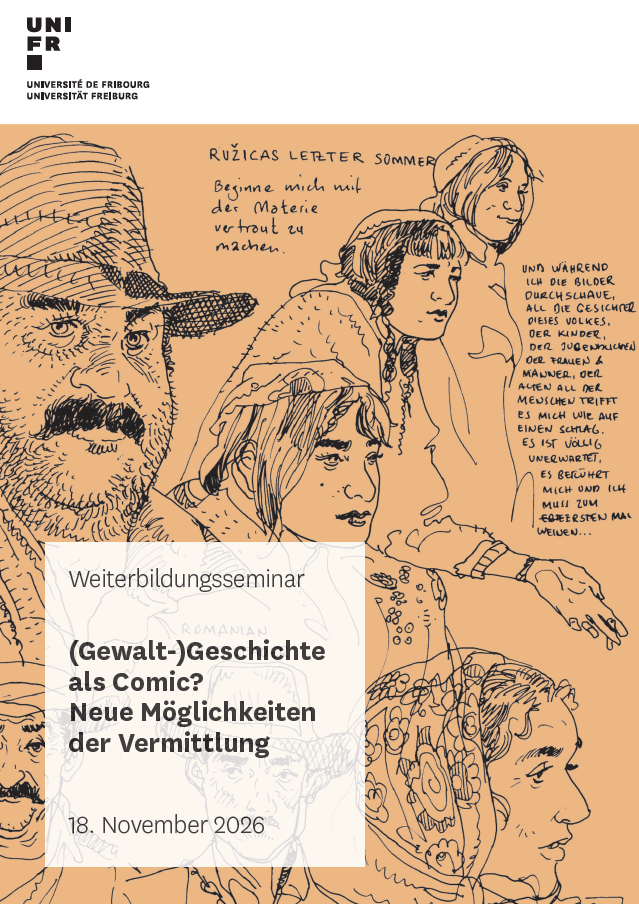
Workshop outline:
Historical scholarship continues to rely primarily on written texts, both in its use of source materials and in its research literature. With regard to epistemic and experienced violence, the question arises as to how this can be adequately discussed with school and university students, as well as among fellow historians. For several years now, graphic novels (also called “comics” in Switzerland) have offered a new approach. Art Spiegelman’s “Maus,” now considered an icon of this genre, made comics a recognized medium for historical engagement with the Holocaust through its visual representation of history. Since then, the number of possible approaches to (violent) history via graphic novels has increased. Examples include Joe Sacco’s works on the besieged Sarajevo of the 1990s and Jacques Tardi’s on the First World War.
In this professional development course, we aim to establish a foundation by providing an overview of graphic novels in historical scholarship in the first part. In this section, we explain important works, their reception history, and how the approach to the comic genre in historical scholarship has gradually changed.
In the second part, we will specifically address our approach in the large-scale project “Survivor-Centred Visual Narratives.” This will demonstrate how this new approach to the history of violence is shaped by the fact that the survivor is not merely an interviewee, but an integral part of the project from beginning to end. At a time when students are increasingly working with the method of oral history and sometimes even conducting interviews themselves, this second part offers insights and demonstrates ways in which respectful engagement with people who have experienced violence can be ensured in projects.
In the third part, we will explore the teaching of (violent) history through graphic novels in the classroom. The following questions will be central: How do artists, eyewitnesses, and historians collaborate? How does the spoken word—the narrated memory, but also the invisible aspects of epistemic violence—become a narrative in images and words? How does historical expertise find its way into this story? How does the artist manage to tell biographical stories in such a way that life memories are made visible and coherently embedded in a broader historical context? And how can history be conveyed through a comic?
In a fourth and final part, graphic novelist Jared Muralt will join us and provide direct insights into his work before we conclude the day with a feedback session.
Target audience: Secondary school teachers, teachers of lower and upper secondary education
Course instructor:
Franziska Anna Zaugg , PhD, Department of Contemporary History, University of Fribourg
Guest speakers:
Tatia Gruenbaum, PhD, Visiting Scientist, Technical University of Braunschweig
Jared Muralt, graphic artist
Date and location:
November 18, 2026, from 9:15 am to 4:45 pm
University of Fribourg’s Continuing Education Center
Register here: https://www.unifr.ch/formcont/de/katalog/4487
Please note this workshop will be conducted in German.