Filming Darkness: Interview with Lidija Zelovic
On February 27, 2026, Survivor-Centred Visual Narrative (SCVN)’s research assistant Ghada Youssef interviewed with Lidija Zelovic, the filmmaker of How to draw darkness? a story from Syria (2026). The film features Akram Al Saud, a survivor of Assad’s regime and Syria’s prison systems, and graphic artist Tobi Dahmen, who engaged in a series of interviews to create the graphic novel Al Faẓia’: The Horror – Surviving Syria’s Prisons (Carlsen Verlag, 2026; University of Toronto Press, 2026).
The interview with Lidija explores the significance of making films centred around survivors of war and genocide and the best practices for approaching such projects responsibly. She also reflects on the relationship she developed with Akram and Tobi, as well as how her personal background influences her filmmaking approach.
This interview was adapted for the blog by Sophie Daschuk and Alyssa Logie.
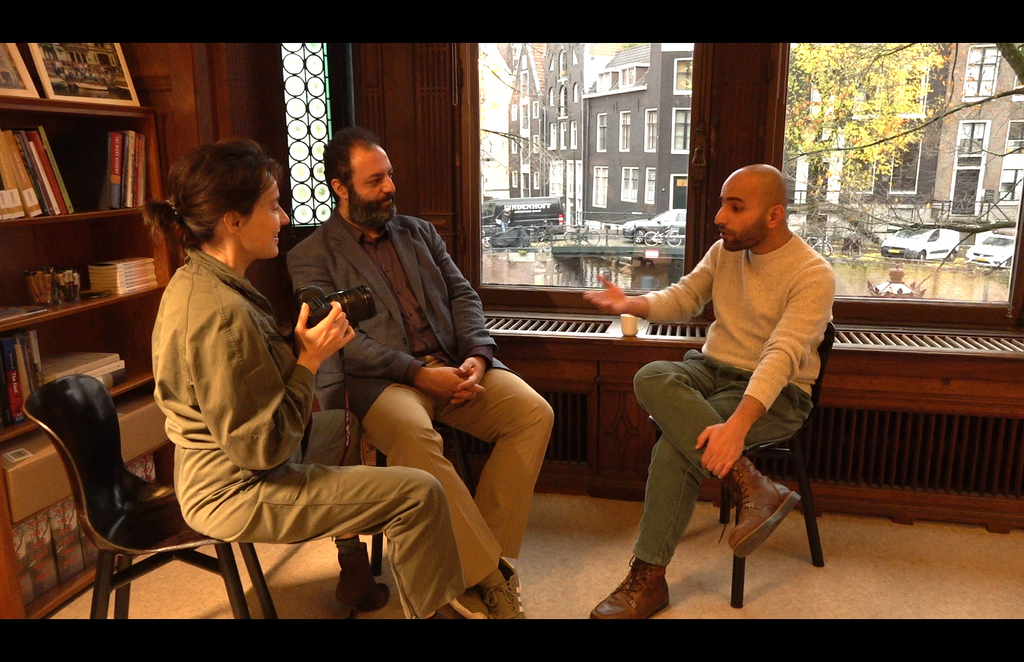
Filmmaker Lidija Zelovic (left), Iraq and Syria Research Cluster Co-Lead Uğur Ümit Üngör (middle) interviewing Akram Al Saud (right) at the NIOD Institute for War, Holocaust and Genocide Studies. Photo credit: Susan Koenen, 2023.
Ghada: Can you tell me about yourself and your professional background? How did you end up as a filmmaker?
Lidija: I am from Yugoslavia and I now live in the Netherlands. I came here as a refugee in the ‘90s. I wanted to study literature back home, but then when I came here, I thought I would not be able to since I could not speak Dutch. Back home I was working as a presenter for TV. I learned how TV worked and thought about studying film. I had so much to tell.
Ghada: Working with personal experiences, especially where trauma and memory might be involved, requires careful navigation and sustained diligence in how these stories are handled, represented, and shared. I would like to start with your relationship with Akram. How did you create a space that was emotionally safe for him to share his story? From trust, to privacy, to boundaries: What can you tell us about this connection?
Lidija: There are not many advantages to having been in a war, but there are some. When you talk to other people who have been in a war, there is some mutual understanding that is immediately made. I have been in prison during my work as a war reporter, and although it was nothing compared to what Akram went through, there was still this immediate understanding between us. When we first started talking, we went on discussing geopolitics in more general terms. But that’s going to stay between us.
I have been in prison during my work as a war reporter, and although it was nothing compared to what Akram went through, there was still this immediate understanding between us.
There was a professor [Dr. Uğur Ümit Üngör] who suggested me to make the film because he knows Akram very well and he wanted him to feel comfortable. If you have not been in a war, you would not dare to ask certain questions, because you do not want to hurt the person you are interviewing. However, someone who has not been in a war will not know what is truly hurting. Some things that we may experience as hurting, others will not experience as hurting. So that was never a problem between us.
Originally, I wanted to film more of the creative process—but I did not want to be in the way of Tobi—he is this great animator, and he needed his focus to be on his relationship with Akram. That was the most important thing. We discussed that carefully.
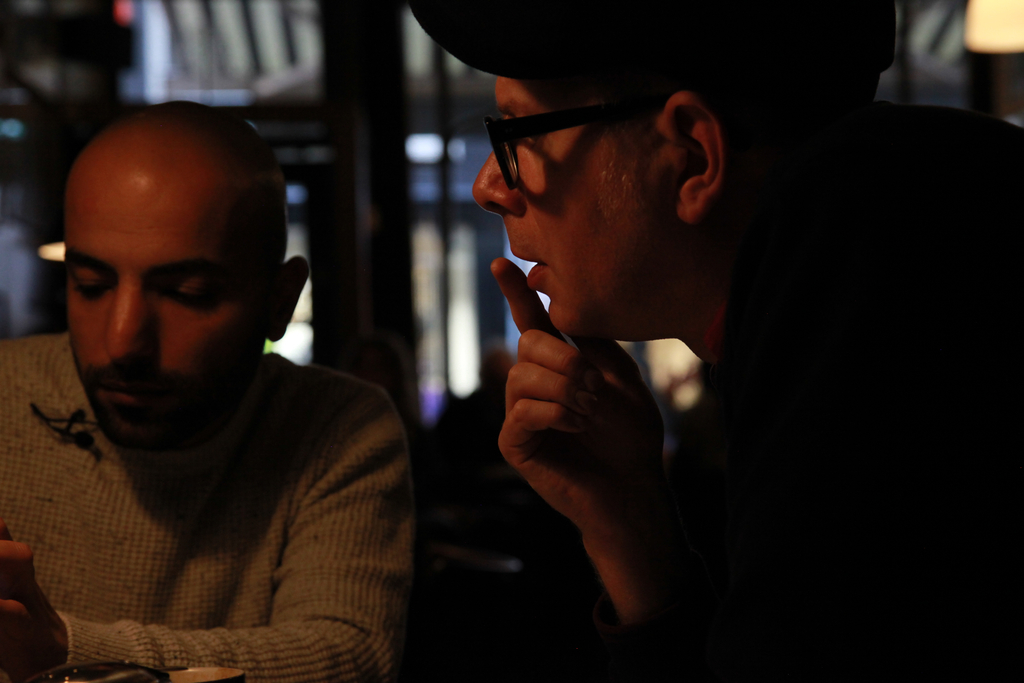
Akram and Tobi in conversation at the cafe. Still from How to draw darkness? a story from Syria (2026).
Ghada: You are not just working with Akram; you are working with the relationship between Akram and Tobi while they are working on this graphic novel. It is like there was this layer of visualization that was already there, and then you came in and introduced another layer. Can you tell me more about how you received the visuals?
Lidija: That was really the most difficult thing, imagining how to do that, because I felt that the relationship between the two of them was really precious and important. And there was the fact that I had my own way of relating to Akram, while Tobi had a completely different way of connecting with him. So, while filming, I wanted to capture the process in which the story developed, but as you do that, your relationship develops as well. Things always work out differently than how you imagine them, and sometimes for the better. I tried to be the fly on the wall for the two of them, but you can never be that with the camera. This idea that a documentary film tells the truth is a joke. As soon as you turn on a camera, it all changes.
I tried to make a kind of meeting in that bar in Amsterdam. And I thought that it was so interesting that they would meet in a place where people are just having coffee and are coming in for fun, while they’re diving into this deep darkness in which Tobi is trying to get to the bottom of. He is such a thorough person, and he is so careful. It was amazing to be a part of that process, to be so close to it and to see how it developed. I have seen it from the first drawings to what it became. Tobi would constantly check in with Akram. And he would realize, “Oh my God, I did not get that completely well,” then he would have to do it all over again. So, there is so much care put into the storytelling. I feel privileged for having seen that.
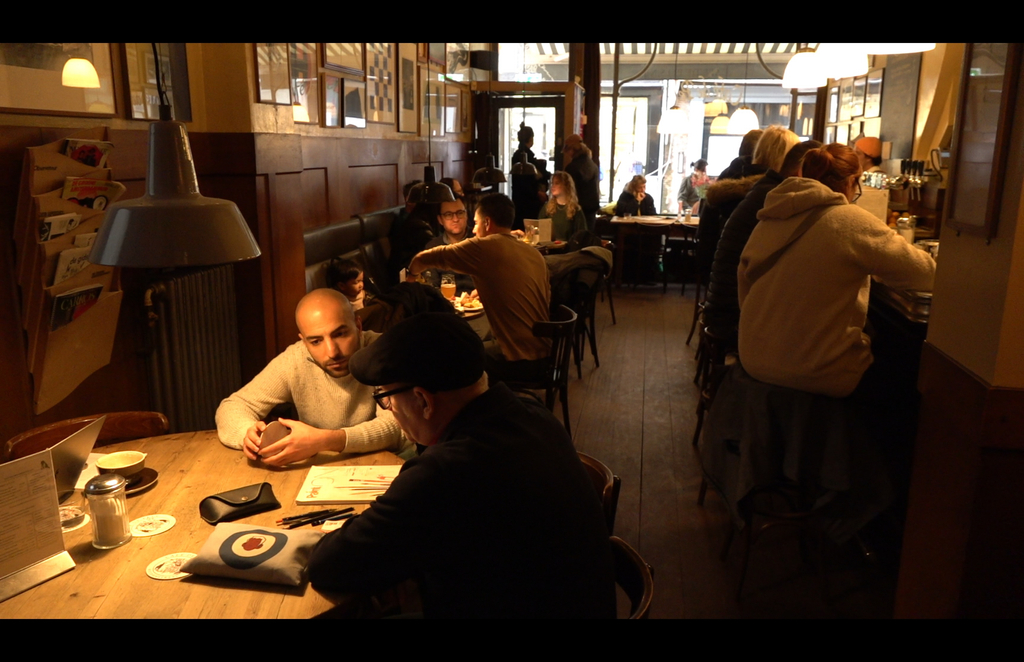
Akram and Tobi in a local coffee shop. Still from How to draw darkness? a story from Syria (2026)
Ghada: It is very interesting what you said about the coffee. Especially when I remember the scene where Akram is telling us about the meaning of the coffee cup back home. It is kind of absurd that he is talking to us about this difficult topic when people are relaxing with a cup of coffee. You never know what is happening around you? You might be in a coffee shop taking it lightly, but then there might be those two people digging into a story that just touches on the darkest parts of humanity.
Lidija: You never know who you might be sitting next to. It is also good not to take people for granted. I am so glad that I had this immediate understanding with Akram, because if you had not been in a war, you would maybe not dare to set such a heavy story inside a random bar in Amsterdam. Since there is this understanding between us, we know this is not hurting.
As an outsider, you might want to think that war is happening in some special, sterile place, but it is here, it is a part of your life, and a part of your society…You will never know when you are going to be sitting next to someone impacted.
As an outsider, you might want to think that war is happening in some special, sterile place, but it is here, it is a part of your life, and a part of your society. You may not see it, you may try to ignore it, but it’s here. It’s in your bar. You will never know when you are going to be sitting next to someone impacted.
Ghada: Do you think that the filmmaker has a bigger responsibility with survivors, in this context, when you’re making a documentary about a survivor of war or genocide?
Lidija: I think as a filmmaker you should feel responsible. One does generally feel a sense of responsibility if you make a documentary about something—even if you make one about my cat, you have to take it seriously. I do not want to say I have extra responsibility, but I think I am an activist that just learned to make films. And I really feel that film is my tool.
Film is always manipulation…Film is not meant to be neutral. There is an author behind it, and the opinion of the author is there and has to be expressed.
Film is always manipulation. It gives you responsibility because whatever you do, when you turn the camera on, how and where, you decide what the audience is seeing. Film is not meant to be neutral. There is an author behind it, and the opinion of the author is there and has to be expressed. I only make the things that I believe in—I can afford it as well now, after so many years of making films…
Videos are influential, this gives us extra responsibility. With the same material, we can tell three different stories, and it’s up to you as a filmmaker to figure out what you’re going to say.
Ghada: What do you think the role of a documentary like this is? What are we doing when we decide to document these stories, collaborations and processes and have the survivors to tell their stories?
Lidija: We are not, as people would say, recreating reality. I think we are creating a reality. We are creating what we see as reality, how we experience something. If you thoroughly do your job and know what you are doing, you should not be this fly on the wall.
Because on which wall are you on? Where is the lighting coming from? Who are you filming? What are you filming? What are you NOT filming? I am trying to use all the knowledge I have about film and about that manipulation to tell that story.
Manipulation has a negative connotation, but I use it on purpose to make people aware that there is someone behind it all who is telling a story.
Manipulation has a negative connotation, but I use it on purpose to make people aware that there is someone behind it all who is telling a story. It is not that you have to be aware of the director, but you should be feeling that there is an opinion being shared and you should leave the film feeling different than when you came in. If you leave the same as you came in, what’s the point?
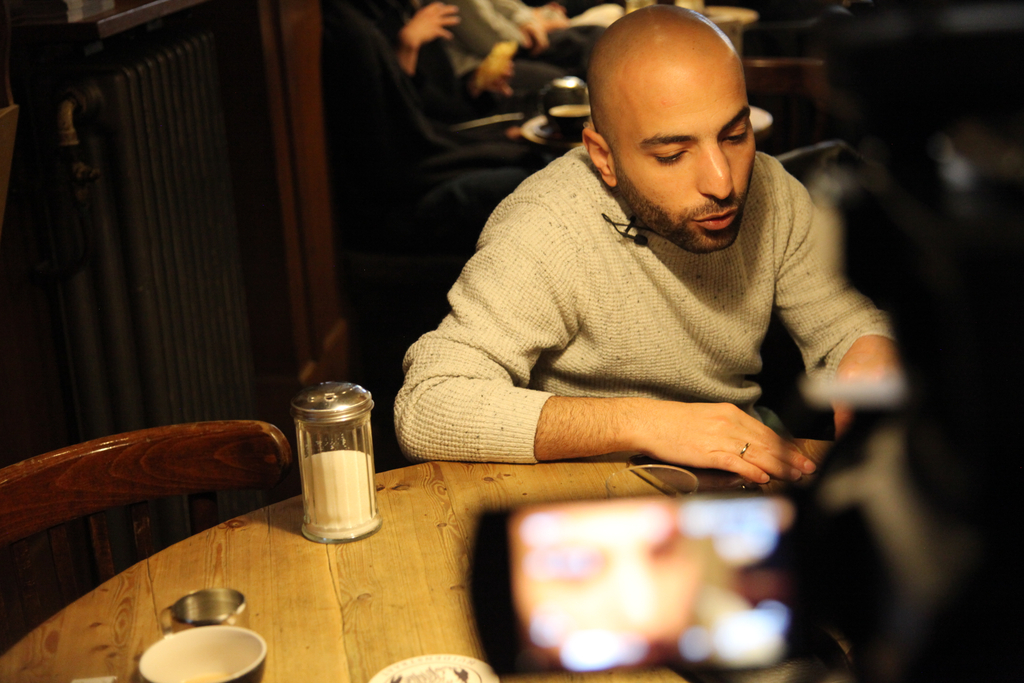
Akram being filmed in the coffee shop. Photo credit: Lidija Zelovic, 2023.
Ghada: You need to engage in that process of reflection, right? If I watch it, it invites me to reflect on Syria, on imprisonment and on war.
Lidija: We are making a film about the war, for people who have never been in war. The most important thing is to get you to feel something. Most people cannot really identify with those who have been in a war. It is very tricky to identify with someone like that. And maybe that is a good thing because it is war and it is so horrible. But then we are making these films to make you feel something so that the world can change.
We are making a film about the war, for people who have never been in war. The most important thing is to get you to feel something. Most people cannot really identify with those who have been in a war.
That is why these coffees are important: we all drink coffee, if you have been in war or not. There is this connection—a tiny connection—because we are all the same at the end. He just happened to be in the wrong place at the wrong time—but it could have been you. It is random, why things happen, the longer I live and the more I learn about how the world functions, I see that it is just very lucky that you were not there.
Ghada: It is a matter of luck. It is always a matter of luck.
Lidija: Where one is born, with this or that family, where you were at a certain moment—it can decide your life completely. It has nothing to do with your own merits.
Ghada: Can you share with us how the filming unfolded? Was this a guerrilla project? What kind of equipment did you use? How much was planned and rehearsed versus improvised?
Lidija: I made a plan to come on this and that day, and for Tobi and Akram to sit at the same place every time during the course of a year. The world around them—people and seasons—kept on changing, as they just sat around that same table. I arranged that with the bar because if they had kept on moving from place to place, the viewer would not get the feeling of the time passing. I thought the continuity of the location would add something.
I worked with three different camera professionals. And they all insisted on working on their own camera. I did not mind that because we were not making a fiction film. I found it much more important that they felt as comfortable as possible, so then Akram and Tobi would feel comfortable. So it ended up being three different people using three different cameras, which meant three different sound systems. Then you add in the fact that it is set in a real bar, so the sound was challenging. That is why we had a bug on Akram and Tobi so we could hear them well. Since Akram is telling rather intimate stories, I was not going to tell either of them to speak louder.
There are lots of challenges that arise when filming. For instance, people did not always want to be filmed in their bar, so I had to go from one person to the next and ask them personally. Every time we filmed, a new crowd with new waiters were there. It was always tricky. But we had good luck; it was a very friendly place, and the owner stood behind our message.
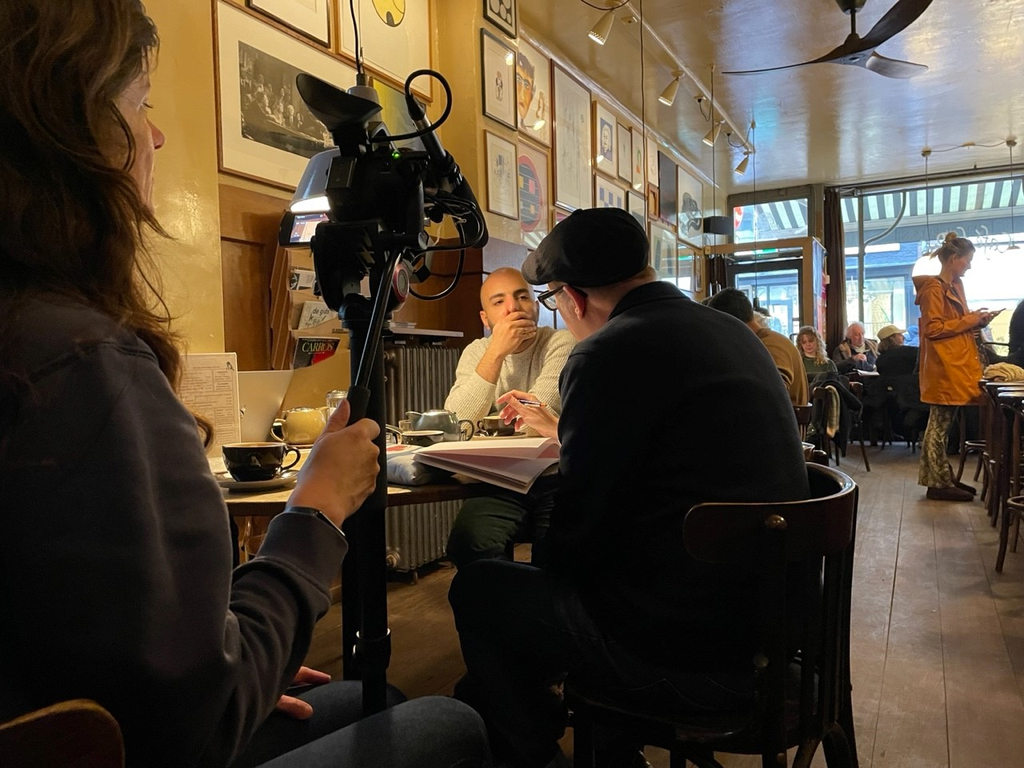
Lidija filming Akram and Tobi inside the coffee shop. Photo credit: Tobi Dahmen, 2023.
Ghada: For us filmmakers in these positions, our communication and how we approach other people can make it or break it.
Lidija: Communication with everyone is important. With a bigger crew, you would have a producer who organizes the location so you could focus solely on the film. But with this small-scale projects, you do everything. You have to arrange everything—which is good: you have more control, and you are a part of it all. I like working that way because it is my connection with these people and I have to be there with them. It is maybe more challenging, but I think it is also better.
Ghada: The SCVN project grounds itself in collaboration. How did this influence your own work? Was there a moment when you had to revise your approach based on the feedback of a survivor, an artist or a research cluster co-lead?
Lidija: From the beginning, the SCVN partners were very generous and open to me doing whatever I wanted. We learned from each other.
I do not often work with people who are not in the film world. I usually work with producers where everyone knows what the obstacles will be and how we are going to tackle them. There are always extra obstacles, but the general ones we know about. I edited with a friend of mine who is a very good editor in Belgrade. We understand each other and understand the topic.
When you work with people who are not in film (like academics), you come across comments that you would not expect. For example, I sent the non-finished version of the film (which you do to the colleges that can look through the not polished version) [and I thought] that the University might panic. Which is why I did my own viewings with other filmmakers. I am sure that they deal with the same thing while working with filmmakers, since we are not academics. We might come across as messy and chaotic. It is a different approach—not an academic approach.
Ghada: Were there any cinematic choices you made in the film that you would like to highlight for us?
Lidija: For me, the most important thing was to bring that book to light. I felt as though that was the film’s purpose, and I wanted to explore how it came to life. So, you have a very normal person—Akram—who became part of a very abnormal situation. He is back to living a normal life now, but he will never be the same. When watching the film, you end up seeing him differently than you viewed him at the beginning. What I thought was very interesting was his thoughts on the book. What does it mean for him? How did he think this project was going to come across? And as someone living in the Netherlands—which is turning extremely right wing—what does it all mean?
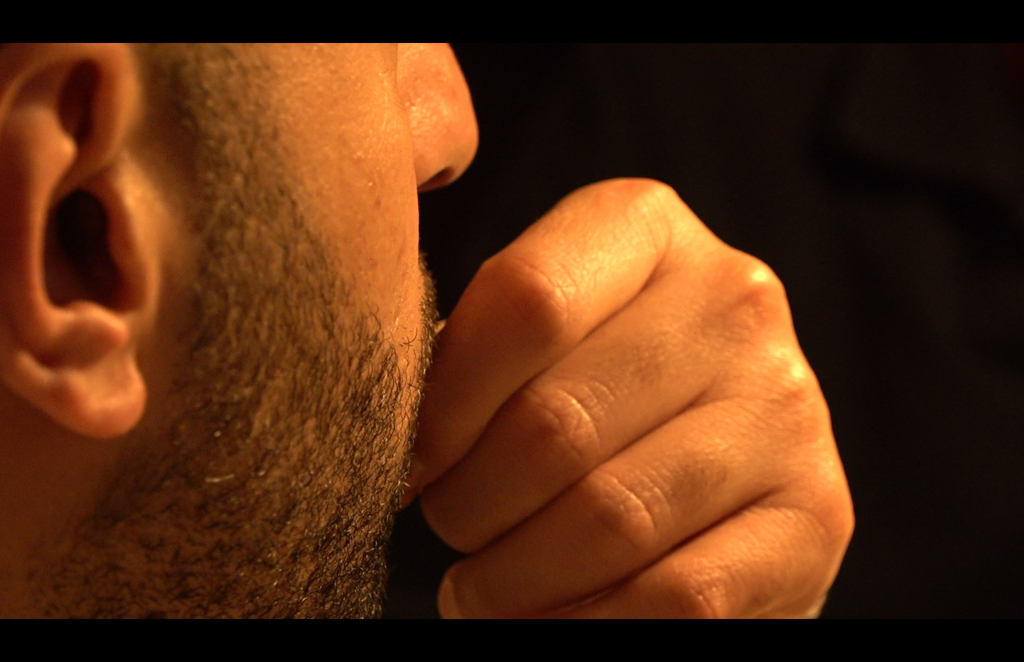
Close-up of Akram from How to draw darkness? a story from Syria (2026).
Ghada: I really appreciated your use of close-ups, especially when Akram is standing with a cigarette. As you were just saying, he is a very normal person, who ended up in an abnormal situation. I feel like if I saw Akram, I could have a conversation with him right away—I feel like I know him.
Lidija: The idea was to have him as just a guy from a bar. He is in so many ways, just a guy from a bar. He should have been just a guy from a bar, but his life took a different course. And at the end, when you see him, he is working very hard on being just a guy from a bar again.
The idea was to have him as just a guy from a bar…but his life took a different course. And at the end, when you see him, he is working very hard on being just a guy from a bar again.
You need that close-up to get closer to him. There is also such a close-up in the book. With Tobi and Akram together, they are just two guys in the bar. The bigger and busier the bar is, the closer they get to each other. Because we are not filming with any expensive equipment and since it is not an expensive project, you are limited. But I think that limitation is liberating as it makes you use your creativity.
Ghada: What is your advice to a filmmaker who wants to do these types of projects?
Lidija: I would really advise anyone to do it. And if you do it, try not to view these people as victims. They are actually stronger than most people you know. And yes, they are also victims, but they are not first and foremost a victim. Being a victim is just a part of who they are, but they are also heroes and are incredibly strong.
Try not to view these people as victims. They are actually stronger than most people you know…Being a victim is just a part of who they are, but they are also heroes and are incredibly strong.
Making a film about them gets you closer to them, which makes you learn not to be afraid of doing something wrong, because we do live in a world where we are so afraid of hurting each other. Which is in many ways a good thing, but doing so, we tend to actually distance ourselves from one another, which is, in some ways, even worse than hurting each other. So just, you know, talk to people, get to know them. People should know about these stories. They should know what happened, so it never happens again.
Ghada: How did you personally manage the emotional weight of the subject matter? You being a refugee yourself, already knowing what war is like, and now inviting yourself to go through it again, how did you manage all that?
Lidija: I really feel that once a refugee, always a refugee. Although you do move-on, on an everyday basis, you still have this immediate understanding with any refugee from any place. It is with all refugees, there is something, some understanding. So I do not have a need to protect myself from it.
But you know who do I need to protect myself from? The outside world who constantly sees me as a refugee. This is what I want to protect Akram from. I am talking about the system that keeps on bringing individuals down for being a refugee…It is not my identity, but it is something that made me who I am.
But you know who do I need to protect myself from? The outside world who constantly sees me as a refugee. This is what I want to protect Akram from. I am talking about the system that keeps on bringing individuals down for being a refugee. Being a refugee is like a religion. It’s yours. It’s personal. It’s mine. It is not my identity, but it is something that made me who I am. I wish I did not have to go through it, but it made me who I am. And I think I became a better person for it and that experience of war has really made me look at life differently. And when I see Akram—and that was the thing from the beginning—we understood that about each other
Ghada: In a way, those experiences now give you this privilege of understanding those who are going through it now, and they allow you to tell their stories from a perspective that people who did not live through it would not know about. In just saying “refugees,” we start thinking of them as losing all agency.
Lidija: We develop these rules about how people should be and that pushes them further away from you. Instead of learning something from them and learning something about them, you actually push them further away because you get scared of them, sometimes even when you have the best intentions. It’s very tricky. But we live in very funny times like that.
Ghada: The SCVN films will be used in genocide and human rights education. They will be shown at traveling exhibits, in classrooms, and online for the general public. What kind of response do you hope for from the diversity of audiences?
Lidija: I hope they will love Akram and fall in love with Akram and Tobi’s relationship. I would like them to share a similar experience to the one you had where you left feeling like you knew him.
Ghada: Thank you so much for this beautiful conversation. I am happy to have met you.
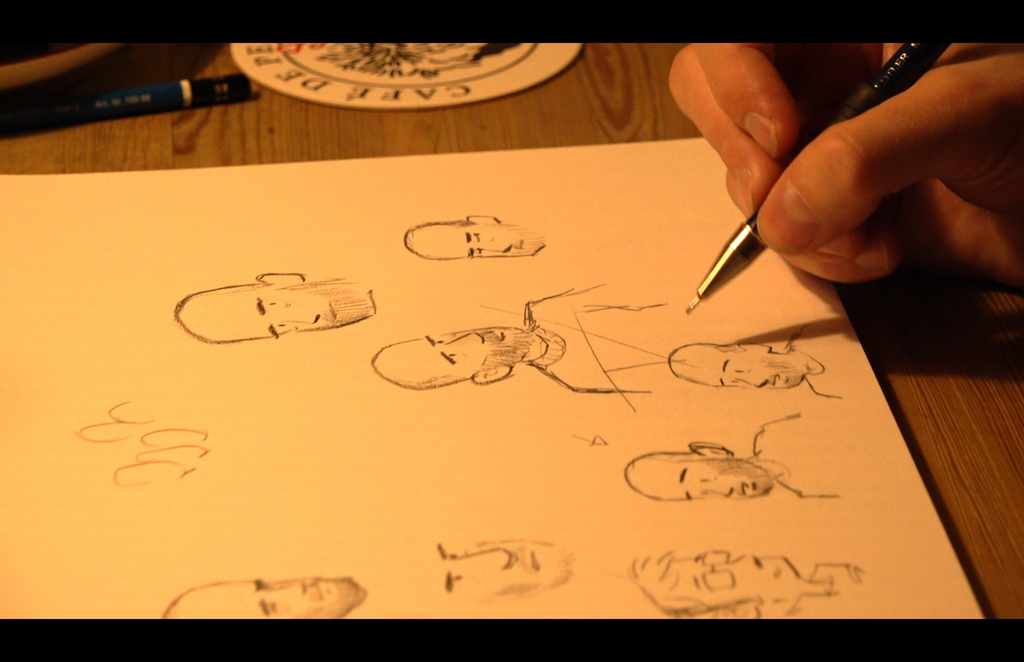
Tobi’s sketches of Akram. Still from How to draw darkness? a story from Syria (2026).
We would like to thank Lidija for her insights on film and for sharing her personal story, and to Ghada for conducting a thoughtful interview.
The trailer for How to Draw Darkness: A Story from Syria (2026) is out now, and the full documentary will be available on our YouTube in 2027.
How to Draw Darkness: A Story from Syria (2026) documents the creation of the graphic novel Al Faẓia’: The Horror – Surviving Syria’s Prisons (2026) by Tobi Dahmen and Akram Al Saud, which was created as part of Survivor-Centred Visual Narratives (SCVN) at the University of Victoria and funded by the Social Sciences and Humanities Research Council of Canada (SSHRC).
For more information about SCVN’s graphic novel Al Faẓia’: The Horror – Surviving Syria’s Prisons (2026), please click here.
Works Cited
“Akram & Tobi.” Survivor-Centred Visual Narratives, visualnarratives.org/projects/films/akram-tobi/. Accessed 10 Oct. 2026.
“Al Fa<u>ẓ</u>ia’: The Horror – Surviving Syria’s Prisons” Survivor-Centred Visual Narratives, visualnarratives.org/projects/graphic-novels-al-fazia/. Accessed 10 Oct. 2026.
How to Draw Darkness? A Story from Syria. Directed by Lidija Zelović, cinematography by Susan Koenen, produced by Survivor-Centred Visual Narratives, 2026.
Zelović, Lidija. Personal interview conducted by Ghada Youssef, Survivor-Centred Visual Narratives Research Assistant. Zoom, 27 Feb. 2026.