
The Artist Archives: “I Don’t Remember” – Mediating Oral Testimony and Historical Records in ‘But I Live’ with Leonie Solomons
In 2025, Holocaust Studies MA student and Survivor-Centred Visual Narratives Student Researcher Leonie Solomons archived the artistic materials from Barbara Yelin’s graphic narrative collaboration with Holocaust survivor Emmie Arbel, But I Live. It is one of the three stories featured in our award-winning graphic anthology But I Live: Three Stories of Child Survivors of the Holocaust (2022).
This guest blog is a digital exhibit representing the months of work that went into better understanding Barbara’s artistic approach and process while working with Emmie to develop the graphic narrative.
Introduction
Emmie Arbel entered the Nazi concentration camp system at age five and was seven years old when she was liberated from Bergen-Belsen. In collaboration with German cartoonist Barbara Yelin, Emmie shared her story through a combined literary-visual medium in But I Live: Three Stories of Child Survivors of the Holocaust. Central to this collaboration between survivor and artist was the decision to preserve Emmie’s recurring phrase “I don’t remember” throughout the graphic novella, a choice that both reflects the fragmented nature of Emmie’s memory and the reality of her oral testimony.
In an oral format alone, Emmie’s repeated expression of “I don’t remember” risks giving the impression that her narration is insufficient or unreliable. However, when integrated within the graphic novel, the phrase takes on a new meaning. By blending Emmie’s oral accounts with visual storytelling, supported by external archival records and documents, Emmie and Barbara’s collaboration ensured the graphic novella was both historically accurate and faithful to Emmie’s lived experience. Under a conventional oral testimony collection process, a statement like “I don’t remember” might have been understood as a mere gap in memory and therefore insignificant. Through the unique testimony collection and representation process offered by the Survivor Centered Visual Narratives (SCVN) research project, Emmie’s repeated invocation of “I don’t remember” became a deliberate and necessary part of her story.
As SCVN project lead and co-director Charlotte Schallié discusses in Slowing Down and Taking Time: A Proposal for Integrating Care Ethics into Visual Storytelling Research and Practice, the relationship between the survivor and the artist is designed to facilitate a move away from a logocentric focus of testimony to a more immersive, sensory approach to documentation (103). Such a process becomes uniquely possible with the methodology set out by SCVN, where survivors and artists rely on relationship building to co-create a graphic novel narrative of survivors’ stories. This blog explores how the SCVN methodology came to depict important details of Emmie’s life, despite the constraints of Emmie’s memory in her oral testimony account. The archive of But I Live acts as a lens into the collaboration and mediation undertaken throughout the creation process of the graphic novel. I will focus on page 114 to show how But I Live integrates Emmie’s fragmented oral testimony within a graphic novel format, despite her oral testimony’s statement, “I don’t remember”.
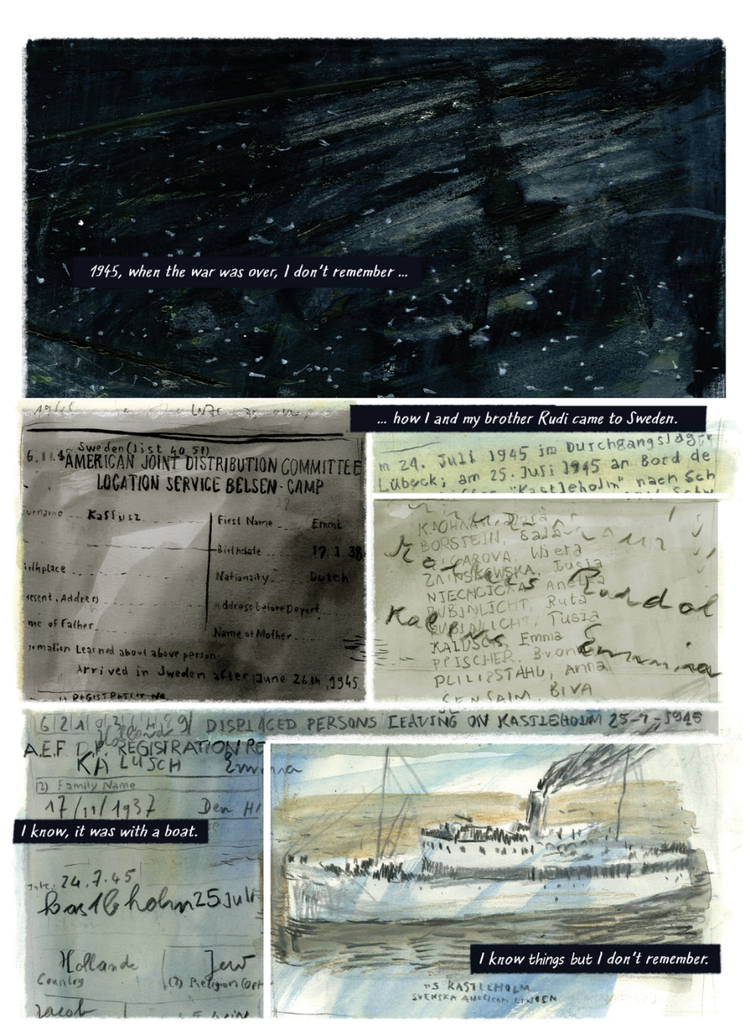
But I Live (2022, p.114)
Page 114
Page 114 of But I Live follows Emmie’s recollection of her life immediately post-liberation, layered alongside illustrations documenting her journey from Bergen-Belsen to Sweden. Emmie’s narration on this page reads: “1945, when the war was over, I don’t remember… how I and my brother Rudi came to Sweden. I know, it was on a boat. I know things but I don’t remember.”
The illustrative panels contextualize Emmie’s oral account of her journey post-liberation, as she travels to Sweden with Rudi. This page includes six panels combining renderings of archival documents with an illustration of the vessel that transported displaced persons to Sweden after liberation, called the S.S. Kastelholm.
Page 114 as a completed work conveys how Barbara and Emmie constructed a cohesive visual narrative through corroboration of multiple sources existing in tandem, including oral testimony and official archival and historical records. Yet, the finished page represents just one layer of a much deeper collaborative process of recording survivor testimony, inherent to the SCVN ethos.
To understand how Emmie’s memories, sometimes fragmented and uncertain, became part of a larger visual mechanism of testimony, it is worth turning to the archive of But I Live. The archive of But I Live is a collection of materials that documents the process of testimony collection and development that made page 114, and the novella possible. This archive consists of storyboard drafts, audio recordings and transcripts of Emmie’s oral testimony, Barbara’s reference photographs, and official records sourced from external archives documenting Emmie’s war and post-war life, among other materials. Each item has been carefully indexed, reflecting the individual role each file played in informing the creation of the final storyboard. Over the course of months spend indexing each and every item in the archive, I became aware of an interesting meta-analysis: Barbara’s decision to include Emmie’s fragmented memories within the graphic novel format was critically supported through integrating archival records and documents alongside Emmie’s oral testimony. Page 114 offers a snapshot of the importance of the SCVN methodology at play, where the collaboration between a survivor and artist constructed a multi-layered depiction of Emmie’s story.
Emmie’s Oral Testimony
The following excerpt is from a transcribed conversation between Emmie and Barbara, and shapes Emmie’s narration on page 114:
Barbara Yelin: Can you remember anything else? What did you do you in these days after liberation? Did you get something to eat then, to drink?
Emmie Arbel: I think so, but I don’t remember
(…)
Barbara Yelin: And then Red Cross. It was the Red Cross people who came to…
Emmie Arbel: That I know, but I don’t remember
Barbara Yelin: Ok. No, you don’t.
Emmie Arbel: I don’t remember how [at] all that they took us and
Barbara Yelin: Brought you to Sweden.
Emmie Arbel: To Sweden. With a boat. This I know. I know but I don’t remember.
An expert of a transcribed conversation between Emmie and Barbara about Emmie’s life immediately post-liberation (2020).
The narration used in the completed version of page 114 captures the essence of Emmie’s oral testimony that she shared with Barbara: an awareness of certain facts about her life as a Displaced Person unaccompanied by any true memory of having lived them. One their own, Emmie’s memories of her post-liberation journey are likely to be overlooked, given the limited detail she is able to offer. Despite this, Barbara’s first drafts reveal is her desire to include this part of Emmie’s story into the final storyboard.
Emmie’s Liberation Story in the Drafts
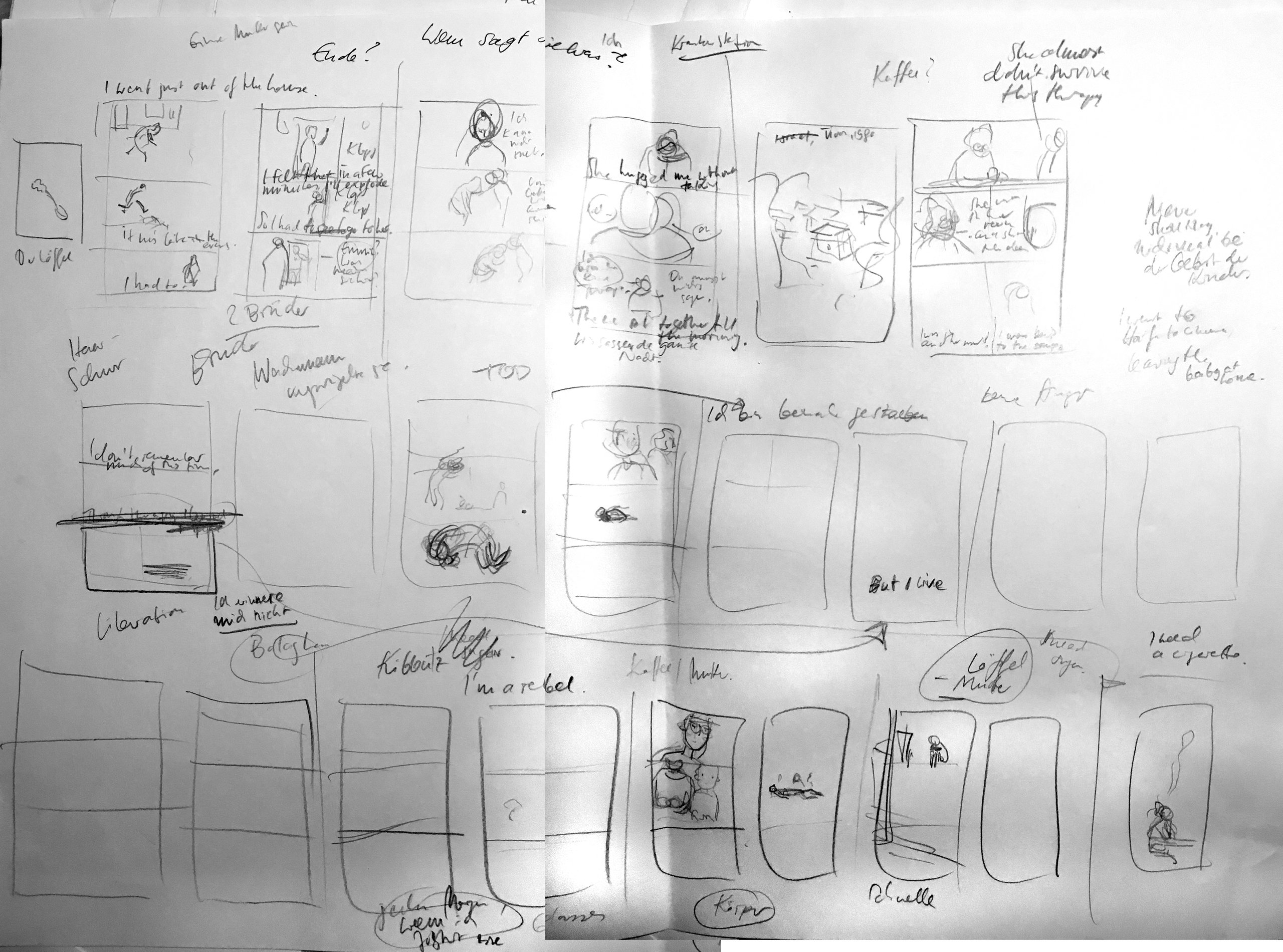
Babara’s early sketch of the page and content order of the storyboard (2019). Image credit: Barbara Yelin.
The image above features one of Barbara’s early drafts mapping the page order and content that would eventually form the final storyboard of But I Live. The page drafted on the far left of the middle row is an early iteration of what would become page 114, identifiable by a handwritten note marking this page with the theme of “Liberation”. While the detail and content of page 114 in this draft stage is minimal, Barbara has included Emmie’s oral account of liberation, narrated as “I don’t remember much from this time.”
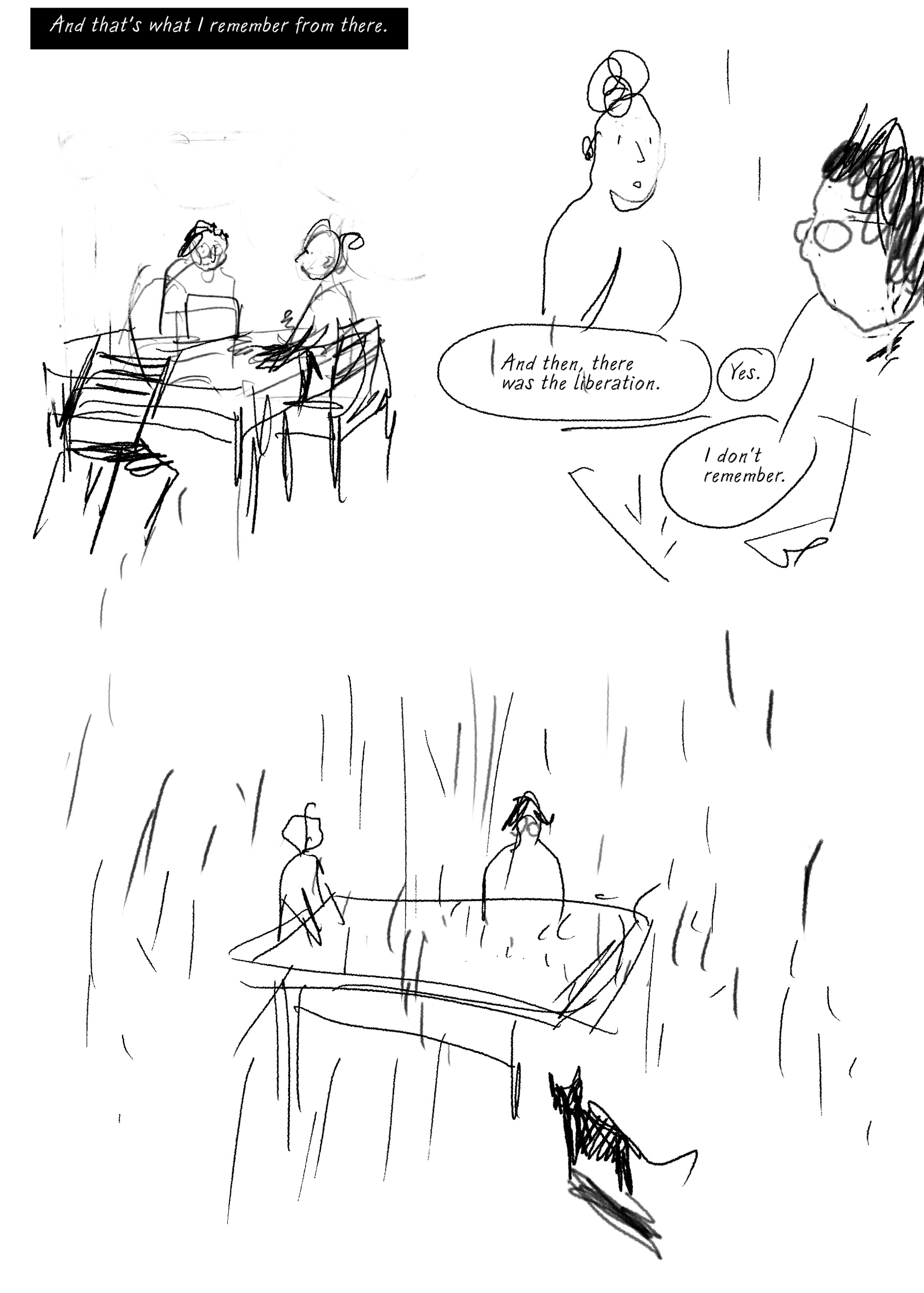
Digital sketch of Emmie and Barbara discussing life immediately post-liberation (2019). Image credit: Barbara Yelin.
This image shows a later draft of the conversation between Emmie and Barbara that would eventually become page 114. Echoing Emmie’s oral testimony of liberation, her character sketch is depicted saying “I don’t remember”. The dialogue between Emmie and Barbara seen in this earlier draft, eventually became narrated on the final version of page 114, as Barbara used illustrated references to contextualise Emmie’s post-liberation experience.
Archives within Archives
The illustrations on page 114 primarily draw from a collection of documents sourced from the Arolsen Archives, including Emmie’s transportation records and registration forms. The Arolsen Archive is a centre that maintains a digital database of the survivors and victims of the death camp, concentration camp, and forced labour systems under National Socialism, including individuals like Emmie. These materials corroborated Emmie’s oral testimony, where she recalls that she and Rudi came to Sweden by boat, adding “This I know. I know but I don’t remember,” which appears in the final version as “I know, it was on a boat. I know things but I don’t remember.” Where Emmie’s memory cannot account for her journey post-liberation, historical records fill in what she cannot recall.
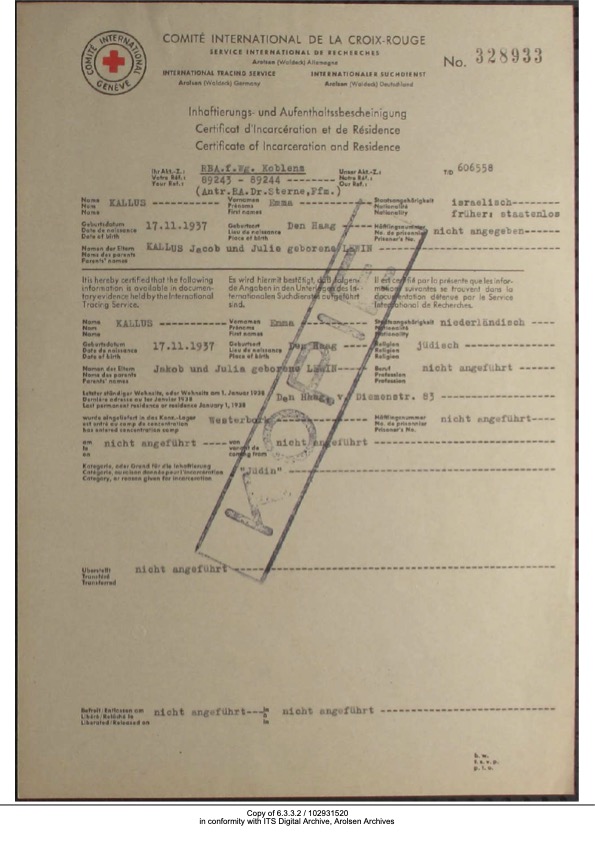
A Red Cross document preserved by the Arolsen Archives, listing Emmie’s name, date of birth, parents’ names, place of birth, and reason for incarceration, which is listed as “Judin” (1937). Image Credit: Arolsen Archives.
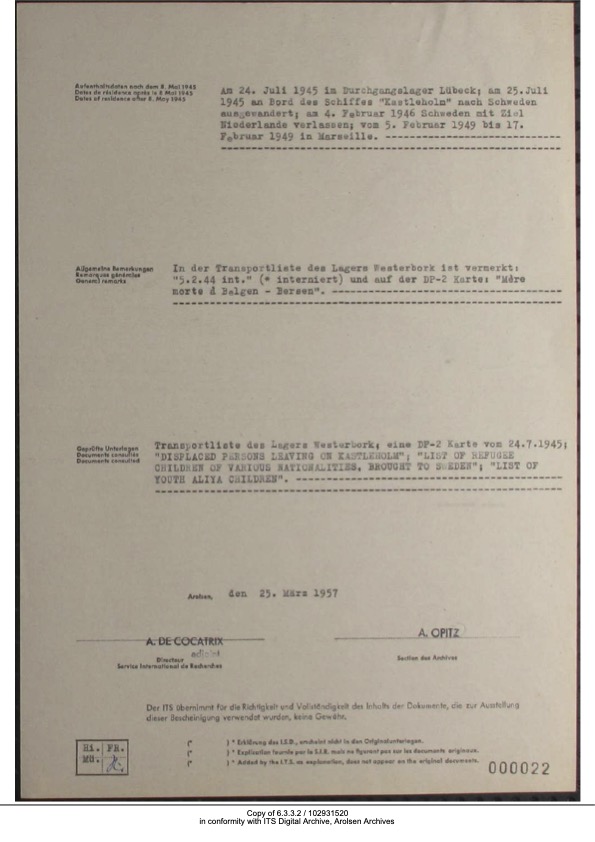
The second page of the Red Cross document, listing Emmie’s transportation route following liberation and the loss of her mother (1937). Image Credit: Arolsen Archives.
The second page of this document records some of Emmie’s internment information, including her transportation to Westerbork. This document also includes the written statement, “Mère morte à [Bergen-Belsen],” meaning “Mother died in Bergen Belsen”. The second box of text on this page lists Emmie as a “Displaced Person” and “Refugee Child…” who was brought to Sweden via the Kastleholm. The two pages of this Red Cross document appear to have influenced Barbara’s rendered illustrations of panel 2 (middle left) and panel 3 (middle right) on page 114.
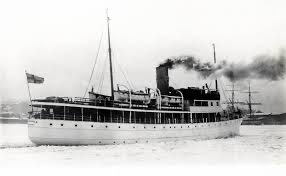
A photograph of the S.S. Kastelholm, a Swedish ship used to transport Displaced Persons after liberation in 1945 (n.d.). Source unknown.
The Red Cross document listed the “Kastelholm” as the vessel that carried Emmie, Rudi, and other Displaced Persons to Sweden after the war. An illustration of the S.S. Kastelholm makes up panel 6 (bottom right) of page 114. This image is drawn from a collection of reference photographs of the Kastelholm, consulted by Barbara during the creation process is now indexed within the But I Live archive. While Emmie does not remember her post-liberation journey or the boat she took, this account exists in the historical record of the Arolsen Archive, which Barbara transposes into the graphic novel format.
Conclusion
Tracing the progression of page 114 through the But I Live archive, from Barbara’s earliest drafts to the Arolsen Archive records that informed her illustrations, reveals that the making of this page was never simply a creative exercise. Rather, it was an act of careful, collaborative testimony. From the earliest stages of drafting, Barbara’s commitment to preserving Emmie’s declaration of “I don’t remember” signals an understanding that fragmented memory is not a limitation of testimony, but a vital part of it. The inclusion of transportation records and the illustration of the Kastelholm further reflects Barbara’s dedication to mediating Emmie’s testimony alongside preserved historical documents. Instead of attempting to fill the gaps in Emmie’s memory, the But I Live archive shows how different media, such as oral testimony and an official preserved record, can be simultaneously honoured.
Works Cited
Schallié, Charlotte, editor. But I Live: Three Stories of Child Survivors of the Holocaust. New Jewish Press, 2022.
Schallié, Charlotte. “Slowing Down and Taking Time: A Proposal for Integrating Care Ethics into Visual Storytelling Research and Practice.” Seminar: A Journal of Germanic Studies, vol. 61, no. 2, 2025, pp. 102–10. https://doi.org/10.3138/seminar.61.2.5.
Thank you to the University of Victoria’s Libraries and Art Collections for supporting the development of our archival materials.
The Survivor-Centred Visual Narratives project is supported in part by funding from the Social Sciences and Humanities Research Council of Canada and the Government of Canada. We are grateful for their support in making this work possible.