Survivor-Centred Visual Narratives

Category: conferences

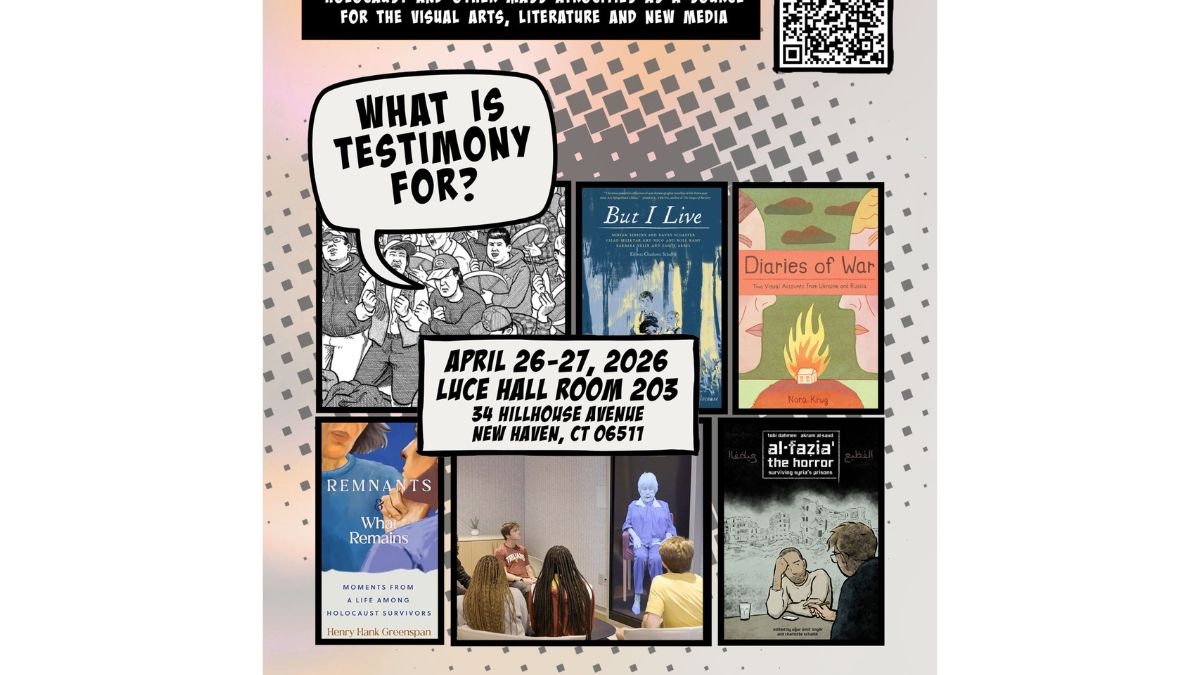
Upcoming Conference at Yale: ‘What is Testimony For?’ – Apr 26 & 27, 2026

SCVN is collaborating with project partners the Fortunoff Video Archive, Yale Macmillan Center Genocide Studies Program, and the Sam & Frances Holocaust and Genocide Academy (UNO) to host on a two-day conference at Yale University from Sunday April 26 to Monday April 27.  The conference explores the use of testimony from the Holocaust and other mass atrocities as a source for the visual arts, literature, and new media.

The event will bring together artists, co-applicants and a survivor from the SCVN project, including Nora Krug, Tobi Dahmen, Miriam Libicki, Akram Al Saud, Charlotte Schallié, Mark Celinscak and Alexander Korb. It will also feature scholars supporting the project, including Hank Greenspan, Victoria Aarons and Sara Horowitz.

The event will take place at Luce Hall on the Yale campus. Registration for two workshops is available at the following link.
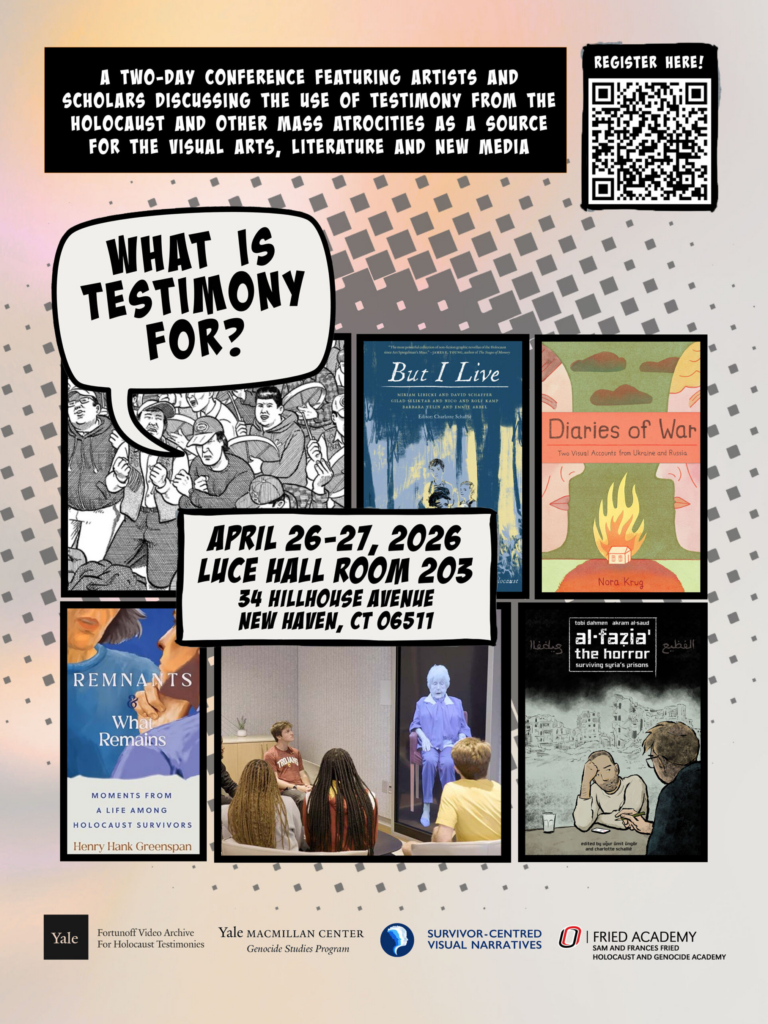
The Conference Schedule is listed below, with our project collaborators highlighted:

Sunday, April 26, 2026

5:00 PM: Panel I | Mediated Memory through the Drawn Image: Victoria Aarons (Trinity University), Nora Krug (Parsons School of Design), Miriam Libicki (Graphic Novelist, Vancouver) Respondent: Charlotte Schallié (University of Victoria)

Monday, April 27, 2026

9:00 AM: Coffee

9:15 AM: Introduction, David Simon (Yale)

9:30-11:00 AM: Opening event | Graphic Witness Beyond the Holocaust with Akram Al Saud (The Hague), Tobi Dahmen (Comic Artist and Illustrator, Utrecht) Respondent: Charlotte Schallié (University of Victoria)

11:00-12:30 PM: Panel II: Holocaust Testimony and New Media Representations with Jakob Ari Labendz (Ramapo College), Eugen Pfister (HKB Bern), Dan Leopard (Independent Scholar and Artist), Noah Shenker (Colgate) Respondent: Alexander Korb (Arolsen Archives)

12:30-2:00 PM: Lunch

2:00-3:30 PM: Panel III | Testimony and Literary Representations with Hank Greenspan (University of Michigan), Anna Veprinska, (University of Calgary), Sara Horowitz, (York University) Respondent: Mark Celinscak (University of Nebraska at Omaha)

4:00 PM: Performance | REMNANTS with Hank Greenspan (University of Michigan)

Mark Celinscak and Miriam Libicki present at Jewish American & Holocaust Literature Symposium – Feb 2, 2026

SCVN graphic artist Miriam Libicki and Holocaust Research Cluster Co-Lead Mark Celinscak attended the Jewish America & Holocaust Literature Symposium’s 30th annual conference from February 1 – 3, 2026 at Tulane University in New Orleans.

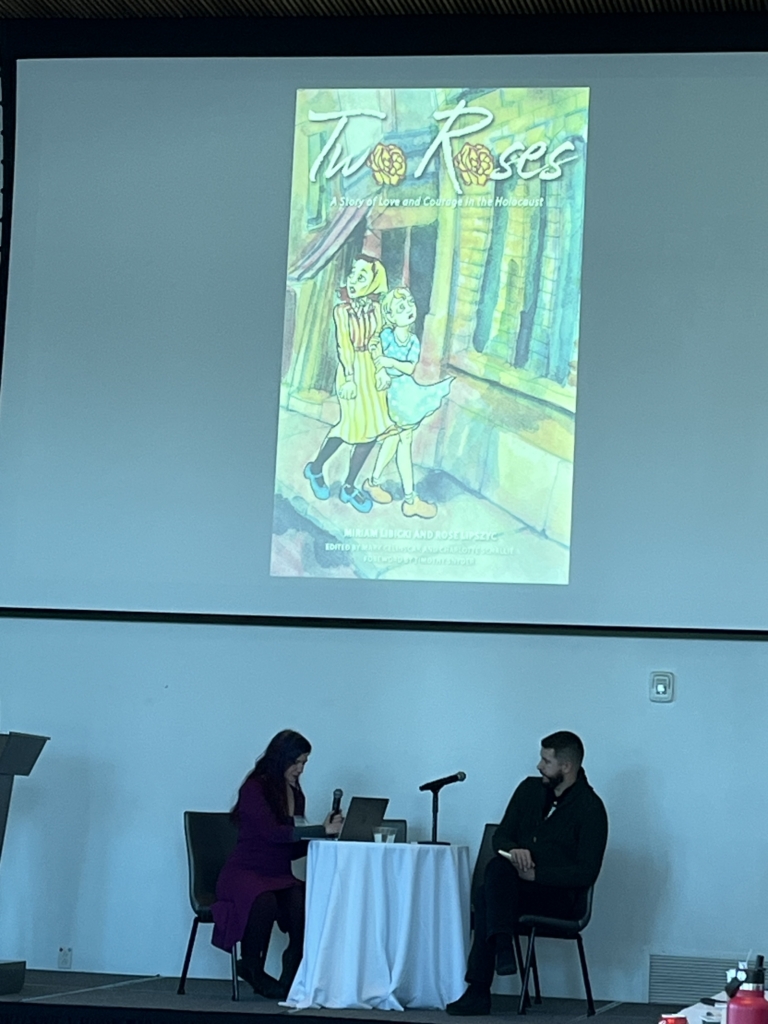
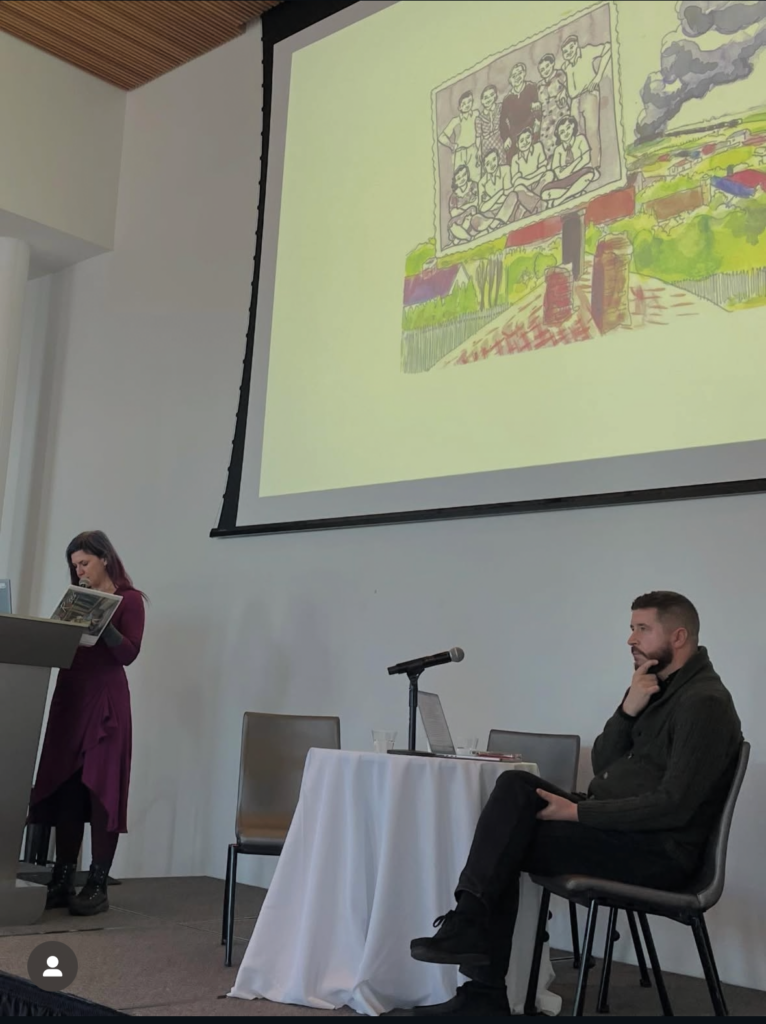
On February 2, they presented in a panel titled “Two Roses: Utilizing Holocaust Survivor Testimony in Graphic Art Narratives,” moderated by Oren Baruch Stier (Florida International University). The discussion focused on the project’s upcoming publication of the graphic novel Two Roses: A Story of Deception and Determination in Nazi Germany, and was an excellent opportunity to share insights from their collaboration with new audiences. Two Roses is will be released on February 24, and is available for advance purchase by the University of Toronto Press here.

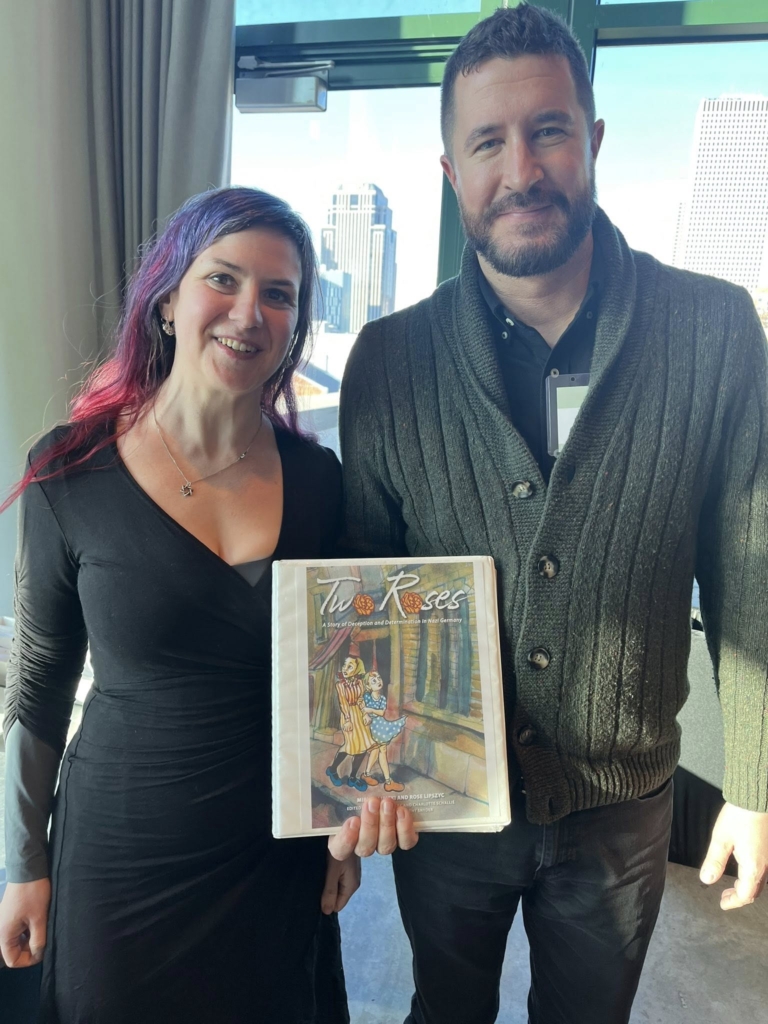
Miriam Libicki (left) and Mark Celinscake (right) with a pre-publication, printed copy of Two Roses at JAHLIT, 2026.

Thank you to the Jewish America & Holocaust Literature Symposium for hosting Mark and Miriam!

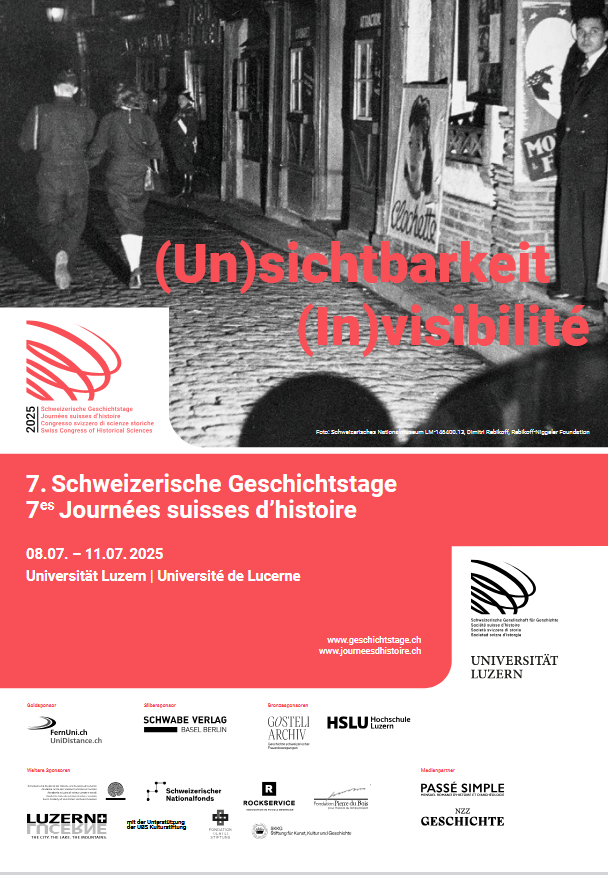
Drs. Franziska Zaugg and Sabine Rutar chair panel at 7th Swiss History Days Conference – July 9, 2025


From left to right: Jared Muralt, Franziska Zaugg, Sabine Rutar, Mirjam Janett, Béatrice Gysin, and Athena Grandis.

The Yugoslav Wars Research Cluster’s Drs. Franziska Zaugg and Sabine Rutar, with graphic artist Jared Muralt, are organizing a panel ‘Images as bridges: Graphic novels as a means of visualizing historical experiences of violence’ on July 9, 2025. This session is a part of the 7th Swiss History Days Conference taking place at the University of Lucerne from July 8 to July 11.

The Swiss Historical Society, the professional association of historians in Switzerland, organizes the Swiss History Days every three years at different locations. This congress brings together hundreds of historians from Switzerland and abroad, and is one of the largest symposia of its kind in Europe. The Swiss History Days invite all disciplines into the dialogue and attract young academics as well as internationally renowned history teachers and researchers.


The theme for this year’s conference is (In)visibility. This focus is predicated upon the fact that visuality is omnipresent in the 21st century. Its aesthetic, technical, and social conditions, and their impacts, require a fresh engagement with its historiographical classification and perspective. The panel proposed and chaired by Dr. Zaugg and Dr. Rutar aims to reflect upon the visualizing power and impact of graphic novels within historical context. Here is the description of the session:

To this day, historical scholarship is primarily oriented towards written texts, both in terms of its sources and the research literature. With regard to epistemic and experienced violence, the question arises as to how this can be adequately discussed with students and colleagues. For several years now, graphic novels (also called “comics”) have offered a new approach. Art Spiegelman’s “Maus,” which is now considered an icon of this genre, marked the beginning of making history visible through images. Since then, the possible approaches to the history of violence through graphic novels have intensified. Examples include the works of Joe Sacco on besieged Sarajevo in the 1990s and Jacques Tardi on the First World War.

Our panel aims to address this issue by bringing historians and artists into discussion about how violence can be methodically and convincingly visualized in graphic novels. The following questions will be central: How do artists, contemporary witnesses, and historians work together? How does the spoken word—the narrated memory, but also the invisible aspect of epistemic violence—become a narrative in images and words? How does historical expertise enter this story? How does the artist succeed in narrating biographical information in such a way that the memory can be made visible and coherently embedded in a larger historical context? What role do archival sources, both written and, in particular, visual (photos, films), play in the creation of a science-based, artistically compelling graphic novel?”

The panel touches on the research fields of biographical narrative, the history of war and violence, memory studies, visual history, trauma research, and political and historical education.

We also look forward to their insights and experience working with graphic artists and survivors with the Yugoslav Wars Research Cluster.

For further information about the conference program, please click here.

For a more detailed description of the three presentations on this panel, please click here.

‘Images as bridges: Graphic novels as a means of visualizing historical experiences of violence’
July 9, 2025
3:45 – 5:15 p.m. CEST
Seminarraum 3B48
University of Lucerne
Conference program:
https://geschichtstage.ch/frontend/index.php


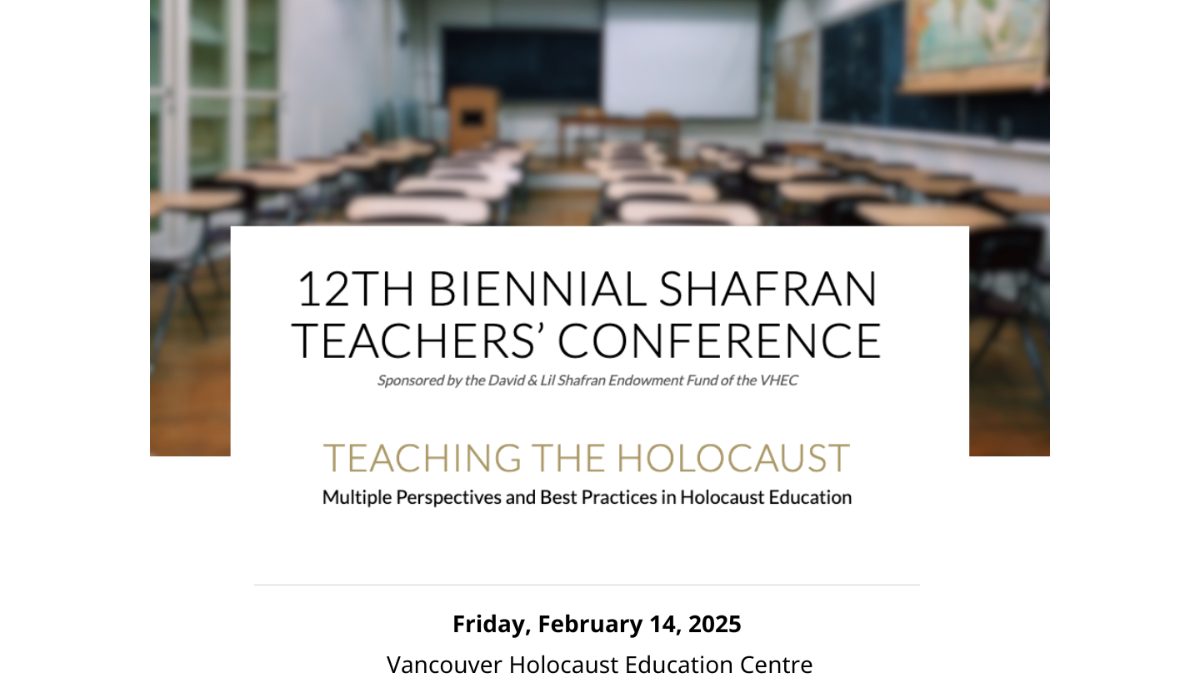
 ‘12th Biennial Shafran Teachers’ Conference’ with Co-Director Dr. Andrea Webb – Feb 14, 2025

Registration closes February 1!
https://www.vhec.org/professional-development/shafran-teachers-conference/

On February 14, the Vancouver Holocaust Education Centre(VHEC) is hosting the one-day ’12th Biennial Shafran Teachers’ Conference’. This year’s conference, entitled ‘Teaching the Holocaust: Multiple Perspectives and Best Practices in Holocaust Education’, focuses on providing teachers in various disciplines with new teaching resources to support Holocaust education in the classroom.

SCVN Co-Director Dr. Andrea Webb will be a presenter at the conference and will draw from her experience as a high school teacher, teacher educator, and researcher to support educators’ confidence and engagement in Holocaust education.

Dr. Webb has also developed the Educators’ Resource for the graphic novel ‘But I Live: Three Stories of Child Survivors of the Holocaust’ and is leading the development of the teaching materials and educational resources for all of SCVN’s Research Clusters.

Thank you to the VHEC for hosting this event and we look forward Dr. Webb’s presentation!

Conference Details:
Friday, February 14, 2025
8:30 am – 3:30 pm PDT
Vancouver Holocaust Education Centre
950 West 41st Avenue, Vancouver 2nd Floor, Dayson Boardroom

Visit the VHEC’s main website for more information and registration:
Shafran Teachers’ Conference – Vancouver Holocaust Education Centre