On October 13, the Scottish Graduate School for Arts & Humanities hosted a panel and workshop featuring members of SCVN’s Rwanda Research Cluster titled ‘Community Engagement and Intercultural Sensitivity: Ethics, Design and Practice’. It was led by Dr. Fransiska Louwagie and featured three speakers with backgrounds in ethnographic research: Drs. Anna Ball, Erin Jessee, and María Soledad Montañez. The full day event included an online panel in the morning and an in-person workshop in the afternoon, hosted at the Sir Duncan Rice Library at the University of Aberdeen.
The panel focused on how community engagement is an increasingly important academic practice, offering insightful pathways to both the impactful dissemination and collaborative creation of new knowledge.
Anna Ball introducing the morning panel session. Photo credit: Fransiska Louwagie.
It explored the questions: how can we ensure that engagement practices are sensitive to the cultural identities, practices and beliefs of those within the communities with which we work? And how can we design community engagement practices that enhance understanding, dialogue and agency across perceived differences, in ethical ways?
Following the panel, the workshop invited the speakers to share their experiences with safeguarding, consent, positionality, trauma-informed practice and participant agency. They examined what interculturally sensitive community engagement looks like in terms of research design, ethics and practice. They also focused on the use of listening as a methodology for community engagement of various styles, with lessons from academic experts in intercultural fieldwork with varied communities, including survivors of the Rwandan genocide and people navigating the asylum system.
From left to right: Rwanda Research Cluster Co-Leads Fransiska Louwagie and Erin Jessee, with Advanced Research Fellow, Anna Ball. Photo credit: Fransiska Louwagie.
On October 23, SCVN’s project partner the Wiener Library is hosting a talk to explore how graphic novels have proven to be a powerful medium for sharing stories of the Holocaust and other genocides and mass atrocities.
A panel discussion will reveal those lessons are currently being applied in the creation of new survivor-centered graphic novels about the Holocaust and the 1994 genocide against the Tutsi in Rwanda.
Drawing on the expertise of three of the SCVN’s Research Cluster Co-Leads, Dr. Erin Jesse, Dr. Fransiska Louwagie and Dr. Alexander Korb, the talk will showcase the potential of the graphic novel medium to portray survivor stories. The researchers will discuss how the project works with artists and survivors to create new educational approaches.
The evening will include the public premiere of our short film, ‘Why We Dance’, that has been made by filmmaker Marc Ellison about the team’s current co-creative work with Rwandan genocide survivor Jerome Irankunda and graphic novelist Michel Kichka (the son of a Holocaust survivor).
EventDetails Venue: The Wiener Holocaust Library (London, UK) Date: October 23, 2025 Time: 6:00pm – 8:00pm (GMT+1)
This year’s AGM convened eighteen Research Cluster Co-Leads, project partners and researchers from Canada, England, Germany, The Netherlands, Scotland, and Switzerland. The AGM focused on how the five Research Clusters can prepare to “go public” through the publication of their graphic novels and associated public engagement activities. Hosted at the Royal Netherlands Academy of the Arts and Sciences’ (KNAW) Trippenhuis, the AGM provided a forum for participants to consider cross-cluster collaboration opportunities, conceptualize public engagement, share research cluster progress from the last year, and contemplate milestones for the years ahead.
SCVN Annual General Meeting for Year 3: ‘Knowledge Mobilization’ at the Royal Netherlands Academy of the Arts and Sciences’ (KNAW) Trippenhuis. Photo credit: Jennifer Sauter.
Day 1 began with cross-cluster conversations. Each Research Cluster met on a rotating basis with the other clusters to explore connections between their work, share challenges, and consider how insights from other groups could inform their own approaches.
In the afternoon, a facilitated conversation with the Iraq and Syria Research Cluster led by Fransiska Louwagie invited reflection on the cluster’s experiences developing their graphic novels and their public trajectories. The day concluded with a discussion about project planning for 2025 and beyond, including archiving, long-term community engagement strategies, audience conceptualization, graphic novel publicity, and more. Each cluster contemplated these topics and developed preliminary timelines for Year 4 of the project.
Charlotte introducing the AGM: What does it mean to “go public”? (left) and Fransiska Louwagie leading a discussion with the Iraq and Syria Research Cluster’s Leyla Ferman, Kjell Anderson, Kees Ribbens and Uğur Ümit Üngör (right). Photo credit: Jennifer Sauter.
Day 2 started with presentations from four external speakers involved in the development and/or use of graphic novels about mass violence. Steven Stegers (Euroclio) spoke about using visual media in history teaching while Rob Verheijen (Hogeschool Arnhem Nijmegen) presented on using World War II and Holocaust graphic novels in Dutch history education.
Steven Stegers from Euroclio presenting (left) and Rob Verheijen (right + below) leading our team through a workshop engaging with a Holocaust comic for highschool students to identify characters as perpetrators, victims, helpers, bystanders and society.
Sabine Rutar, Franziska Zaugg and Erin Jessee. Photo credit: Jennifer Sauter.
Fransiska Louwagie, Andrea Webb, Shannon Leddy and Elissa Boghosian. Photo credit: Jennifer Sauter.
Following these presentations, Kees Ribbens moderated a conversation with Bas Kortholt (Kamp Westerbork) and Adriaan Baccaert (Kazerne Dossin) about the development and publication of Picturing the Unimaginable: Ten Comic Authors, Ten Stories about the Holocaust and other Nazi Crimes (see below). In addition to speaking about the graphic novel itself, Bas and Adriaan shared about the associated exhibition and other public engagement considerations from the project.
Adriaan Baccaert (Kazerne Dossin) far left, with Bas Kortholt (Kamp Westerbork) presenting, moderated by Kees Ribbens (right). Photo credit: Jennifer Sauter.Cover of Picturing the Unimaginable (right).
The program concluded with status update presentations from each Research Cluster, showcasing moving film trailers and artwork from their graphic novels. It was a formative moment for each Research Cluster to share their progress and journey since their initial gathering at our Year 1 AGM in Glasgow.
We would like to thank our hosts, project partners and all those who contributed to the fruitful discussions throughout the AGM in Amsterdam. We hope the program offered participants meaningful opportunities to learn, share, and connect, and that it laid a strong foundation for the next year of the Survivor-Centred Visual Narratives project.
On Wednesday, June 18, the NIOD Institute for War, Holocaust and Genocide Studies hosted a public event at Spui25 in Amsterdam: “Visualizing Survivors’ Voices.” The event featured contributions from Dr. Charlotte Schallié and Dr. Andrea Webb, Co-Directors of the Survivor-Centred Visual Narratives (SCVN) project; graphic artist Tobi Dahmen; survivor of the Assad regime and the narrator of Dahmen’s forthcoming graphic novel, Akram Al Saud; and NIOD historians Dr. Kees Ribbens and Dr. Uğur Ümit Üngör. The event served as a prelude to the SCVN project’s two-day Annual General Meeting in Amsterdam.
At the heart of the public event was the question: How can graphic novels strengthen historical understanding of mass violence survivors’ experiences?
On the Trajectories of Graphic Novels
Kees opened the event with an overview of the evolving uses and public perceptions of graphic novels. He observed that, historically, “there has not always been a recognition of the power of comics”. However, from the late 20th century onward, there has been growing recognition of the medium’s capacity to convey the experiences of survivors of mass violence and human rights violations. Today, Kees offered, we are still realizing the potentials of graphic novels:
“In 2025, we are still discovering what serious graphic novels can express. We are still finding out how they open up new ways of historical understanding. We are still trying to figure out what interpretations, connections, and identifications readers derive from engaging with graphic novels, and also, we are trying to figure out where the limits of the medium’s possibilities actually lie.”
Kees Ribbens introduces the public panel event. Photo credit: Jennifer Sauter.
Public Reading: Al-Fazia – The Horror: Surviving Assad’s Prisons
Following the introduction, Akram and Tobi read from their forthcoming graphic novel Al-Fazia – The Horror: Surviving Assad’s Prisons. This reading marked the first time in the project’s history in which a survivor participated in a live reading, and it was the first such time for Akram as well. The moving presentation provided the audience with a glimpse into the manuscript that details Akram’s survival of Assad regime violence and the thoughtful collaboration between Akram and Tobi behind its visual retelling.
From the top left: Akram Al Saud and Tobi Dahmen read an excerpt from the graphic novel, Tobi sharing process sketches, panelists from left to right Charlotte Schallié, Tobi Dahmen, Akram al-Saud, Uğur Üngör, and Andrea Webb. Photo credit: Jennifer Sauter.
Deepening the Dialogue
The reading set the stage for a group discussion between Charlotte, Andrea, Uğur, Akram, and Tobi. The conversation initially focused on the relationship between Akram and Tobi in the graphic novel co-creation process. They reflected on questions such as: What does it mean for an artist and survivor to work together over an extended period of time? How did their creative partnership unfold? Why did Akram decide to share his story? And how did Tobi navigate artistic choices about depicting mass violence?
“What I appreciated in Tobi…[was] that he didn’t stand a distance from my story. No. He was trying most of the time to come closer, trying to, let’s say, collect the fragments.” – Akram
“I tried to get closer to the situation but always be aware that I could never totally depict an experience like that.” – Tobi
“It was a very caring process.” – Akram
Tobi Dahmen and Akram Al Saud in conversation on panel. Photo credit: Jennifer Sauter.
The second half of the conversation shifted to broader questions about the capacities and potentials of graphic novels about mass violence: How can a graphic novel hold the weight of genocide and mass violence? How can the medium be used to depict survivors’ experiences with care and complexity? And how can graphic novels serve as educational resources? Uğur spoke about the power of graphic novels to break through layers of silences surrounding mass violence. In the Syrian context, he identified three interconnected silences this graphic novel helped confront: 1) National silences enforced by over 50 years of violent authoritarian rule under the Assad regime; 2) Secrecy surrounding the prison system in particular; and 3) Personal silences, as few Syrians – inside or outside the country – had been invited to share their stories in such a public way.
Andrea described how graphic novels can activate student engagement with testimonies:
“When we talk to youth and in education, individual stories are powerful. We need to see the scale, but we also need to connect and give meaning for youth, and also prepare for a post-survivor world, so these testimonies are not lost.”
The discussion concluded with reflections on medium’s potential to elevate voices from the recent past that have often been left out of public discourse, offering meaningful and lasting contributions to education, memory, and, perhaps, justice. Following the formal ‘Question and Answer’, audience members continued to engage with the presenters and ask them questions during the event’s reception.
From left to right: Jared Muralt, Franziska Zaugg, Sabine Rutar, Mirjam Janett, Béatrice Gysin, and Athena Grandis.
The Yugoslav Wars Research Cluster’s Drs. Franziska Zaugg and Sabine Rutar, with graphic artist Jared Muralt, are organizing a panel ‘Images as bridges: Graphic novels as a means of visualizing historical experiences of violence’ on July 9, 2025. This session is a part of the 7th Swiss History Days Conference taking place at the University of Lucerne from July 8 to July 11.
The Swiss Historical Society, the professional association of historians in Switzerland, organizes the Swiss History Days every three years at different locations. This congress brings together hundreds of historians from Switzerland and abroad, and is one of the largest symposia of its kind in Europe. The Swiss History Days invite all disciplines into the dialogue and attract young academics as well as internationally renowned history teachers and researchers.
The theme for this year’s conference is (In)visibility. This focus is predicated upon the fact that visuality is omnipresent in the 21st century. Its aesthetic, technical, and social conditions, and their impacts, require a fresh engagement with its historiographical classification and perspective. The panel proposed and chaired by Dr. Zaugg and Dr. Rutar aims to reflect upon the visualizing power and impact of graphic novels within historical context. Here is the description of the session:
“To this day, historical scholarship is primarily oriented towards written texts, both in terms of its sources and the research literature. With regard to epistemic and experienced violence, the question arises as to how this can be adequately discussed with students and colleagues. For several years now, graphic novels (also called “comics”) have offered a new approach. Art Spiegelman’s “Maus,” which is now considered an icon of this genre, marked the beginning of making history visible through images. Since then, the possible approaches to the history of violence through graphic novels have intensified. Examples include the works of Joe Sacco on besieged Sarajevo in the 1990s and Jacques Tardi on the First World War.
Our panel aims to address this issue by bringing historians and artists into discussion about how violence can be methodically and convincingly visualized in graphic novels. The following questions will be central: How do artists, contemporary witnesses, and historians work together? How does the spoken word—the narrated memory, but also the invisible aspect of epistemic violence—become a narrative in images and words? How does historical expertise enter this story? How does the artist succeed in narrating biographical information in such a way that the memory can be made visible and coherently embedded in a larger historical context? What role do archival sources, both written and, in particular, visual (photos, films), play in the creation of a science-based, artistically compelling graphic novel?”
The panel touches on the research fields of biographical narrative, the history of war and violence, memory studies, visual history, trauma research, and political and historical education.
We also look forward to their insights and experience working with graphic artists and survivors with the Yugoslav Wars Research Cluster.
For further information about the conference program, please click here.
For a more detailed description of the three presentations on this panel, please click here.
‘Images as bridges: Graphic novels as a means of visualizing historical experiences of violence’ July 9, 2025 3:45 – 5:15 p.m. CEST Seminarraum 3B48 University of Lucerne Conference program: https://geschichtstage.ch/frontend/index.php
On March 26, the upper level seminar GRMN 3262 Representations of the Holocaust, taught by Dr. Stephan Jaeger at the Department of German and Slavic Studies of the University of Manitoba, welcomed Project Director, Dr. Charlotte Schallié, as a guest speaker. She presented in the class session titled “Visual Storytelling and Remembrance in Graphic Novels to tell and work through the Holocaust.” The session was based on the students’ reading of the anthology of graphic novels But I Live: Three Stories of Child Survivors of the Holocaust (2022).
Via Zoom, Dr. Schallié shared research insights on the background of the project, the methodology of graphic testimony, and themes of history and memory. She drew the students’ attention to the unique style of each of the three graphic survivor stories included in But I Live through specific examples and detailed analysis. Her presentation was followed by a lively discussion of the book in which the participants had a chance to further explore the concept introduced by Dr. Schallié – that memory of the Holocaust is a two-way road between past and present.
We invited to Dr. Jaeger to contribute to our blog by sharing his reflections and a selection of student engagements from the session, whereby he stated:
“…students gained a much deeper insight into the opportunities of graphic survivor testimonies, into the use of colours, text-image relations, and silences, and into the impact of the collaboration in the present that made the remembering and new or expanded forms of testimony possible.”
After the seminar, all students wrote a weekly journal entry commenting on the session. Dr. Jaeger shared many of their thoughtful reflections, highlighting a few:
“I was especially drawn to Emmie’s story [Barbara Yelin, “But I Live,” based on the memories of Emmie Arbel], which illustrates the lasting effects of the Holocaust on her later in life. The use of minimal text, or at times, empty panels, encouraged reflection, allowing the images to convey meaning rather than simply acting as a supplement for words.”
“My favourite art style is in the first story [“A Kind of Resistance” by Miriam Libicki from interviews with David Schaffer]. I thought the undertones of red paint throughout and the deep lines around the eyes made the characters more expressive and uneasy. I liked the fact that each story had a different but in some aspects similar experiences – which is sad to think about, but sometimes we have to remember that it is the reality for many survivors of the Holocaust.”
Another student saw Charlotte’s talk as a “first-hand account” on the memory process and highlighted that they particularly appreciated “the relational dynamics between the survivors and interviewers / artists.”
Although Dr. Jaeger’s class had discussed Art Spiegelman’s Maus in the previous session, he believed that the insight into the processes of the collaborations clearly contributed to the understanding of the range of representational opportunities that the medium graphic novel provides. Similarly, a student noted that:
“[It] was cool seeing how the artist got paired up with the survivor(s), and in the end created these works, and each story was created and expressed differently […]. From representing it, not to historically record it, these stories show that not every survivor was the same. And a lot of the time I find when the victim is not human but a number, or a name, there is no emotional connection, and we as people tend to see that as less important to us. Often we list off countless numbers on deaths, but a number doesn’t mean much without seeing what that number is.”
Several students wished that the book itself would have included an essay similar to Dr. Schallié’s talk:
“The only addition [….], perhaps to the description of the artists would be to explain why the styles were different, why certain colours would use or (what I personally found most interesting) the research/relationship process. While this may be more interesting for a historian or academic, it does make any reader see the story in a new and more appreciative light.”
Dr. Jaeger also shared with us that several students in the group listed But I Live as one of their favorite and most insightful representations of the Holocaust during the term in the course’s final survey and that they all strongly recommended to invite Dr. Schallié again to the next iteration of the course. He closed with his appreciation:
“Overall, Dr. Schallié’s generous sharing of her time and expertise energized all students in the class to engage more deeply in the challenges and opportunities of representations of Holocaust memories and visual story-telling.”
Thank you to Dr. Jaeger and our project partners at the University of Manitoba for hosting Dr. Schallié online and for this exciting opportunity to connect and engage with students about the project.
In a session titled ‘A Kind of Resistance: Illustrating Holocaust Survivor Stories’ that took place at the Pennsylvania State University on February 25, graphic artist Miriam Libicki discussed the collaborative nature of her graphic narratives. During the event, she showed a detailed deconstruction of the process of building a graphic novel out of interviews and active collaboration with survivors, historians and researchers. She discussed the unique strengths, as well as challenges, of using comics to depict the Holocaust, and to depict subjective memory in the absence of photographic documentation.
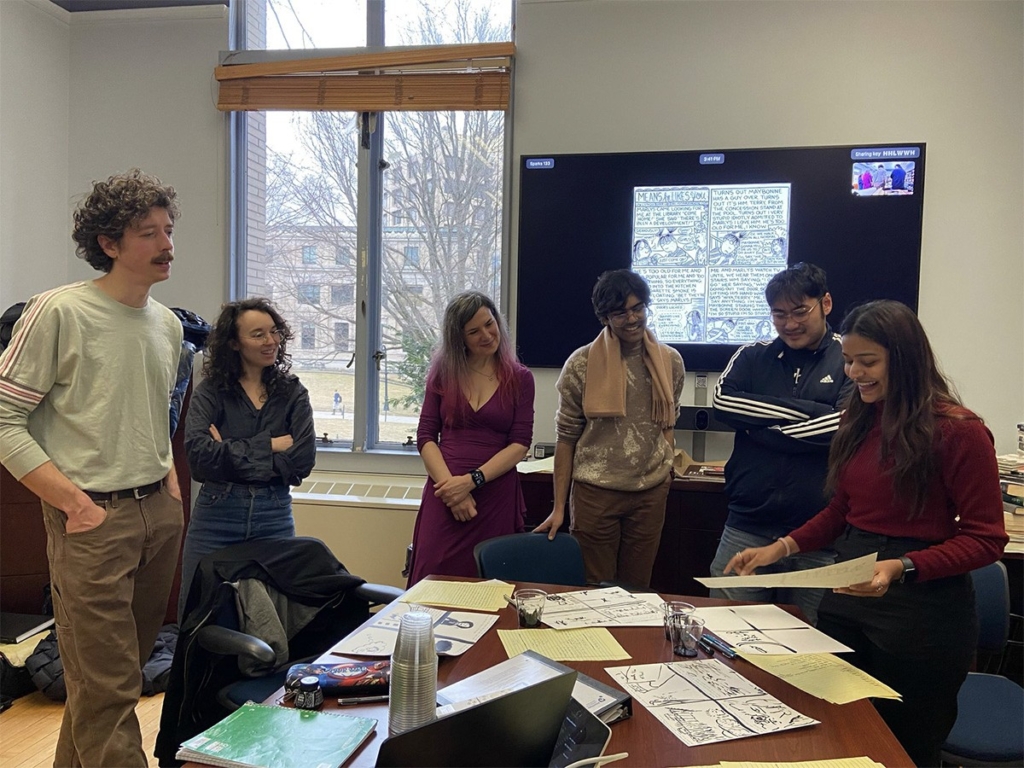
Students engaging with workshop drawings created in session. Photo credit: Kobi Kabalek.
During the follow-up event on February 26, ‘Inking the Unthinkable: A Sense-Memory Writing and Cartooning Workshop’, participants engaged in a drawing exercise to experience the creative process as an act of memory, observation, and communication. According to Libicki, this hands-on memoir comics workshop was inspired by educator/cartoonist Lynda Barry’s theories of creative concentration as “deep play,” and writing as “delivering an image.”
Workshop drawing exercise led by Miriam Libicki. Photo credit: Miriam Libicki and Kobi Kabalek.
Miriam Libicki’s most recent collaborative piece, ‘A Kind of Resistance’, was published in the anthology of Holocaust survivor graphic memoirs But I Live: Three Stories of Child Survivors of the Holocaust which received the Canadian Jewish Literary Award in 2022.
For further reading about the collaborative nature of Miriam’s art and the research behind her graphic narrative featured in But I Live, please click here.
‘A Kind of Resistance: Illustrating Holocaust Survivor Stories’ February 25, 2025 2:00 pm EST W043A Dewey Room Collaboration Commons, Patee Library Pennsylvania State University Event link: https://events.la.psu.edu/event/a-kind-of-resistance/
‘Inking the Unthinkable: A Sense-Memory Writing and Cartooning Workshop’ February 26, 2025 2:00 pm EST College of Liberal Arts – 133 Sparks Building Pennsylvania State University Event link: https://events.la.psu.edu/event/inking-the-unthinkable/