Archiving the Process: Interview with artist Gilad Seliktar on working with child Holocaust survivors
On June 18, 2026, Survivor-Centred Visual Narrative’s research assistant Nevaeh Bitzer and KULA director Matt Huculak had the pleasure to interview graphic novelist Gilad Seliktar via Zoom. Gilad has worked on two graphic novels with the SCVN project. The first being Nico and Rolf Kamps’ story Thirteen Secrets, which is a part of But I Live: Three Stories of Child Survivors of the Holocaust (2022). The second is Did They Forget About Us? (2026) which was recently released in German by C.H. Beck. This graphic novel shares Klaus Zwilsky’s story of surviving the Holocaust at the Jewish Hospital of Berlin.
This interview touches on Gilad’s process making graphic novels, and his experience working with the SCVN project and the survivors. The images seen throughout this interview were generated in process of making Thirteen Secrets, and are a part of the Kamp brothers archive for But I Live.
Nevaeh: When looking specifically at this archive compared to some of the others, there are around 1,400 photographs out of, I think, 1,500 archival items, which is a lot compared to the other archives here. What role do pictures play in the archival process for you?
Gilad: I think the way I create and use pictures is very important in my creative process. It starts with trying to turn complicated things into more cinematic comics. I want to show a few angles and play with it a little bit, like cinema with the camera. There is something about the way I cut and edit it that is more like cinema. If I have a thousand pictures for one scene, I can edit them in so many ways, and this helps me tell the story the way I imagined it.
Sometimes I see something in the reference, and it takes me in another direction that I hadn’t thought of until I saw that one detail in the pictures or perhaps in the field while I was researching. I think this started with my first book, Where Are You Anyway? It started with a digital camera that a friend gave me, and from there I developed the process from book to book.
Matt: You mentioned just now that when you go back through the photographs, you might notice something that you hadn’t noticed before, and then it becomes part of the storytelling. Do you have an example of that from the Kamp brothers?
Gilad: I can tell you where that starts, how to look at things, or what to look for. Most of the time, it’s about looking for mistakes. Sometimes you take the wrong picture, or someone moves aside and doesn’t take the position you want them to take, and something happens. I learned to listen to the mistakes.
In my second book, I took pictures to document a village for one of the stories in Farm 54. It was a story set in the 1980s about the army and soldiers going to a village and blowing up a house. So, I went to the village and took pictures. I had very tight deadlines—I had about one week to send the book to the publisher. It was my first big book.
I took the pictures with a very old digital camera, around 2007 or 2008. When I went home and developed the pictures on the computer, they were not what I had intended. But I noticed one picture that was the perfect ending for the book, and that became the last frame. From that moment, I knew that I could use everything. I need to observe, and I have to go outside and explore and investigate, because things happen when you go outside.
With the Kamp brothers, as Nevaeh wrote about the rabbit candles, we went to their house and started the interview, suddenly, we saw two rabbit candles, just like in the story. Nico had a white rabbit, and Rolf had a black rabbit. Suddenly, there were candle rabbits. It was the perfect image for the beginning of the story, from my perspective. I knew it was going to be in the story. If we hadn’t gone to their home, we never would have seen that, and nobody would have thought, “Listen, there’s a rabbit candle.” I had to be there and see it. When Charlotte and I saw it, we were both like, “Whoa.” We couldn’t believe what we were seeing.
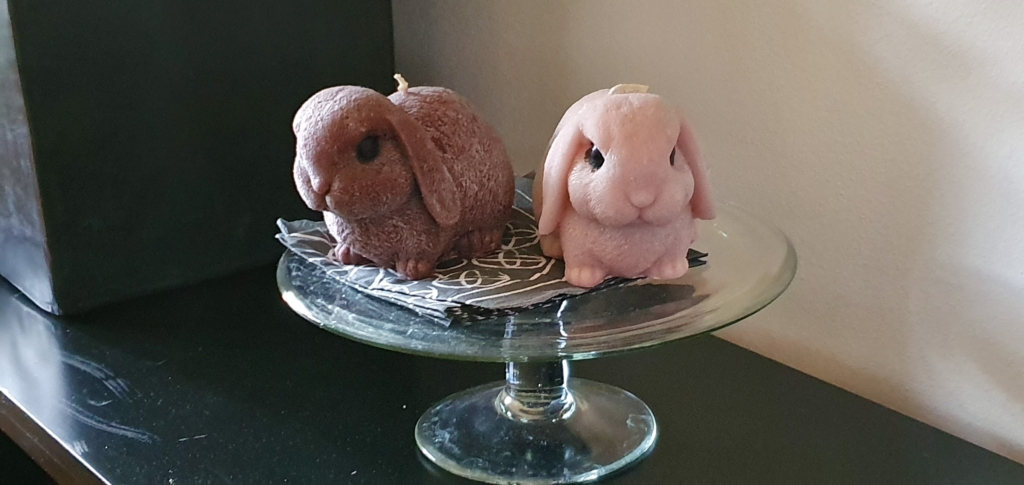
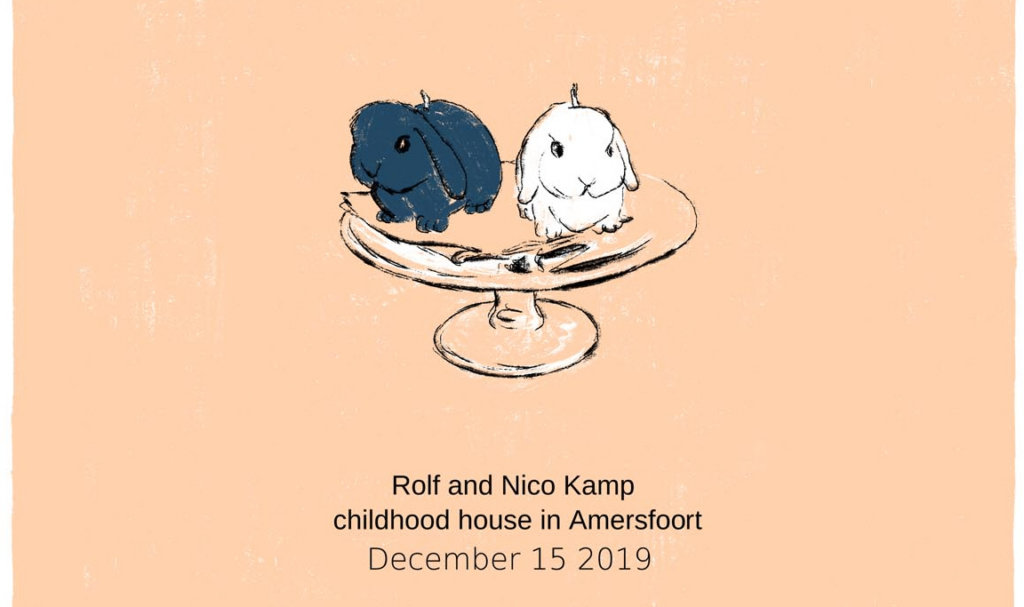
Top: Photograph of two rabbit candles on a platter. Photo by Gilad Seliktar. Bottom: Draft of the introductory illustration for Thirteen Secrets. Illustration by Gilad Seliktar.
Nevaeh: Looking at your digital templating, you have all the pages set up, with two or three photos underneath every page template. Is that how you work with all of your books, just to incorporate these photos and visuals?
Gilad: I think that was at the beginning, when I was using the Miro board application. It’s like a big digital wall that you can zoom in and out of. I had to try it, but it didn’t last long because I love putting things on the wall and seeing them.
When I sit in my studio, most of the time the entire space is covered with pictures, pages, and the process of the book. I look around and think about the book, and suddenly I see something on the other side of the studio. I see a page and think, “Okay, maybe I can put it here.” Everything is always moving. On the computer, in Miro, you need to go into each page.
After a few weeks, I left that behind and moved to pencil and paper. I think there are a few pictures of that. I used yellow notes, like square notes, and tried to find the order of the memories. I was trying to find a way to organize my thoughts. Most of the time, though, I work a little messily, and that’s the way I work. I find my order in the mess. Maybe that system was too ordered and too direct. I like to feel the materials a little bit.
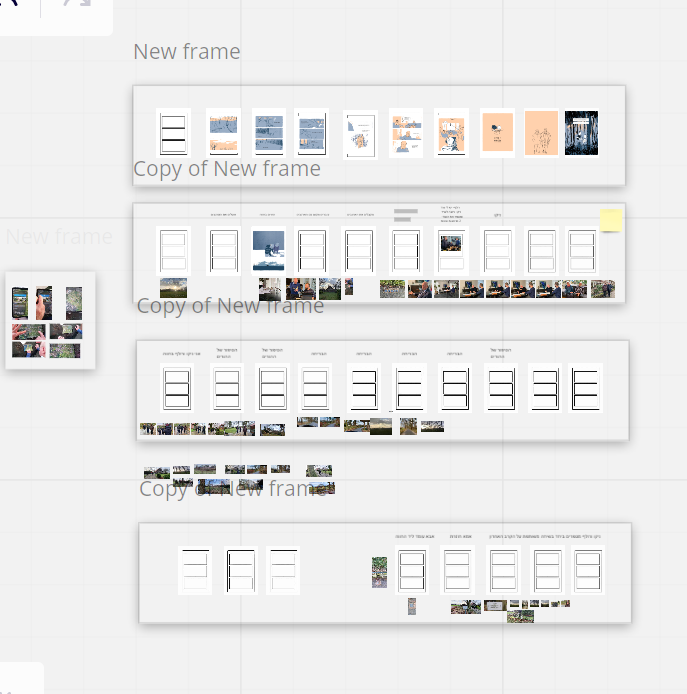
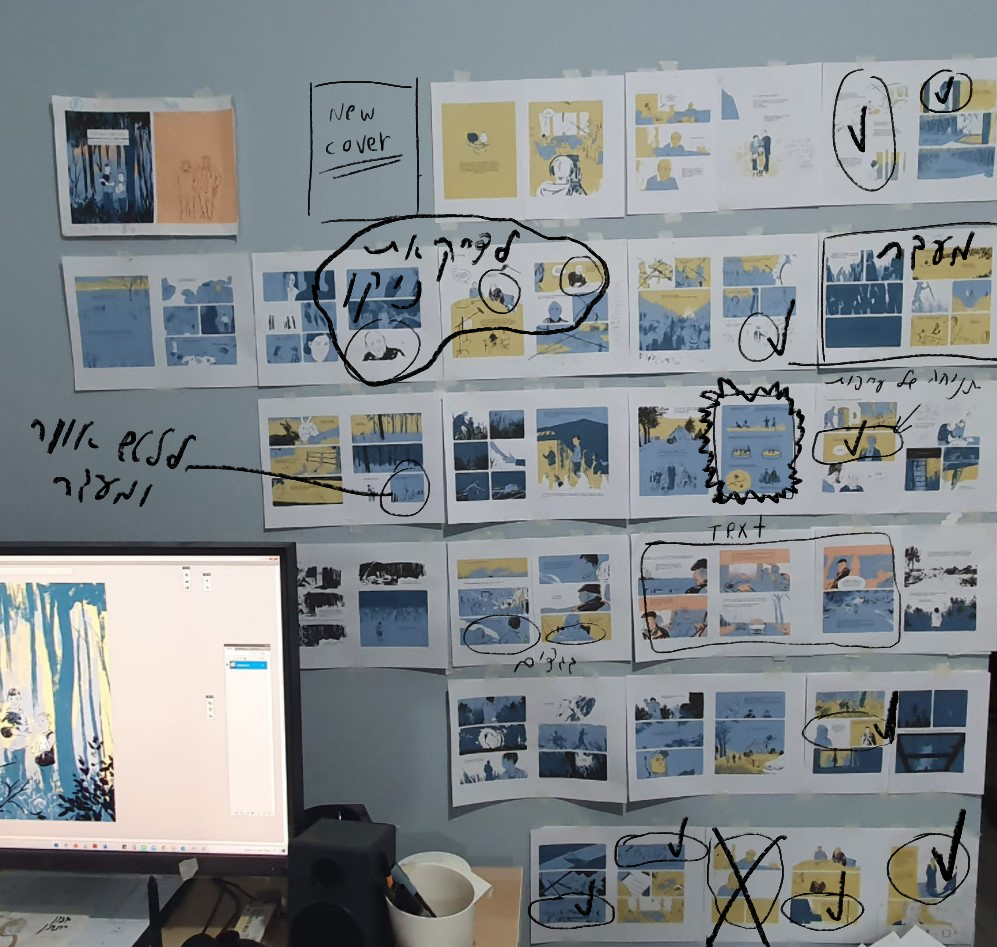
Top: Gilad Seliktar’s Miro board for Thirteen Secrets. Bottom: Photograph of Gilad’s office wall covered in draft pages for Thirteen Secrets. He has drawn and written notes on the digital image. Photo by Gilad Seliktar.
Nevaeh: When you began creating this graphic novel, did you know that you wanted to incorporate the interview into the novel, or is that something you developed while interviewing both brothers?
Gilad: I think that most of the time—again, it was my first book—it was very important to me to show Nico and Rolf in the present. The book focuses on a few months or two years of their lives in the past, and I think it’s very important to tell that story. I think there is a place for the present because it shows what became of them, how they see it, and their perspective from the present. It was very important to me to show them as they are now.
Because it was my first documentary comic book, I tried to find a way to start the story before introducing their memories. I had to find a way to tell the story. The present is a very good place to start because if I begin by talking with one of them, I can go anywhere I want from that point. It’s a way to start the book, and I did it again in Klaus, in a slightly different way. I think it gives me a center. I would say it’s like the ground. It lets me use my imagination a little bit because I always have a way to return to it. It’s like going back to a moment. It’s very intimate.
Nevaeh: When you read a book or look at other graphic novels, all you see is the finished product. But I’ve seen how much this changed, specifically the colour palette—from that peachy-orange colour to yellow in the finished product. Why did you make that colour switch?
Gilad: I think it was very intuitive. I always start with a peach colour. I always begin with that; I don’t know why. Then I find my colour palette.
I don’t have a very good explanation for the change. Maybe one day I started playing with the colours and stayed with that. Perhaps the colour was a little too dark in the printing. I’m not coming from a design background, so I play with colour like a painter. I change the colour without thinking about how it will print.
In the new book, Klaus, I worked with a designer, so I think the colours are more exact. He gave me the numbers [Hex code numbers] and adjusted them to one colour. With the previous book, it was different. Again, I learned from that experience. In the end, it could have been white instead of yellow. For me, it felt like the right direction, so I just went with it.
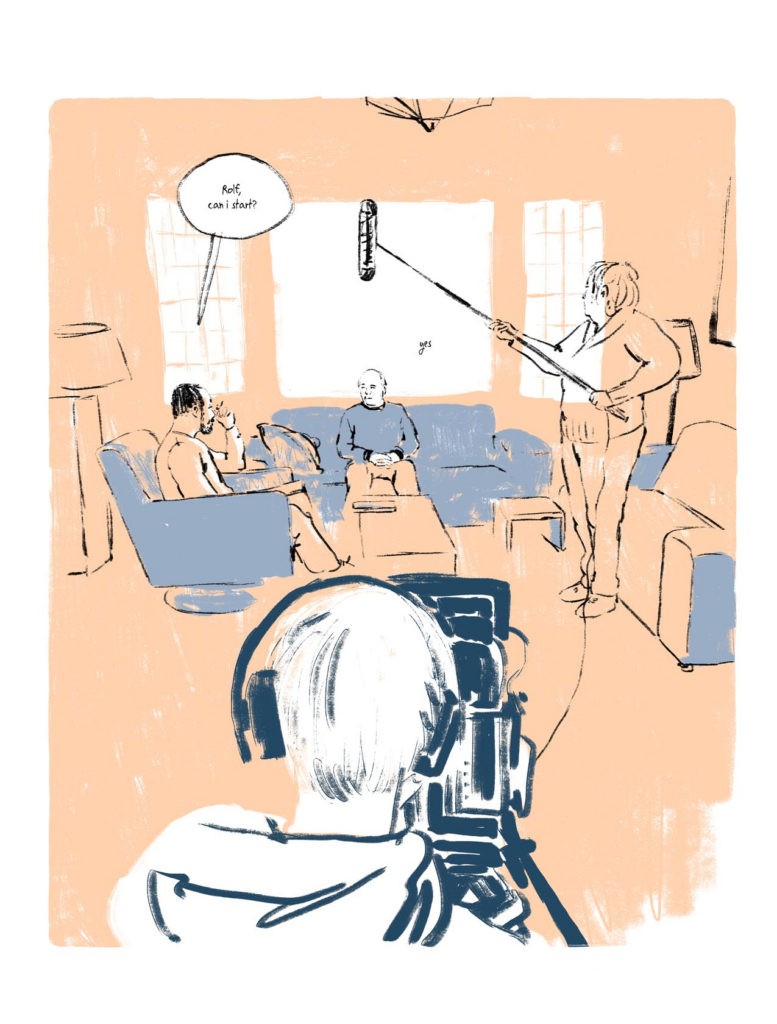
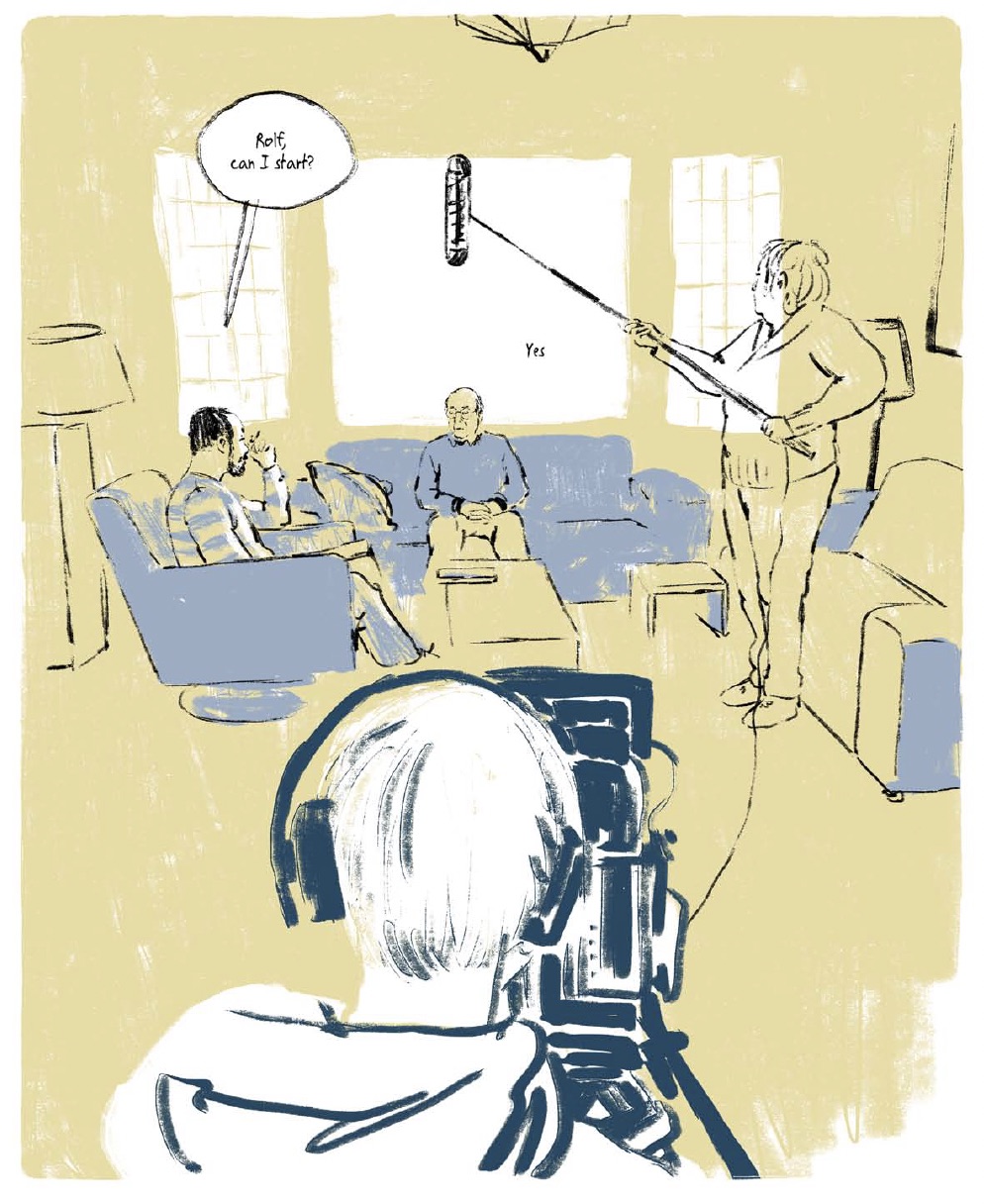
Left: Draft of page 43 from But I Live in peach. Right: Finalized page 43 from But I Live (2022). Illustrations by Gilad Seliktar.
Nevaeh: Can I ask about your use of translucent paper in the process? I saw that there’s a seven-second video of you layering images over one another. What does that do for your process?
Video of Gilad using tracing paper on a photograph taken in Achterveld. Video by Charlotte Schallié.
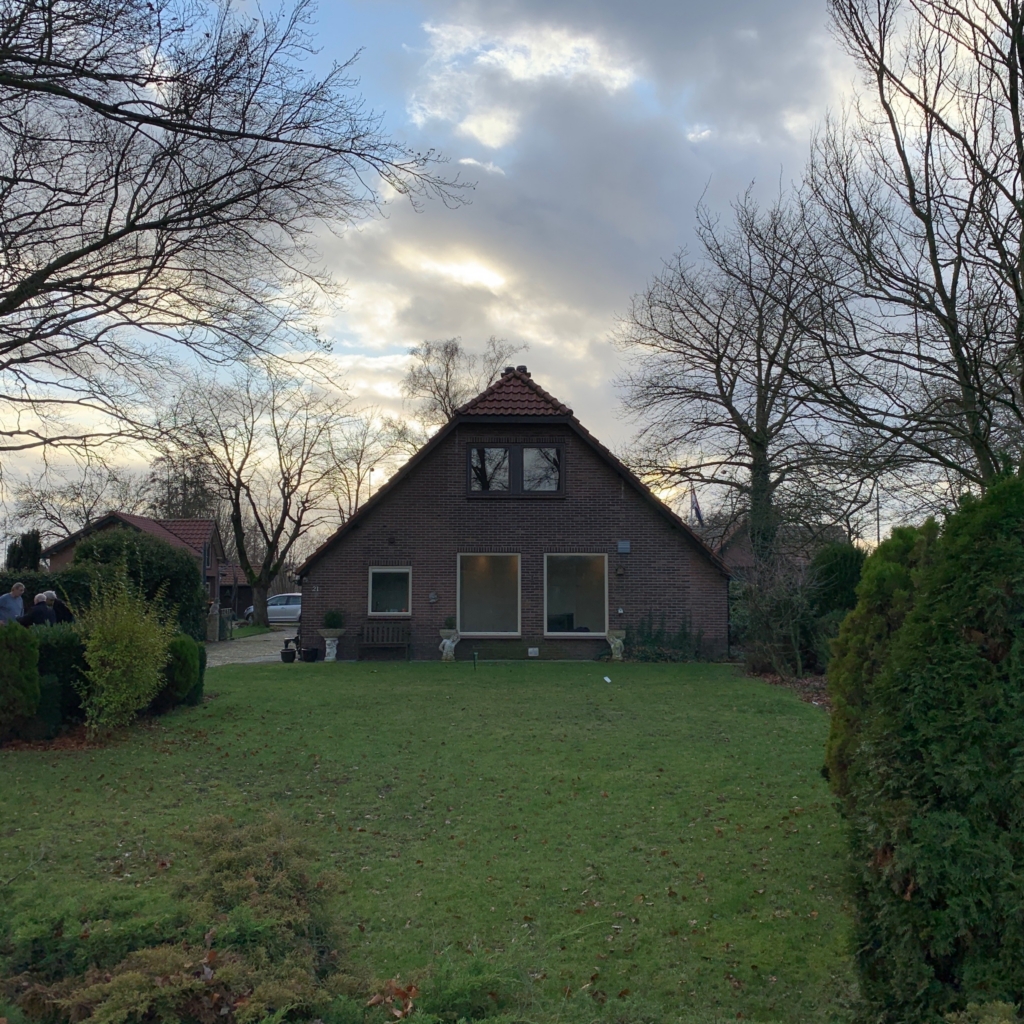
Farmhouse in Achterveld. Photo by Charlotte Schallié.
Gilad: It’s 90-gram paper. I work with it all the time because it’s very easy to use. You can turn it and play with it, and you don’t have to use a light table. A light table is very difficult to work with. I don’t like using it too much because I need to prepare everything, and I like to work right away without thinking too much.
The materials I work with, like Panda oil pastels and graphite, work well on that paper, so it’s very important to me. In Klaus, I worked with transparent plastic paper, so the ink doesn’t dry on it too quickly, and it works a little differently. I always try to find materials that work well with the process.
I saw that you asked a question about digital tools [What role did digital art tools play in creating the graphic novel?]. Most of the time, I try to find the right way to work with the materials and the concept. With the Nico and Rolf book, I worked digitally, but I drew it. Most of the time, I work analog with pencils, and only at the end do I transfer the work to digital. I found a digital pencil that works like my regular pencils, so I stayed with that. But I didn’t plan it ahead of time because I didn’t know what the book would look like in the end.
Nevaeh: Did you find that working more digitally resulted in less draft material, just because of the way you edited in the app?
Gilad: I wish it resulted in less draft work, because I draw each painting and each drawing several times. I think I drew each book three or four times before I created the final draft. There are a lot of drafts and a lot of material.
I usually spend two years—or often even longer—looking for the style of the book. For my previous book, Tsav 8, it took about three years to figure out how I wanted to work with the colour and the 90-gram paper. What would the colour palette be? Would I use coloured pencils throughout the book, or perhaps Panda oil pastels? I didn’t know, but I tried. I drew a lot of the book again and again until I found the right direction.
With the Nico and Rolf book, I tried working with a monotype print. Because it was a very short story, I thought it might be too much to go back to the past and change the style; the changes would happen too quickly. I took that experience and applied it to Klaus. I used that approach in Klaus because it was longer and broader, so I had a lot more space to play with it.
Each experience takes me to the next book or project. I always take something from each experience, even if I don’t end up using it.
Nevaeh: How do you feel the process has changed from making such a small graphic novel, like in terms of pages, compared to Klaus, which is quite large in scale? How do you change the way you work with the material and present it?
Gilad: I have more space. For me, it’s the perfect match because I can play with it, stay with the book much longer, imagine things more broadly, and jump from the past to the present.
In Klaus, I play with the structure. The first two chapters include interviews with Klaus and his wife, Roberta Safer, and then with Aubrey Pomerance. Then I go back to Klaus, and Klaus goes to sleep on the couch. Suddenly, in the third chapter, we are in the past. I couldn’t do something like that in a 14-page book. It’s something you have to build gradually. I made the book longer because I wanted to create that effect. I tried to find a different way to tell this kind of story. My previous book was 200 pages, so I had some experience working with longer stories.
I have to say that after we made But I Live, making another anthology with one very short story would have felt like doing the same thing, and I didn’t want to do that. Of course, I told Charlotte that I would do whatever she wanted because I trust her and like the process. I enjoy working with the whole team; it’s been a very good experience for me. But artistically, I wanted to do something new. I had never done anything like this before. Again, I tried to find a new way to tell a documentary story.
Nevaeh: How important was it to use the historical photographs from the Kamp family photo album when trying to create a vision of what the boys looked like when they were younger, as well as what their family looked like, since you never met them?
Gilad: This is tricky because my style is somewhat realistic. You lay down a realistic environment—it’s like real people—and sometimes I try to find the middle ground. Because I started with Nico and Rolf in the present, I couldn’t go too far into the past. If I’m drawing Nico and Rolf exactly as they are in the present, I have to find a way to draw them as closely as possible to how they look in the photographs from the past. They didn’t have many pictures.
In my books, when I tell a story based on real people or a real experience—whether it’s autobiographical or something else—it’s usually about me. But here, it’s about two children. I had to find children who looked like Nico and Rolf, and finding the right people was always in the back of my mind.
My son, Yonatan, has two brothers in his school. One day, I went to pick him up at the end of the day. I sat in the car, and suddenly the two boys walked past. It was like in a movie, in slow motion. I suddenly saw Nico and Rolf walking. They were almost the same age as Nico and Rolf, and they were brothers who played with each other. The older brother was a little mean to the younger one. They were acting exactly like brothers. I asked their parents, whom I knew, and they agreed to be part of the project. For me, that was when the project started to move forward. I had Nico and Rolf in the present and the perfect Nico and Rolf in the past. The boys looked alike and played along with the story. I had the way they looked, but they also had the way they acted. You can’t draw people acting like brothers. If you find the right reference, you have an actor, their expression, their age, and the way you want to draw them. You have most of the elements you need to draw someone who feels real. I think that’s what I’m trying to do with the books: take you into the book. You’re supposed to feel that you’re in a real place.
I also used reference pictures from books. In the 1990s and in 2008, there were forums, from Facebook or something like that perhaps Facebook or similar sites. Later, I used references from the internet, history books, and the library. I use everything I can. It’s a little bit like a collage. I try to collect things and play with them, and then I think the style and materials make the difference. It’s like giving them a new life.
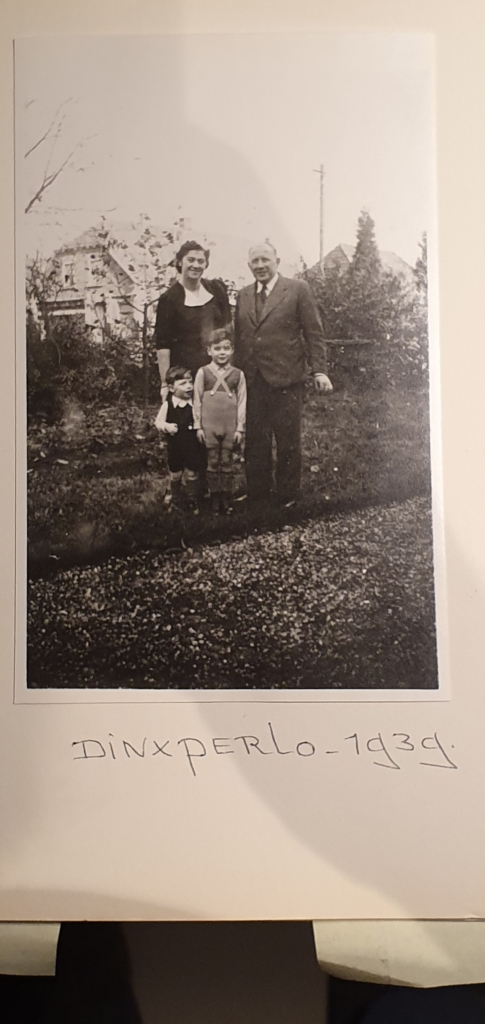
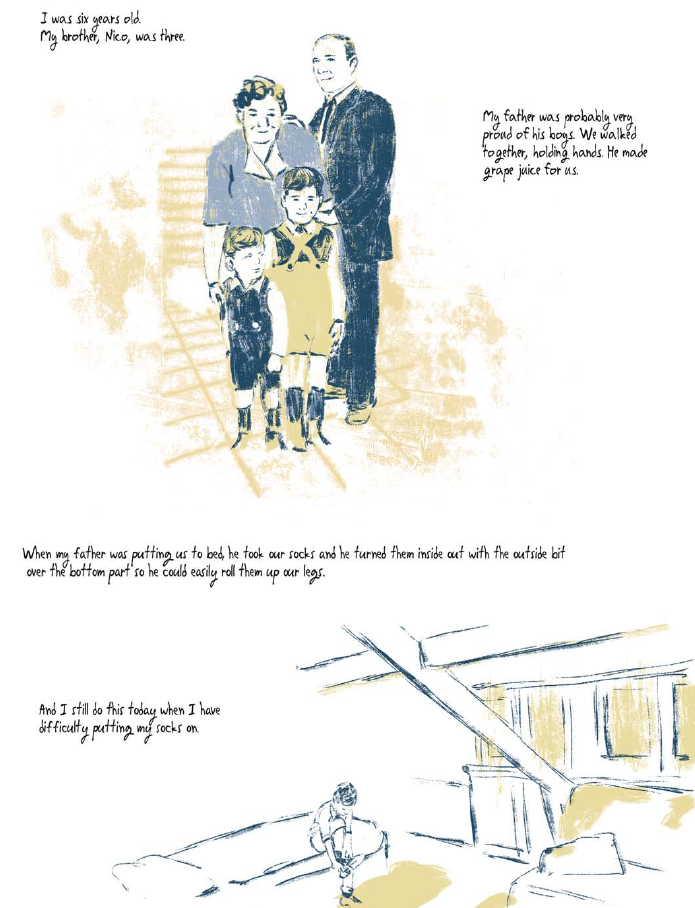
Left: Photograph from the Kamp family. Right: Page 45 from But I Live (2022). Illustration by Gilad Seliktar.
Matt: Gilad, I want to go back even further—or perhaps further out into the future—and ask you two questions. First, what does the word “archive” mean to you in terms of your artistic practice? Second, 50 or 100 years from now, what do you hope people will know about the artistic process behind this project—something they might not necessarily see in the material that remains?
Gilad: From my perspective, when I look at the process of other artists, that’s where I learn everything. If I look at someone’s drawing, I can see the nuances. I can see the way they move. I think that’s where I learn the most. I hope that if someone reads about or sees the process, they might learn something from it. More importantly, perhaps they can understand how I create, from my perspective.
Again, I think the same thing happened with Klaus. Most people who work on something will tell you that the next time it will be different. I always tell my publisher, “Next time, the book will be funny,” and then I do something about the Holocaust. Then, with the next book, I say, “I’ll do something very short,” and it ends up being 200 pages. What I think is important for people who see the process is that they let it carry them. Don’t think too much about what you want to do—just do it. It will take you somewhere.
And, of course, you need to find the right partners. That’s very important.
Matt: Speaking of that, I would love to have a little oral history about how you met Charlotte. For those who don’t know her, Dr. Charlotte Schallié is the lead of this project. She’s the one who brought everyone together: the artist and the survivors. How did you meet Charlotte? When she proposed this idea to you, what were you thinking? What did you expect from it, and what ended up happening?
Gilad: You never know what will happen when someone approaches you. Sometimes people send me emails, and I don’t answer them because they don’t catch my attention, or perhaps I forget. Things like that happen. If I remember correctly, Charlotte wrote to me on Facebook or something like that. She told me that Barbara Yelin, a graphic novelist with the SCVN, had recommended me. I knew Barbara, of course, and I had met her in Berlin at one of the festivals where we were on a panel together. I think she’s a great artist, and we have a very good relationship. When Barbara sent her that link, I thought, “Okay. If Barbara told her about me, I have to talk with her and see what we can do.”
I remember telling Charlotte that it was very interesting. It was something I hadn’t done before, so I was very curious. I told her that I wanted to do it, but she had to promise me one thing: that I would have complete freedom to do whatever I wanted. She has kept that promise to this day. I think that was the most important thing. If I’m going to give 100 percent of myself to a project, I have to know that I’m in the right hands. That’s why I came back, and we continued working together.
Then, of course, I met her in the Netherlands, and we developed a very good relationship. She took the pictures, and we had a great time together. For me, as an artist, to see someone take on a project of that size and stay with it is remarkable. It’s a very unique and ambitious project. She gave, from the way I see it, 200 percent. So, when I work on it, I feel comfortable doing everything I can to make the project as good as possible.
Matt: The results speak for themselves. It’s beautiful work all the way around. My last question concerns your process and the independence of your creativity. What was it like to work with the survivors and co-create the images? How was that different from your previous work, and has it shaped who you are as an artist moving forward?
Gilad: I have to tell you that, in the way I work, I can sometimes work on one image for two weeks or even longer. It’s a little bit crazy. You can’t bring someone into that process. I can’t start sending Klaus pictures and asking, “Maybe this one? Maybe that one?” I’ve been working on the new cover of the book for about four months, and I haven’t finished it yet. It’s like a nightmare, but I don’t mind because I’m sure we’ll find the right cover. I didn’t show it to Klaus because I didn’t want him to start asking himself questions. It would be too much.
During the process of making the book, I usually show the materials only at a few points because I need to give myself space to explore. It’s a risk. Sometimes you show someone a page that you think is very good, and they say, “Hmm,” because it isn’t finished yet. They can’t understand it because it’s in the middle of a thought. You throw it onto the page, and not everyone can understand that because it’s very difficult to process. So, with Nico and Rolf, I don’t think I spoke with them until the book was finished. With Klaus, I showed him things a few times during the process. He’s a very kind man, and he gave me freedom.
But, as an artist, I’m sensitive to whether someone isn’t fully comfortable with something, doesn’t like it, or feels uncomfortable. I always try to listen and notice those reactions when we’re talking or on Zoom, and then I change it.
Matt: It sounds like you seek that balance through empathy. Because you’ve met the person and have a personal connection with them, you have a visceral sense of what they might like.
Gilad: I would never do anything that would hurt him or make him uncomfortable. I appreciate his time and everything else. When you’re working with someone, you have to trust them, and they have to trust you. If that doesn’t work, it becomes a problem. I’m sure every artist has had a bad experience when something isn’t working. Sometimes you illustrate a book, and suddenly the writer starts calling you at odd hours: “What’s happening here?” or “It’s not right,” or “I don’t understand.” Things happen. In this project, I think everything is in the right place. The heart is in the right place, and that’s very important. When you work with survivors, you want to give them the safest place you can.
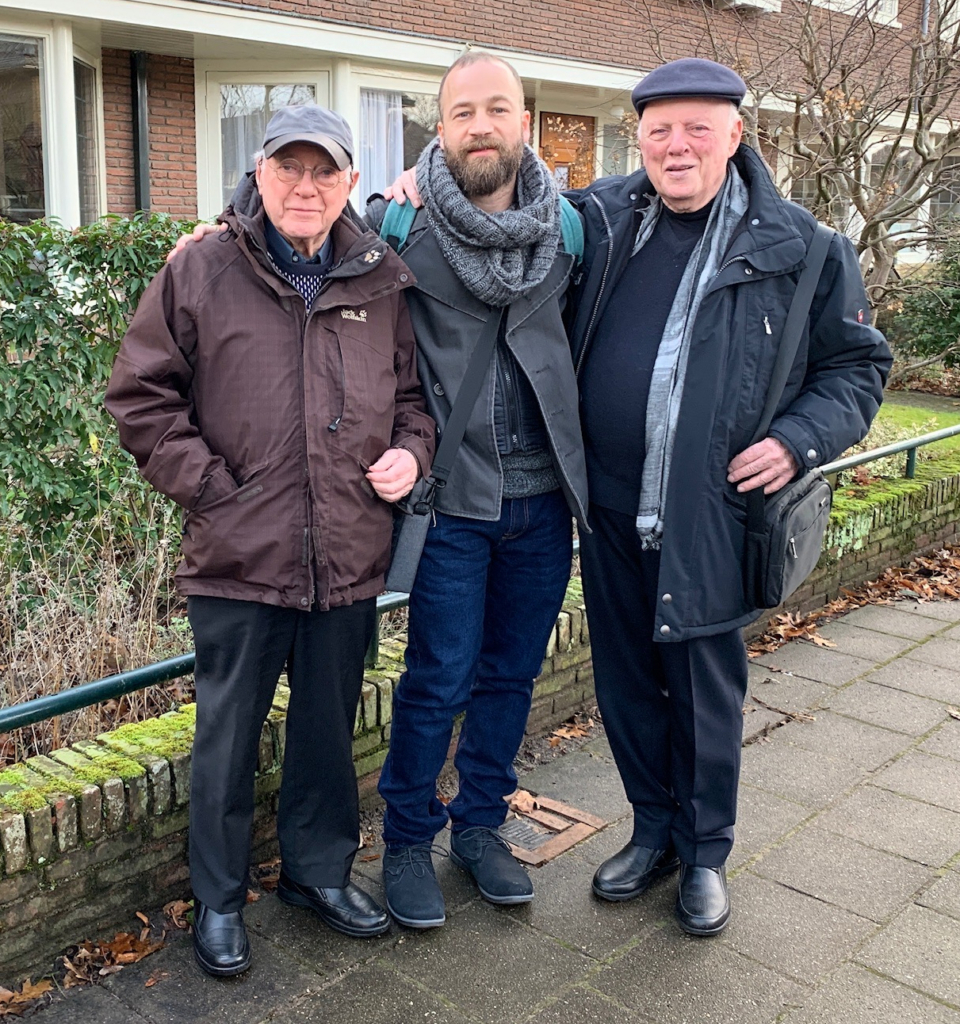
From left to right, of Rolf Kamp, Gilad Seliktar, and Nico Kamp outside the Kamp childhood home in Amersfoort.
Photo by Charlotte Schallié.
Nevaeh: Going back to something you said about not liking to present half a thought, is that why there is so little draft material in this archive specifically? Was it because you didn’t want those half-formed thoughts in the archive?
Gilad: Yes, I think that’s part of the reason. Archives often want you to present everything—the moment you have it, even if it’s in the middle of the night and you’ve just made a drawing. For me, it’s very personal. The process is interesting, and there are things I’m willing to show, but I have to feel very comfortable with that. You don’t show half-finished work—or at least, I don’t.
When we included the diary and interview at the end of But I Live, I didn’t want to show too much of the process. I remember that when we eventually showed something, I didn’t feel very comfortable with it. But I trusted everyone, and it ended up very well. That’s why, with Klaus, I didn’t talk about the process. I talked about the experience because the experience is what’s interesting for me to tell the reader. For you, I can show the process, and perhaps in the archive it’s part of the project. Now, the canvas is a little bit bigger.
But I don’t know. Maybe in the new book I’ll have more material. I have a lot of material, but I still need to photograph it and send it to the archive, right?
Nevaeh: I think this is such a good conversation to have because sometimes you can forget that care-based practices also should extend to the artists themselves. We’re protecting the survivors and we want them to feel comfortable, but also you, in your process, because what we’re sharing is what we want you to be comfortable with sharing.
Gilad: Yes, it’s very important. Each artist is different. Each one has their self-confidence. You know, sometimes you don’t want people to see you when you wake up. You want to put something on yourself, something that looks right and you have your self-image. I think artists have that in their art too. They don’t talk about it much, I think. There are artists that don’t want people to take pictures of them at all. It’s like they are names on the book and that’s it. So, for me the sketches are like the most way to expose myself.
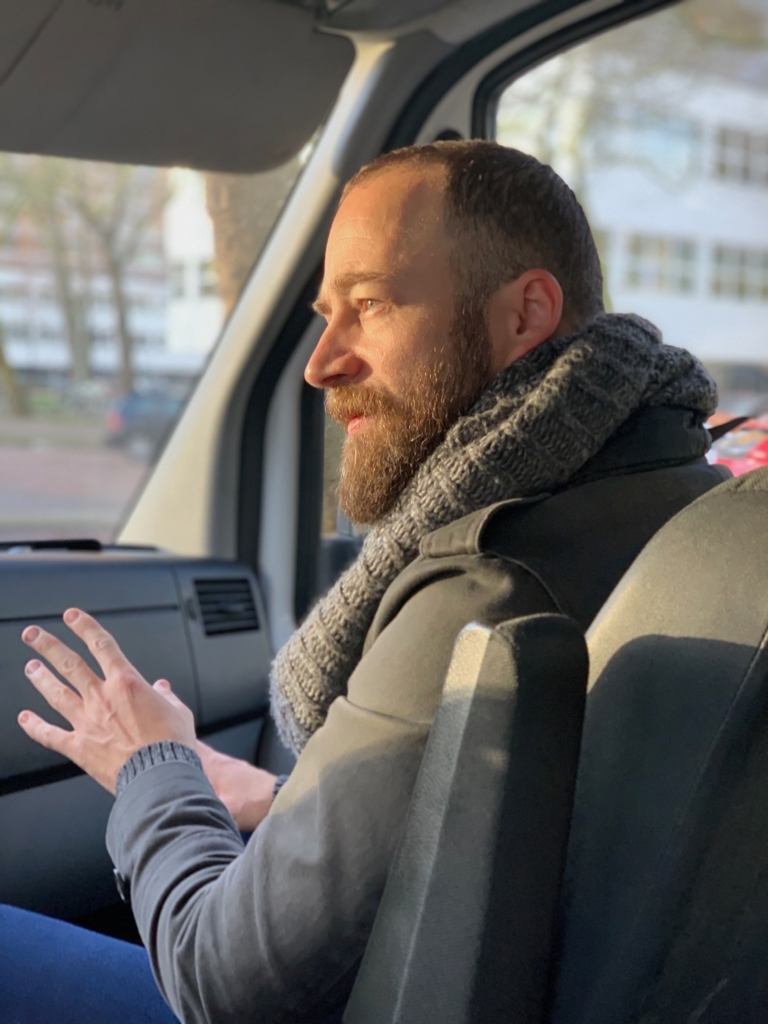
Photograph of Gilad Seliktar from the archive. Photo by Charlotte Schallié.
Nevaeh: That was very lovely to put it that way. Thank you. And I think that is now officially the end of our questions.
Visit Gilad’s website to learn more about his work here.
Learn more about SCVN’s But I Live here.
The German release of Did They Forget About Us? is available for purchase here.
Works Cited:
Schallié, Charlotte, editor. But I Live: Three Stories of Child Survivors of the Holocaust. University of Toronto Press, 2022.
Seliktar, Gilad. Interview by Nevaeh Bitzer and Matt Huculak. Survivor-Centred Visual Narratives, Zoom recording, 18 June 2026.