Survivor-Centred Visual Narratives

Author: Jennifer Sauter

Filming Anonymity: Interview with Olaf Markmann

The following interview is adapted from a conversation on January 23, 2026 between SCVN Media Lead Maya Wei Yan Linsley and filmmaker Olaf Markmann, who worked with SCVN’s Iraq/Syria Research Cluster on the documentary short film “I Just Keep Going.” Olaf’s film offers a glimpse into the collaboration between comic artist Birgit Weyhe and Yezidi survivor Jilan (pseudonym), and explores Jilan’s experiences in northern Iraq when the Islamic State (ISIS) began a genocide against the Yezidi people in August of 2014. Since Jilan’s identity remains anonymous, Olaf’s approach required sensitivity, confidentiality, and technical skills to conceal her while filming and editing. This interview explores Olaf’s approach to filmmaking, how he connected with the SCVN project, and his considerations when filming with Jilan to ensure her privacy while sharing her experiences.

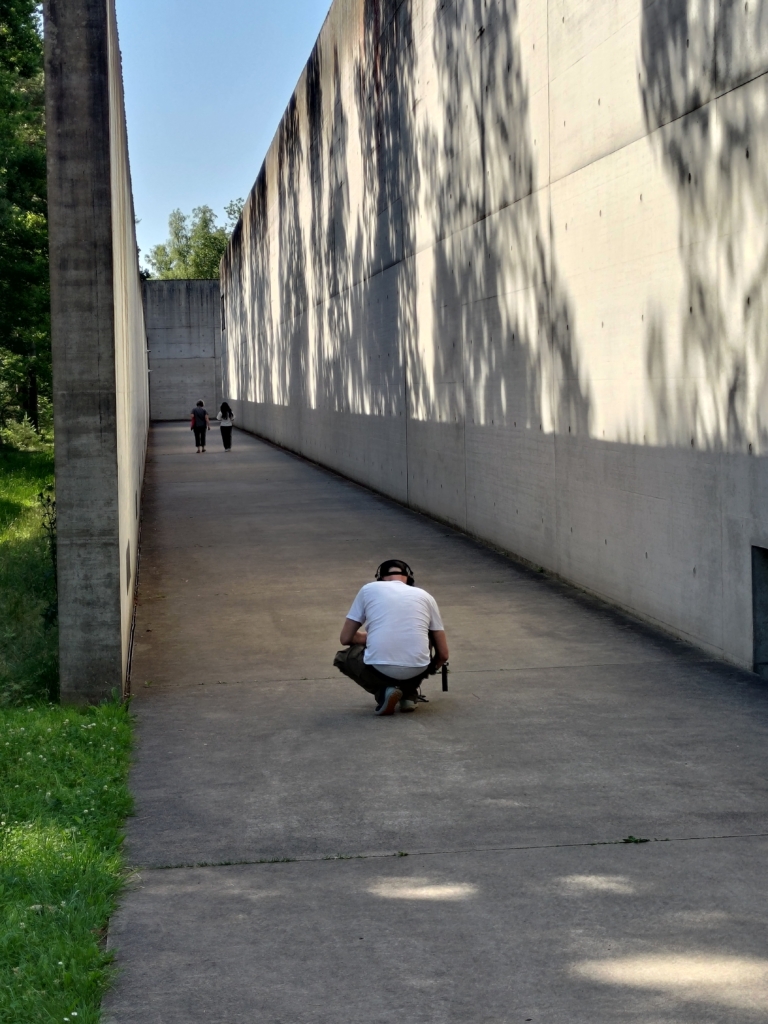
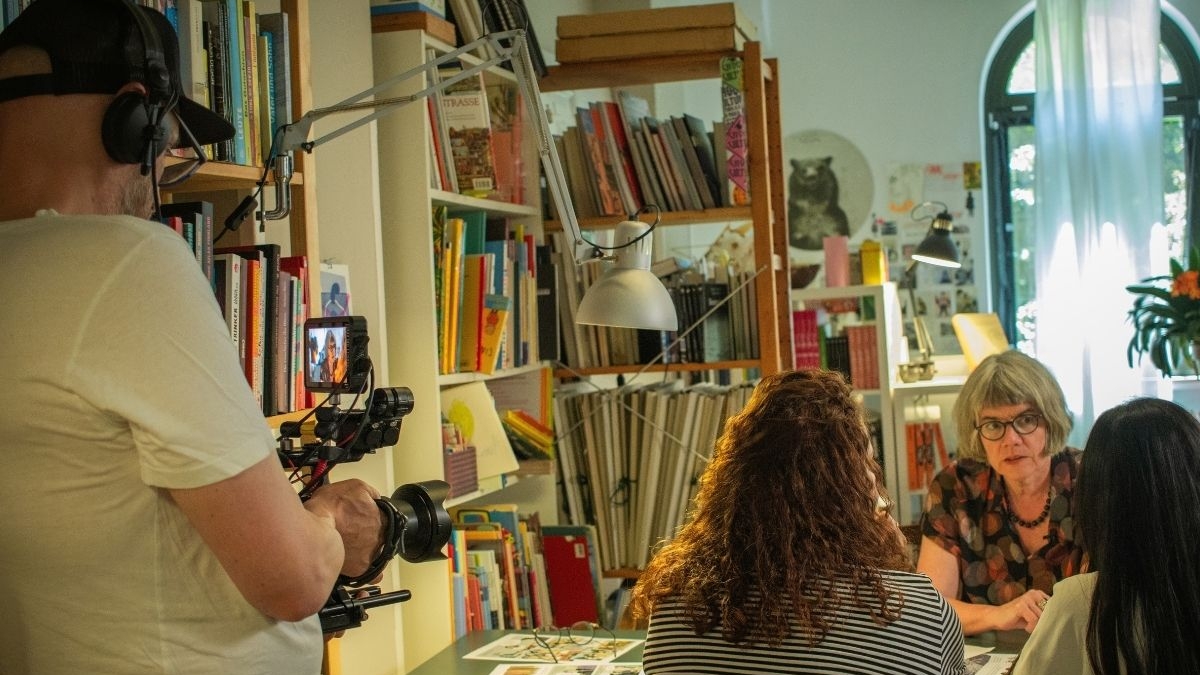
Olaf Markmann filming for “I Just Keep Going” in Birgit Weyhe’s studio.

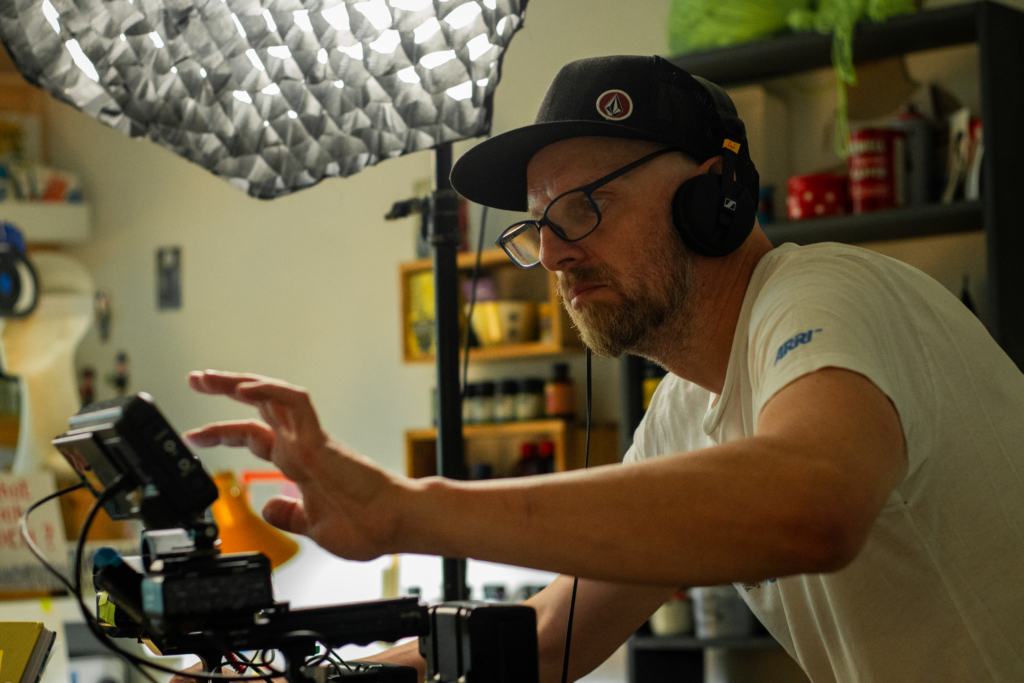
The photographs featured in this interview are a behind-the-scenes glimpse of Olaf’s time filming with Birgit and Jilan in July 2025. The photos from Birgit’s studio were taken by Elif Eker and the photos from Bergen-Belsen Memorial were taken by Kjell Anderson.

Maya: Thanks for being here with me. Let’s talk about your film. How did you end up working with SCVN? How did you find the project?

Olaf: SCVN actually found me through Leyla Ferman. I used to work with her, years ago, on a Yezidi project. We did a couple of interviews for her project, and she now and then seemed to work for SCVN, and recommended me.

And so, one morning I woke up and had an e-mail from Jennifer [Sauter] saying, “Hey, we have this recommendation from Leyla, and we have this film project with a lot of information, and read through it, take your time and let me know what you think.” And I went through it, having my coffee in the morning, and I was like, that sounds really great! I’m always in for a good cause. And then I said, yes, of course. That’s how I got on the project.

Maya: You were working on something related to Yezidi stories before?

Olaf: Yes. With Leyla together, we had a project for a memorial organization in Germany. There was a project funded for only two years. Leyla is Kurdish herself, but she knows the language. So she was perfect for doing the interviews. And we had like, I don’t know, 12 or 15 interviews of Yezidi survivors from the 2014 genocide in the north of Iraq.

I have a legacy of doing interviews for the memorial for Bergen-Belsen, for the concentration camp, and for the Nazi prison in Brunswick and Wolfenbüttel. I did close to 100 interviews for the memorial with survivors, with second generation survivors, sometimes third generation survivors, because you have family traumas. 

And that’s where we met, because I’m recommended internally at the memorial. And then I met Leyla and then we did the Yezidi project.
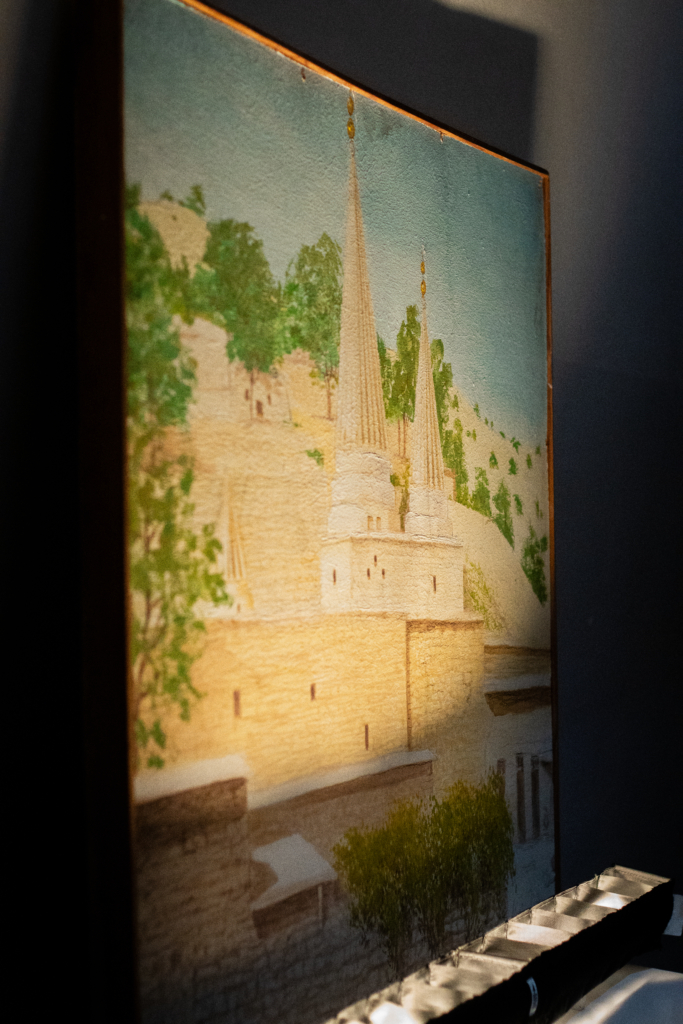
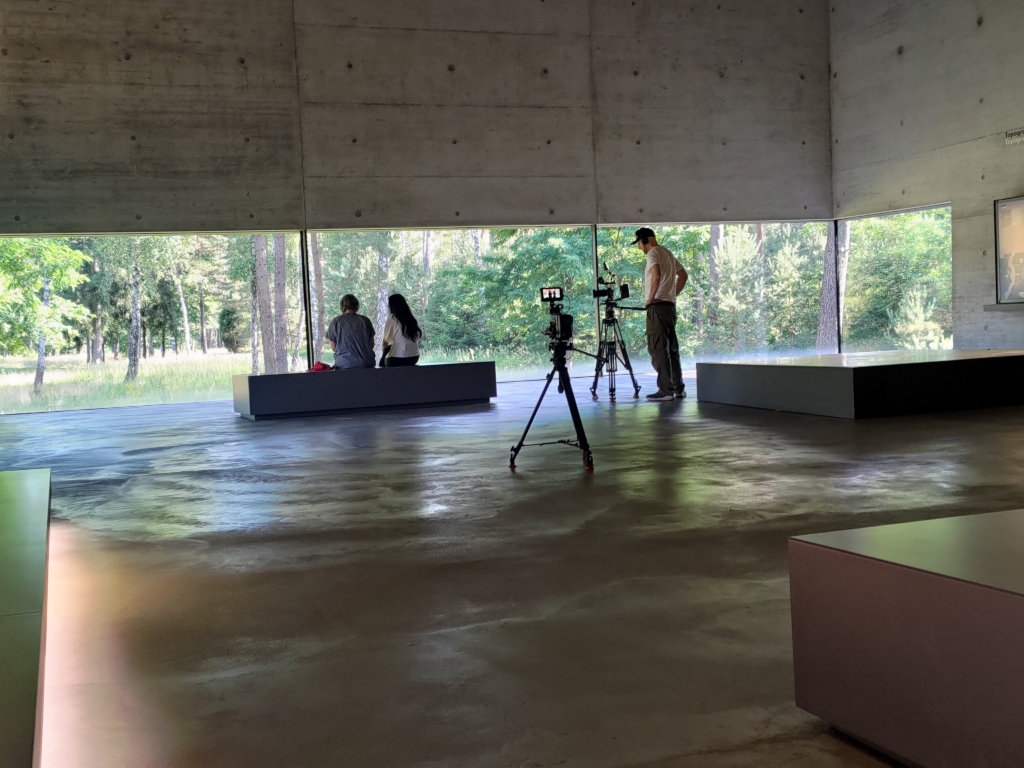
Right: Tapestry depicting a Yezidi temple. Centre & left: Olaf films Birgit Weyhe and Jilan at the Bergen-Belsen Memorial.

Maya: That’s really cool. How did you come to start doing that kind of work? Were you always interested in that?

Olaf: Not necessarily. It was because of a colleague that was asked by one of the interviewers from Bergen-Belsen. They had a first round of interviews [with Holocaust survivors]– let’s say in the late 90s or beginning of the 2000s – collected for a big exhibition, which was with post-production and everything, and planning a lot of work that took years. It kind of silenced all these interviews for a time.

Then Diana Gring, from the memorial in Bergen-Belsen, asked a colleague that she knew, [and] he asked me because I have all the gear. And then I talked to Diana, and we liked each other and started working [together] in 2010.

Maya: I like hearing about how people’s journeys have led them to where they are now.

Olaf: The beginning of the story is usually a really, really tragic one. Everybody has lost someone in the worst way imaginable. And that is the bad part of the story, which you have to hear if you want it or not all the time. There are similarities in those stories, but they all differ from the point when they leave the concentration camp, of course, because if they don’t leave, I wouldn’t interview them. And then that’s when it becomes interesting.

And most of the people are really nice people, thankful people, decent people. Most of them made something out of [their lives] because, “Hey, we survived the hell in a concentration camp. What else can kill me? Come on, let’s go for whatever life throws at us.” And it grounds me. It used to ground me a lot when I did these interviews back then, because I worry about things. I worry about my health, I worry about my family, I worry about taxes. 

And when I go out of these interviews, I’m like, my life is perfect compared to other people, really. It’s warm in my room. I have something in my fridge. There’s still some money in my bank account. We’re all kind of healthy. And we live in Germany. It’s good. Really, it’s good.

It’s good to have this kind of interview going on. And I tell those people a lot of times that I’m always a little grounded and very thankful for what I have when I’m going out of these interviews, because of the stories that you hear that you sometimes really cannot believe.

Maya: And so with Jilan’s story, how did you feel while you were making her film, and how were you taking care of yourself?

Olaf: The thing is, she speaks German because she’s been living here for 10 years. She speaks very good German. But once she gets emotional in her story and goes really deep in, she switches to Kurdish, so I’m not able to understand. And this is why we have Leyla also in the movie to translate.

Birgit, the comic artist, who is talking to her, understands what she’s saying. And in post-production, I got the transcript from the interview, and most of the things I first heard then, or I read then, because I couldn’t hear it on the day, except for some key points. Leyla’s always translating the main issues, but not everything word to word. And on the other hand, because I’m the filmmaker, I have to take care of the cameras, of the lights, of the sound, of the surrounding, of any noises, basically of everything.

Because I knew that Leyla was there, as a foundation or as a security for Jilan on the one hand, and for translating on the other hand. I knew that she’s very protected and I don’t really have to [worry] that much for Jilan, because she has Leyla, who she had known for years and trusts her.

And she also knew Birgit before. They had some meetings for the first draft of the comics. And I was the only new person there. But I guess Leyla said, “Olaf is a good guy. You will like him. He’s always fine. He did several interviews with [survivors].” So I guess that was a working ground, that was pretty good to start.

Maya: So when you were actually making the film, you were more focused on the technical aspects of the filmmaking and making sure everything was running smoothly?

Olaf: Yeah. More or less, because I had to, I was alone. The budget, as you know, was moderate. I tried to bring an assistant in for the two shooting days, but considering the budget, it was impossible. Oh, and there was a lot to do, but I’ve done this for over 25 years as a freelancer, so I know what I’m doing. 

Maya: What was it like for you during the filming process and the editing, making sure that you were protecting Jilan’s privacy? Because I know she’s supposed to be anonymous, and you don’t see her face. So how did you go about that?

Olaf: That was hard. Hard for me because when I said yes to Jennifer, I’ll do the movie, then she mentioned, well, “you remember in the briefing that I sent you, she needs to be anonymous. We cannot see her face, to protect the family.”
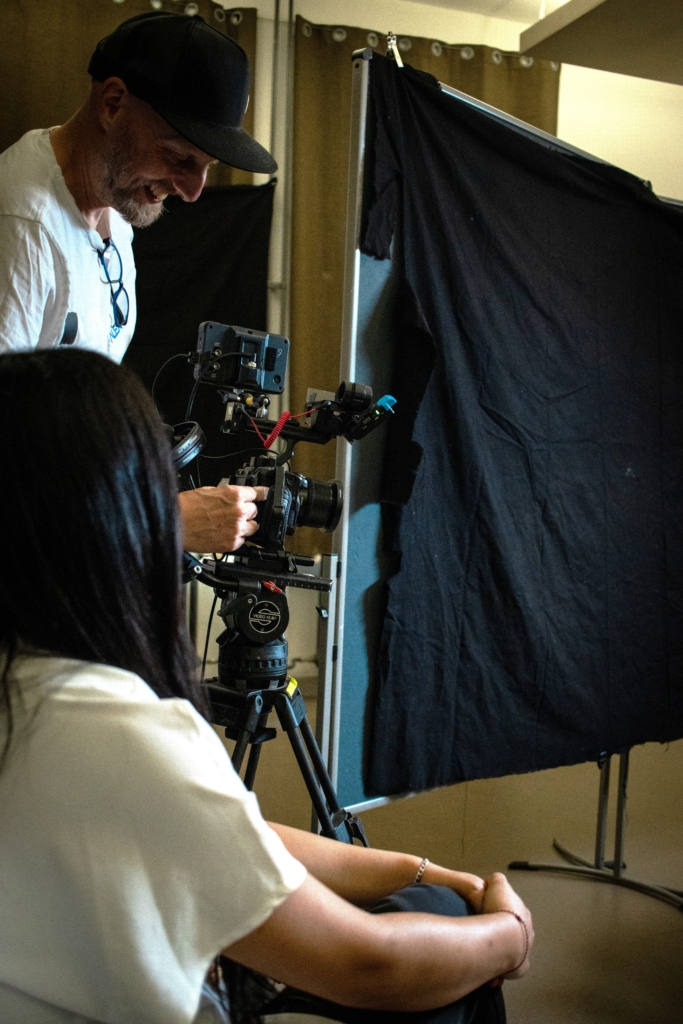
Olaf and Jilan in between filming.

I said, “yes. Now, as you mention it again, I remember. That sounds like a challenge, but I’m up for the task lightheartedly”. And I had a location scout in the office, but we were shooting with Birgit in Hamburg. I was there, I don’t know, two weeks before, just to see how it looks and where I can place the cameras securely. So one camera can always run, and the other camera is like run-and-gun [fast-paced filming with minimal gear]. 

Since I will not see her face, I always have a fallback camera that I can cut to if something happens with the other one. And I was able to look. When I stay here, I won’t see her face. When I was here, I can hide her face behind this. There was a lot of planning of having a lot of camera angles to keep the movie, and the footage, interesting for the viewer because, in my opinion, if you cannot see the person’s face, it is so hard.

Maya: So what kind of choices were you making when you edited the film to deal with that? What kind of decisions have you been making to bring out the impact?

Olaf: I tried to bring out the impact over the story because the interview is like 2 hours long, and the film can only be like 10 or 12 minutes. You have a little freedom. 

But I had to read this two-hour long interview, like 50, 60, 80 pages, and filter it, “Okay, what is the key point?” So the viewer can see the story, what happened, how horrific is it, what happened then to her when she’s separated, and how she escaped. This is why she’s here now and can tell her story. And what happened in between is the horrific thing that people need to hear to connect, of course.

And I just tried to build a story around this, but Jilan, maybe due to her age, was not so open about what really happened to her. I talked to Birgit also about it before and after. Jilan is very closed off in saying things. She’s protecting herself, I guess. Maybe she doesn’t want to think about it again. I think it was really, really, really, really bad for her being in captivity. But what really happened, it always scratches the surface and opens the door just a little bit and then closes it back again.

Reading the interview in the translation was difficult. I needed to have an impact, but I cannot see her face; I cannot see emotions. So what she’s saying has to be impactful. And I think I found the passages that make sense. I have the story in these minutes, so I can build up a story in these minutes that I have, with the impact that we need, to let the audience have these feelings for her.

Hopefully, I cannot really keep at it anymore because I’m working since May on this movie. And sometimes, I don’t really know. I need to step back and let it rest for some weeks and then go back at it again. To say, “OK, is it good or is it bad? Was it the right choice to do?”

Maya: Wow, it sounds like the editing was really the big challenge.

Olaf: Yeah. It was. You say a lot of times: “the movie is made in post-production.” There it all comes together; there you build a story. I’m usually not of this opinion because I’m a cinematographer. The story is built on set or in pre-production. But this time I totally agree.

Yes, I had to make the story. I made sure during shooting that I had everything, that everything is there that I need to tell the story image-wise, footage-wise. And then I had the freedom to do everything in post-production, just to have enough footage of here, enough footage of there.

And I needed a lot of what we call B-roll. So we need a lot of footage, like a wide shot, a tighter shot from another angle, just to have these one, two, three-minute passages where she is speaking, I need something that the viewer can see. Maybe some reactions from her, so I can underline what she’s saying with some footage.

I think we did good, and hopefully people are sensitive enough to get the story. I really think that. 
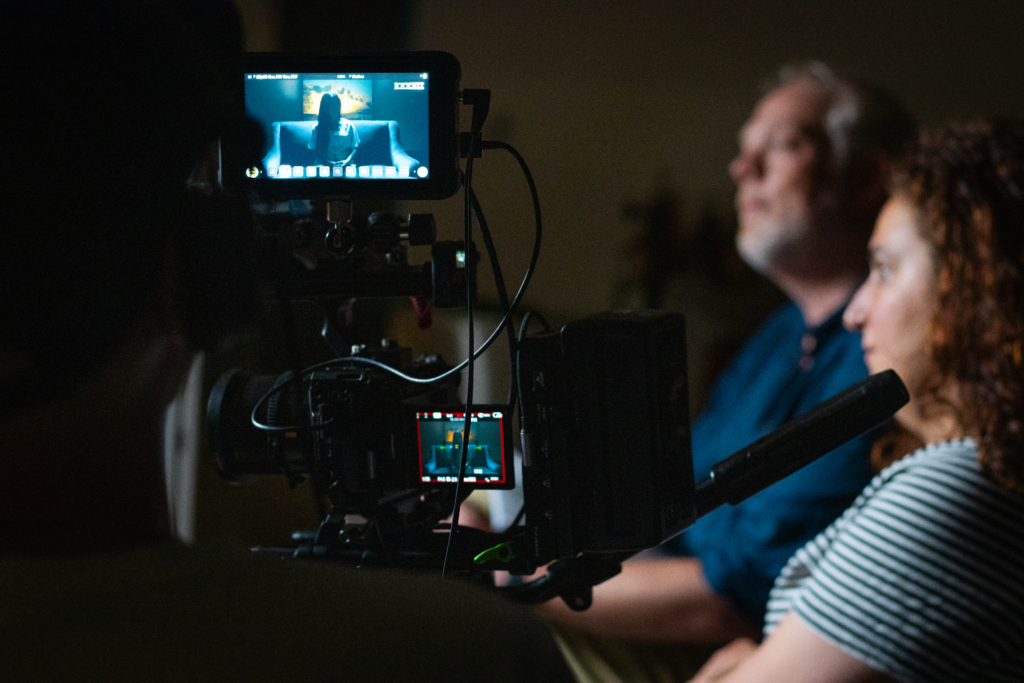
Close-up of Jilan being filmed in interview with Kjell and Leyla.

Maya: So in your perfect world, what kind of impact would this film have on its viewers?

Olaf: I don’t know the word. I have the German word, but I just don’t know the translation to English. In German, it’s Empörung [indignation]… I want them to be angry about the situation.

I want them to be angry about the injustice, about racism, about fascism, about religious fanaticism. I want them to be angry and loud about it. And I want them to stand up and say, “OK, I don’t know what, but I want to do something about it. I want to take action and not sit silent at home and doom scroll till death.”

Hopefully it has the same impact. And if it’s just one of 100 people that starts doing something, that would be enough. That’s why I’m doing this.

Maya: How do you think that film, specifically, has the potential to inspire anger and inspire people to action?

Olaf: I think people can relate because they see things they maybe already know, or things they don’t know. And I feel like if you’re doing this kind of documentary work, you are documenting things that are already there. And people can, I think, better relate to things that they know are real, and are more grounded in realism, than fictional movies.

Fictional movies can better play with emotions and evoke emotions. It has to be made good for the viewers. If you’re not interested in the topic and just watch it on some documentary channel, chances are maybe not so big that it has the impact, that it has a movie that is just built for evoking emotions in you. That’s why it’s made.

Maya: Yeah, I agree. And these films, including yours, I think our hope is that they will end up in classroom settings and students will be able to see them, which is maybe, you know, the best place to have a film like that. 

Maya: Could you talk a little bit more about the ethical considerations behind your work on the film? I’m interested to hear about the work you did preparing to make the film, and the things you were thinking about.

Olaf:  Because I did so much work for the memorials, I did not think that much about ethical considerations because they are imminent for me. Really, my main concern was, how do I get impactful footage without showing her face? That was my main concern, because that is like three quarters of the work on these shooting days. And I had to check on the time and so on. Ethics were mandatory and an obligation, but I didn’t really have to think about it.

I was very polite when I first met Jilan. We met her at lunch. I first did some footage with Birgit, the comic artist, and then we did a little interview with her. And then we went to lunch. And there I met Jilan for the first time. And after lunch, we just went right into an interview, going over comic footage and talking about the story. I had to be a little sensitive with her and not overwhelm her with technical aspects. That was my main goal for the, let’s say, first hour. She has to feel confident and secure and warm so she can open up herself a little bit.

Maya:  Yeah, totally. Did Birgit’s comic drawing work influence your vision for the film at all?

Olaf:  I really have to think about that because I saw the comic first on the shooting day. After the shooting day, she sent me the first 15 pages, and I was thinking of incorporating some of the comic images, but I didn’t feel they were right in the movie that I was doing. I did a very slow pan over the first pictures because they were perfectly aligned with what she was saying. “I was young. I played with Arabs and Muslims and Yezidis, we were all friends. We slept together. We ate together. Everything was fine. I wanted to become a doctor.” And I saw this all-in-one comic picture. And that was perfect for going into the movie.
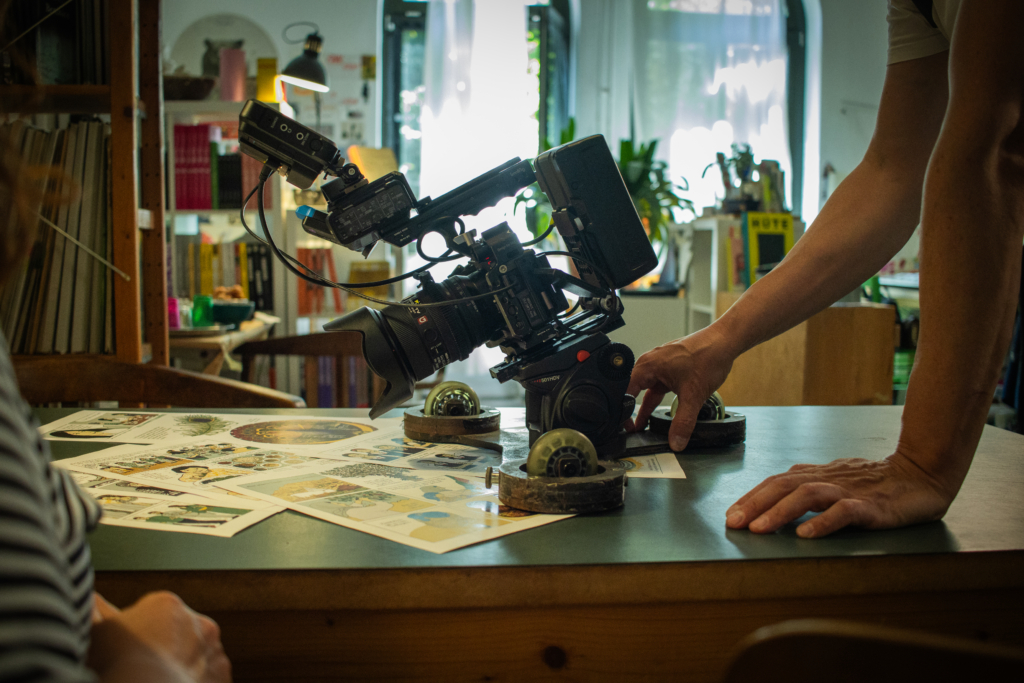
Olaf filming the opening sequence panning over pages on rollers.

But then it was like, I looked over the other pictures that I had and was like, “no, these don’t really fit.” So I put them aside. I watched it; I read it. But they were not really fitting because it was a lot of story before everything happened. That wasn’t really my main point for the movie, so I didn’t really need that comic much.

But I must say, I like Birgit’s style a lot. And now, I don’t know if you know, but we had a little reshoot three months after principal shooting because Jilan was not really satisfied with her answers because, she said, “it’s not good that I switched between German and Kurdish.”

I was like, but it doesn’t get more realistic than this. Going emotional, going to your mother language. I mean, everybody can relate to this.

And let’s be honest, maybe 1% of the people that watch this movie can either understand Kurdish or German. So they don’t really know what you are saying. They are reading subtitles.

But she was pretty adamant about it. And they told me, well, we are recording this with an iPhone. I said, “you don’t record anything. I’m coming over!” And we did another round of shooting, of course, hiding her face. And I did another concept for the room that we were in. The room was one of the smallest rooms I ever shot in. So it didn’t really look nice.

But there was one situation where she started crying a little bit and had like two, three sentences with a crying voice. And really, I still get goosebumps when I think about it. It wasn’t that present to me when I was in the situation with her, because I knew she was protected by Leyla. She was with us. And I couldn’t see her either because she was behind this white wall. I just saw a shadow. I heard her. And I was like, “Oh, I’m curious what she’s saying,” because she did it all in Kurdish. I didn’t understand a word. And so I had to wait for the translation, and I had to scroll through the footage to find it, to look after the time codes and see, okay, what is she saying at this point?

Fortunately, she said something I could use. But I hate to show people crying. I really, really hate it. I don’t want to see people crying in the movie. But this is the most impactful scene ever I had with Jilan. And I was very – I’m sorry to say that – but I was very thankful for the scene. And I edited it in. And Jennifer agreed to it. She said, it’s really, really, really impactful.
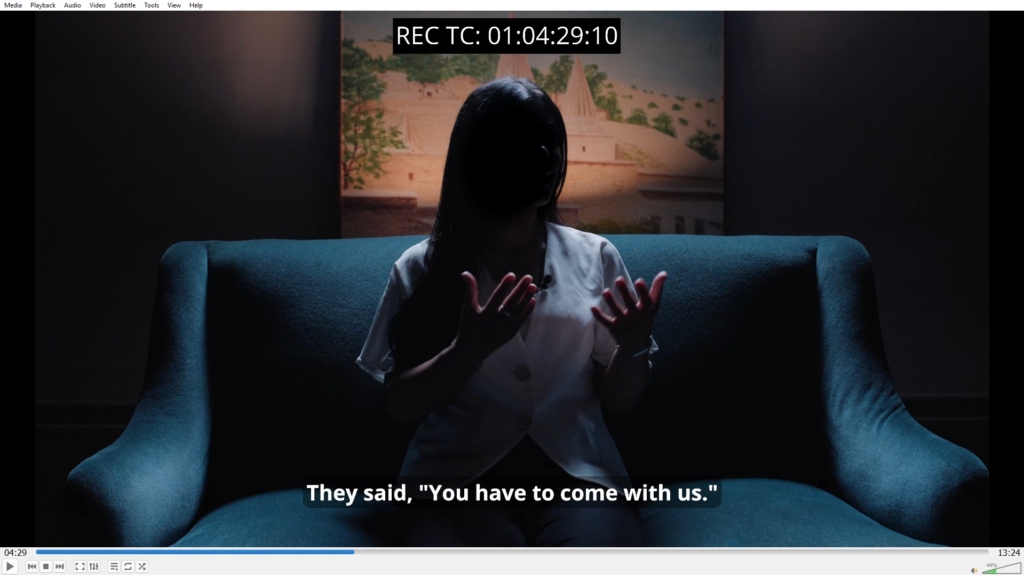
Screenshot from one of the different draft versions of the filmed interview with Jilan.

Maya: How was your experience working with SCVN? What was it like working with all the different levels of team members and support people to create the film?

Olaf: I just actually worked together with Kjell Anderson. He was present and did the long interview. He was quite helpful and a very nice guy. But most of the discussions I had with Jennifer, we had two Zoom calls and endless emails. And I like Jennifer. She has very good energy. And she’s really deep into the project and really wholeheartedly in it. I like this energy. I think you must to have this energy on this topic. You cannot handle this like, I don’t know, any commercial for any perfume or shoe or dresses or whatever.

You have to bring – you must want to do this, and you feel it with Jennifer. And I haven’t talked to anyone else. My artistic freedom was very limited in the feedback. But okay, it’s straightforward feedback. So I’ll deal with it. If I say no, then it’s no and it’s fine. I had Jennifer also say, “Olaf, do it as you want it. I thought about it once again and I think it’s good what you said, and do it.”

That’s the kind of professionalism that I really admire. That was really on the same eye level that I had with Jennifer. The working experience, that was really, really, really nice. I wish I had every producer would be like Jennifer. My life would be so much easier. So kudos to you, Jennifer, if you see this!
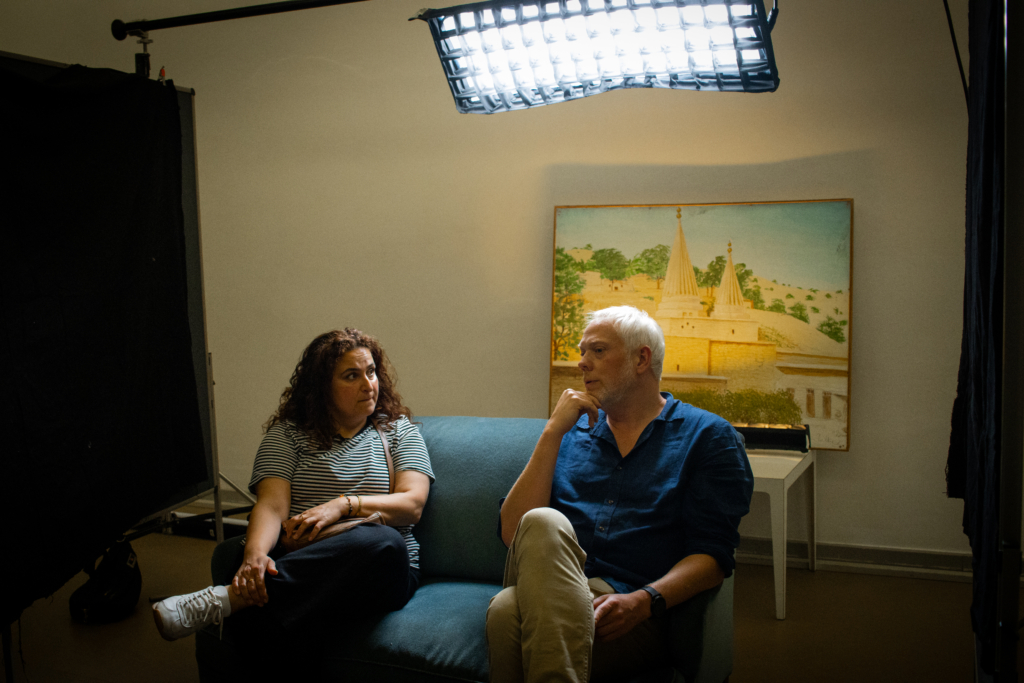
Leyla and Kjell in between filming the interviews.

Maya:  What advice would you give to other filmmakers working on storytelling and documentary about human rights and atrocities?

Olaf: You need to deal with it, and that it’s not always easy. If you want to deal with atrocities and human rights and so on, I think you will have seen maybe a lot in movies and magazines and photos that you know what you’re up to do. So hopefully you’re not shocked by what you might hear or see when you start working on it, and find yourself a project or a survivor that is willing to tell you a story and you make something out of it.

Like we said, it grounds me, and I’m very thankful for the experiences that I can share and collect and distribute. On the other hand, I am shocked and horrified that this is possible in 2025. Sometimes it seems like we’re still in the Middle Ages or in the Stone Age – how people treat other people. It’s unbelievable and it leaves me speechless a lot of times.

I learned when I come home from shooting and when I shut down the computer, I don’t think about it anymore. To protect myself and my family, especially my wife.

Because usually we talk when I come home, “how was your shooting day? What did you do?” Now I’m doing a lot of things for the Nazi prison in Wolfenbüttel near Brunswick. And we have the children and the grandchildren of the inmates that are killed there, that have been killed there in ’44, ’45. And there’s a trauma in the family. It’s not that horrifying of a story, of course, because they usually don’t know their grandparents because they were killed in the prison. They just know the traumatized grandmother, usually.

But these people are nice people, and we have a chat about this and that. They call the memorial because they heard their grandfather was executed there, and somebody who’s executed must have been a really, really bad person. When they call them, sometimes people are crying. They tell them, “yes, the name is so and so. Yes, we have him in our database. And the family really needs to know what he did. He must have been a horrible person.” Well, yes, I look it up. We have like a small database where we can like look right now. We have a big database where it takes us some time to research it. And Martina, that is my interview person that I constantly work with in the prison, this one call she said, “oh, yes, I have the name here. He stole a chicken.”

That was it. He was executed for stealing a chicken in 1944. That was Nazi Germany. It’s called Volksschädling [offensive term used during the Nazi regime that translates as “harmful organism”] which is somebody who does bad things towards his tribe, his peoples. And the family is so relieved, and of course they are then willing to come to visit the memorial and maybe give an interview. I get to know these people, and they’re nice people. 

I remember one story years ago, maybe 10 years ago, in Bergen-Belsen from the concentration camp, we had a survivor from Bergen-Belsen. She was way over 90 years old. And she was 16 when she was in the concentration camps. And she was in Auschwitz. She was in Bergen-Belsen. She saw everything. She made the big hunger march. And she really saw everything. And this story, because it was in German, I could understand everything. It was the worst story I’ve ever heard.

And on that evening when my wife asked, “how was today? How was the survivor?” I said, “Not today. I cannot tell. Later.”

That was the worst story.

Maya:  It’s good advice. Keeping a boundary. You need to. Even with my work on the project, I need to. Sometimes I have to close my computer and take a walk, not think about it.

Maya: Before we wrap up, Is there anything else you want to share or highlight about this project?

Olaf:  I think I said everything. I put the inside out, so to say. It was an honour and a privilege to do a project like this, which came out of nowhere. Just in my inbox one morning. And usually it looks like spam. I was close to deleting it, but then I saw the name Leyla Ferman, and I was like, “Oh, Leyla, maybe I should read the mail. Maybe it’s important.” And yes, the rest is history.

Maya: Lovely. Thank you for chatting with me. I loved hearing your insights.

Olaf: Thank you, Maya. It was a pleasure to meet you and to talk to you.
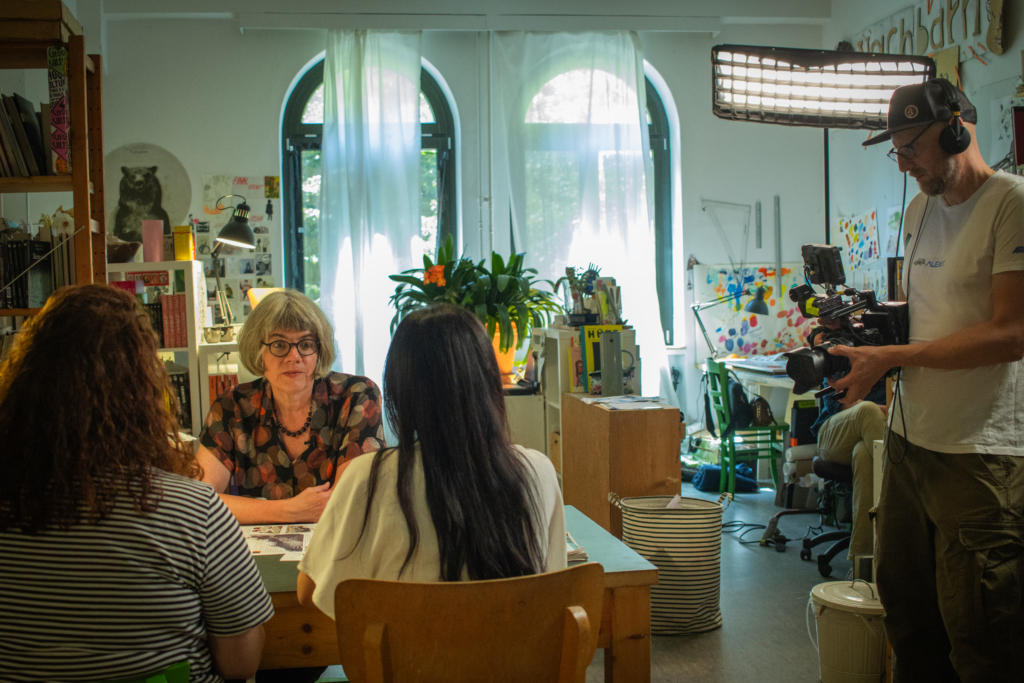
From left to right: Leyla, Birgit, Jilan and Olaf filming in Birgit’s studio.

Personal Histories in the Public Archive: Archiving the Klaus Zwilsky Story – Webinar – Jan 29

Aubrey Pomerance working with objects from the Zwilsky collection at the
Jewish Museum Berlin. Photo credit Charlotte Schallié.

What happens when family history becomes part of the public archive?

Join us for a presentation and discussion with Aubrey Pomerance, Head Archivist of the Jewish Museum Berlin; Klaus Zwilsky, Holocaust survivor; and Dr. Charlotte Schallié, SCVN project director and professor of Germanic Studies at the University of Victoria, as they examine how archives with personal histories can be developed with care.

As a curator, Aubrey Pomerance worked with the Zwilsky family’s documents, photographs and objects relating to their experiences in Berlin, Germany, where they survived the Holocaust at the Jewish Hospital. This webinar will explore Aubrey’s archiving of the Zwilsky Collection in conversation with Dr. Charlotte Schallié. They will be joined by Klaus to reflect upon his collaboration with Aubrey and the complexity of having personal family history become part of the public archives. The discussion will be followed by a question and answer period for attendees.

This webinar is part of the 2026 Archiving with Care series, a collaboration between UBC Public Humanities Hub and the Survivor Centered Visual Narratives Project.

Personal Histories in the Public Archive: Archiving the Klaus Zwilsky Story
Thursday, January 29
10:00 – 11:30 am PST
Webinar Info: https://publichumanities.ubc.ca/events/event/personal-histories-in-the-public-archive-archiving-the-klaus-zwilsky-story/
Registration Link:https://ubc.ca1.qualtrics.com/jfe/form/SV_7alvVDG4OgnUwom

Speaker Profiles

Left: Klaus Max Zwilsky, middle: Aubrey Pomerance, and right: Dr. Charlotte Schallié.

Aubrey Pomerance is the Head of Archives at the Jewish Museum Berlin. Born in Calgary, Canada, he studies Jewish Studies and History at the Freie Universität Berlin. There he was a research assistant at the Institut für Judaistik in 1995 and 1996 and thereafter at the Salomon Ludwig Steinheim Institut for German Jewish history in Duisburg. In April 2001, he took up his position at the Jewish Museum Berlin, being responsible for the establishment of a branch of the Archives of the Leo Baeck Institute and for the museum’s archival collection. He is the community liaison overseeing the Zwilsky Collection working with Klaus Zwilsky and his family, which connected him with the Survivor-Centred Visual Narratives (SCVN) Project.

Klaus Max Zwilsky was born in Berlin, Germany, on August 16, 1932. He and his parents survived the Nazi regime in the Berlin Jewish Hospital, where his father was an administrator, while his mother did forced labor at Siemens. Following the end of the war, Klaus became the first boy to celebrate a Bar Mitzvah in Berlin. In 1946, he and his parents emigrated to the United States. After obtaining his Doctor of Science degree from MIT, Klaus pursued a career in Materials Science and Engineering.

In 2000, he began organizing an extensive collection of papers left by his parents, detailing the fate of his extended family who perished during the war. He organized his family’s personal papers from the war period and donated these documents to the Jewish Museum in Berlin. Klaus has frequently returned to Berlin to participate in Holocaust workshops for German high school students and other educational programs organized by the Jewish Museum Berlin. He has also spoken extensively to share his personal experiences with high school and middle school students as well as social and professional groups in the United States.

Charlotte Schallié is a Professor of Germanic Studies at the University of Victoria. Her teaching and research interests include memory studies, visual culture studies & graphic narratives, teaching and learning about the Holocaust, genocide and human rights education, community-engaged participatory research and arts-based action research. Together with Dr. Andrea Webb (UBC), she is the co-director of the Survivor-Centred Visual Narratives Project (www.visualnarratives.org), funded by a 7-year SSHRC Partnership Grant.

Thank you to the UBC’s Public Humanities Hub team for co-hosting
and facilitating this webinar!

New Funding from the National Holocaust Remembrance Program

We are pleased to announce that our funding application to the National Holocaust Remembrance Program has been successful.


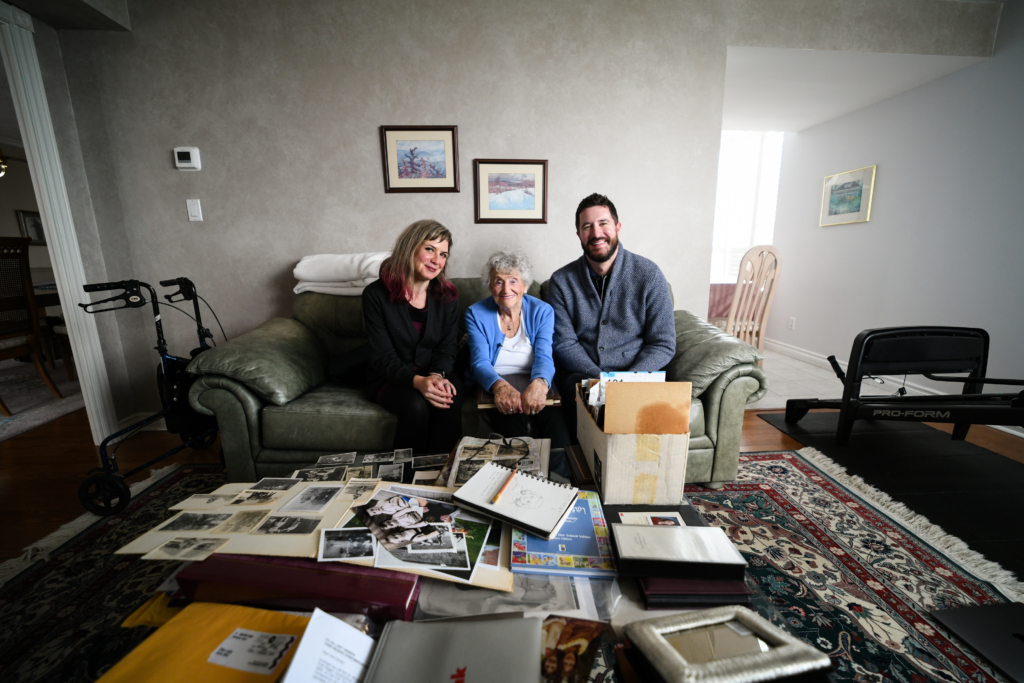
From left to right: Graphic artist Miriam Libicki, Holocaust survivor Rose Lipszyc, and Research Cluster Co-lead Mark Celinscak meeting for interviews and the documentary film at Rose’s home in Toronto, Ontario in the summer 2023. Photo credit: Chorong Kim.

Charlotte Schallié and her team have been awarded the Multiculturalism and Anti-Racism Program (MARP)’s National Holocaust Remembrance Program funding from Heritage Canada for their project, Developing Trauma-Informed Teaching Resources and Outreach Activities for Arts-Based Survivor Testimonies. The application was developed by Drs. Charlotte Schallié, Andrea Webb, Mark Celinscak, and Project Manager Jennifer Sauter with support from the following partners: Toronto Holocaust Museum Azrieli Foundation, Vancouver Holocaust Education Centre, Canadian Museum for Human Rights, Memorial University of Newfoundland, University of British Columbia, University of Victoria, Sam and Frances Fried Holocaust and Genocide Academy, University of Nebraska at Omaha, and Facing History and Ourselves.

The funding totals $129,769, and will be granted over a 5-year period. It will support the development of open-access educational resources, learning activities (in-person and online) and an art exhibition to accompany two non-fiction graphic novels by award-winning artist Miriam Libicki: A Kind of Resistance (published in the anthology But I Live: Three Stories of Child Survivors of the Holocaust, New Jewish Press, 2022) and Two Roses (New Jewish Press, 2025). Created in close partnership with David Schaffer (Vancouver) and Rose Lipszyc (Toronto), respectively, Libicki’s graphic narratives shed light on child survivors’ lived experiences before, during, and after the Holocaust in Poland, Germany, and Romania. The target audience for these books is students in Grades 9-12. 

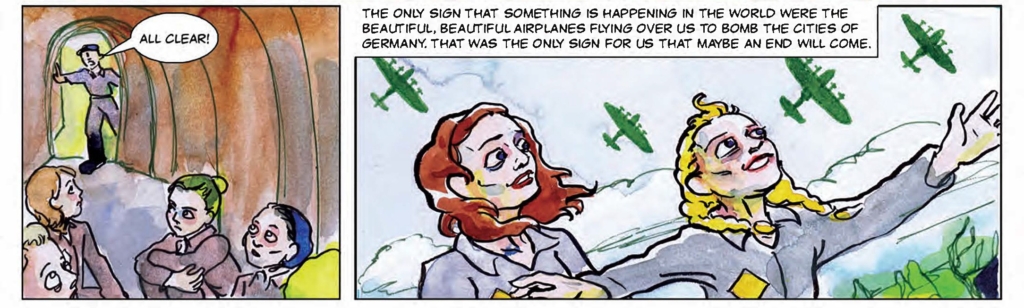
An excerpt from Two Roses (New Jewish Press, 2026), the story of Holocaust survivor Rose Lipszyc, by Miriam Libicki.

These two graphic novels have been conceived and co-created as part of two SSHRC-funded projects: Narrative Art and Visual Storytelling in Holocaust and Human Rights Education (2019-2022; https://holocaustgraphicnovels.uvic.ca/) and our Survivor-Centred Visual Narratives (2022-2029).

The funding from the National Holocaust Remembrance Program will allow us to deepen and expand our current teaching resources (which also include two open-access short documentaries). Our goal is to create innovative evidence-based educational tools to help Canadian high school teachers apply a human rights framework and integrate Holocaust education into the secondary school curriculum.

We would like to thank all the partners who supported our vision and helped make this application a success!

Berner Design Foundation exhibits first drawings of “Ružica’s Last Summer” by Jared Muralt, Mar. 28 – Apr. 27, 2025

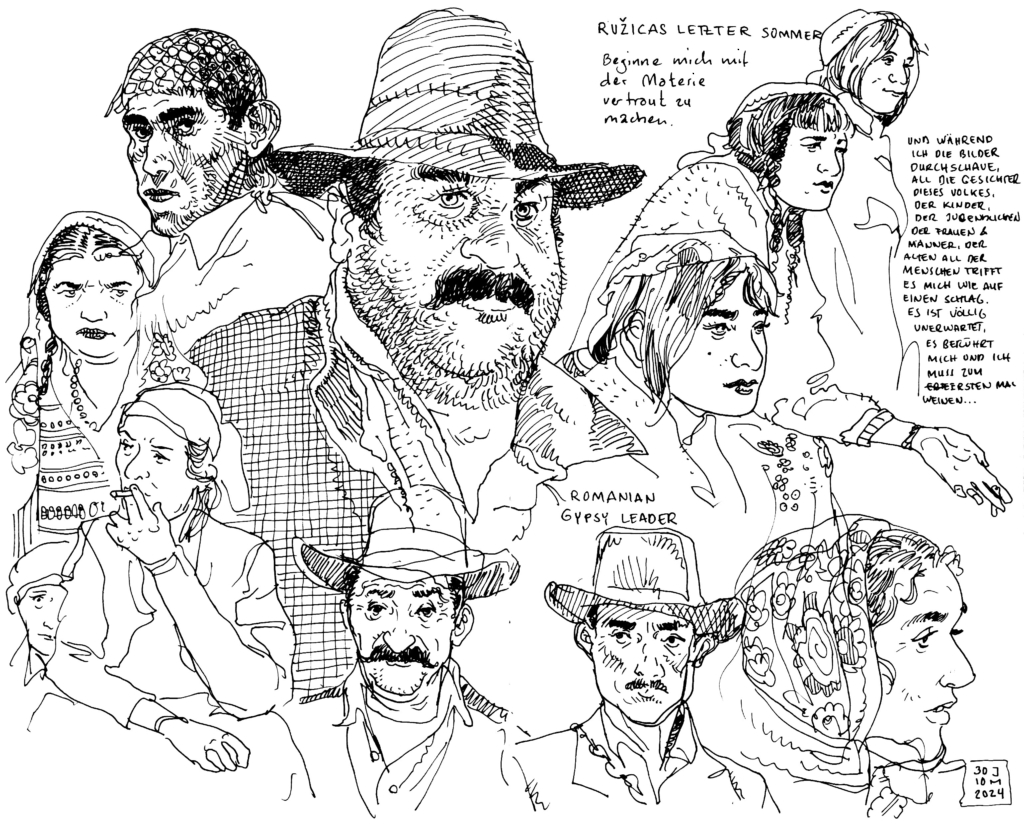
As part of our Yugoslav Wars Research Cluster, Swiss comics artist Jared Muralt has been collaborating with a Roma woman, Ružica (not her real name), retelling her life in Serbia in the 1990s where the discrimination and violence of the Yugoslav Wars shaped Ružica’s childhood.

The concept drawings and character sketches for the graphic novel project “Ružica’s Last Summer” were recently showcased at the Berner Design Foundation’s annual BESTFORM exhibition from March 28 to April 27, 2025. This event represents the first public showing of Jared’s work on the project.

The Berner Design Foundation supports professional designers from the fields of graphic and product design, ceramics, fashion and textile design as well as scenography, while managing the Canton of Bern’s collection of applied arts.

In addition to hosting Jared’s work, the Berner Design Foundation has generously supported Jared’s graphic novel through additional funding. We gratefully acknowledge their contribution to our project, and their support in expanding the graphic narrative to bring Ružica’s story to life.

Image gallery image

Photo and image credit: Lea Moser and Jared Muralt, May 2025.

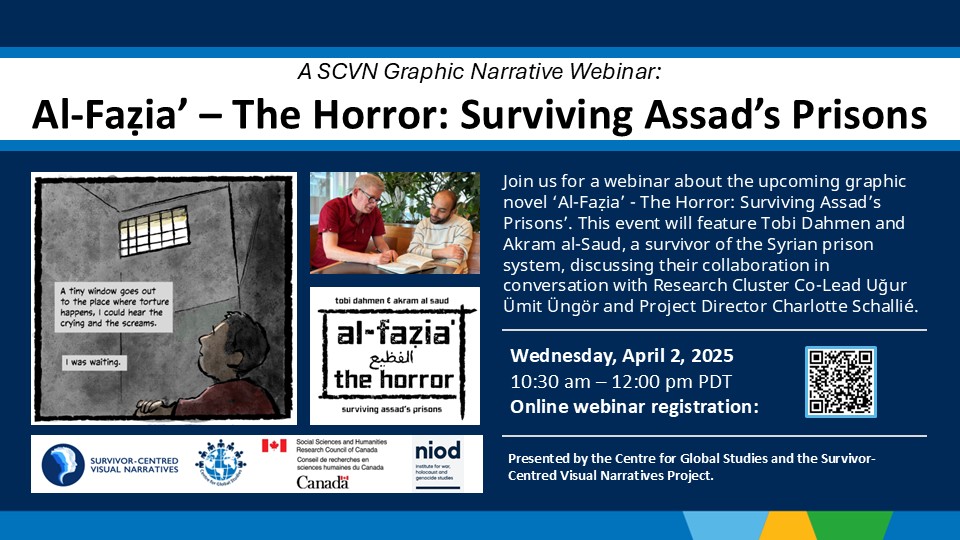
A SCVN Graphic Narrative Webinar: ‘Al-Faia’ – The Horror: Surviving Assad’s Prisons’ – April 2, 2025

In February 2023, graphic artist Tobi Dahmen was introduced to Syrian survivor Akram al-Saud by Dr. Uğur Ümit Üngör, the Research Cluster Co-Lead on the SSHRC Partnership Grant Survivor-Centred Visual Narratives Project. Based in The Netherlands, Tobi and Akram have been collaborating locally over two years in a series of interviews to share Akram’s unique story of surviving a series of Syrian prisons.

Since the fall of the Bashar al-Assad regime on December 8, 2024, Syria has opened up to the world again, and the international community has begun to learn more about the oppression and injustices of the regime. This webinar will feature Tobi Dahmen and Akram al-Saud discussing their collaboration, in conversation with Dr. Üngör and Project Director Dr. Charlotte Schallié. They will explore the difficulties of representing imprisonment and torture, and how graphic narratives can help survivors of mass violence find a voice.

A SCVN Graphic Narrative Webinar: ‘Al-Faẓia’ – The Horror: Surviving Assad’s Prisons
Date: Wednesday, April 2, 2025
Time: 10:30 am – 12:00 pm PDT /  6:30 – 8:00 pm CET
Registration Link:
https://uvic.zoom.us/webinar/register/WN_Unhe0GVZT1qyMy-q9iijNQ#/registration
Contact: Lia Lancaster | cfgs@uvic.ca

Speakers

Tobi Dahmen
Tobi Dahmen, born in 1971 in Frankfurt/Main, is a German illustrator and comic artist. He has published several comic books, including Fahrradmod (2015). Dahmen has received numerous awards for his work and is currently working on a new graphic novel with a Syrian survivor as part of the Survivor-Centred Visual Narratives Project. The graphic novel Columbusstrasse: Eine Familiengeschichte 1935-1945, was released on May 29, 2024, and is available to order online here.

Akram al-Saud
Akram al-Saud is from Deir Ez-Zor and now lives in the Netherlands. He has been arrested four times before fleeing from Syria. His longest detention began on March 28th, 2010—before the revolution—and lasted for nine months. At the time, he was a student at the Faculty of Architecture in Aleppo, and was arrested by the intelligence services of the air force. After the 2011 revolution, he was arrested three more times.

Dr. Uğur Ümit Üngör

Uğur Ümit Üngör (PhD Amsterdam, 2009) is Professor of Holocaust and Genocide Studies at the University of Amsterdam and the NIOD Institute for War, Holocaust, and Genocide Studies. His main areas of interest are genocide and mass violence, with a particular focus on the modern and contemporary Middle East. He is an editor of the Journal of Perpetrator Research, and coordinator of the Syria Oral History Project. His publications include Confiscation and Destruction: The Young Turk Seizure of Armenian Property (Continuum, 2011), and the award-winning The Making of Modern Turkey: Nation and State in Eastern Anatolia, 1913-1950 (Oxford University Press, 2011). From 2014 to 2019, Üngör coordinated a Dutch Research Council-funded research project on paramilitarism, which led to the monograph Paramilitarism: Mass Violence in the Shadow of the State (Oxford University Press, 2020). He is currently working on its follow-up monograph Assad’s Militias and Mass Violence in Syria (forthcoming, 2025). He is also co-author of Syrian Gulag: Assad’s Prison System, 1970-2020 (I.B.Tauris, 2023).

Dr. Charlotte Schallié
Charlotte Schallié is a Professor of Germanic Studies in the School of Languages, Linguistics and Culture at the University of Victoria (Canada). Her teaching and research interests include memory studies, visual culture studies & graphic narratives, teaching and learning about the Holocaust, genocide and human rights education, community-engaged participatory research, care ethics, and arts-based action research. Together with Dr. Andrea Webb (UBC), she is the Project Director of a 7-year SSHRC-funded Partnership Grant entitled Visual Storytelling and Graphic Art in Genocide and Human Rights Education.

Holocaust research archives

Reflecting on the Role of Research Assistants with Jessica Botts

Holocaust research archives

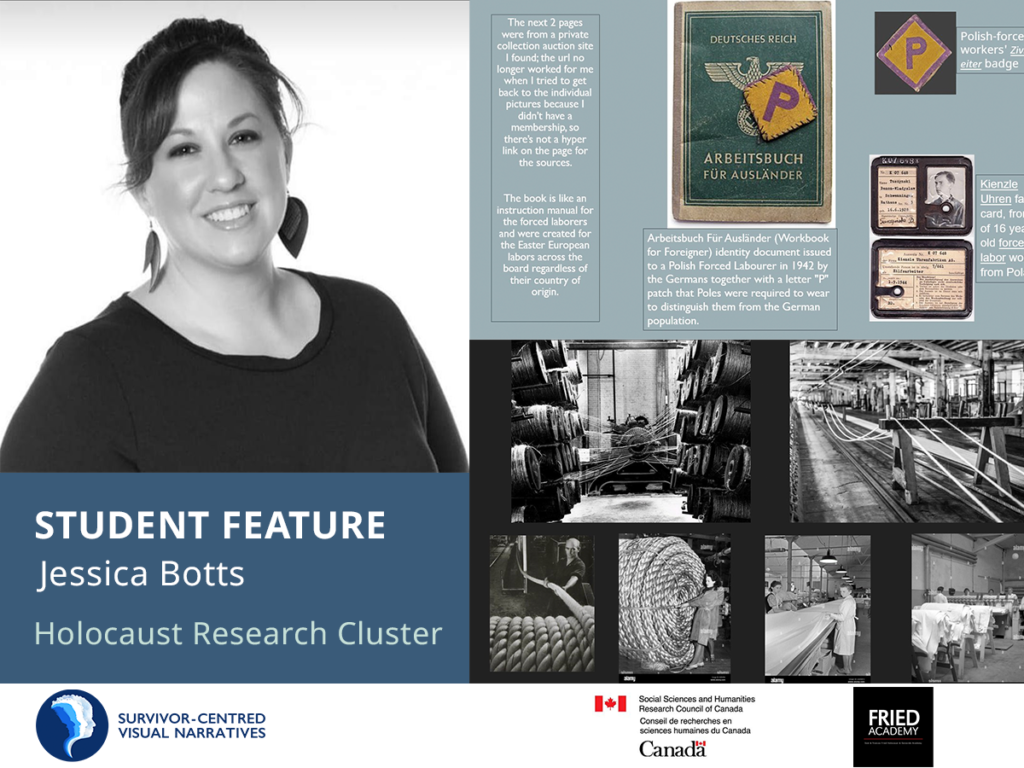
From transcribing interviews to navigating the archives, Research Assistant Jessica Botts had an instrumental role in the process of developing Two Roses, the graphic novel created by Miriam Libicki in collaboration with Holocaust survivor Rose Lipszyc. 

Jessica is a U.S. Navy Veteran who has lived in and been deployed to several countries. Currently, she is a graduate student pursuing a master’s degree in Environmental History at the University of Nebraska Omaha, with a minor focus in Native American Studies. She joined the SCVN project in September 2023, and worked closely with Holocaust Research Cluster Co-Lead and historian, Dr. Mark Celinscak, and graphic artist Miriam Libicki.

As a Research Assistant, Jessica transcribed interviews between Miriam and Rose and researched throughout historical archives for specific information and materials for Miriam to consult. To prepare her research findings for Miriam, she created PowerPoint presentations with a selection of historical images and notes describing historical sources and translations. The collection of images provided a visual reference for Miriam to develop her graphic narrative.

The following images are a selection of highlights from Jessica’s research:

We also followed up with Miriam, who shared her experience of collaborating with Jessica, and highlighted her detailed approach and diligence:

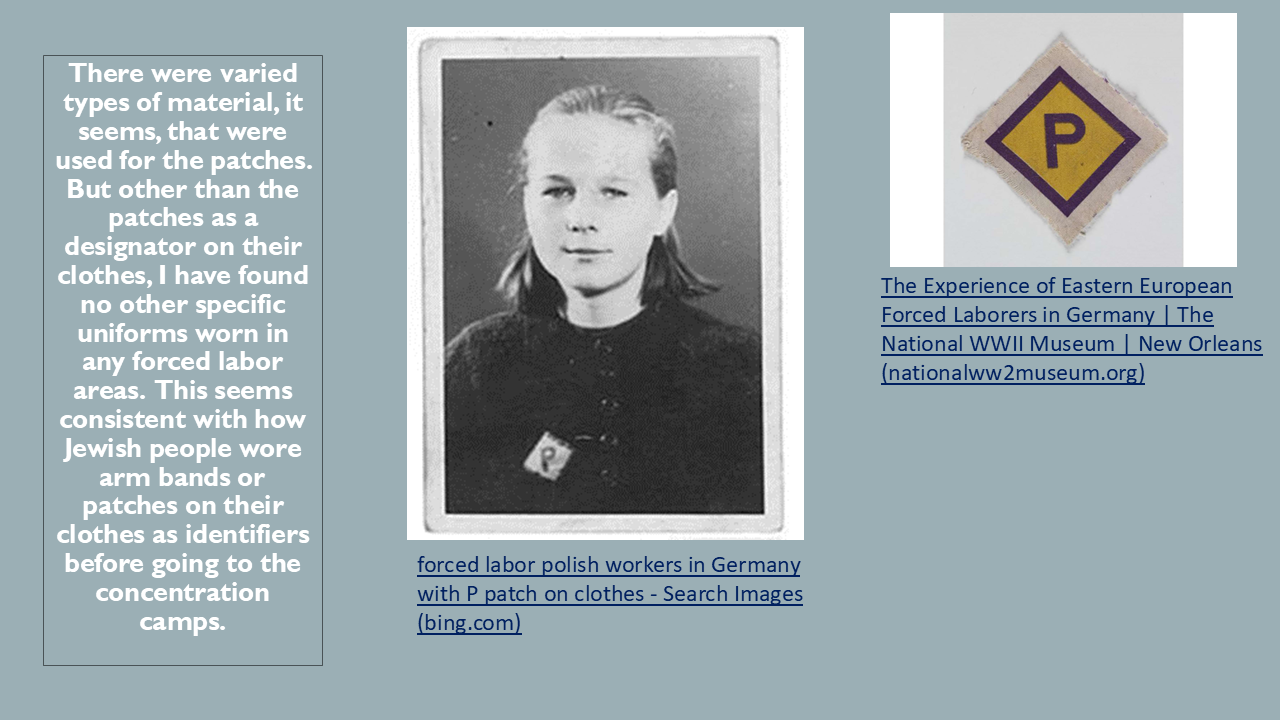
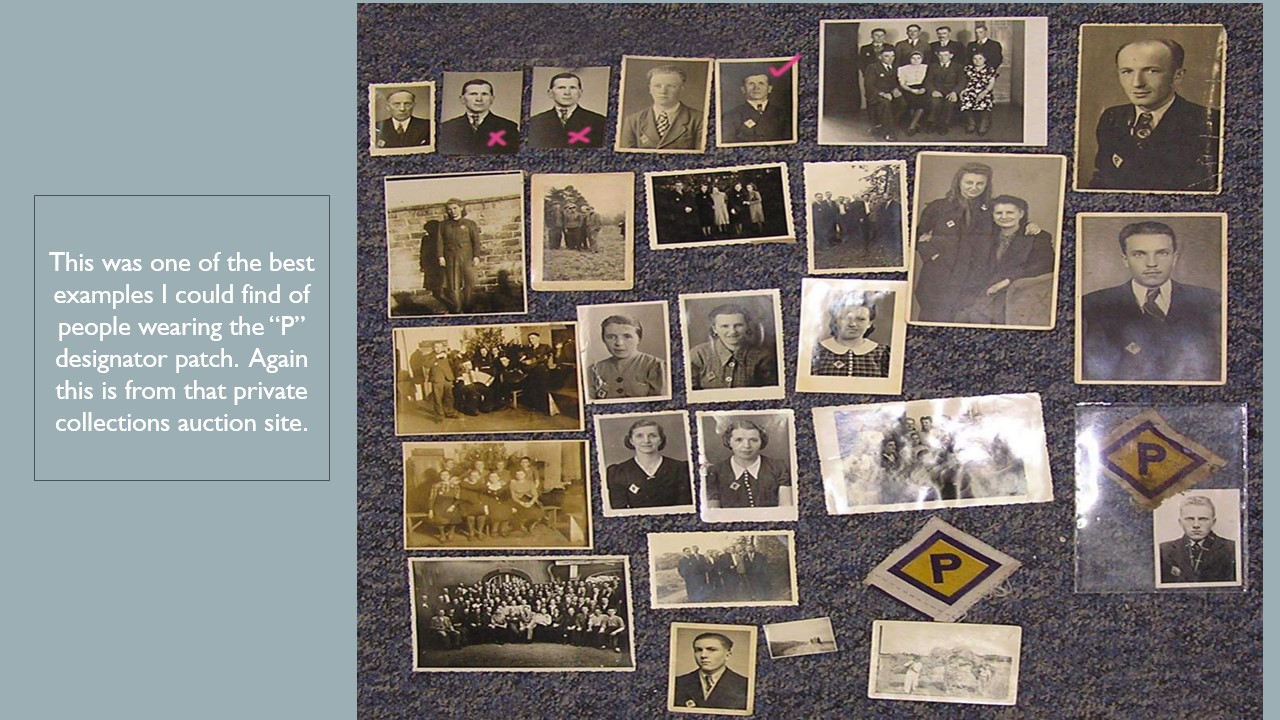
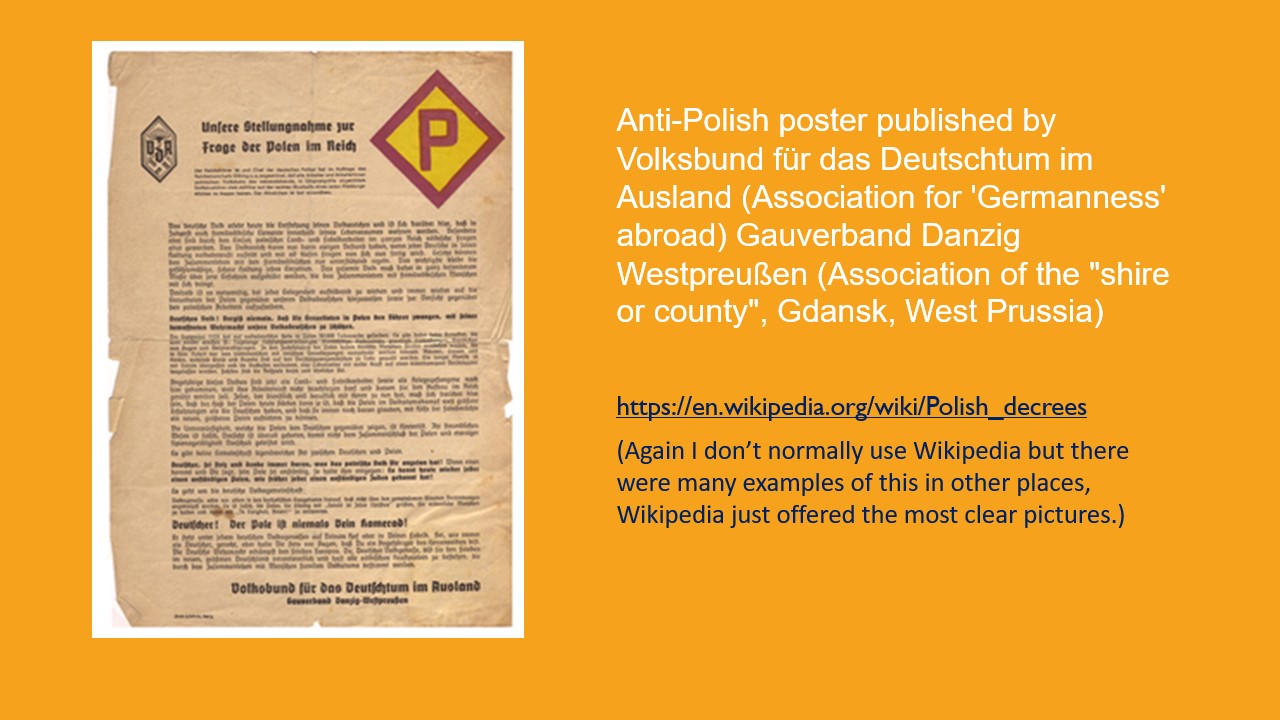
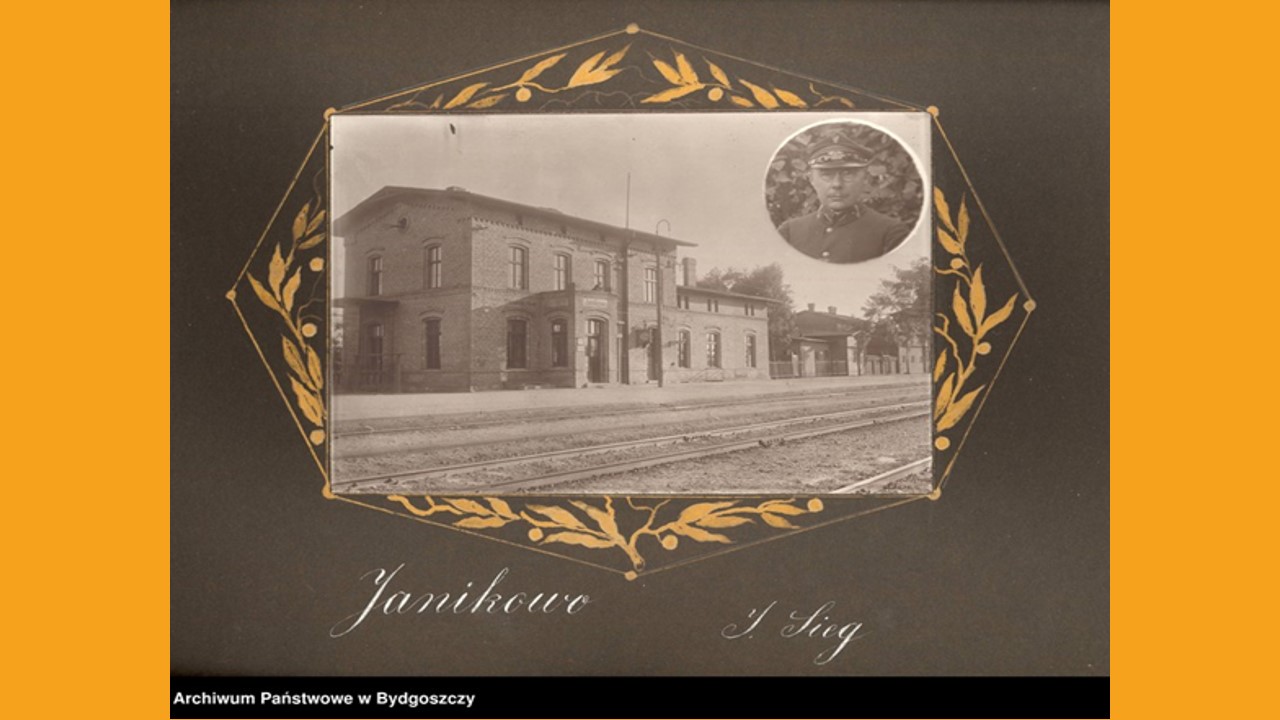
“Jessica had to transcribe, type and organize four days of conversations, with a quick turnaround so that I could start on my script. She also helped enormously when I was first establishing the look of the story’s settings. She found photos both recent and archival, of Rose’s birthplace neighbourhood in Lublin, as well as the clothes and patches Polish slave labourers were given to wear.

Without my asking, she found photos of the very specific stiff wooden shoes labourers all wore, and when I showed this photo to Rose, it brought back strong memories and great sensory descriptions of slipping on snow.

I really appreciated how organized Jessica was, and how she diligently kept me updated on her progress and her research plans.”

Jessica’s role as Research Assistant on SCVN was unique due to her close and direct support to one of the graphic artists. In January 2025, she shared the following reflections on this experience with us:

“It has been a privilege and honor to work as a Research Assistant with historian Dr. Mark Celinscak and graphic artist Miriam Libicki on the Survivor-Centered Visual Narratives project to create a graphic novel about Rose Lipszyc’s story of surviving the Holocaust with her aunt. I have learned a lot about the Second World War and the Holocaust that I never knew before. Though I never met Rose in person, I feel like I know her because of the friendship and openness that she shared with Miriam, Dr. Celinscak, and others in the recordings of their time together. As a Research Assistant on the team, it was my job to transcribe their many interviews together. In the interviews with Rose, I listened to her story and became quite familiar with it as she revealed the details from her memories of her time in hiding in plain sight, as they unfolded bit by bit. Rose told of how a Jewish girl from Poland escaped the rounding up of the Lublin Jewish population and went on to work in Germany at a factory under the noses of her oppressors. She and her aunt made every situation work out as best as possible for them, and with a bit of luck, quick-wittedness, and some unlikely friendships, they were able to make it through the war until Allied troops came and liberated the area.

Documenting Rose’s story into written transcriptions helped Miriam ensure she could capture each detail to be highlighted on the pages of the novel. 

In addition, I was often asked to find historical photographs of the places and clothing Rose encountered and wore on her journey. I then put them into power points for references for Miriam to create the visual depiction of Rose’s story for the novel. Sometimes, to give perspective, I would find modern pictures of specific locations to contrast with generalized pictures of a similar place when period photos were unable to be located. I used military archives, different types of maps, Polish national archives, photos from groups where people were sharing their family histories about how they lived and what they went through during WWII as Polish laborers, and sometimes just scouring pages on the internet to find images for Miriam to reference. The photographs shared by descendants from Polish families telling about their family’s stories were especially helpful because Rose and her aunt posed as Polish girls from the countryside, working in German factories to send money home to their families.  

Rose is astounding in terms of the number of languages that she speaks. To pull off posing as Polish laborers, Rose had to speak “a perfect Polish,” as she would say, though that was not what was spoken at home growing up but was learned at school; she also learned German while in Germany, and spoke Yiddish, Hebrew, and later learned English as well when she immigrated to Canada.

Because Rose speaks so many languages, she would sometimes recall songs, sayings, and conversations she had had in another language, and I would have to figure out the translation for it.

I am very fortunate to have lived in Europe for several years and have friends who speak German fluently and have a grasp of other neighboring countries’ languages, so they were able to help me with translations at times when trying to search the internet for them was unfruitful. Dr. Celinscak also had academic colleagues overseas who assisted me by looking through some local archives to help find photographs and information I could not access.  

I have found it fascinating and encouraging to see how different relationships and friendships helped bring Rose’s story to life in the graphic novel Miriam authored and illustrated. Through researching, writing the transcriptions, finding proper translations, and historical images, I became engrossed in the stories, videos, and images of Holocaust survivors.

It truly is heart-wrenching to know the atrocities that people had to endure and inspiring to see how they have overcome that trauma to move on with their lives afterward.

Rose would tell how her mom would say that she did not think the whole world had gone crazy and that someone would help her. Hearing her tell about some of the small acts of kindness she and her aunt were given demonstrated the hope in the human spirit her mother held during such a terrible time lived out in the day-to-day exchanges in people’s lives. It could become frustrating when pictures, documentation, or paperwork seemingly disappeared from the historical record when I could not find what I was looking for to help Miriam. It was like somehow the evil of that time had won that battle of the documentation that was such a big part of people’s lives from that time period, but then seeing how people around the world worked together to help put all the pieces together to complete bringing Rose’s story to the graphic novel page, it felt like a victory again too. I genuinely appreciate the opportunity to be a part of this project and to have had the privilege to get to know Rose and her story, as well as Miriam and many other people who are a part of the Survivor-Centered Visual Narratives project.”
On behalf of the SCVN team, we sincerely thank Jessica for her hard work and dedication. Her contribution was essential to supporting Miriam’s work and telling Rose Lipszyc’s story as closely as possible to her testimonial. 
Emily Carr University of Art + Design hosts Dr. Charlotte Schallié – ‘Remembering the Holocaust: 80 years after the liberation of Auschwitz’ – Feb. 12, 2025

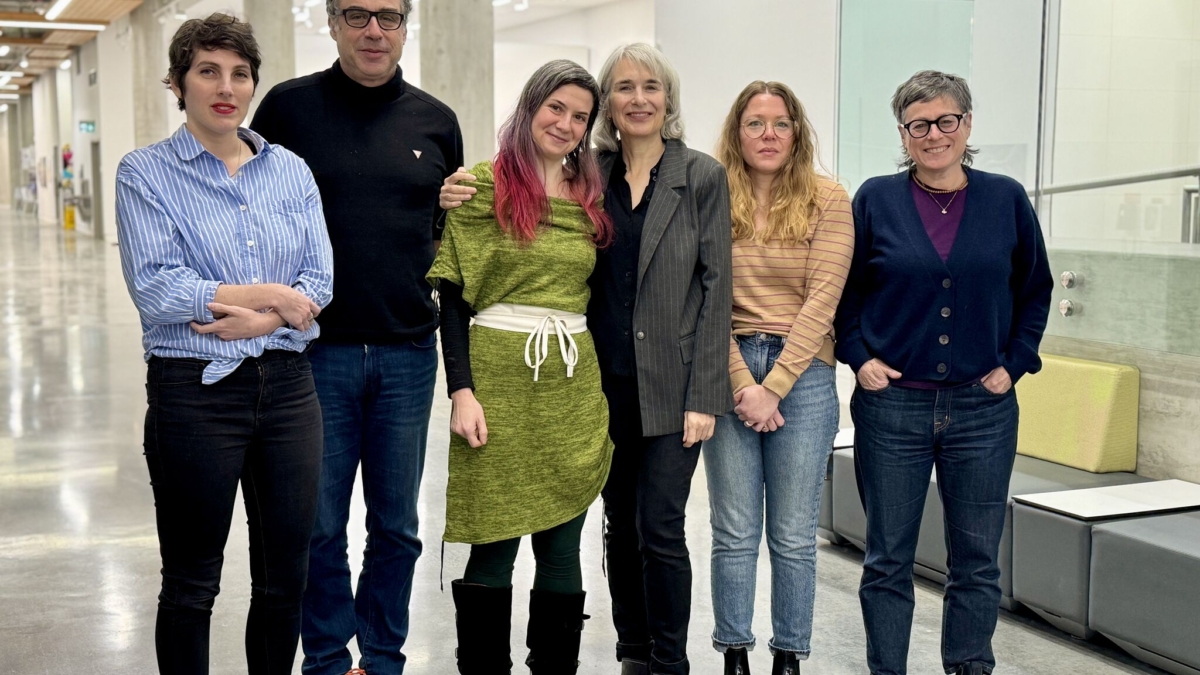
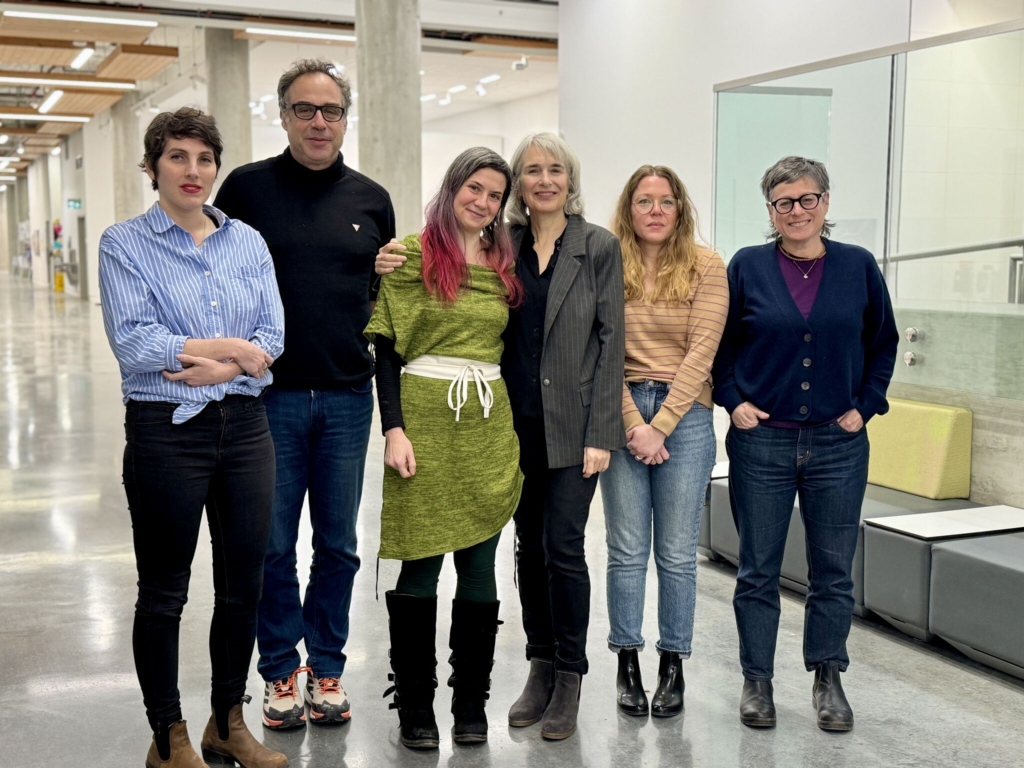
From left to right: Éléonore Goldberg, Alan Goldman, Miriam Libicki, Charlotte Schallié, Lee Gilad and Randy Lee Cutler.

This year’s International Holocaust Remembrance Day (January 27) marked the 80th anniversary of the Auschwitz-Birkenau extermination camp liberation. In commemoration of this event, the Emily Carr University of Art + Design (ECU) hosted a talk to recognize victims of the Holocaust and its impact on survivors. Project Director Dr. Charlotte Schallié was invited to discuss the graphic novel But I Live: Three Stories of Child Survivors of the Holocaust with the ECU community, including students, faculty, and staff.

Dr. Schallié extends her gratitude the the ECU team for hosting the event:

I learned so much from all of you and was deeply touched by the ECU faculty and staff members who reflected on artwork made by Holocaust survivors and their descendants. It’s rare to find such a caring and supportive space of togetherness and belonging, and you created it for all of us! Thank you!

“Remembering the Holocaust: 80 years after the liberation of Auschwitz”
February 12, 2025
3:30 – 6:00 pm PST
Emily Carr University
Boardroom, D2315
520 East 1st Avenue
Event Contact: Lee Gilad | lgilad@ecuad.ca

Event link: https://www.ecuad.ca/events/remembering-the-holocaust-80-years-after-the-liberation-of-auschwitz-guest-talk

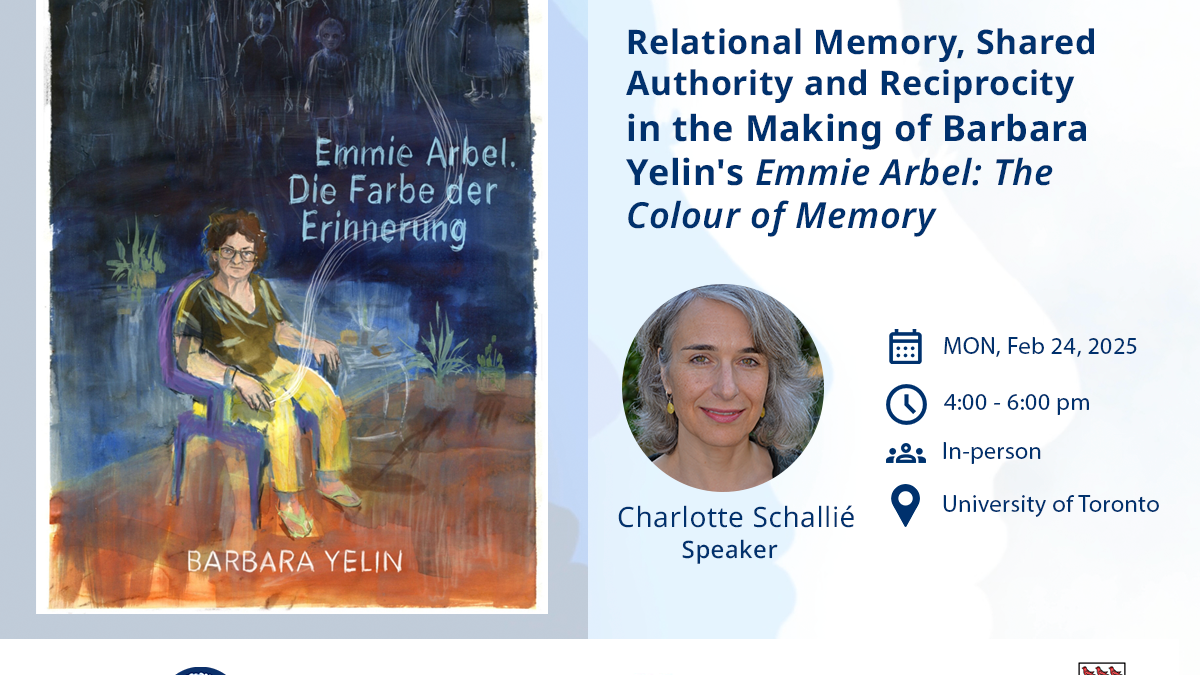
University of Toronto hosts Dr. Schallié – ‘Relational Memory, Shared Authority and Reciprocity in the Making of Barbara Yelin’s Emmie Arbel: The Colour of Memory’ – Feb 24, 2025

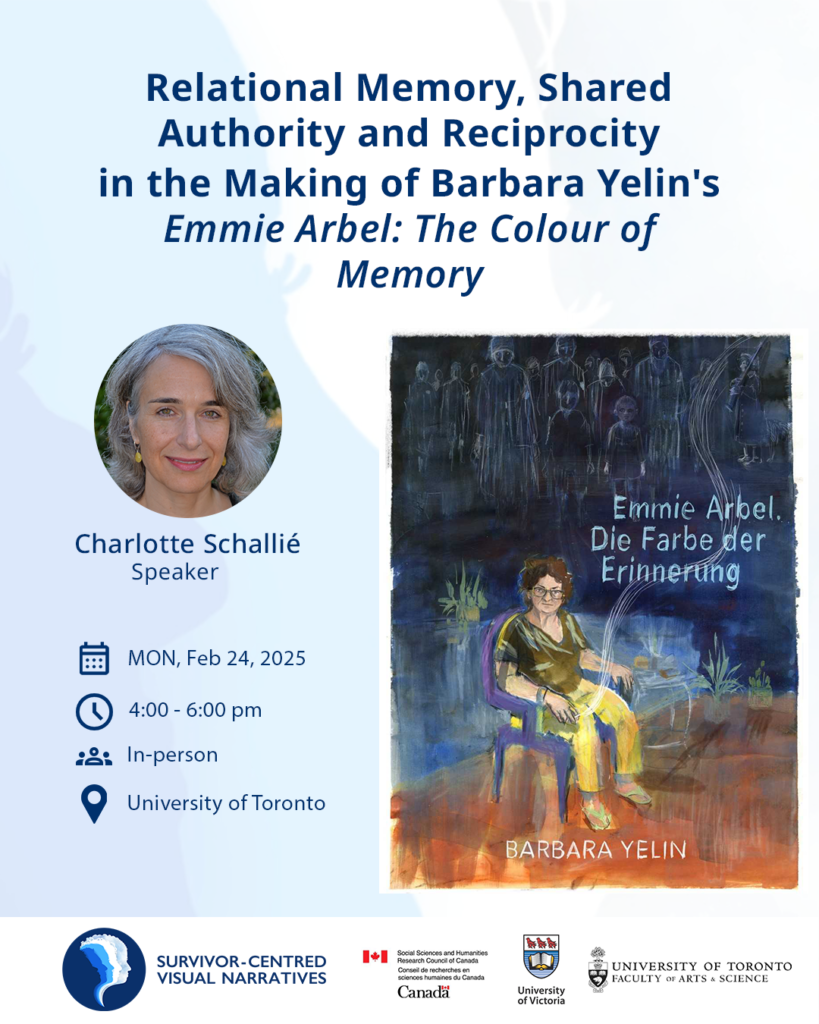
On February 24, Dr. Schallié will visit the University of Toronto to present on ‘Relational Memory, Shared Authority and Reciprocity in the Making of Barbara Yelin’s Emmie Arbel: The Colour of Memory‘.

Event description:
In this presentation, Charlotte Schallié discusses her arts-based collaborative research with graphic novelist Barbara Yelin and Holocaust child survivor Emmie Arbel. Their work together resulted in two publications, the most recent one being Emmie Arbel. The Colour of Memory (2023), co-edited with Alexander Korb. Barbara Yelin’s graphic novel expands Arbel’s seven-page witness testimony into a book-length graphic narrative inviting us to reconsider the role of creative practice in gathering and representing living memory. As a published graphic novel, Emmie Arbel. The Colour of Memory is a multi-genre creation. It is a collaborative piece of scholarship based on mutual care and relationship building, an artistic rendering of a life narrative, and an artwork that documents creative practice as research.

When Barbara Yelin met Emmie Arbel for the first time at the Ravensbrück Memorial in 2019, Arbel conveyed to the artist that she remembered very little “from the war.” In traditional eyewitness testimonies, such memory gaps create significant obstacles resulting in an incomplete oral history document. Yet, in Yelin’s artwork, Arbel’s embodied memories and silent interactions are not just made visible, they are inseparably interwoven into the (hi)storytelling. Dr. Schallié will elaborate on how creative renderings of nonverbal expressions of memories in Emmie Arbel. The Colour of Memory may challenge our understanding of testimony, agency, and absence.

Relational Memory, Shared Authority and Reciprocity in the Making of Barbara Yelin’s Emmie Arbel. The Colour of Memory” 
Monday, February 24, 2025 
4:00 – 6:00 pm PST
Room 100 – Jackman Humanities Building
170 St. George Street

University of Toronto

Registration: https://www.jewishstudies.utoronto.ca/events/charlotte-schalli%C3%A9-relational-memory-shared-authority-and-reciprocity-making-barbara-yelins

 ‘12th Biennial Shafran Teachers’ Conference’ with Co-Director Dr. Andrea Webb – Feb 14, 2025

Registration closes February 1!
https://www.vhec.org/professional-development/shafran-teachers-conference/

On February 14, the Vancouver Holocaust Education Centre(VHEC) is hosting the one-day ’12th Biennial Shafran Teachers’ Conference’. This year’s conference, entitled ‘Teaching the Holocaust: Multiple Perspectives and Best Practices in Holocaust Education’, focuses on providing teachers in various disciplines with new teaching resources to support Holocaust education in the classroom.

SCVN Co-Director Dr. Andrea Webb will be a presenter at the conference and will draw from her experience as a high school teacher, teacher educator, and researcher to support educators’ confidence and engagement in Holocaust education.

Dr. Webb has also developed the Educators’ Resource for the graphic novel ‘But I Live: Three Stories of Child Survivors of the Holocaust’ and is leading the development of the teaching materials and educational resources for all of SCVN’s Research Clusters.

Thank you to the VHEC for hosting this event and we look forward Dr. Webb’s presentation!

Conference Details:
Friday, February 14, 2025
8:30 am – 3:30 pm PDT
Vancouver Holocaust Education Centre
950 West 41st Avenue, Vancouver 2nd Floor, Dayson Boardroom

Visit the VHEC’s main website for more information and registration:
Shafran Teachers’ Conference – Vancouver Holocaust Education Centre