Survivor-Centred Visual Narratives

Category: events

Mark Celinscak and Miriam Libicki present at Jewish American & Holocaust Literature Symposium – Feb 2, 2026

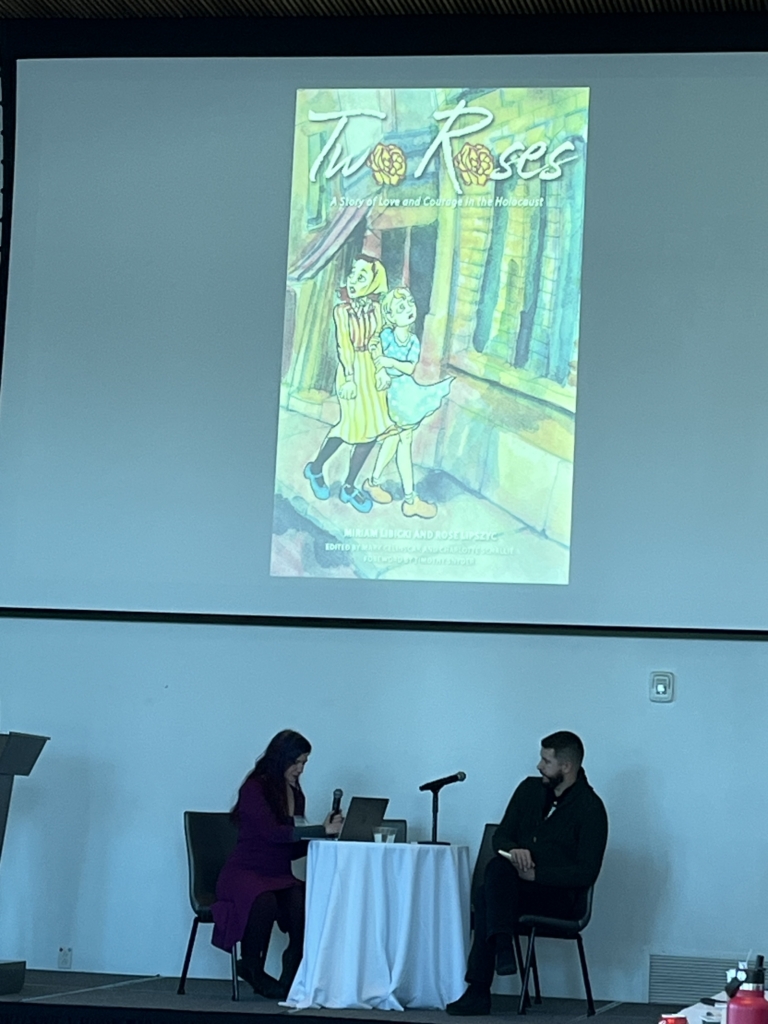
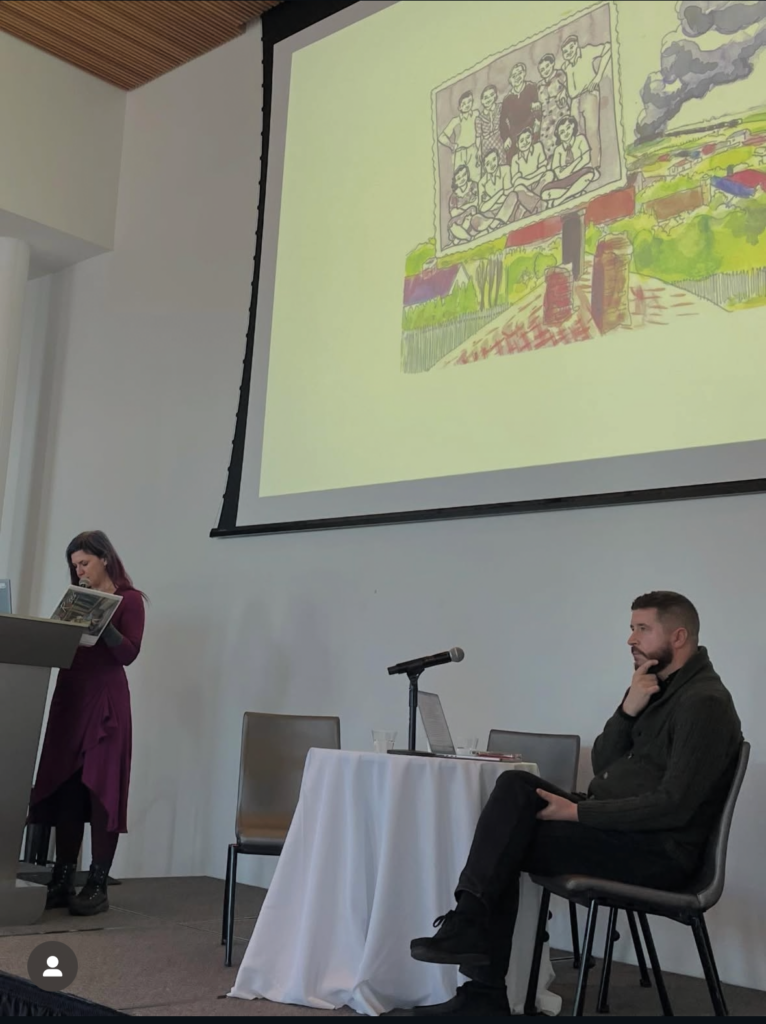
SCVN graphic artist Miriam Libicki and Holocaust Research Cluster Co-Lead Mark Celinscak attended the Jewish America & Holocaust Literature Symposium’s 30th annual conference from February 1 – 3, 2026 at Tulane University in New Orleans.

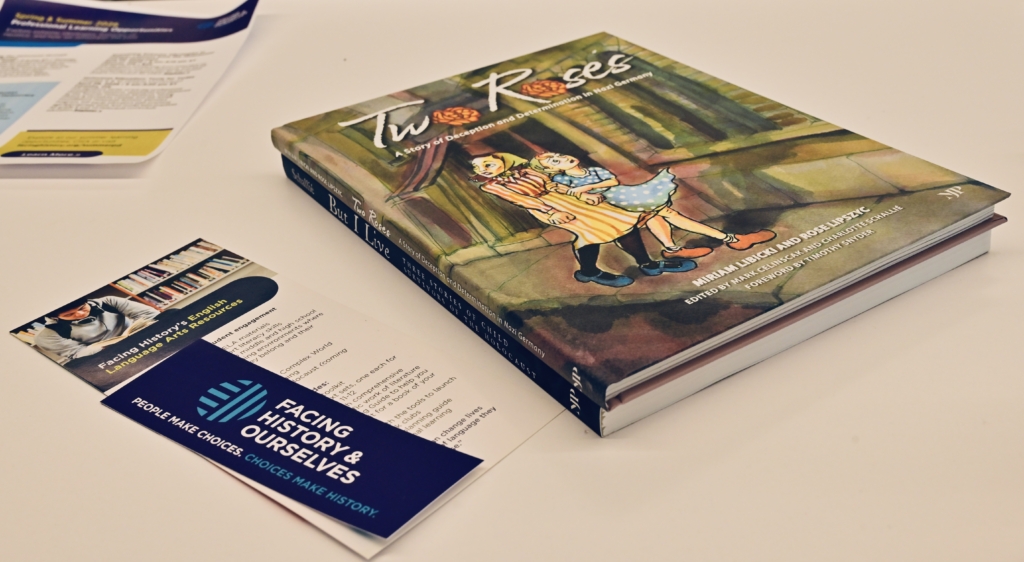
On February 2, they presented in a panel titled “Two Roses: Utilizing Holocaust Survivor Testimony in Graphic Art Narratives,” moderated by Oren Baruch Stier (Florida International University). The discussion focused on the project’s upcoming publication of the graphic novel Two Roses: A Story of Deception and Determination in Nazi Germany, and was an excellent opportunity to share insights from their collaboration with new audiences. Two Roses is will be released on February 24, and is available for advance purchase by the University of Toronto Press here.

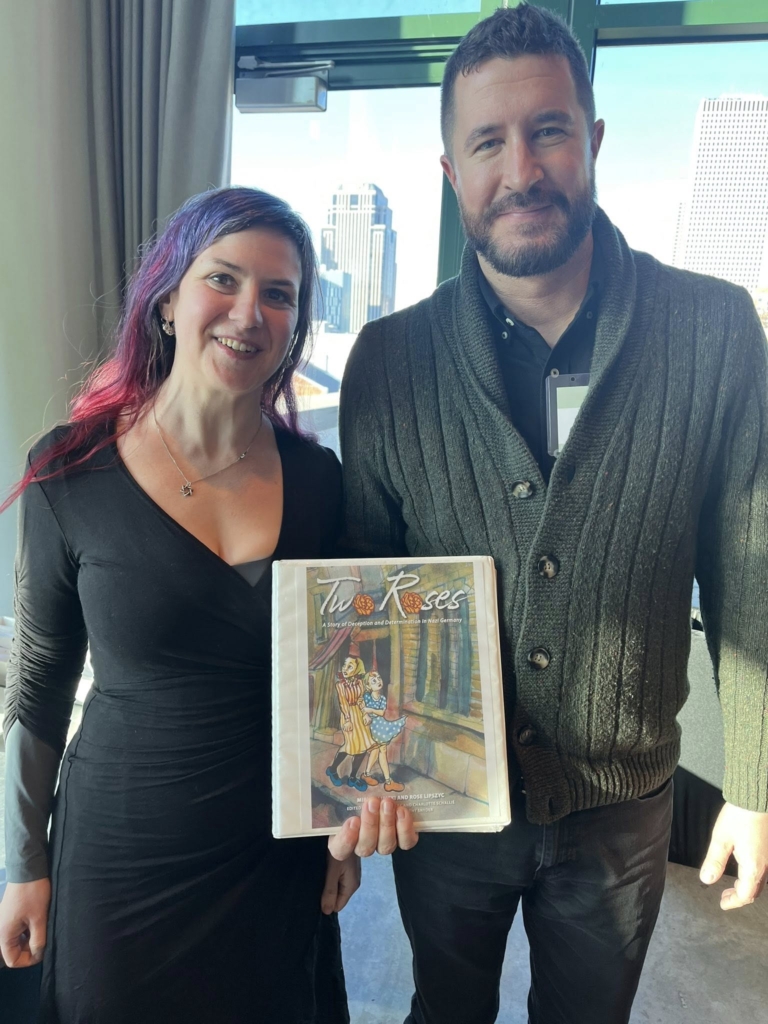
Miriam Libicki (left) and Mark Celinscake (right) with a pre-publication, printed copy of Two Roses at JAHLIT, 2026.

Thank you to the Jewish America & Holocaust Literature Symposium for hosting Mark and Miriam!

‘Trauma-Informed Research Ethics’: Roundtable discussion at Emily Carr University – Feb 9

On February 9, Dr. Charlotte Schallié, co-director of SCVN, will take part in a roundtable discussion focused on the ethical considerations and protocols of arts-based research with trauma survivors.

Organized by the Emily Carr University Research Ethics Board (ECU-REB), the event will take place in person at the Emily Carr University, Boardroom (D2315) and online via Microsoft Teams (registration required).

Charlotte will be joined by Dr. Alla Gadassik, an animation scholar and curator whose work focuses on media materiality, creative labour, and animation exhibition practices. You can find more details about the speakers here.

Personal Histories in the Public Archive: Archiving the Klaus Zwilsky Story – Webinar – Jan 29

Aubrey Pomerance working with objects from the Zwilsky collection at the
Jewish Museum Berlin. Photo credit Charlotte Schallié.

What happens when family history becomes part of the public archive?

Join us for a presentation and discussion with Aubrey Pomerance, Head Archivist of the Jewish Museum Berlin; Klaus Zwilsky, Holocaust survivor; and Dr. Charlotte Schallié, SCVN project director and professor of Germanic Studies at the University of Victoria, as they examine how archives with personal histories can be developed with care.

As a curator, Aubrey Pomerance worked with the Zwilsky family’s documents, photographs and objects relating to their experiences in Berlin, Germany, where they survived the Holocaust at the Jewish Hospital. This webinar will explore Aubrey’s archiving of the Zwilsky Collection in conversation with Dr. Charlotte Schallié. They will be joined by Klaus to reflect upon his collaboration with Aubrey and the complexity of having personal family history become part of the public archives. The discussion will be followed by a question and answer period for attendees.

This webinar is part of the 2026 Archiving with Care series, a collaboration between UBC Public Humanities Hub and the Survivor Centered Visual Narratives Project.

Personal Histories in the Public Archive: Archiving the Klaus Zwilsky Story
Thursday, January 29
10:00 – 11:30 am PST
Webinar Info: https://publichumanities.ubc.ca/events/event/personal-histories-in-the-public-archive-archiving-the-klaus-zwilsky-story/
Registration Link:https://ubc.ca1.qualtrics.com/jfe/form/SV_7alvVDG4OgnUwom

Speaker Profiles

Left: Klaus Max Zwilsky, middle: Aubrey Pomerance, and right: Dr. Charlotte Schallié.

Aubrey Pomerance is the Head of Archives at the Jewish Museum Berlin. Born in Calgary, Canada, he studies Jewish Studies and History at the Freie Universität Berlin. There he was a research assistant at the Institut für Judaistik in 1995 and 1996 and thereafter at the Salomon Ludwig Steinheim Institut for German Jewish history in Duisburg. In April 2001, he took up his position at the Jewish Museum Berlin, being responsible for the establishment of a branch of the Archives of the Leo Baeck Institute and for the museum’s archival collection. He is the community liaison overseeing the Zwilsky Collection working with Klaus Zwilsky and his family, which connected him with the Survivor-Centred Visual Narratives (SCVN) Project.

Klaus Max Zwilsky was born in Berlin, Germany, on August 16, 1932. He and his parents survived the Nazi regime in the Berlin Jewish Hospital, where his father was an administrator, while his mother did forced labor at Siemens. Following the end of the war, Klaus became the first boy to celebrate a Bar Mitzvah in Berlin. In 1946, he and his parents emigrated to the United States. After obtaining his Doctor of Science degree from MIT, Klaus pursued a career in Materials Science and Engineering.

In 2000, he began organizing an extensive collection of papers left by his parents, detailing the fate of his extended family who perished during the war. He organized his family’s personal papers from the war period and donated these documents to the Jewish Museum in Berlin. Klaus has frequently returned to Berlin to participate in Holocaust workshops for German high school students and other educational programs organized by the Jewish Museum Berlin. He has also spoken extensively to share his personal experiences with high school and middle school students as well as social and professional groups in the United States.

Charlotte Schallié is a Professor of Germanic Studies at the University of Victoria. Her teaching and research interests include memory studies, visual culture studies & graphic narratives, teaching and learning about the Holocaust, genocide and human rights education, community-engaged participatory research and arts-based action research. Together with Dr. Andrea Webb (UBC), she is the co-director of the Survivor-Centred Visual Narratives Project (www.visualnarratives.org), funded by a 7-year SSHRC Partnership Grant.

Thank you to the UBC’s Public Humanities Hub team for co-hosting
and facilitating this webinar!

‘Al-Faia’ part of scientific experiment at Betweter Festival, The Netherlands – Sept 26, 2025

On September 26, pages from Tobi Dahmen’s graphic novel Al-Faia’ – The Horror: Surviving Syria’s Prisons were included in a one-day scientific experiment in visual journalism. Al-Faia’ is about survivor Akram Al Saud’s experiences as a prisoner of the totalitarian Assad regime, and the experiment presented students with panels from his story to review. The experiment, called ‘Voer Voor Je Feed’ (Food For Your Feed), was organized by Winnifred Wijnker and Yael de Haan, researchers at Hogeschool Utrecht, for the 2025 Betweter Festival. Its goal was to understand how young people’s experience of reading the news changed when the stories were presented in the form of comics. Over one hundred people participated in the experiment.

Pages from Al-Faia’ used in the experiment. Photo credit: Tobi Dahmen.

The Betweter Festival is a one-day event that celebrates science and art through a mix of presentations, interviews, film screenings, musical performances, interactive scientific experiments, and more. The festival has been held annually at TivoliVredenburg since 2016.

More information about this year’s festival can be found at the Betweter Festival website.

Photos of students from the event reviewing the graphic narratives and pages from Al-Faia’. Photo credit: Winnifred Wijnker.

‘Zeitzeichnen. Comic & Erinnerung’ exhibit opens at Turm zur Katz – Nov 7, 2025 – Mar 15, 2026

After a successful four-month run at the Kunsthaus Wiesbaden under the title ‘I will not be silent! Drawn Memories in Comics’, curator Jakob Hoffmann’s exhibit is now featured at the Turm zur Katz in Konstanz as ‘Zeitzeichnen. Comic & Erinnerung’ (Drawing Time. Comic & Memory).

For this exhibit, Jakob Hoffmann has brought together internationally acclaimed, award-winning artists Tobi Dahmen, Nora Krug, Birgit Weyhe, and Hannah Brinkmann, all of whom ‘shed light on history through graphic storytelling’. The exhibit features original drawings, sketches, interviews, and research materials from the development of their graphic narratives.

Three of the four artists—Tobi, Nora, and Birgit—are collaborating on upcoming graphic novels with our Survivor-Centred Visual Narratives project. While Nora and Birgit are not presenting work associated with the SCVN project, Tobi’s collaboration with the Iraq/Syria Research Cluster is featured, showcasing panels from Al-Faẓia’ – The Horror: Surviving Syria’s Prisons. It tells the story of Akram Al Saud’s experiences as a prisoner of the totalitarian Assad regime. Al-Faẓia’ will be published by Carlsen Verlag in June, 2026 and University of Toronto Press in fall 2026.

Left: Panels from all artists, title translation: ‘Violence and its representation: What can one endure?’ Right: Panels from Al-Faẓia’. Photo credit: Torben Nuding.

The exhibit opened on November 6 with a panel discussion between Jakob Hoffmann, Birgit Weyhe, and renowned literary and cultural scholar Prof. Dr. Aleida Assmann. Then, on November 16, Birgit Weyhe sat down with Holocaust survivor Ernst Grube to discuss her book Time Heals No Wounds: The Life of Ernst Grube.

Photos from opening night, which included a panel discussion followed by a book signing and viewing of the exhibit. Photo credit: Torben Nuding.

‘Zeitzeichnen. Comic & Erinnerung’ will be open until March 15, 2026. Turm zur Katz offers free public tours on the first Sunday of every month. For more details about the exhibit, visit their website here.

To read about the exhibit’s run at the Kunsthaus Wiesbaden, follow the link to our blog post.

‘Community Engagement and Intercultural Sensitivity: Ethics, Design and Practice’ – Panel and workshop with Rwanda Research Cluster

On October 13, the Scottish Graduate School for Arts & Humanities hosted a panel and workshop featuring members of SCVN’s Rwanda Research Cluster titled ‘Community Engagement and Intercultural Sensitivity: Ethics, Design and Practice’. It was led by Dr. Fransiska Louwagie and featured three speakers with backgrounds in ethnographic research: Drs. Anna Ball, Erin Jessee, and María Soledad Montañez. The full day event included an online panel in the morning and an in-person workshop in the afternoon, hosted at the Sir Duncan Rice Library at the University of Aberdeen.

The panel focused on how community engagement is an increasingly important academic practice, offering insightful pathways to both the impactful dissemination and collaborative creation of new knowledge.

Anna Ball introducing the morning panel session. Photo credit: Fransiska Louwagie.

It explored the questions: how can we ensure that engagement practices are sensitive to the cultural identities, practices and beliefs of those within the communities with which we work? And how can we design community engagement practices that enhance understanding, dialogue and agency across perceived differences, in ethical ways?

Following the panel, the workshop invited the speakers to share their experiences with safeguarding, consent, positionality, trauma-informed practice and participant agency. They examined what interculturally sensitive community engagement looks like in terms of research design, ethics and practice. They also focused on the use of listening as a methodology for community engagement of various styles, with lessons from academic experts in intercultural fieldwork with varied communities, including survivors of the Rwandan genocide and people navigating the asylum system.

Thank you to the Scottish Graduate School for Arts & Humanities and University of Aberdeen for hosting the panel and workshop.

From left to right: Rwanda Research Cluster Co-Leads Fransiska Louwagie and Erin Jessee, with Advanced Research Fellow, Anna Ball. Photo credit: Fransiska Louwagie.

For more information about the event: https://tockify.com/sgsah/detail/355/1760349600000

The Wiener Library hosts film premiere of ‘Why We Dance’ and panel with Research Cluster Co-Leads – Oct 23, 2025

On October 23, SCVN’s project partner the Wiener Library is hosting a talk to explore how graphic novels have proven to be a powerful medium for sharing stories of the Holocaust and other genocides and mass atrocities.  

A panel discussion will reveal those lessons are currently being applied in the creation of new survivor-centered graphic novels about the Holocaust and the 1994 genocide against the Tutsi in Rwanda.

Drawing on the expertise of three of the SCVN’s Research Cluster Co-Leads, Dr. Erin Jesse, Dr. Fransiska Louwagie and Dr. Alexander Korb, the talk will showcase the potential of the graphic novel medium to portray survivor stories. The researchers will discuss how the project works with artists and survivors to create new educational approaches.

The evening will include the public premiere of our short film, ‘Why We Dance’, that has been made by filmmaker Marc Ellison about the team’s current co-creative work with Rwandan genocide survivor Jerome Irankunda and graphic novelist Michel Kichka (the son of a Holocaust survivor).

Event Details
Venue: The Wiener Holocaust Library (London, UK)
Date: October 23, 2025
Time: 6:00pm – 8:00pm (GMT+1)

Visit the Weiner Holocaust Library main website for more information and registration:
https://wienerholocaustlibrary.org/event/project-talk-why-comics-telling-survivor-stories-through-graphic-novels

Trailer of ‘Why We Dance’:

2025 Annual General Meeting in Amsterdam: Mobilizing Knowledge and Conceptualizing Public Engagement

Guest blog feature by Elissa Boghosian

On June 19 and 20, 2025, project partners from the NIOD Institute for War, Holocaust and Genocide Studies and the Iraq and Syria Research Cluster hosted a two-day Annual General Meeting (AGM) in Amsterdam for the Survivor-Centred Visual Narratives project. The AGM was preceded by a public event on June 18: ‘Visualizing Survivors’ Voices: How graphic novels strengthen historical understanding of witnesses’ experiences’. It featured a live reading of the forthcoming Al-Fazia –The Horror: Surviving Assad’s Prisons by Akram al-Saud and Tobi Dahmen with a panel discussion.

This year’s AGM convened eighteen Research Cluster Co-Leads, project partners and researchers from Canada, England, Germany, The Netherlands, Scotland, and Switzerland. The AGM focused on how the five Research Clusters can prepare to “go public” through the publication of their graphic novels and associated public engagement activities. Hosted at the Royal Netherlands Academy of the Arts and Sciences’ (KNAW) Trippenhuis, the AGM provided a forum for participants to consider cross-cluster collaboration opportunities, conceptualize public engagement, share research cluster progress from the last year, and contemplate milestones for the years ahead.

SCVN Annual General Meeting for Year 3: ‘Knowledge Mobilization’ at the Royal Netherlands Academy of the Arts and Sciences’ (KNAW) Trippenhuis. Photo credit: Jennifer Sauter.

Day 1 began with cross-cluster conversations. Each Research Cluster met on a rotating basis with the other clusters to explore connections between their work, share challenges, and consider how insights from other groups could inform their own approaches.

In the afternoon, a facilitated conversation with the Iraq and Syria Research Cluster led by Fransiska Louwagie invited reflection on the cluster’s experiences developing their graphic novels and their public trajectories. The day concluded with a discussion about project planning for 2025 and beyond, including archiving, long-term community engagement strategies, audience conceptualization, graphic novel publicity, and more. Each cluster contemplated these topics and developed preliminary timelines for Year 4 of the project.

Charlotte introducing the AGM: What does it mean to “go public”? (left) and Fransiska Louwagie leading a discussion with the Iraq and Syria Research Cluster’s Leyla Ferman, Kjell Anderson, Kees Ribbens and Uğur Ümit Üngör (right). Photo credit: Jennifer Sauter.

Day 2 started with presentations from four external speakers involved in the development and/or use of graphic novels about mass violence. Steven Stegers (Euroclio) spoke about using visual media in history teaching while Rob Verheijen (Hogeschool Arnhem Nijmegen) presented on using World War II and Holocaust graphic novels in Dutch history education.

Steven Stegers from Euroclio presenting (left) and Rob Verheijen (right + below) leading our team through a workshop engaging with a Holocaust comic for highschool students to identify characters as perpetrators, victims, helpers, bystanders and society.

Sabine Rutar, Franziska Zaugg and Erin Jessee. Photo credit: Jennifer Sauter.

Fransiska Louwagie, Andrea Webb, Shannon Leddy and Elissa Boghosian. Photo credit: Jennifer Sauter.

Following these presentations, Kees Ribbens moderated a conversation with Bas Kortholt (Kamp Westerbork) and Adriaan Baccaert (Kazerne Dossin) about the development and publication of Picturing the Unimaginable: Ten Comic Authors, Ten Stories about the Holocaust and other Nazi Crimes (see below). In addition to speaking about the graphic novel itself, Bas and Adriaan shared about the associated exhibition and other public engagement considerations from the project.

Adriaan Baccaert (Kazerne Dossin) far left, with Bas Kortholt (Kamp Westerbork) presenting, moderated by Kees Ribbens (right). Photo credit: Jennifer Sauter. Cover of Picturing the Unimaginable (right).

The program concluded with status update presentations from each Research Cluster, showcasing moving film trailers and artwork from their graphic novels. It was a formative moment for each Research Cluster to share their progress and journey since their initial gathering at our Year 1 AGM in Glasgow.

We would like to thank our hosts, project partners and all those who contributed to the fruitful discussions throughout the AGM in Amsterdam. We hope the program offered participants meaningful opportunities to learn, share, and connect, and that it laid a strong foundation for the next year of the Survivor-Centred Visual Narratives project.

Webinar and public debut of ‘Two Roses’: Arts Based Storytelling and the Holocaust – July 15, 2025

As noted above, on July 15, the Friends of Simon Wisenthal Center for Holocaust Studies will host a webinar titled “The ‘Two Roses’ Project: Arts-Based Storytelling and the Holocaust”, introducing the forthcoming graphic novel sharing the extraordinary story of Toronto-based Holocaust survivor Rose Lipszyc to the public.

The program will open with an introduction to the Survivor-Centred Visual Narratives project, highlighting its ethics of care framework that centres the voices, agency, and emotional well-being of Holocaust survivors. This will be followed by an overview of Two Roses, including a brief reflection on Rose Lipszyc’s biography and lived experience.

Miriam Libicki will then read selected pages from Two Roses and join Dr. Charlotte Schallié and Dr. Mark Celinscak in a conversation about their collaborative work with Rose. They will discuss the unique potential of comics to convey survivor testimony with emotional depth and visual impact.

The event will conclude with a Q&A session, during which we are honoured to invite Rose to take part in the discussion.

Many thanks to the Friends of Simon Wiesenthal Center for Holocaust Studies for coordinating and hosting this webinar.

To register for this virtual event, please click here.