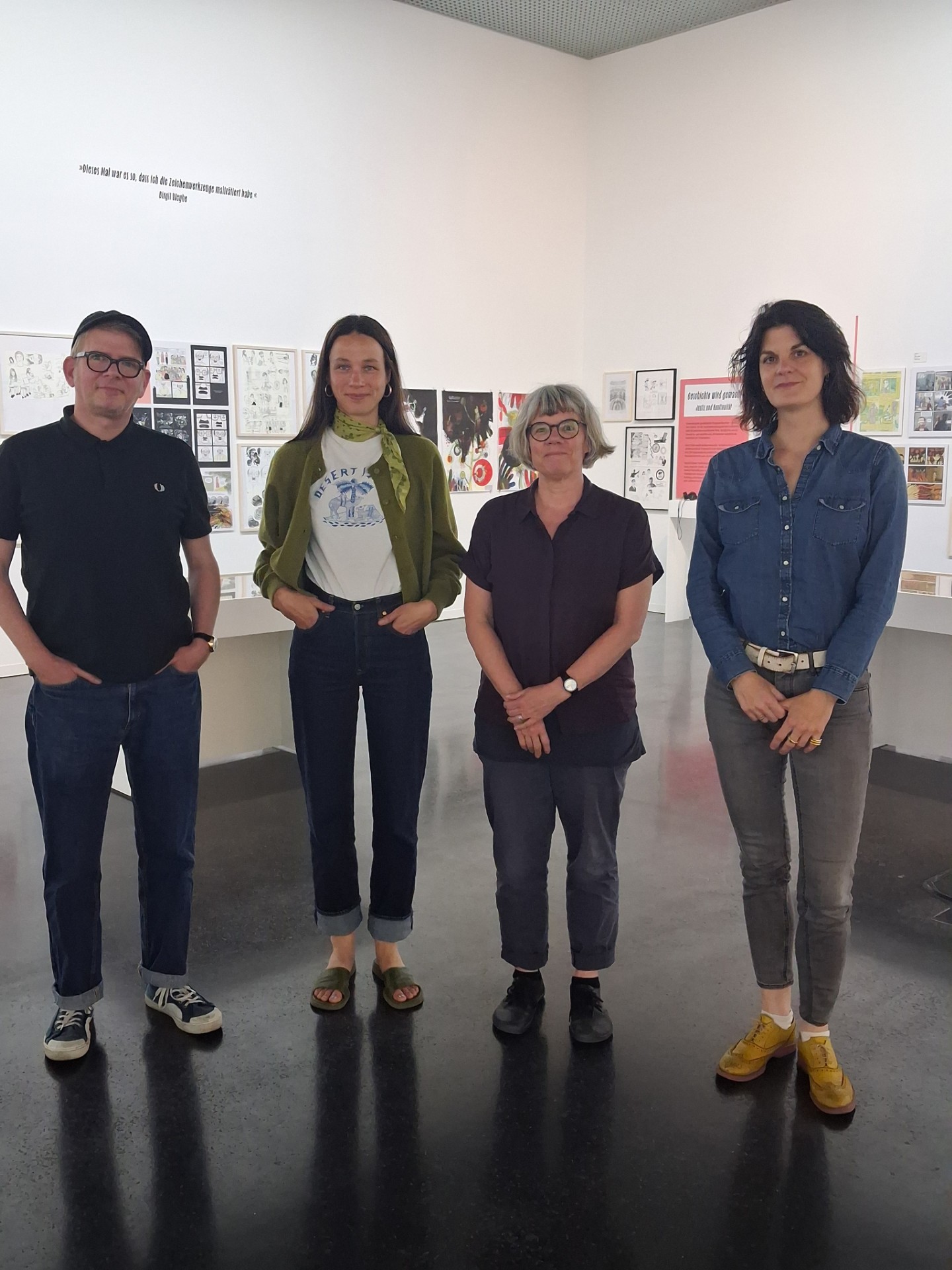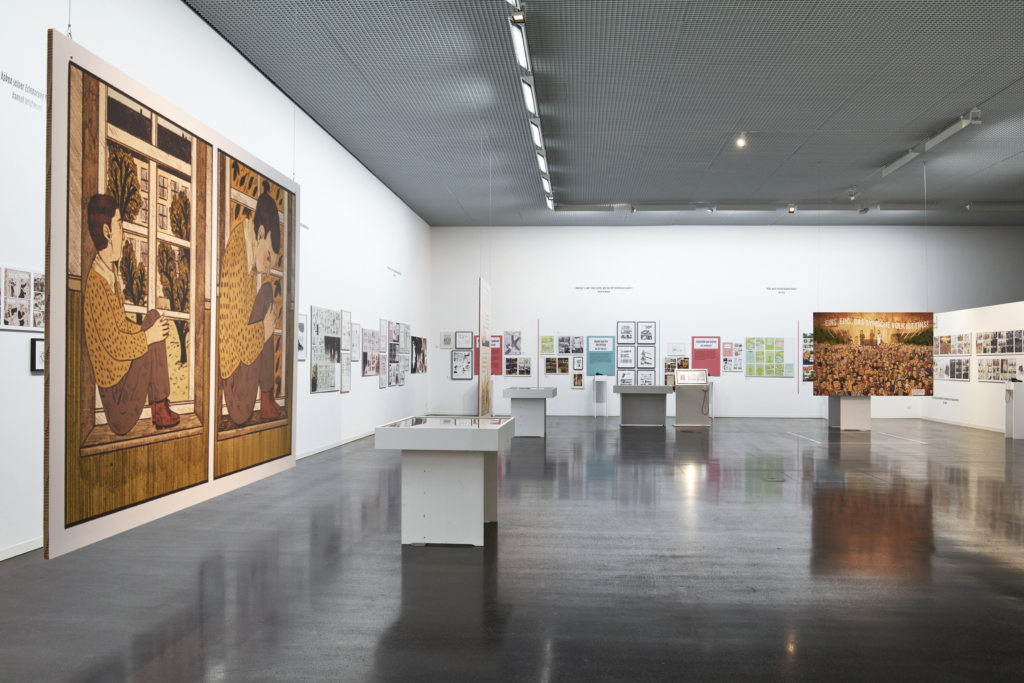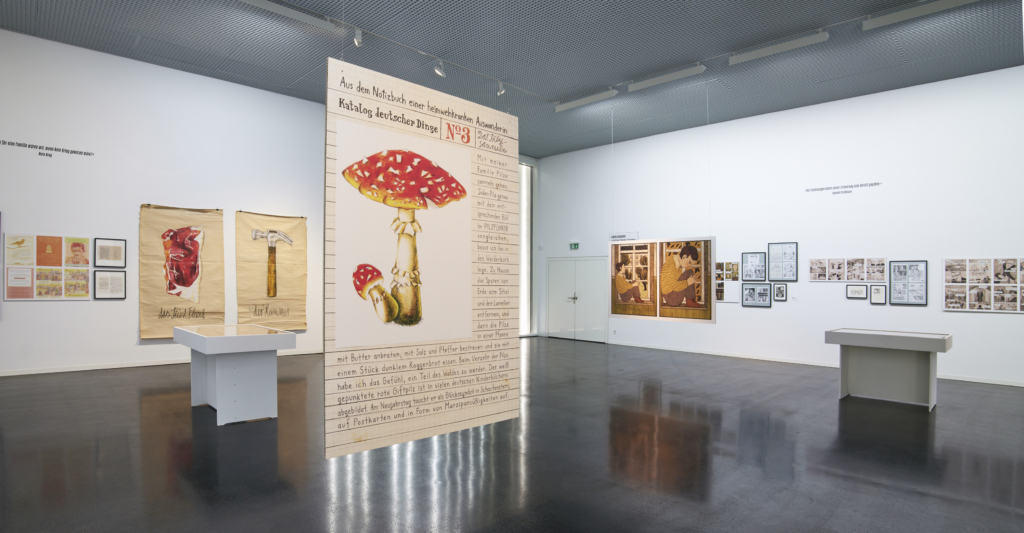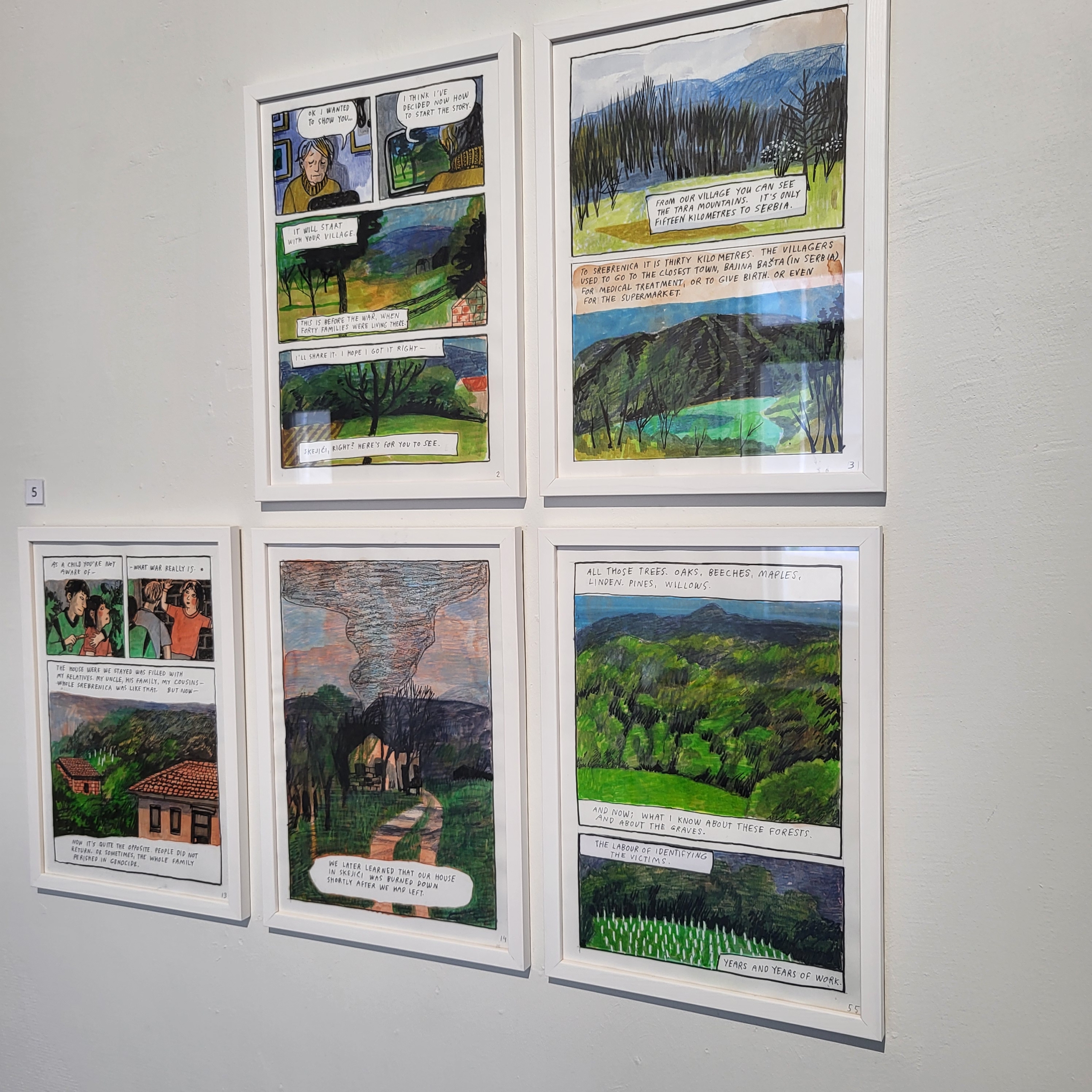
The ‘Landscape in Comics’ exhibition opens on May 21 in Galleria 5 in Oulu, Finland. It will be the first public presentation of Anneli Furmark’s original art from her untitled graphic novel created in collaboration with a survivor of the Srebrenica Genocide within the frame of the Yugoslav Wars Research Cluster. The exhibition focuses on the presence and place of landscape in graphic narratives.
In comics, landscapes often play a secondary role by providing background to the main story. The ‘Landscapes in Comics’ exhibition challenges this convention by exploring the narrative potential of landscapes and their capacity to reveal hidden details and additional layers of meaning in graphic storytelling. In addition to landscape, the exhibition deals with themes such as time, temporality, perception, sensory perception, memory, scale, living conditions and ecosystems.
Furmark’s work is featured alongside artists Juliana Hyrri (Estonia) and Hanneriina Moisseinen (Finland). The exhibition hosted by Galleria 5 in Oulu, Finland is open from May 21 until June 16, 2025.
Thank you Kulturfonden för Sverige och Finland, Grafia and Sortavala – Säätiö for supporting this exhibition.
For more detailed information on Galleria 5 website, please click here.
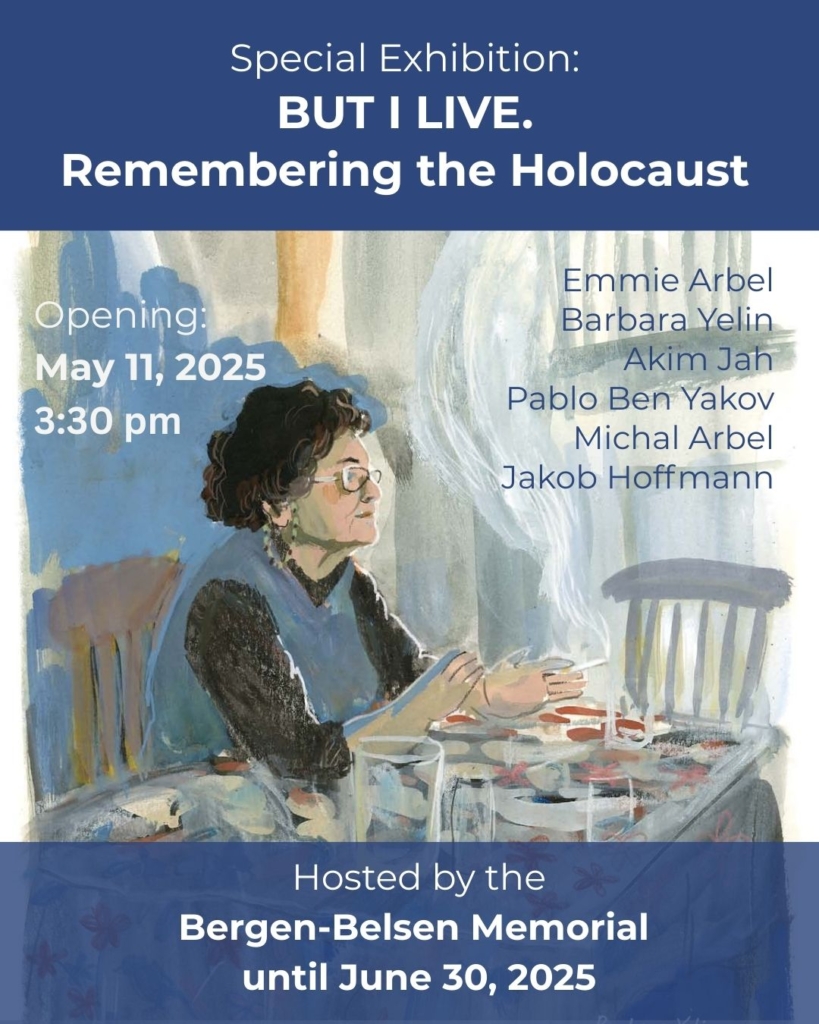
On Sunday, May 11, 2025, the exhibition ‘But I Live. Remembering the Holocaust’ opens at the Bergen-Belsen Memorial.
The exhibition, curated by Jakob Hoffmann and Barbara Yelin, features the process of co-creation and original artwork by artists Barbara Yelin, Miriam Libicki, and Gilad Seliktar produced for the graphic novel But I Live: Three Stories of Child Survivors of the Holocaust, edited by Dr. Charlotte Schallié and inspired by the narratives of Holocaust survivors Emmie Arbel, David Schaffer, and Nico and Rolf Kamp. Displaying original drawings, sketches, archival materials, and interviews with participants, the exhibition illuminates the process by which the book came into existence.
Pages from each of the graphic narratives in ‘But I Live’, from left to right: ‘A Kind of Resistance’ by Miriam Libicki, ‘Thirteen Secrets’ by Gilad Seliktar and ‘But I Live’ by Barbara Yelin.
After a successful three-year run and exhibiting at institutions such as the Stadtmuseum Erlangen, Dortmund schauraum comic + salon, Wiesbaden Kunsthaus, Ravensbrück Memorial, and Erica-Fuchs-Haus Museum in Schwarzenbach a.d. Saale, Germany, the Bergen-Belsen Memorial is now the sixth institution to host the exhibition. The location of the exhibition also has personal and historical significance, as Emmie Arbel survived the concentration camps at Bergen-Belsen when she was just a little girl.
With the publication of Barbara Yelin’s graphic novel Emmie Arbel: The Colour of Memory, more of Emmie’s story has since been shared. In response to its arrival, the exhibition has been expanded to include new original materials.
Exhibitions only come to life through collaborative team efforts. Thank you to Barbara Yelin and Jakob Hoffmann for their leadership, their creative vision, and dedication, and thank you to Dr. Akim Jah and the educational team at the Bergen-Belsen Memorial for making this exhibition possible.
‘But I Live. Remembering the Holocaust’ will be hosted by Bergen-Belsen Memorial from May 11 until June 30, 2025.
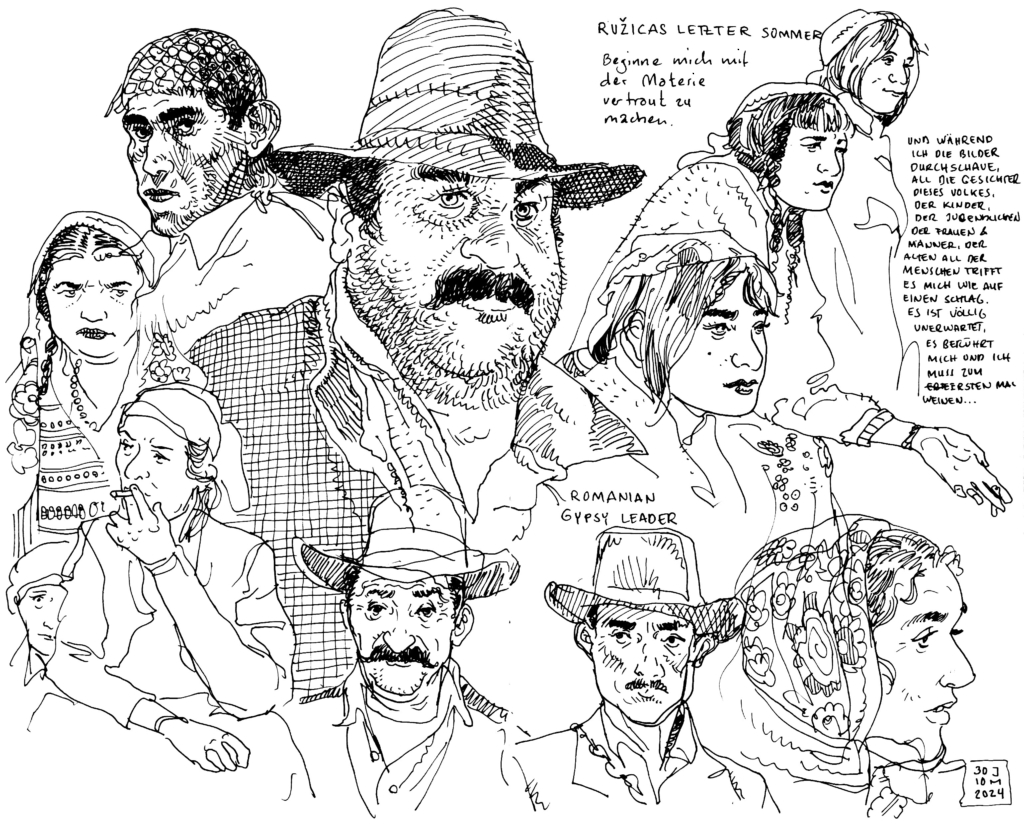
As part of our Yugoslav Wars Research Cluster, Swiss comics artist Jared Muralt has been collaborating with a Roma woman, Ružica (not her real name), retelling her life in Serbia in the 1990s where the discrimination and violence of the Yugoslav Wars shaped Ružica’s childhood.
The concept drawings and character sketches for the graphic novel project “Ružica’s Last Summer” were recently showcased at the Berner Design Foundation’s annual BESTFORM exhibition from March 28 to April 27, 2025. This event represents the first public showing of Jared’s work on the project.
The Berner Design Foundation supports professional designers from the fields of graphic and product design, ceramics, fashion and textile design as well as scenography, while managing the Canton of Bern’s collection of applied arts.
In addition to hosting Jared’s work, the Berner Design Foundation has generously supported Jared’s graphic novel through additional funding. We gratefully acknowledge their contribution to our project, and their support in expanding the graphic narrative to bring Ružica’s story to life.
Photo and image credit: Lea Moser and Jared Muralt, May 2025.
On March 26, the upper level seminar GRMN 3262 Representations of the Holocaust, taught by Dr. Stephan Jaeger at the Department of German and Slavic Studies of the University of Manitoba, welcomed Project Director, Dr. Charlotte Schallié, as a guest speaker. She presented in the class session titled “Visual Storytelling and Remembrance in Graphic Novels to tell and work through the Holocaust.” The session was based on the students’ reading of the anthology of graphic novels But I Live: Three Stories of Child Survivors of the Holocaust (2022).
Via Zoom, Dr. Schallié shared research insights on the background of the project, the methodology of graphic testimony, and themes of history and memory. She drew the students’ attention to the unique style of each of the three graphic survivor stories included in But I Live through specific examples and detailed analysis. Her presentation was followed by a lively discussion of the book in which the participants had a chance to further explore the concept introduced by Dr. Schallié – that memory of the Holocaust is a two-way road between past and present.
We invited to Dr. Jaeger to contribute to our blog by sharing his reflections and a selection of student engagements from the session, whereby he stated:
“…students gained a much deeper insight into the opportunities of graphic survivor testimonies, into the use of colours, text-image relations, and silences, and into the impact of the collaboration in the present that made the remembering and new or expanded forms of testimony possible.”
After the seminar, all students wrote a weekly journal entry commenting on the session. Dr. Jaeger shared many of their thoughtful reflections, highlighting a few:
“I was especially drawn to Emmie’s story [Barbara Yelin, “But I Live,” based on the memories of Emmie Arbel], which illustrates the lasting effects of the Holocaust on her later in life. The use of minimal text, or at times, empty panels, encouraged reflection, allowing the images to convey meaning rather than simply acting as a supplement for words.”
“My favourite art style is in the first story [“A Kind of Resistance” by Miriam Libicki from interviews with David Schaffer]. I thought the undertones of red paint throughout and the deep lines around the eyes made the characters more expressive and uneasy. I liked the fact that each story had a different but in some aspects similar experiences – which is sad to think about, but sometimes we have to remember that it is the reality for many survivors of the Holocaust.”
Another student saw Charlotte’s talk as a “first-hand account” on the memory process and highlighted that they particularly appreciated “the relational dynamics between the survivors and interviewers / artists.”
Although Dr. Jaeger’s class had discussed Art Spiegelman’s Maus in the previous session, he believed that the insight into the processes of the collaborations clearly contributed to the understanding of the range of representational opportunities that the medium graphic novel provides. Similarly, a student noted that:
“[It] was cool seeing how the artist got paired up with the survivor(s), and in the end created these works, and each story was created and expressed differently […]. From representing it, not to historically record it, these stories show that not every survivor was the same. And a lot of the time I find when the victim is not human but a number, or a name, there is no emotional connection, and we as people tend to see that as less important to us. Often we list off countless numbers on deaths, but a number doesn’t mean much without seeing what that number is.”
Several students wished that the book itself would have included an essay similar to Dr. Schallié’s talk:
“The only addition [….], perhaps to the description of the artists would be to explain why the styles were different, why certain colours would use or (what I personally found most interesting) the research/relationship process. While this may be more interesting for a historian or academic, it does make any reader see the story in a new and more appreciative light.”
Dr. Jaeger also shared with us that several students in the group listed But I Live as one of their favorite and most insightful representations of the Holocaust during the term in the course’s final survey and that they all strongly recommended to invite Dr. Schallié again to the next iteration of the course. He closed with his appreciation:
“Overall, Dr. Schallié’s generous sharing of her time and expertise energized all students in the class to engage more deeply in the challenges and opportunities of representations of Holocaust memories and visual story-telling.”
Thank you to Dr. Jaeger and our project partners at the University of Manitoba for hosting Dr. Schallié online and for this exciting opportunity to connect and engage with students about the project.
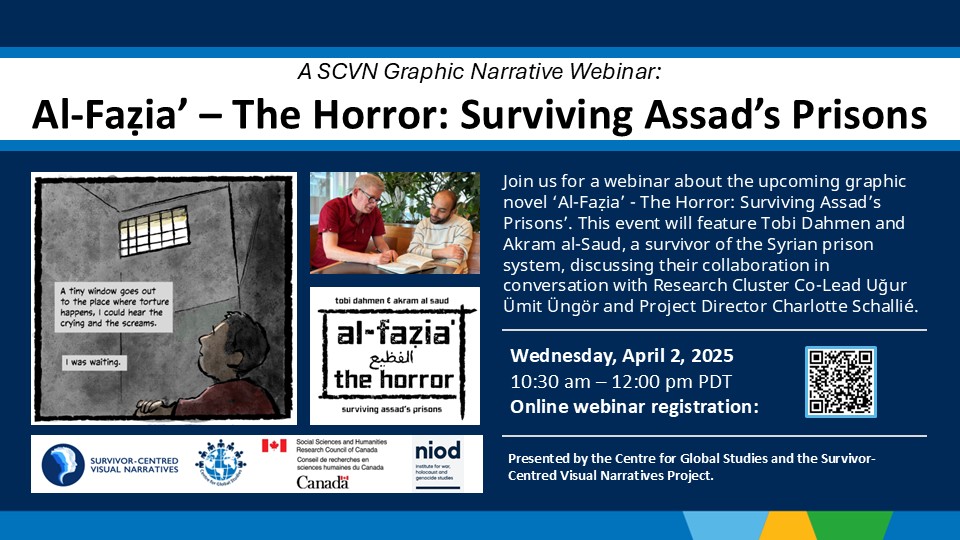
In February 2023, graphic artist Tobi Dahmen was introduced to Syrian survivor Akram al-Saud by Dr. Uğur Ümit Üngör, the Research Cluster Co-Lead on the SSHRC Partnership Grant Survivor-Centred Visual Narratives Project. Based in The Netherlands, Tobi and Akram have been collaborating locally over two years in a series of interviews to share Akram’s unique story of surviving a series of Syrian prisons.
Since the fall of the Bashar al-Assad regime on December 8, 2024, Syria has opened up to the world again, and the international community has begun to learn more about the oppression and injustices of the regime. This webinar will feature Tobi Dahmen and Akram al-Saud discussing their collaboration, in conversation with Dr. Üngör and Project Director Dr. Charlotte Schallié. They will explore the difficulties of representing imprisonment and torture, and how graphic narratives can help survivors of mass violence find a voice.
Tobi Dahmen Tobi Dahmen, born in 1971 in Frankfurt/Main, is a German illustrator and comic artist. He has published several comic books, including Fahrradmod (2015). Dahmen has received numerous awards for his work and is currently working on a new graphic novel with a Syrian survivor as part of the Survivor-Centred Visual Narratives Project. The graphic novel Columbusstrasse: Eine Familiengeschichte 1935-1945, was released on May 29, 2024, and is available to order online here.
Akram al-Saud Akram al-Saud is from Deir Ez-Zor and now lives in the Netherlands. He has been arrested four times before fleeing from Syria. His longest detention began on March 28th, 2010—before the revolution—and lasted for nine months. At the time, he was a student at the Faculty of Architecture in Aleppo, and was arrested by the intelligence services of the air force. After the 2011 revolution, he was arrested three more times. Dr. Uğur Ümit Üngör Uğur Ümit Üngör (PhD Amsterdam, 2009) is Professor of Holocaust and Genocide Studies at the University of Amsterdam and the NIOD Institute for War, Holocaust, and Genocide Studies. His main areas of interest are genocide and mass violence, with a particular focus on the modern and contemporary Middle East. He is an editor of the Journal of Perpetrator Research, and coordinator of the Syria Oral History Project. His publications include Confiscation and Destruction: The Young Turk Seizure of Armenian Property (Continuum, 2011), and the award-winning The Making of Modern Turkey: Nation and State in Eastern Anatolia, 1913-1950 (Oxford University Press, 2011). From 2014 to 2019, Üngör coordinated a Dutch Research Council-funded research project on paramilitarism, which led to the monograph Paramilitarism: Mass Violence in the Shadow of the State (Oxford University Press, 2020). He is currently working on its follow-up monograph Assad’s Militias and Mass Violence in Syria (forthcoming, 2025). He is also co-author of Syrian Gulag: Assad’s Prison System, 1970-2020 (I.B.Tauris, 2023).
Dr. Charlotte Schallié Charlotte Schallié is a Professor of Germanic Studies in the School of Languages, Linguistics and Culture at the University of Victoria (Canada). Her teaching and research interests include memory studies, visual culture studies & graphic narratives, teaching and learning about the Holocaust, genocide and human rights education, community-engaged participatory research, care ethics, and arts-based action research. Together with Dr. Andrea Webb (UBC), she is the Project Director of a 7-year SSHRC-funded Partnership Grant entitled Visual Storytelling and Graphic Art in Genocide and Human Rights Education.
Thank you to our project partner, the Centre for Global Studies at the University of Victoria, for hosting this webinar. A special thanks to Jodie Walsh, Operations Director and Research Coordinator, and Lia Lancaster, Events and Administration Assistant, for their invaluable support.
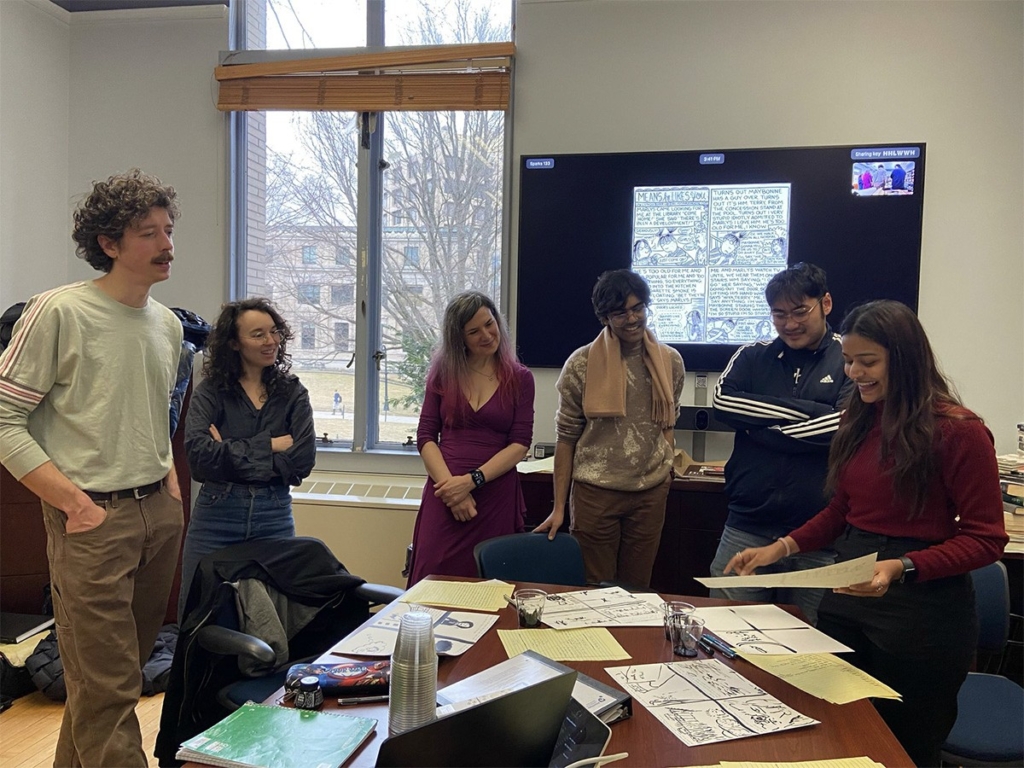
In a session titled ‘A Kind of Resistance: Illustrating Holocaust Survivor Stories’ that took place at the Pennsylvania State University on February 25, graphic artist Miriam Libicki discussed the collaborative nature of her graphic narratives. During the event, she showed a detailed deconstruction of the process of building a graphic novel out of interviews and active collaboration with survivors, historians and researchers. She discussed the unique strengths, as well as challenges, of using comics to depict the Holocaust, and to depict subjective memory in the absence of photographic documentation.
Students engaging with workshop drawings created in session. Photo credit: Kobi Kabalek.
During the follow-up event on February 26, ‘Inking the Unthinkable: A Sense-Memory Writing and Cartooning Workshop’, participants engaged in a drawing exercise to experience the creative process as an act of memory, observation, and communication. According to Libicki, this hands-on memoir comics workshop was inspired by educator/cartoonist Lynda Barry’s theories of creative concentration as “deep play,” and writing as “delivering an image.”
Workshop drawing exercise led by Miriam Libicki. Photo credit: Miriam Libicki and Kobi Kabalek.
Miriam Libicki’s most recent collaborative piece, ‘A Kind of Resistance’, was published in the anthology of Holocaust survivor graphic memoirs But I Live: Three Stories of Child Survivors of the Holocaust which received the Canadian Jewish Literary Award in 2022.
For further reading about the collaborative nature of Miriam’s art and the research behind her graphic narrative featured in But I Live, please click here.
‘A Kind of Resistance: Illustrating Holocaust Survivor Stories’ February 25, 2025 2:00 pm EST W043A Dewey Room Collaboration Commons, Patee Library Pennsylvania State University Event link: https://events.la.psu.edu/event/a-kind-of-resistance/
‘Inking the Unthinkable: A Sense-Memory Writing and Cartooning Workshop’ February 26, 2025 2:00 pm EST College of Liberal Arts – 133 Sparks Building Pennsylvania State University Event link: https://events.la.psu.edu/event/inking-the-unthinkable/
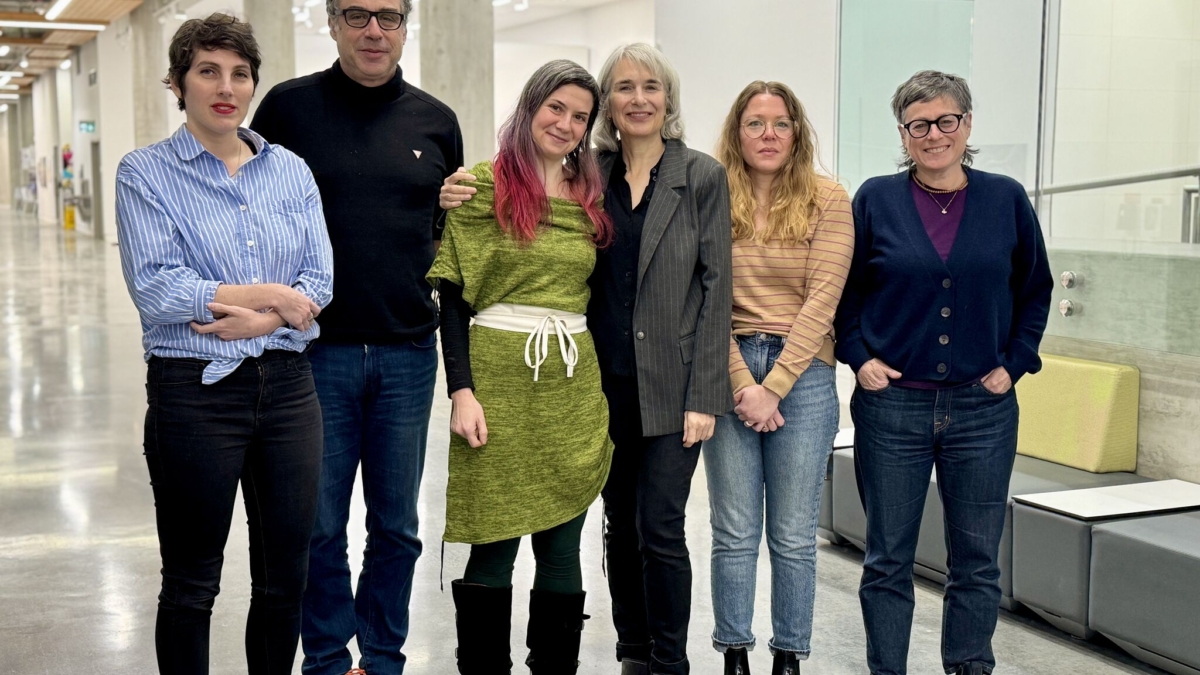
From left to right: Éléonore Goldberg, Alan Goldman, Miriam Libicki, Charlotte Schallié, Lee Gilad and Randy Lee Cutler.
This year’s International Holocaust Remembrance Day (January 27) marked the 80th anniversary of the Auschwitz-Birkenau extermination camp liberation. In commemoration of this event, the Emily Carr University of Art + Design (ECU) hosted a talk to recognize victims of the Holocaust and its impact on survivors. Project Director Dr. Charlotte Schallié was invited to discuss the graphic novel But I Live: Three Stories of Child Survivors of the Holocaust with the ECU community, including students, faculty, and staff.
Dr. Schallié extends her gratitude the the ECU team for hosting the event:
I learned so much from all of you and was deeply touched by the ECU faculty and staff members who reflected on artwork made by Holocaust survivors and their descendants. It’s rare to find such a caring and supportive space of togetherness and belonging, and you created it for all of us! Thank you!
“Remembering the Holocaust: 80 years after the liberation of Auschwitz” February 12, 2025 3:30 – 6:00 pm PST Emily Carr University Boardroom, D2315 520 East 1st Avenue Event Contact: Lee Gilad | lgilad@ecuad.ca
On February 24, Dr. Schallié will visit the University of Toronto to present on ‘Relational Memory, Shared Authority and Reciprocity in the Making of Barbara Yelin’s Emmie Arbel: The Colour of Memory‘.
Event description: In this presentation, Charlotte Schallié discusses her arts-based collaborative research with graphic novelist Barbara Yelin and Holocaust child survivor Emmie Arbel. Their work together resulted in two publications, the most recent one being Emmie Arbel. The Colour of Memory (2023), co-edited with Alexander Korb. Barbara Yelin’s graphic novel expands Arbel’s seven-page witness testimony into a book-length graphic narrative inviting us to reconsider the role of creative practice in gathering and representing living memory. As a published graphic novel, Emmie Arbel. The Colour of Memory is a multi-genre creation. It is a collaborative piece of scholarship based on mutual care and relationship building, an artistic rendering of a life narrative, and an artwork that documents creative practice as research.
When Barbara Yelin met Emmie Arbel for the first time at the Ravensbrück Memorial in 2019, Arbel conveyed to the artist that she remembered very little “from the war.” In traditional eyewitness testimonies, such memory gaps create significant obstacles resulting in an incomplete oral history document. Yet, in Yelin’s artwork, Arbel’s embodied memories and silent interactions are not just made visible, they are inseparably interwoven into the (hi)storytelling. Dr. Schallié will elaborate on how creative renderings of nonverbal expressions of memories in Emmie Arbel. The Colour of Memory may challenge our understanding of testimony, agency, and absence.
“Relational Memory, Shared Authority and Reciprocity in the Making of Barbara Yelin’s Emmie Arbel. The Colour of Memory” Monday, February 24, 2025 4:00 – 6:00 pm PST Room 100 – Jackman Humanities Building 170 St. George Street University of Toronto
On February 14, the Vancouver Holocaust Education Centre(VHEC) is hosting the one-day ’12th Biennial Shafran Teachers’ Conference’. This year’s conference, entitled ‘Teaching the Holocaust: Multiple Perspectives and Best Practices in Holocaust Education’, focuses on providing teachers in various disciplines with new teaching resources to support Holocaust education in the classroom.
SCVN Co-Director Dr. Andrea Webb will be a presenter at the conference and will draw from her experience as a high school teacher, teacher educator, and researcher to support educators’ confidence and engagement in Holocaust education.
Dr. Webb has also developed the Educators’ Resource for the graphic novel ‘But I Live: Three Stories of Child Survivors of the Holocaust’ and is leading the development of the teaching materials and educational resources for all of SCVN’s Research Clusters.
Thank you to the VHEC for hosting this event and we look forward Dr. Webb’s presentation!
Conference Details: Friday, February 14, 2025 8:30 am – 3:30 pm PDT Vancouver Holocaust Education Centre 950 West 41st Avenue, Vancouver 2nd Floor, Dayson Boardroom