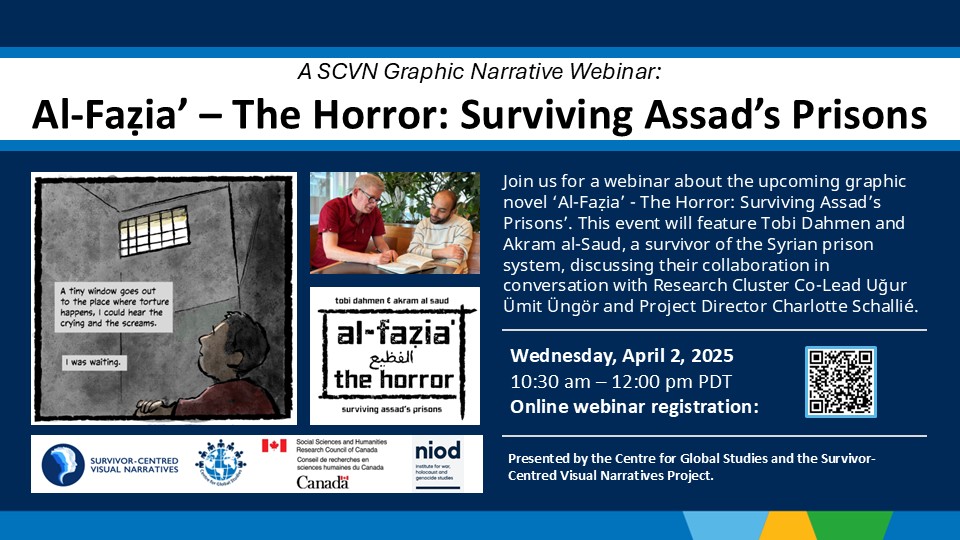
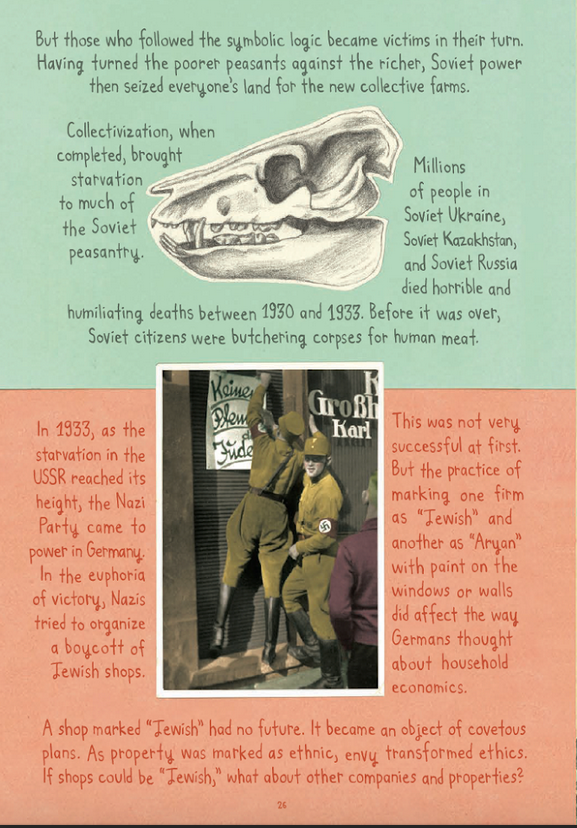
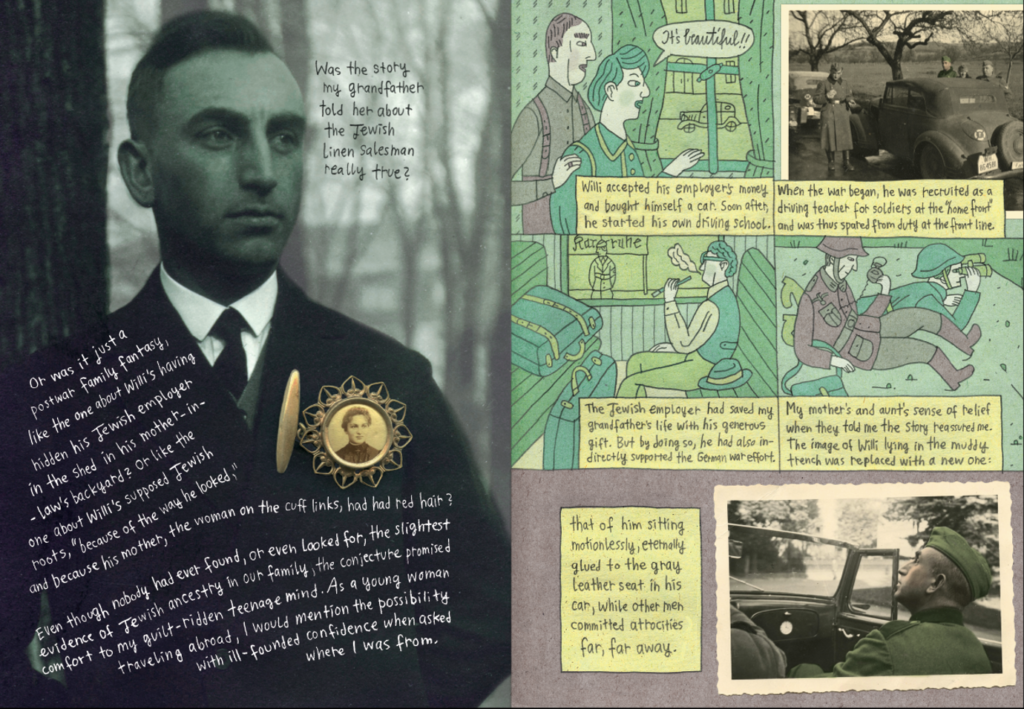
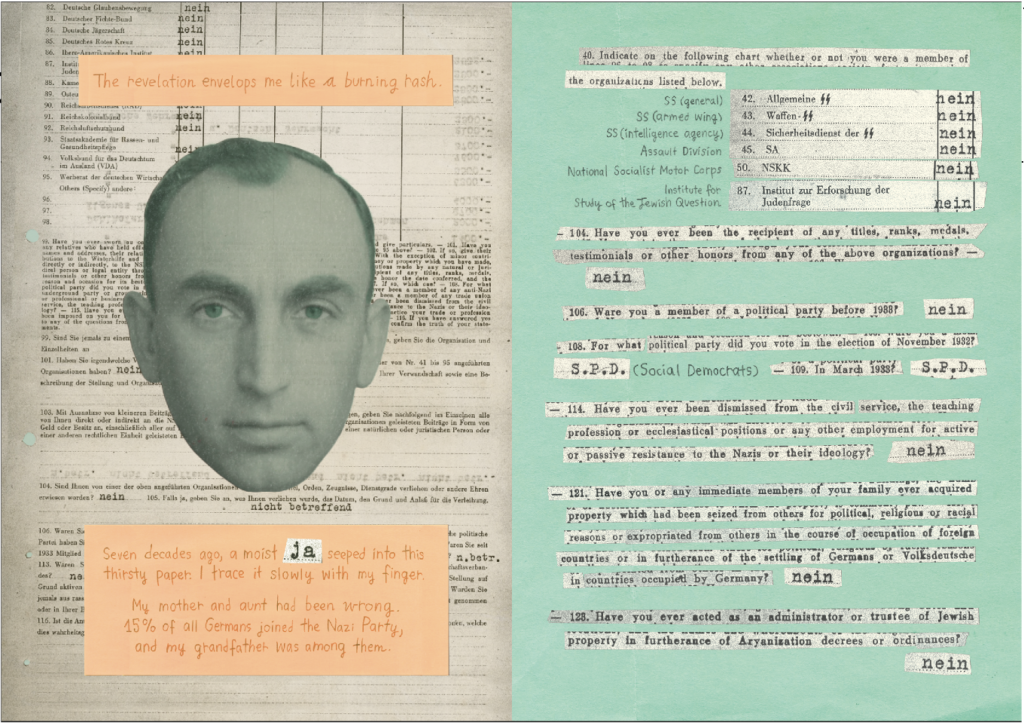
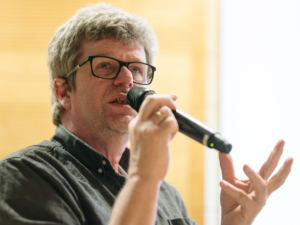
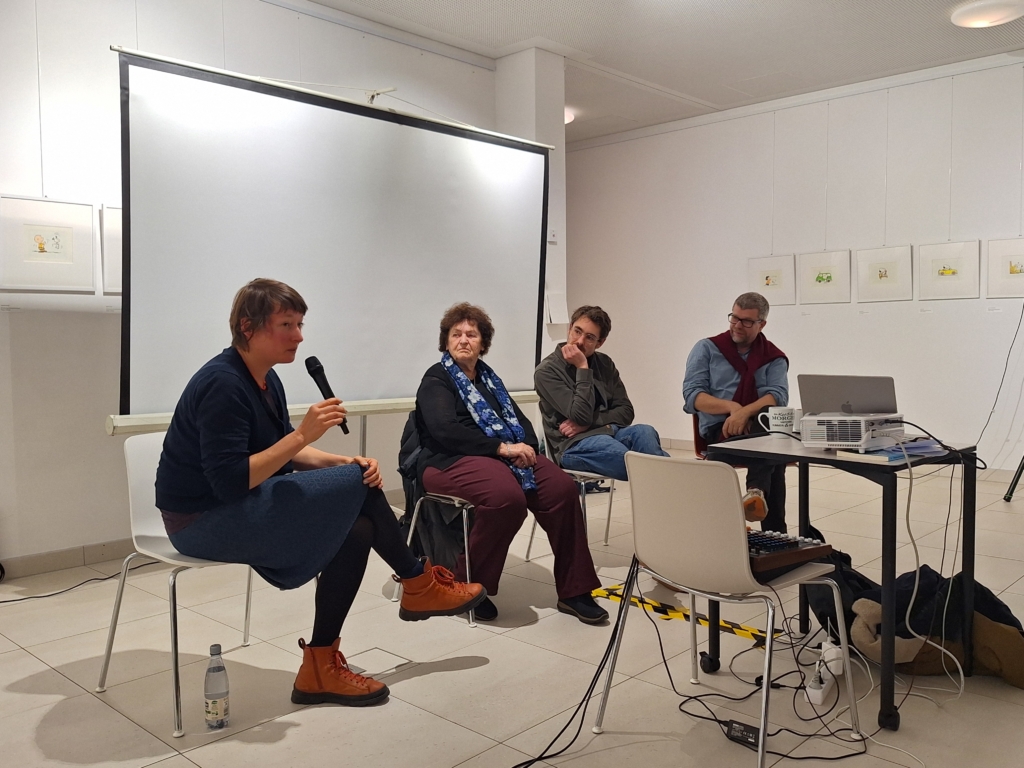
In February 2023, graphic artist Tobi Dahmen was introduced to Syrian survivor Akram al-Saud by Dr. Uğur Ümit Üngör, the Research Cluster Co-Lead on the SSHRC Partnership Grant Survivor-Centred Visual Narratives Project. Based in The Netherlands, Tobi and Akram have been collaborating locally over two years in a series of interviews to share Akram’s unique story of surviving a series of Syrian prisons.
Since the fall of the Bashar al-Assad regime on December 8, 2024, Syria has opened up to the world again, and the international community has begun to learn more about the oppression and injustices of the regime. This webinar will feature Tobi Dahmen and Akram al-Saud discussing their collaboration, in conversation with Dr. Üngör and Project Director Dr. Charlotte Schallié. They will explore the difficulties of representing imprisonment and torture, and how graphic narratives can help survivors of mass violence find a voice.
Tobi Dahmen Tobi Dahmen, born in 1971 in Frankfurt/Main, is a German illustrator and comic artist. He has published several comic books, including Fahrradmod (2015). Dahmen has received numerous awards for his work and is currently working on a new graphic novel with a Syrian survivor as part of the Survivor-Centred Visual Narratives Project. The graphic novel Columbusstrasse: Eine Familiengeschichte 1935-1945, was released on May 29, 2024, and is available to order online here.
Akram al-Saud Akram al-Saud is from Deir Ez-Zor and now lives in the Netherlands. He has been arrested four times before fleeing from Syria. His longest detention began on March 28th, 2010—before the revolution—and lasted for nine months. At the time, he was a student at the Faculty of Architecture in Aleppo, and was arrested by the intelligence services of the air force. After the 2011 revolution, he was arrested three more times. Dr. Uğur Ümit Üngör Uğur Ümit Üngör (PhD Amsterdam, 2009) is Professor of Holocaust and Genocide Studies at the University of Amsterdam and the NIOD Institute for War, Holocaust, and Genocide Studies. His main areas of interest are genocide and mass violence, with a particular focus on the modern and contemporary Middle East. He is an editor of the Journal of Perpetrator Research, and coordinator of the Syria Oral History Project. His publications include Confiscation and Destruction: The Young Turk Seizure of Armenian Property (Continuum, 2011), and the award-winning The Making of Modern Turkey: Nation and State in Eastern Anatolia, 1913-1950 (Oxford University Press, 2011). From 2014 to 2019, Üngör coordinated a Dutch Research Council-funded research project on paramilitarism, which led to the monograph Paramilitarism: Mass Violence in the Shadow of the State (Oxford University Press, 2020). He is currently working on its follow-up monograph Assad’s Militias and Mass Violence in Syria (forthcoming, 2025). He is also co-author of Syrian Gulag: Assad’s Prison System, 1970-2020 (I.B.Tauris, 2023).
Dr. Charlotte Schallié Charlotte Schallié is a Professor of Germanic Studies in the School of Languages, Linguistics and Culture at the University of Victoria (Canada). Her teaching and research interests include memory studies, visual culture studies & graphic narratives, teaching and learning about the Holocaust, genocide and human rights education, community-engaged participatory research, care ethics, and arts-based action research. Together with Dr. Andrea Webb (UBC), she is the Project Director of a 7-year SSHRC-funded Partnership Grant entitled Visual Storytelling and Graphic Art in Genocide and Human Rights Education.
Thank you to our project partner, the Centre for Global Studies at the University of Victoria, for hosting this webinar. A special thanks to Jodie Walsh, Operations Director and Research Coordinator, and Lia Lancaster, Events and Administration Assistant, for their invaluable support.
From transcribing interviews to navigating the archives, Research Assistant Jessica Botts had an instrumental role in the process of developing Two Roses, the graphic novel created by Miriam Libicki in collaboration with Holocaust survivor Rose Lipszyc.
Jessica is a U.S. Navy Veteran who has lived in and been deployed to several countries. Currently, she is a graduate student pursuing a master’s degree in Environmental History at the University of Nebraska Omaha, with a minor focus in Native American Studies. She joined the SCVN project in September 2023, and worked closely with Holocaust Research Cluster Co-Lead and historian, Dr. Mark Celinscak, and graphic artist Miriam Libicki.
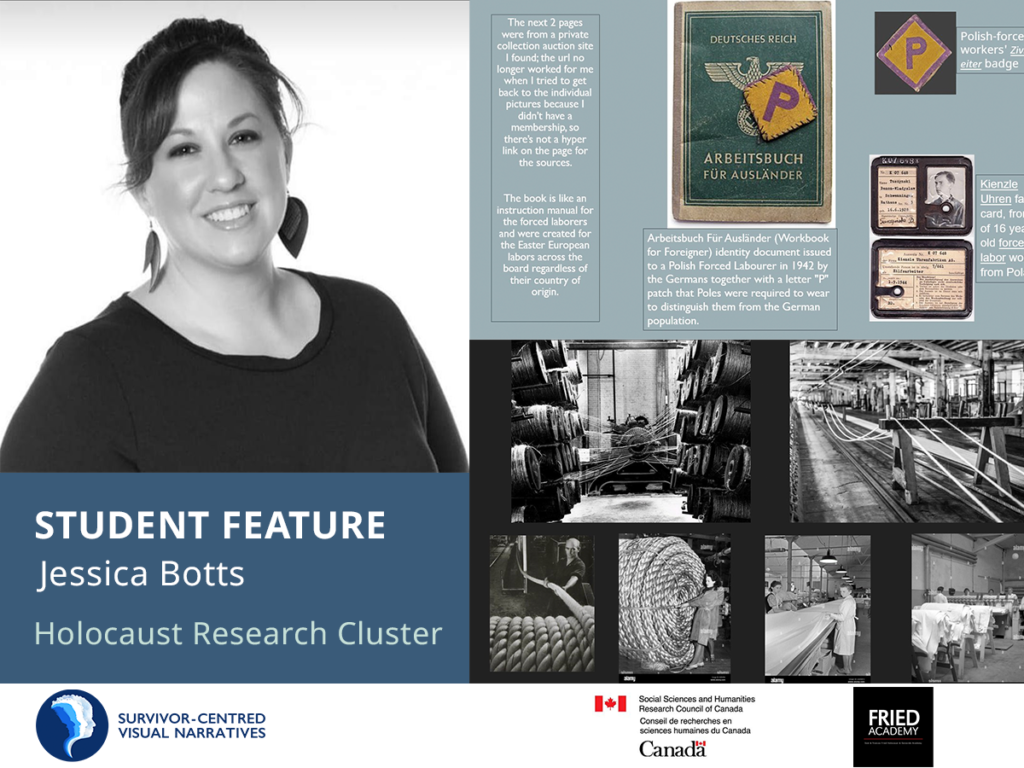
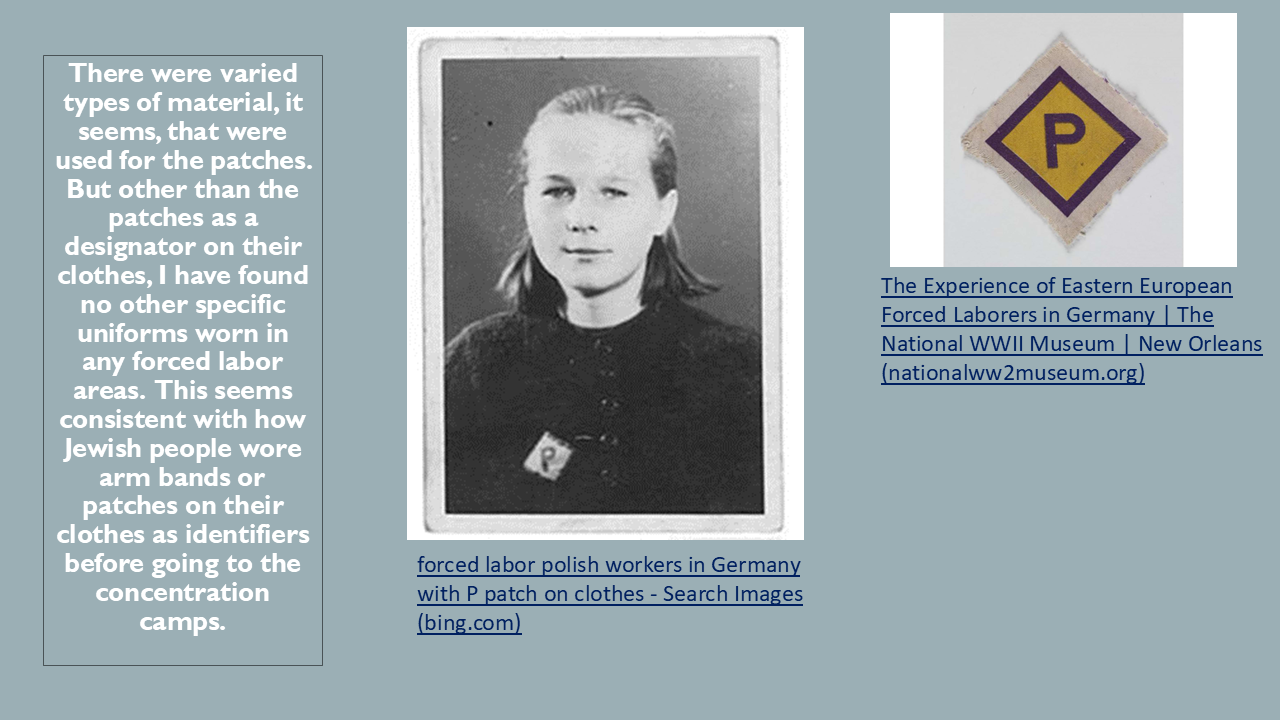
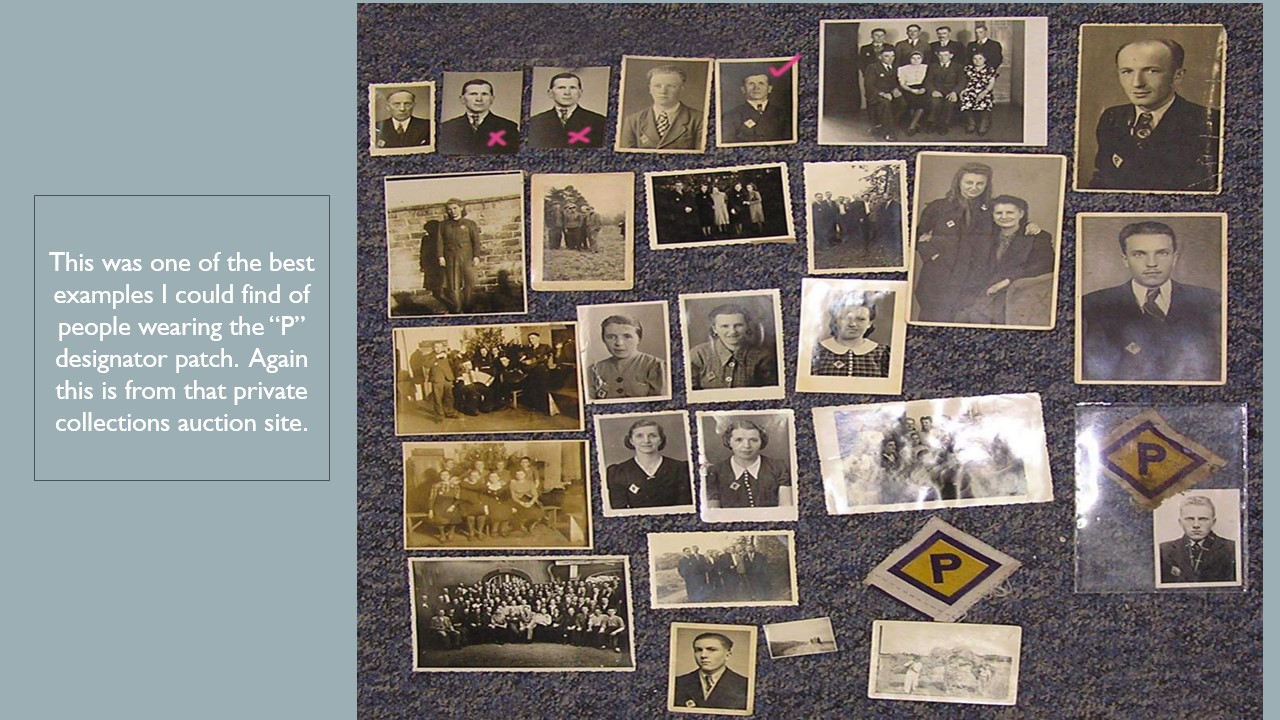
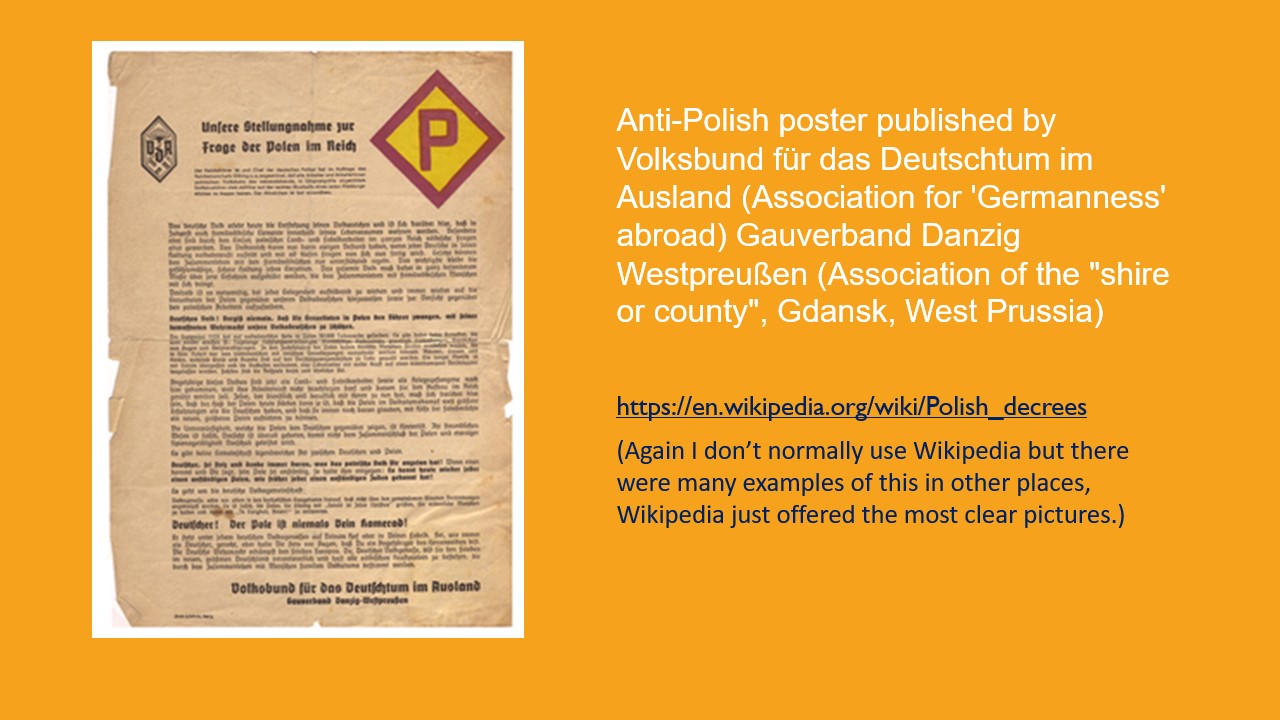
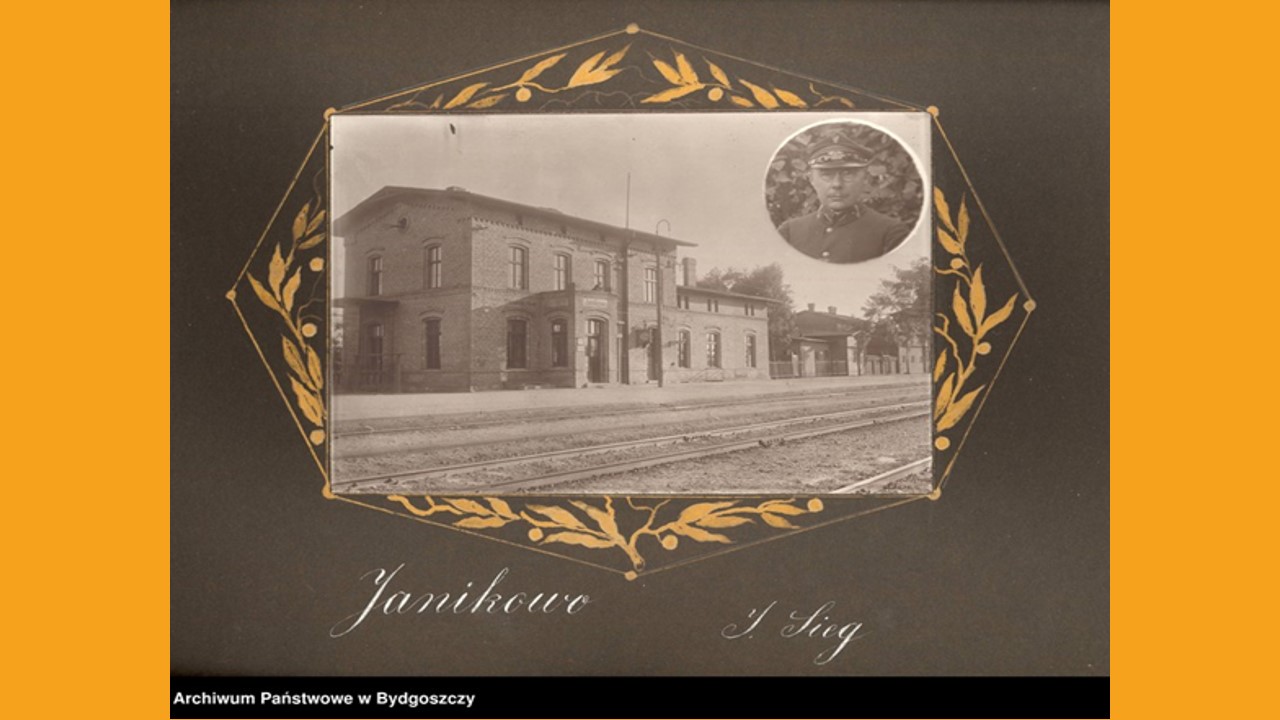
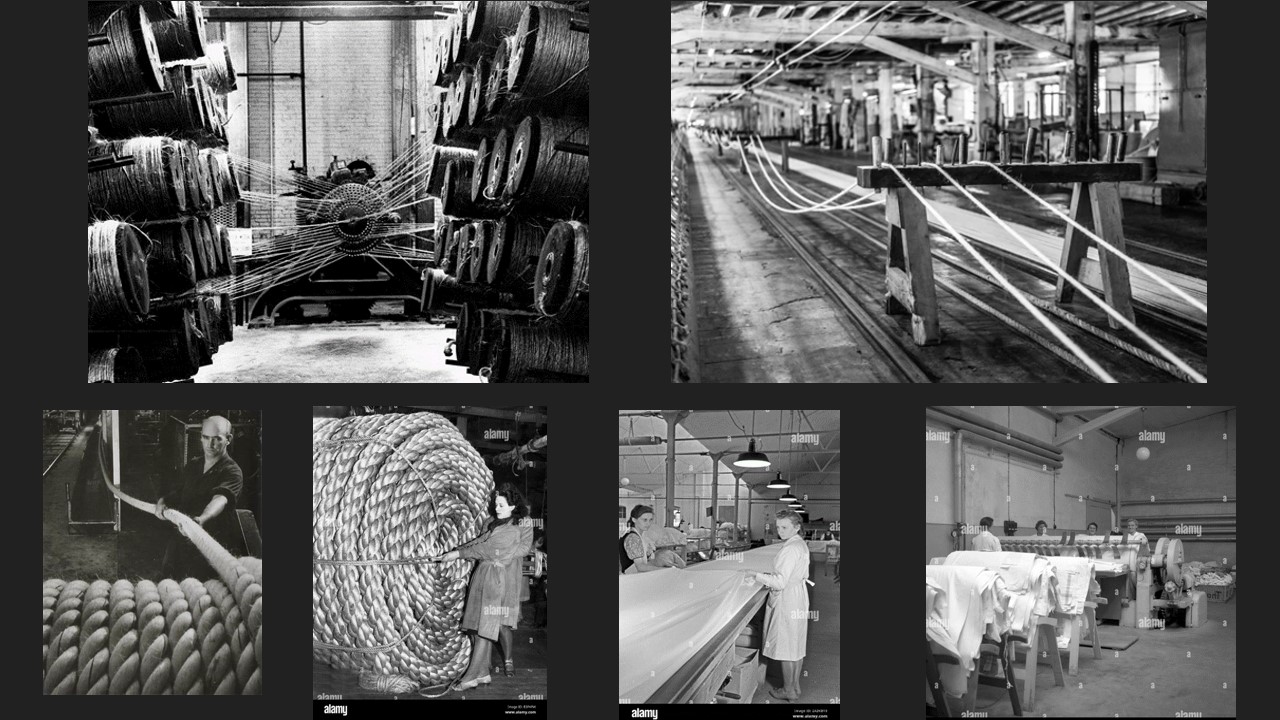
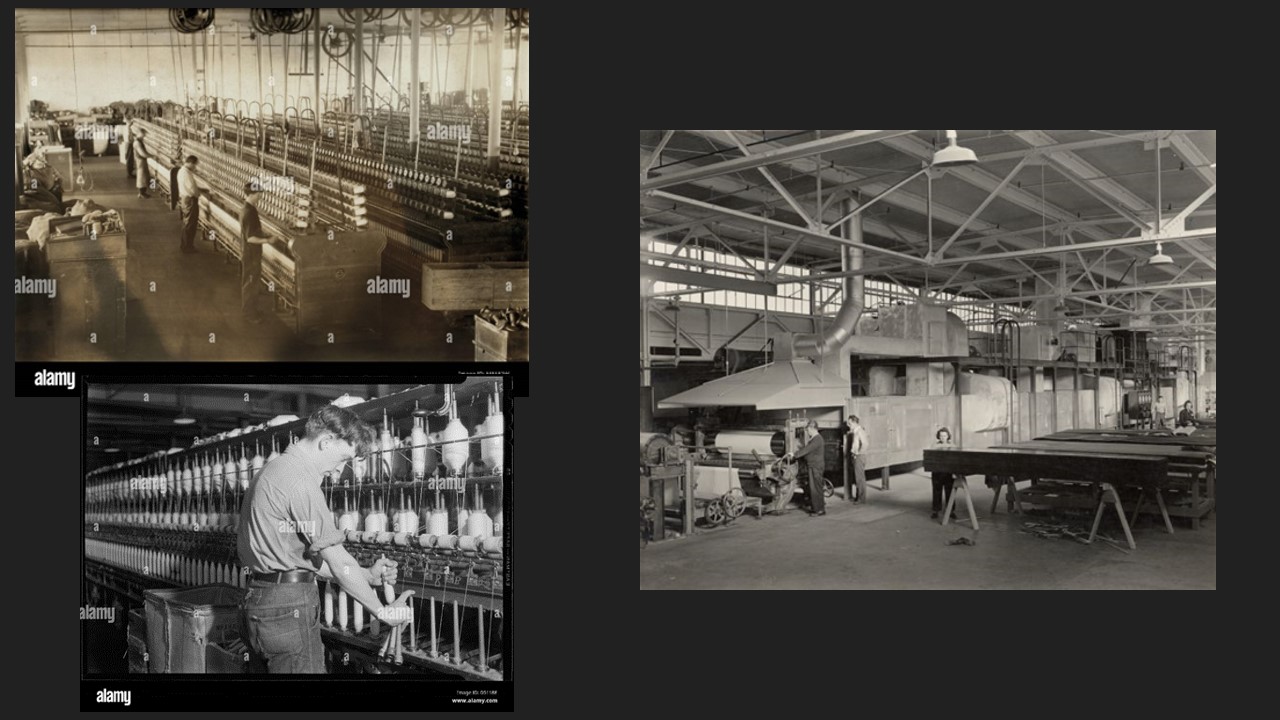
As a Research Assistant, Jessica transcribed interviews between Miriam and Rose and researched throughout historical archives for specific information and materials for Miriam to consult. To prepare her research findings for Miriam, she created PowerPoint presentations with a selection of historical images and notes describing historical sources and translations. The collection of images provided a visual reference for Miriam to develop her graphic narrative.
The following images are a selection of highlights from Jessica’s research:
We also followed up with Miriam, who shared her experience of collaborating with Jessica, and highlighted her detailed approach and diligence:
“Jessica had to transcribe, type and organize four days of conversations, with a quick turnaround so that I could start on my script. She also helped enormously when I was first establishing the look of the story’s settings. She found photos both recent and archival, of Rose’s birthplace neighbourhood in Lublin, as well as the clothes and patches Polish slave labourers were given to wear.
Without my asking, she found photos of the very specific stiff wooden shoes labourers all wore, and when I showed this photo to Rose, it brought back strong memories and great sensory descriptions of slipping on snow.
I really appreciated how organized Jessica was, and how she diligently kept me updated on her progress and her research plans.”
Jessica’s role as Research Assistant on SCVN was unique due to her close and direct support to one of the graphic artists. In January 2025, she shared the following reflections on this experience with us:
“It has been a privilege and honor to work as a Research Assistant with historian Dr. Mark Celinscak and graphic artist Miriam Libicki on the Survivor-Centered Visual Narratives project to create a graphic novel about Rose Lipszyc’s story of surviving the Holocaust with her aunt. I have learned a lot about the Second World War and the Holocaust that I never knew before. Though I never met Rose in person, I feel like I know her because of the friendship and openness that she shared with Miriam, Dr. Celinscak, and others in the recordings of their time together. As a Research Assistant on the team, it was my job to transcribe their many interviews together. In the interviews with Rose, I listened to her story and became quite familiar with it as she revealed the details from her memories of her time in hiding in plain sight, as they unfolded bit by bit. Rose told of how a Jewish girl from Poland escaped the rounding up of the Lublin Jewish population and went on to work in Germany at a factory under the noses of her oppressors. She and her aunt made every situation work out as best as possible for them, and with a bit of luck, quick-wittedness, and some unlikely friendships, they were able to make it through the war until Allied troops came and liberated the area.
Documenting Rose’s story into written transcriptions helped Miriam ensure she could capture each detail to be highlighted on the pages of the novel.
In addition, I was often asked to find historical photographs of the places and clothing Rose encountered and wore on her journey. I then put them into power points for references for Miriam to create the visual depiction of Rose’s story for the novel. Sometimes, to give perspective, I would find modern pictures of specific locations to contrast with generalized pictures of a similar place when period photos were unable to be located. I used military archives, different types of maps, Polish national archives, photos from groups where people were sharing their family histories about how they lived and what they went through during WWII as Polish laborers, and sometimes just scouring pages on the internet to find images for Miriam to reference. The photographs shared by descendants from Polish families telling about their family’s stories were especially helpful because Rose and her aunt posed as Polish girls from the countryside, working in German factories to send money home to their families.
Rose is astounding in terms of the number of languages that she speaks. To pull off posing as Polish laborers, Rose had to speak “a perfect Polish,” as she would say, though that was not what was spoken at home growing up but was learned at school; she also learned German while in Germany, and spoke Yiddish, Hebrew, and later learned English as well when she immigrated to Canada.
Because Rose speaks so many languages, she would sometimes recall songs, sayings, and conversations she had had in another language, and I would have to figure out the translation for it.
I am very fortunate to have lived in Europe for several years and have friends who speak German fluently and have a grasp of other neighboring countries’ languages, so they were able to help me with translations at times when trying to search the internet for them was unfruitful. Dr. Celinscak also had academic colleagues overseas who assisted me by looking through some local archives to help find photographs and information I could not access.
I have found it fascinating and encouraging to see how different relationships and friendships helped bring Rose’s story to life in the graphic novel Miriam authored and illustrated. Through researching, writing the transcriptions, finding proper translations, and historical images, I became engrossed in the stories, videos, and images of Holocaust survivors.
It truly is heart-wrenching to know the atrocities that people had to endure and inspiring to see how they have overcome that trauma to move on with their lives afterward.
Rose would tell how her mom would say that she did not think the whole world had gone crazy and that someone would help her. Hearing her tell about some of the small acts of kindness she and her aunt were given demonstrated the hope in the human spirit her mother held during such a terrible time lived out in the day-to-day exchanges in people’s lives. It could become frustrating when pictures, documentation, or paperwork seemingly disappeared from the historical record when I could not find what I was looking for to help Miriam. It was like somehow the evil of that time had won that battle of the documentation that was such a big part of people’s lives from that time period, but then seeing how people around the world worked together to help put all the pieces together to complete bringing Rose’s story to the graphic novel page, it felt like a victory again too. I genuinely appreciate the opportunity to be a part of this project and to have had the privilege to get to know Rose and her story, as well as Miriam and many other people who are a part of the Survivor-Centered Visual Narratives project.”
On behalf of the SCVN team, we sincerely thank Jessica for her hard work and dedication. Her contribution was essential to supporting Miriam’s work and telling Rose Lipszyc’s story as closely as possible to her testimonial.
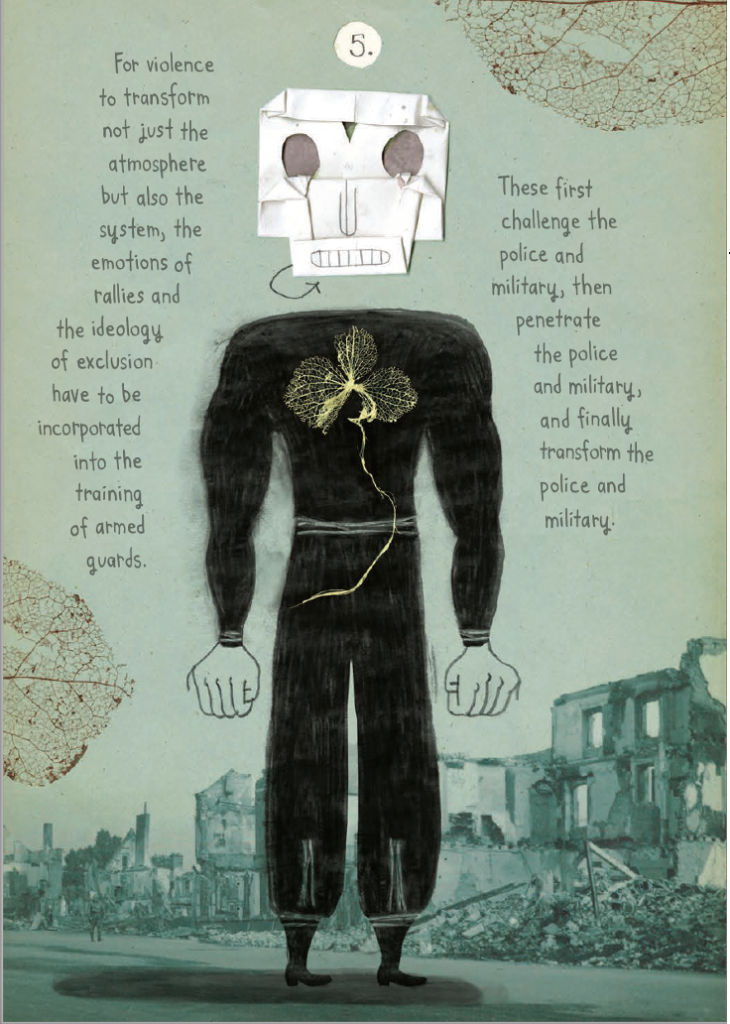
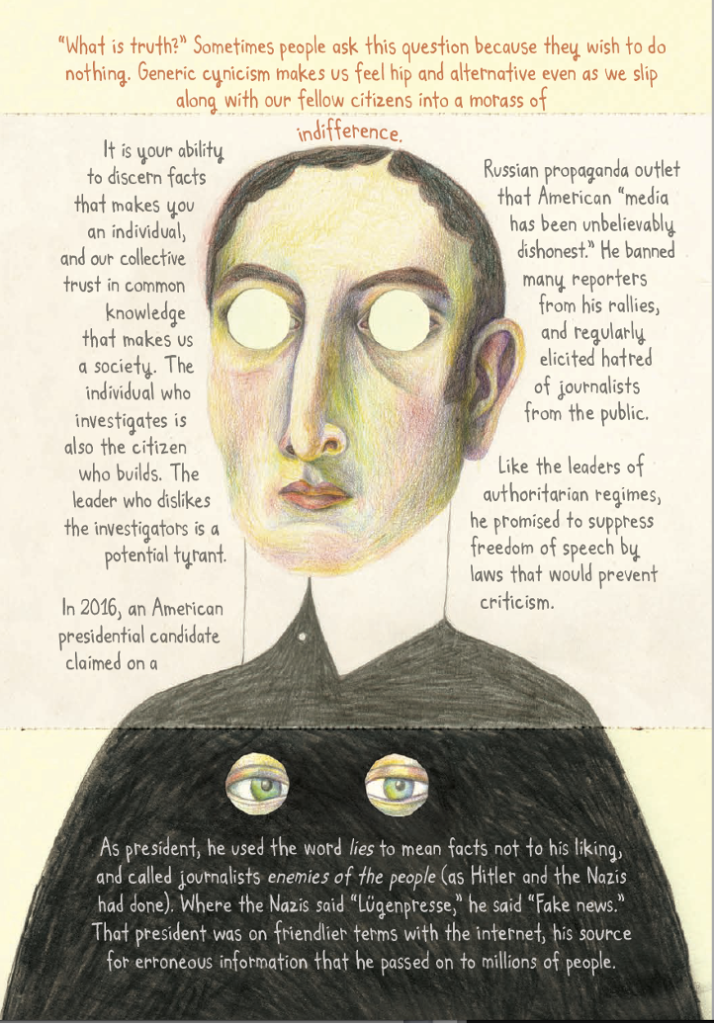
On November 14, SCVN Research Assistant Lucie Kotesovska met with Nora Krug, an internationally acclaimed artist and illustrator and author of several book-length visual narratives. Nora is currently an artist-in-residence at Yale’s Fortunoff Video Archive for Holocaust Testimonies, where she is conducting research of the survivors’ video and written testimonies. Her aim is to produce a graphic novel based on her engagement with these archival sources.
In this interview, Nora spoke about her current research and how she envisions the form of her next book. She also shared her thoughts on the unique potential of the visual narrative when communicating survivors’ experience and whether it is ever possible to overcome the trauma of war.
Lucie:Can you tell us a little bit about your current research and your research method as you work with the materials at Yale’s Fortunoff Video Archives, and also, how do you envision the final product at this point?
Nora: I’m only just embarking on the research for the book. I haven’t fully figured out the themes yet, but roughly speaking, I think it will be about the question of resistance and forgiveness, and whether we can ever overcome political trauma, personal trauma, and retaliation, all of these aspects. I’m researching the testimonies of survivors that were recorded in the 70s and 80s that touch on these subjects. I’m watching the interviews and I’m looking for certain keywords. I’m finding it difficult to find certain information, especially when it comes to description of violence. It’s a taboo, for instance, to talk about violent acts that you might have been involved with during the resistance. That’s an interesting component, but also something that’s hard to track down at least based on what I’ve encountered so far. I’m eager to look at both men’s and women’s testimonies from various different countries. I’ve watched some in Hebrew—there’s often a transcription in English—some in German, some in Polish, some in English. It’s interesting to observe how differently people dealt with the legacy of trauma, of experiencing trauma. People experienced it in different ways and had different modes of survival. I’m interested in that too—what makes us respond to certain traumas in different ways. And while I’m doing this, I’m also doing some research outside.
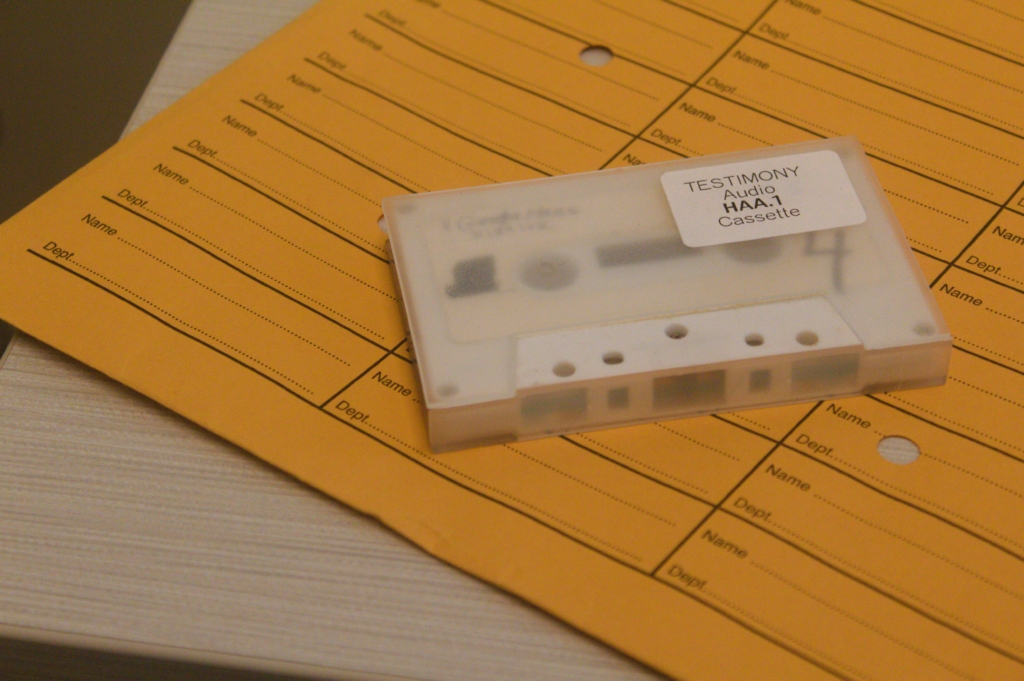
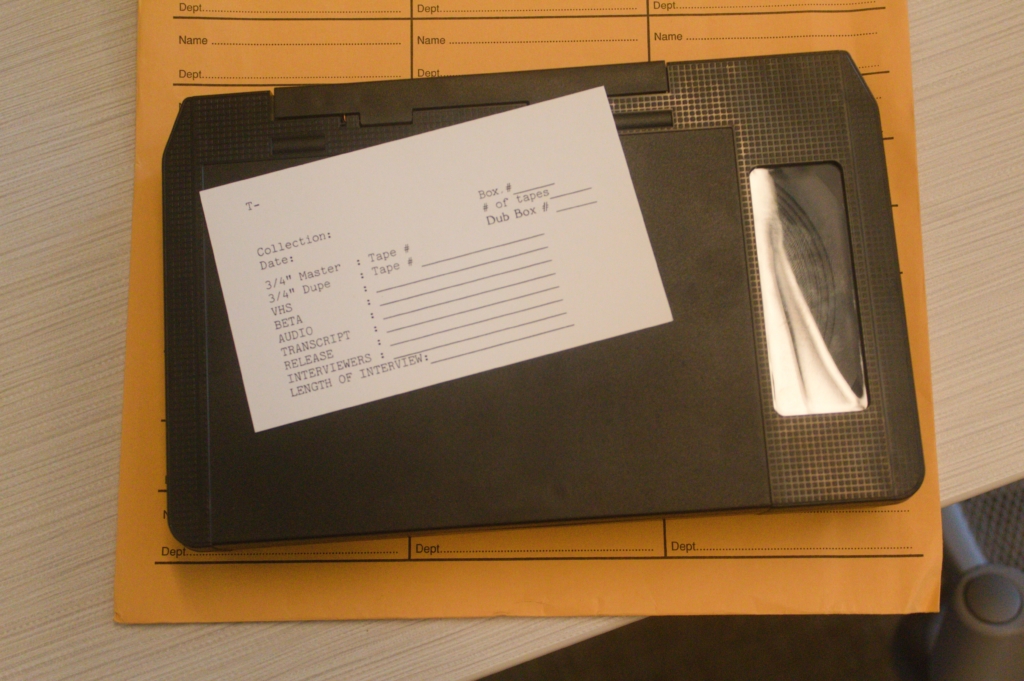
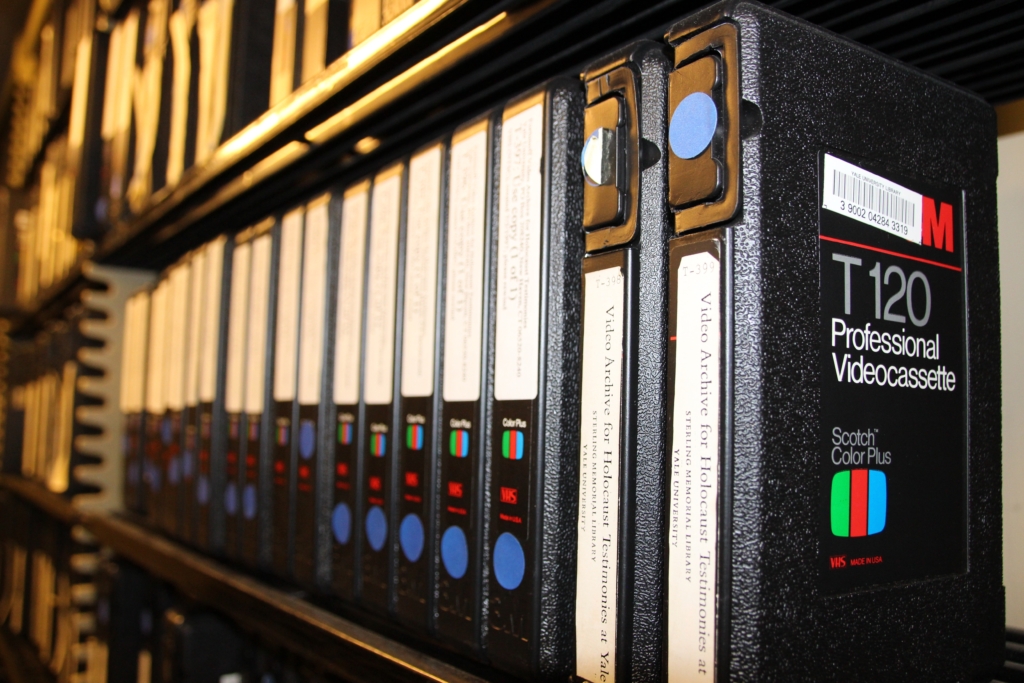
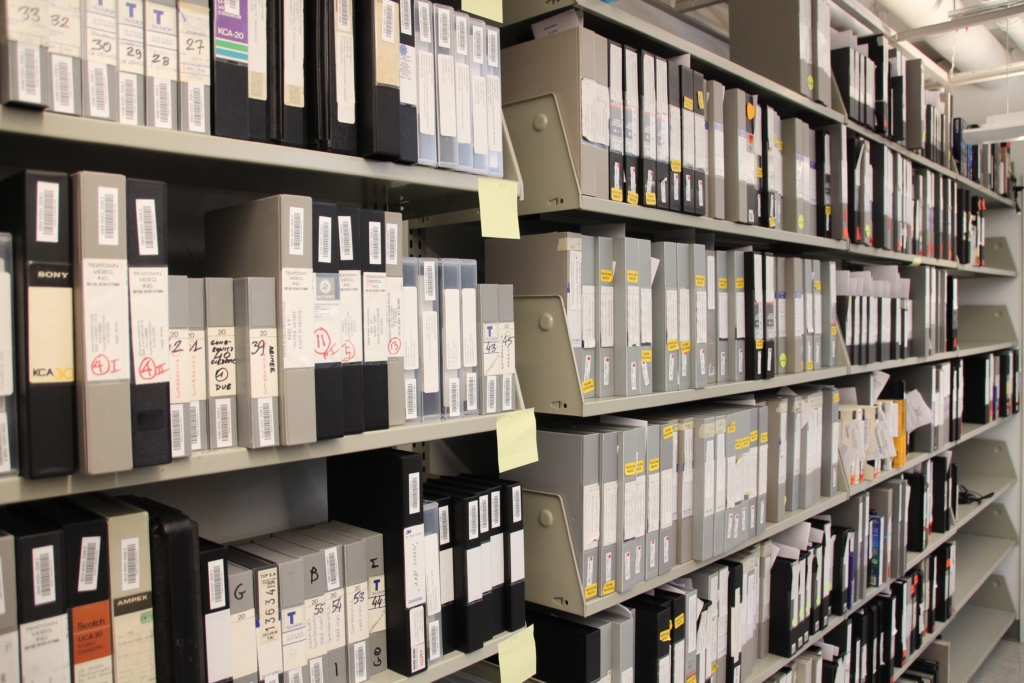
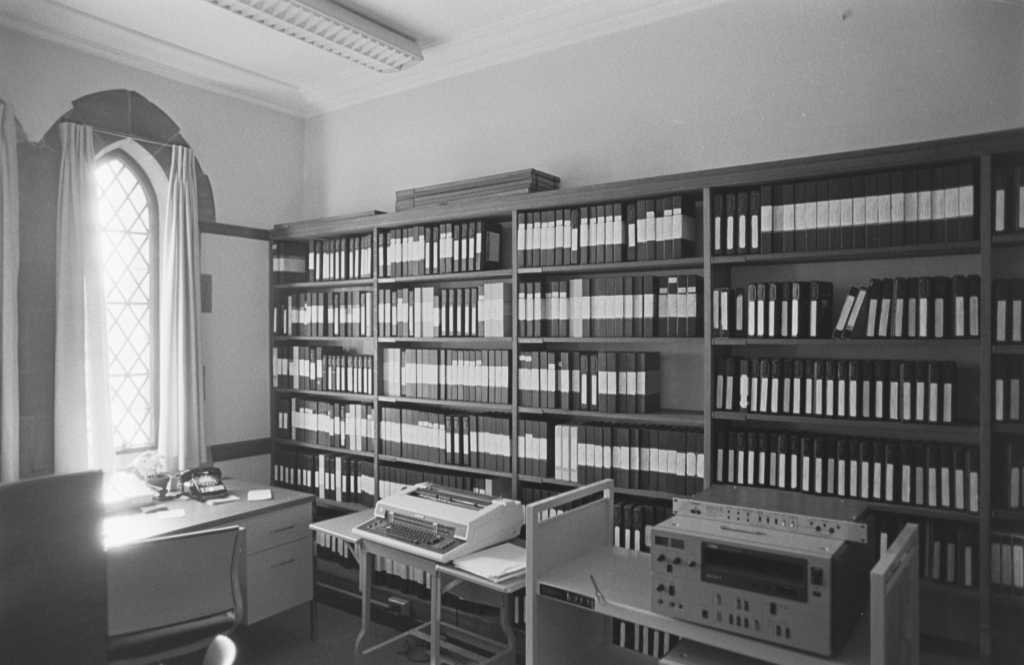
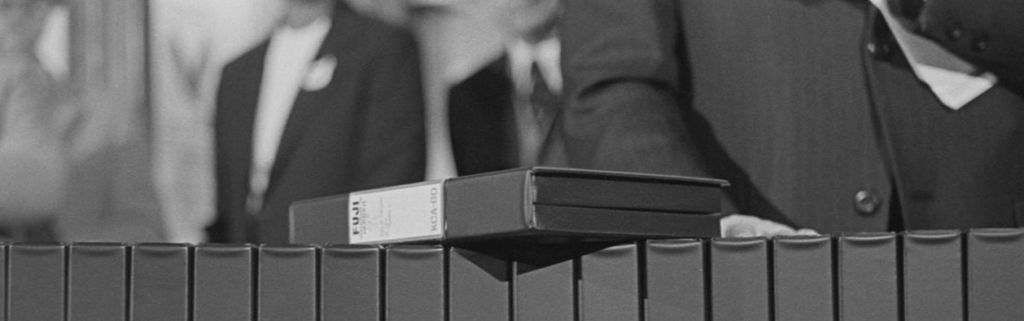
From top left: Cassette tape, files, and VHS tapes from the Fortunoff Video Archive for Holocaust Testimonies. Photos courtesy of Stephen Naron and Nick Porter.
I would say when I embark on research, I’m not extremely systematic, I’m rather very broad. And I try to articulate the basic underlying questions that I’m asking myself for a new book project. I’m not interested in telling a story chronologically, you know, the story of one person’s life. While the testimonies are very gripping and emotional, I’ve decided not to focus on one person’s life, and not to tell a chronological story but rather approach universal themes that I find in the interviews and create a sort of collage of my own thoughts on that subject that will include individual narratives. For instance, my book Belonging was structured in this way: I interwove several different narratives in a kaleidoscopic way. So, I think that’s what I’m envisioning at the moment—including different voices. I would also like to branch out after this year at Yale to other crimes, other wars, other cultures, and other religions, so that the subject of the book won’t entirely focus on the Holocaust, but also on how we deal with these experiences universally.
I’m not interested in telling a story chronologically, you know, the story of one person’s life. While the testimonies are very gripping and emotional, I’ve decided not to focus on one person’s life, and not to tell a chronological story but rather approach universal themes that I find in the interviews and create a sort of collage of my own thoughts on that subject that will include individual narratives.
Now that I’m at Yale, I’ve been connecting with professors from different departments including the Visual Arts Library, the Beinecke Library, and the Psychiatry Department, to get different people’s input into these questions. I also found a photo album at a flea market in Berlin some years ago that belonged to a German soldier. He documented an atrocity committed by the German Wehrmacht in Poland in 1939. I had this album lying around for many years thinking about what I could do with it, how to make those important photographs accessible to the public. And I would like to find a way of integrating it into the narrative of this new project. So, I’ve been reaching out to historians in Poland, the United States, Germany and Austria, to get more information about the historic events surrounding the atrocity depicted in this album, and to try to find out who the people depicted in the photographs are.
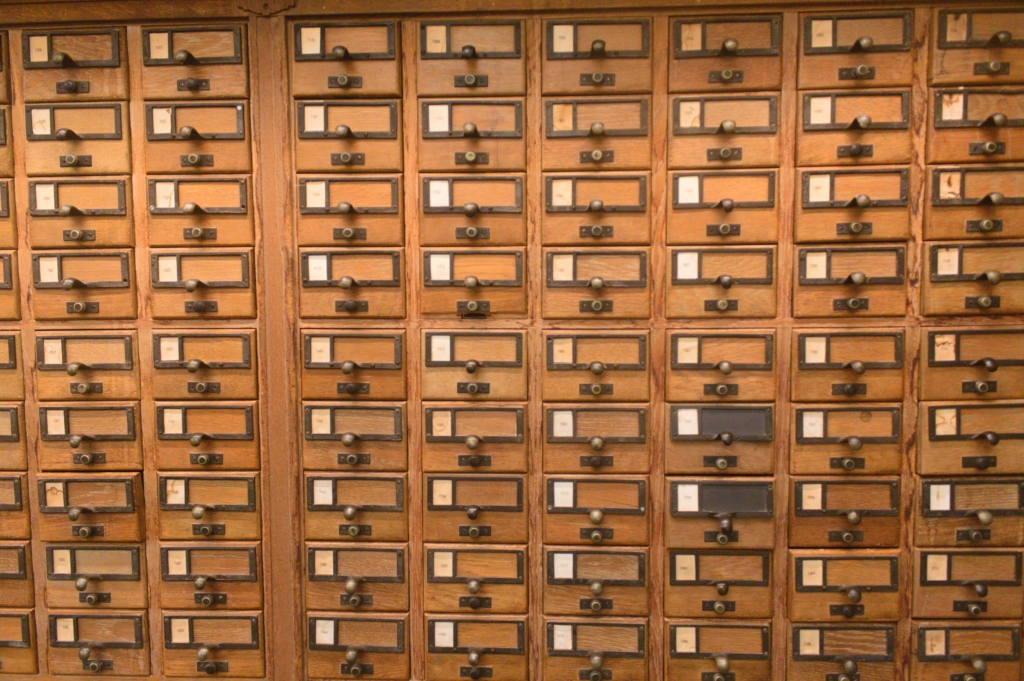
From Left to right: Card catalog cabinets, video library and VHS tape from the Fortunoff Video Archive for Holocaust Testimonies. Photos courtesy of Stephen Naron and Nick Porter.
Lucie:It sounds as if you anticipated my next question and, in a way, already answered it. In the SCVN team, we have been wondering whether you plan to focus on one main story or several of them in your next book project. Could you talk a bit more about how you envision working with multiple narratives?
Nora: Yes, I’m trying to look at my work less as illustrated biography and more as a philosophical reflection on themes that could include multiple narratives, also contradicting ones. This was the case in my last book, Diaries of War, about Ukraine and Russia, where I portrayed the voices of a Ukrainian woman and a Russian man, and even though the Russian man was anti-Putin, it is a contradictory narrative, and it clashes with the perspective of the Ukrainian protagonist. What I’m interested in as an artist and a writer is to bring out the complexities and the subtleties and focus on narratives that can be difficult to confront, because they’re uncomfortable or because they don’t fit into our conventional understanding of war or of the Holocaust.
What I’m interested in as an artist and a writer is to bring out the complexities and the subtleties and focus on narratives that can be difficult to confront, because they’re uncomfortable or because they don’t fit into our conventional understanding of war or of the Holocaust.
Lucie: This leads me to another question. In your understanding and in your practice, what do you see as particular strengths of the visual narrative when dealing with trauma and the topics that you mention?
Nora: For me, it’s very important to recognize the whole political history of illustration as a medium. It’s always been a political medium. It was the only visual medium that communicated political and social ideas before the advent of photography. We tend to forget that now. It is a political tool that shapes the way we think and feel or that hopefully opens up new perspectives because it is so visceral and so direct. And it can provide a very direct emotional entry point into narratives about war and memory and history in a way that I think classic textbooks aren’t able to. We understand that with movies—with movies, there’s no question. I mean, fiction films about the Second World War are very emotionally gripping, but with illustrated narratives, the general population wouldn’t necessarily recognize that medium as a powerful tool in the same way. I don’t know why that is given that for centuries it was such an important tool. I mean, if you think about illustrated church manuscripts, but also illustrated representations in other religions and cultures—illustrations were always used to inform the way we think about the world, but also to propagate, for instance, stereotypical ideas like antisemitic depictions in the Middle Ages.
So, while I really appreciate the political strength of the medium, I’m also aware that you have to treat the medium very sensitively and responsibly as an artist. I thought about that a lot when it comes to the depiction of violence. I’m somebody who really feels that it’s important to not avoid violence in images because we need to know what happened, for instance, during the Holocaust. If there hadn’t been any photographs taken at the time when the camps were liberated, our understanding of the Holocaust would be so much more limited. So, I think I’m really a proponent of showing images, of witnessing historical events, even if they’re hard to look at. But at the same time, there are many different ways of representing violence as an illustrator. It’s more a question of how rather than if you should show violence. But that is a component I think about a lot—what’s my responsibility as an illustrator to illuminate these subjects without being voyeuristic or sentimental. It’s sometimes a very fine line.
But at the same time, there are many different ways of representing violence as an illustrator. It’s more a question of how rather than if you should show violence. But that is a component I think about a lot—what’s my responsibility as an illustrator to illuminate these subjects without being voyeuristic or sentimental. It’s sometimes a very fine line.
Lucie: You mentioned that as a researcher and illustrator working with the trauma of war and mass atrocities can be extremely challenging. Can you speak a little bit about how this might affect you, and also how do you take care of yourself during this process?
Nora: Unfortunately, I don’t reflect enough on how I should take care of myself, because I always focus on my sense of responsibility of dealing with these subjects rather than on how my research will make me feel. I think my curiosity is what drives me forward despite the difficulty of the subject matter. When I wrote Belonging, a lot of people said, oh, that was so brave. I never thought of it as brave. I always felt like I simply had to find out what happened. I had such a burning desire to understand war and why people fight wars and how we live with the trauma of war that everything else was pushed into the background. I know that’s problematic because I also do a lot of visual research and looking at those photos probably impacts me emotionally on some deep level.
As illustrators, we have to do a lot of visual research, which means you look at photographs of the Warsaw ghetto or other atrocities throughout history. I try to switch into a professional mode when I do that, but it probably weighs on me in ways that I’m not always aware of. At the same time, making books on these subjects is my way of dealing with all the terrible things that are happening in the world. It’s my way of staying sane because there’s a lot of anger, a lot of anxiety about what’s going on. And I feel like confronting this directly is my preferred way of handling those feelings. So, it’s in a way therapeutic, even though it can be challenging. But I probably should find better ways of dealing with the emotional repercussions.
Lucie: The archival work, which you engage in at the moment, is quite unique within the Survivor-Centered Visual Narrative project. Is archival work also new to you? And what differences do you see between this kind of work and listening to survivors face to face?
Nora: I’ve done a lot of archival work. I did a lot of archival research for Belonging when I was looking for my grandparents’ files from the time of the Nazi regime. I went to the local archive in my father’s village and looked at the police documents from between 1933 and 1945. I looked at some of the letters that were written after 1945 by Jewish emigres who wanted to know what happened to their houses and their property. So, I’ve done a lot of research in archives, not academic research, but research to look for personal narratives. I love that. I find it so exciting to stumble across these voices that would otherwise remain unheard and then bring them back to life. One thing that I find a bit challenging is that the interviews I’m watching are with people who have already passed away, so I can’t ask follow-up questions. Sometimes I have very different questions than the ones that the interviewers ask. That’s a challenge that I’m experiencing because I’m not the one asking the questions.
A lot of the questions that are asked in these interviews are about the chronology of what happened where they were born, how they experienced anti-Semitism as a child, when they had to flee or hide or what camp they were in, how they escaped or how they survived. All of that is very important. But I would also want to know more about the emotional aspects. What did they go through emotionally at various points during the process, not only what happened to them.
Lucie: When we communicated prior to this interview, you mentioned that one of the central questions you’re exploring is whether it is ever possible to overcome the trauma of war. Do you feel any closer to reaching an answer after working for several months in the archives?
Nora: No. I mean, it’s also so individual. Like I said earlier, I think that everybody deals with it very differently. Some people, as you know, committed suicide. Some people were deeply depressed. One woman whose interview I watched was very interesting. She talked about how after the war she had a child, her first son, and how detached she felt. She felt basically incapable of showing anybody love. And that capacity to love seemed to have died the moment when she was separated from her family in the ghetto, and that was a moment when she basically became incapable of loving or expressing her love for anybody. After the war, she had a son, and she realized that she couldn’t give him what a mother under normal circumstances could give a child.
Thank you so much for your time, Nora, and for sharing your research and artistic experience with me. We are very excited to have you as part of our project and I am looking forward to hearing more about your book in 2026.
On February 27, SCVN research assistant Ghada met with curator Jakob Hoffmann to discuss the exhibition journey of But I Live. Remembering the Holocaust. The exhibition, co-curated by Jakob Hoffmann and Barbara Yelin, features the process of co-creation and original artwork by artists Barbara Yelin, Miriam Libicki, and Gilad Seliktar, produced for the graphic novel But I Live: Three Stories of Child Survivors of the Holocaust, edited by Dr. Charlotte Schallié and based on interviews with Holocaust survivors Emmie Arbel, David Schaffer, and Nico and Rolf Kamp. Displaying original drawings, sketches, archival materials, and interviews with participants, the exhibition illuminates the process by which the book came into existence.
The interview with Jakob offers a closer look into his life and work, while inviting reflection on the concepts and challenges that arise at the intersection of first, artistic media such as graphic novels and film; second, social phenomena such as collective memory and mass atrocities; and third, human experience, particularly through the lens of survivors.
Ghada: Hello Jakob, thank you for taking the time to have this conversation today. Before getting into the details of the project, can you tell us a little bit more about yourself? What do you do? Where are you based? What is the scope of your work?
Jakob: Yes, what can I say about myself? Well, I live here in Frankfurt am Main. I’m 60 years old, and I’ve got a proper regular job, which is working in the Scout movement. This is maybe a little bit unique, because most of the people who are involved in Scout are volunteers and young people. And I’m an old man, and I’m doing it as a job, but you could say I’m kind of a trainer doing projects with young people in the area around Frankfurt. This is my steady job that brings me some income and a lot of joy.
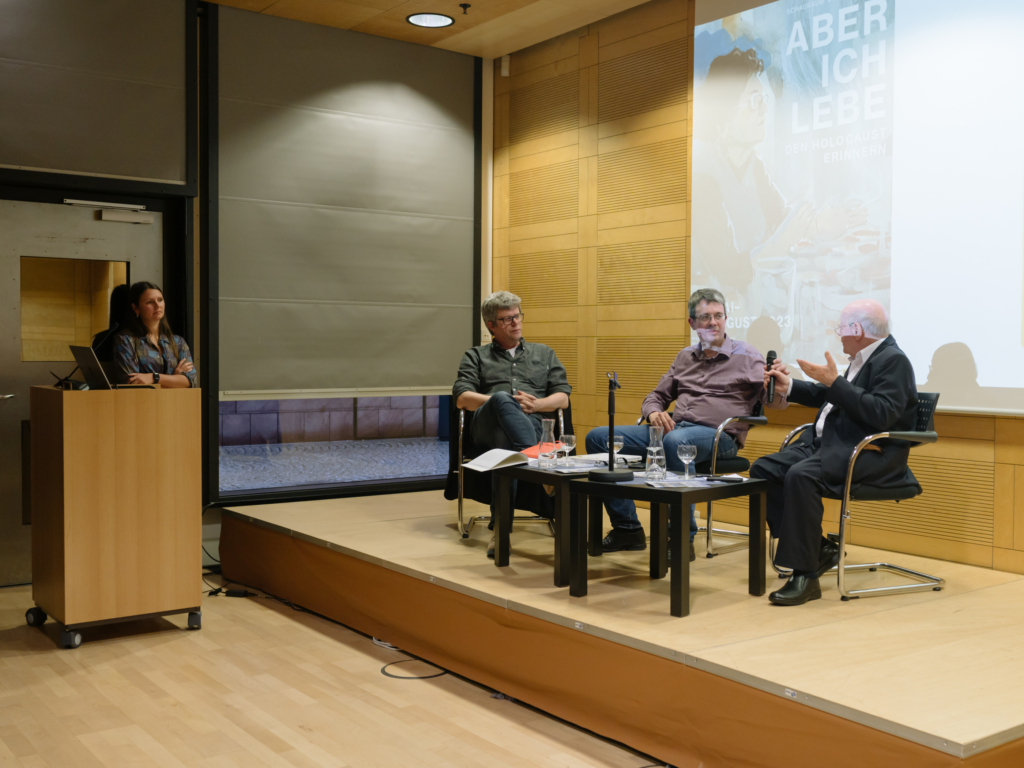
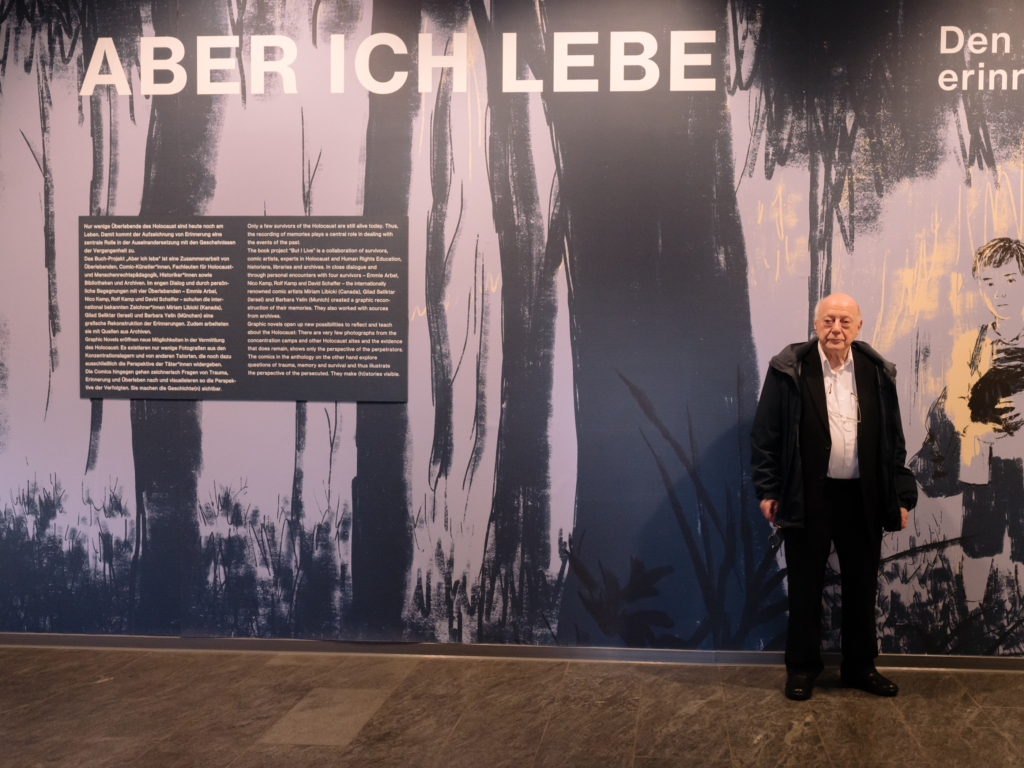
Jakob Hoffmann during the exhibition of ‘But I Live: Remembering the Holocaust’ exhibition in Dortmund, Germany, May 6, 2023. Photo credit: Max Mann.
My job does not have really anything to do with how I’m involved in SCVN, but maybe there are some parallels, because I’m always thinking about how to transfer certain political or cultural topics to young people and students.
I don’t know how exactly that happened, but maybe ten or fifteen years ago, I started getting interested in comics and graphic novels. And since I’m definitely not an artist or someone who can draw a straight line, it was very clear to me that if I want to get involved in this scene, I can do it by organizing things. So, I created a little series of events where I invited comic artists from all over the world.
I’m also into curating exhibitions. I started with a side project for contemporary art and then got the chance to do a bigger exhibition with Art for Children in the Museum of Modern Art in Frankfurt. This was a huge step forward, because, as a non-professional, it’s quite unique to get this chance. But I got it, and it was great, and I worked together with illustrators. Since then, I have done it from time to time.
I don’t know exactly when it was, but I did some exhibitions with comic artists, and that’s how Barbara asked me one day if I wanted to curate an exhibition on But I Live.
Ghada: I will use your last point to ask you to elaborate a little bit on your contribution to SCVN. Between 2022 and 2024, you co-curated and toured an exhibition of But I Live: Remembering the Holocaust. How did you first connect with the project? What inspired the creation of this exhibition?
Jakob: The comic scene in Germany, maybe the comics scene in most of the countries in the world except for perhaps France or Japan, is very well-connected and everybody knows each other. You don’t need an agent to get in contact with somebody else, and there is a strong interest in each other’s work. I’m not a comic artist, but since I invited a lot of people and published a comic magazine for kids, I’m in contact with many people, so it’s very hard to say when some things get started, because you always talk about projects, “Oh, let’s do this, let’s do that”.
In this case, I was talking quite frequently to Barbara Yelin. We had several events together , we met at festivals, and through our private friends. I don’t know exactly when she first told me about this project, about the life of Emmie Arbel, but I remember it was in the middle of COVID, when she called me in January 2022… No, no. It should be before then, maybe 2020, if it was at the beginning of COVID. No, it was 2022. But there was no COVID anymore. Well, you see, I’m very bad at remembering things.
Ghada: Maybe that’s why we need exhibitions, novels, and tangible materials? Because we need better memories? I’m just like you, it’s so hard for me to remember dates and names of people!
Jakob: Yeah, 2022. It was in January 2022, because we had a very short time to prepare this exhibition, so maybe I mixed things up. But Barbara called me—it was five or six months before that one big comic festival in Germany—and asked me: what do you think about offering an exhibition about But I Live for the Erlangen International Comic Salon? And I said, yeah, send me a PDF.
Then I saw the story, and other stories by Miriam and Gilad, and I was overwhelmed. We called Katja Rausch, from the festival in Erlangen, who gave us one of the best spots we could have there. However, we said let’s not limit it to the short exhibition during the festival. Let’s make it a little bigger, a little more durable, so that we have three months to show this beautiful artwork. This was the start. Then everything went very quickly from there.
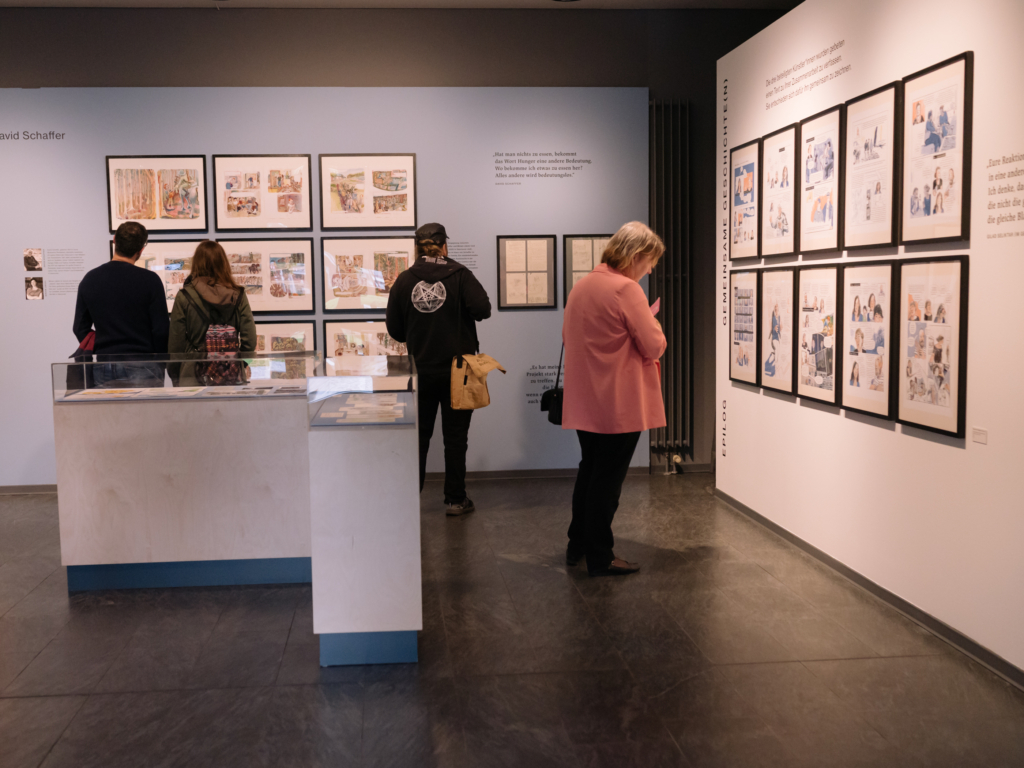
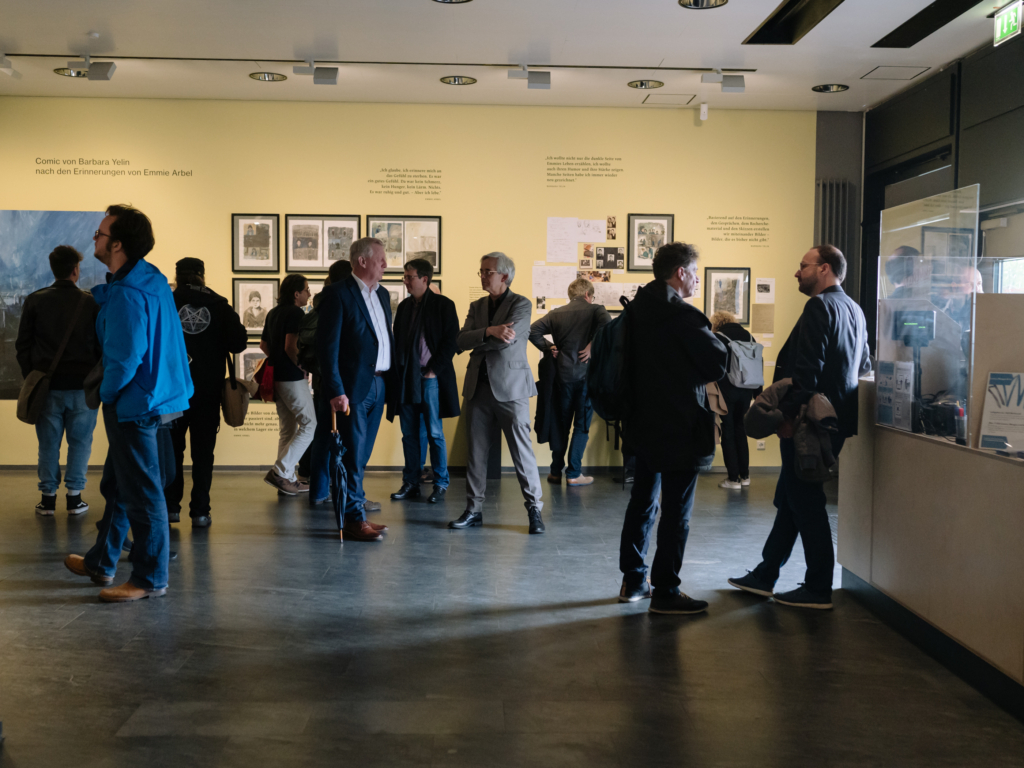
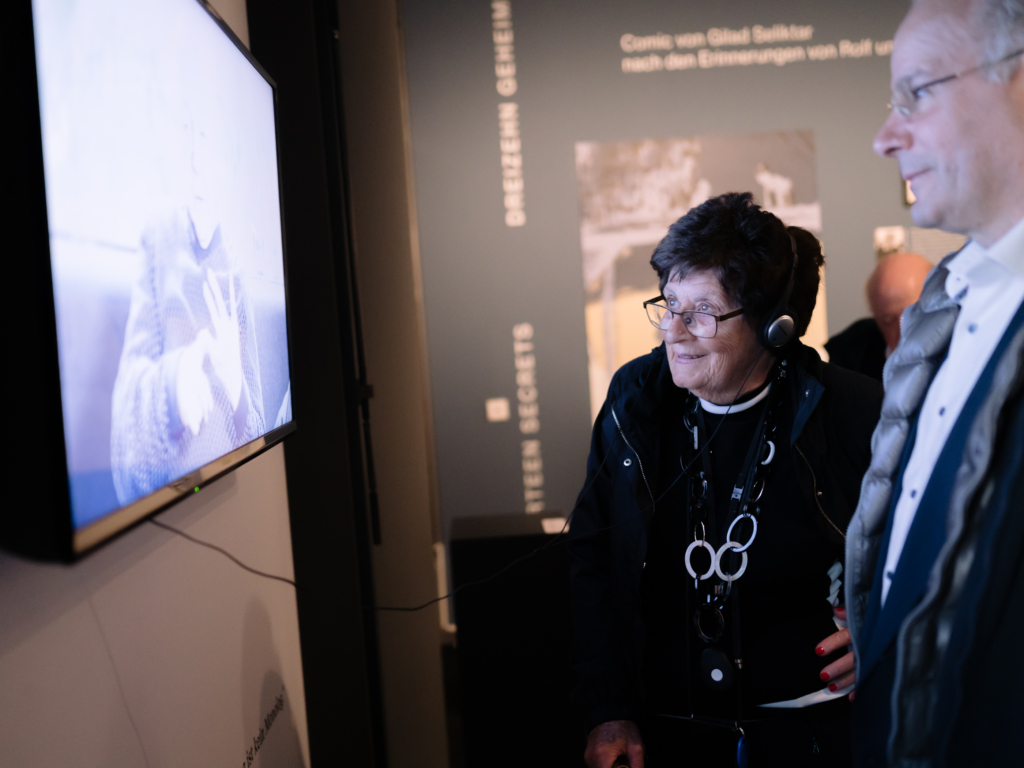
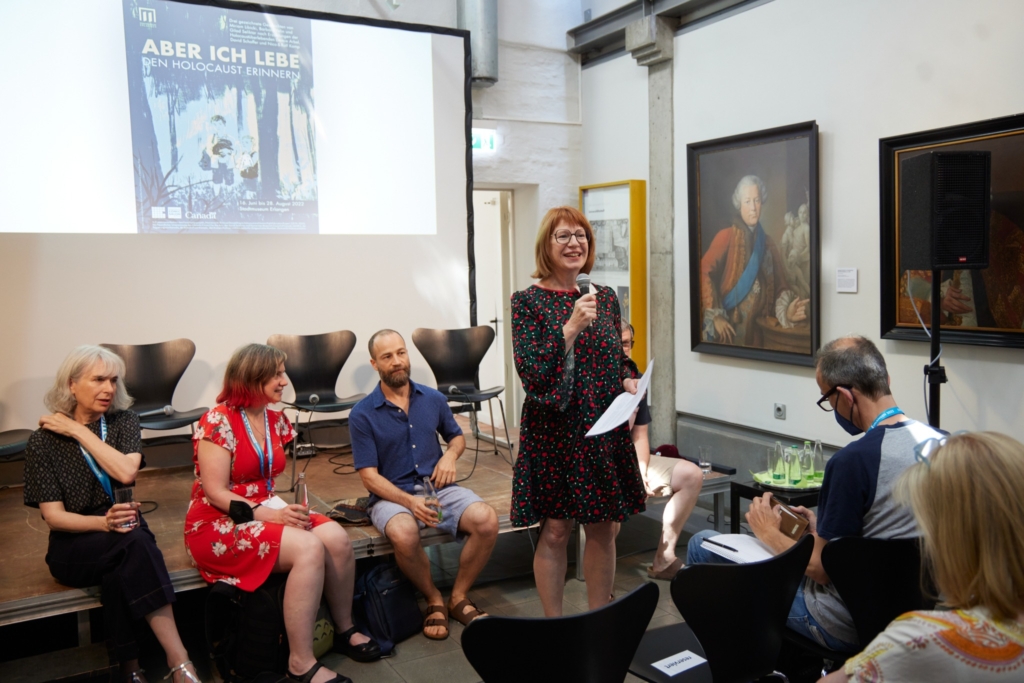
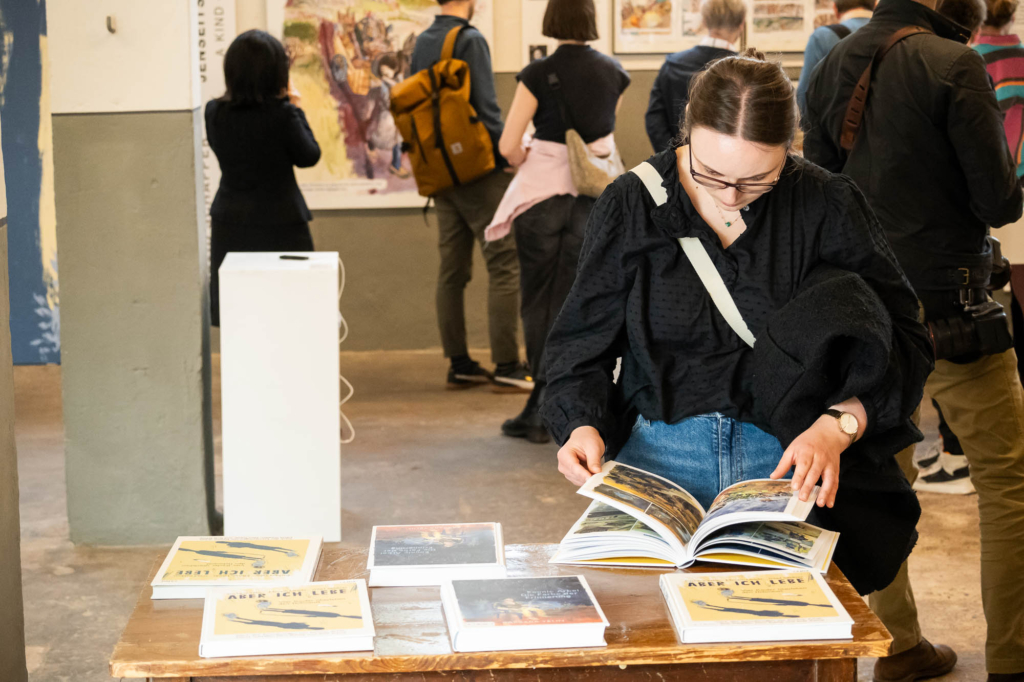
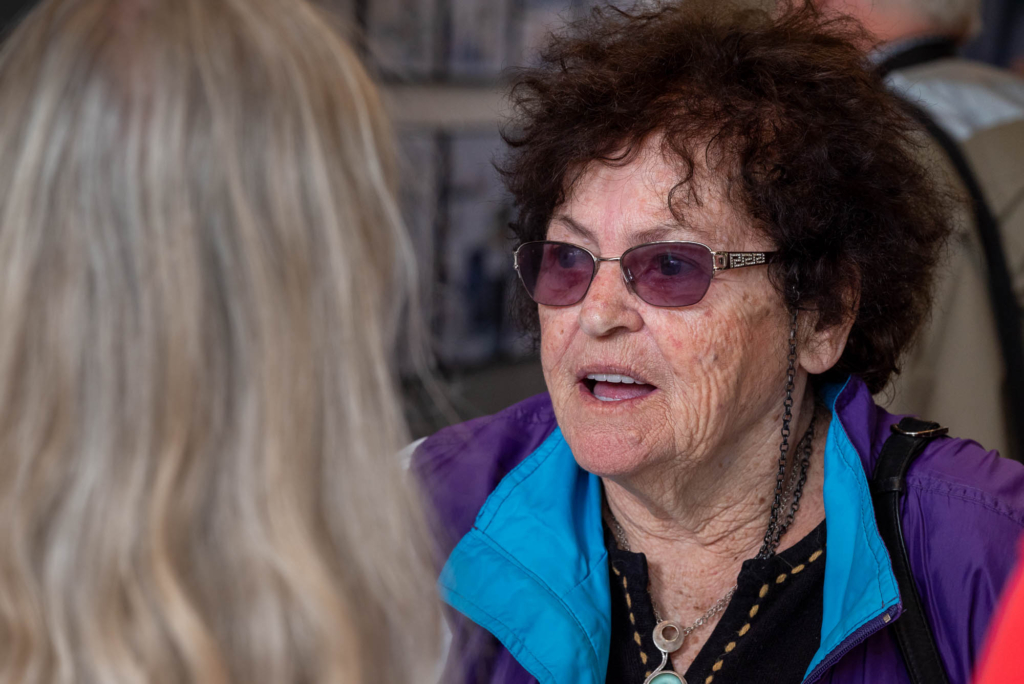
Photos from opening of the “But I Live” exhibition in Dortmund, Germany, May 6, 2023. Photo credit: Max Mann.
Ghada: Can you give us a quick brief of what the exhibition consisted of content-wise for our readers who might not necessarily be familiar with previous posts and information that we’ve shared?
Jakob: Yeah, that’s a very good question, because, you know, it’s always the question, What? What would you show if you were doing an exhibition about a comic? What would you display? Because a comic is happy with itself as a book, and it doesn’t need an exhibition.
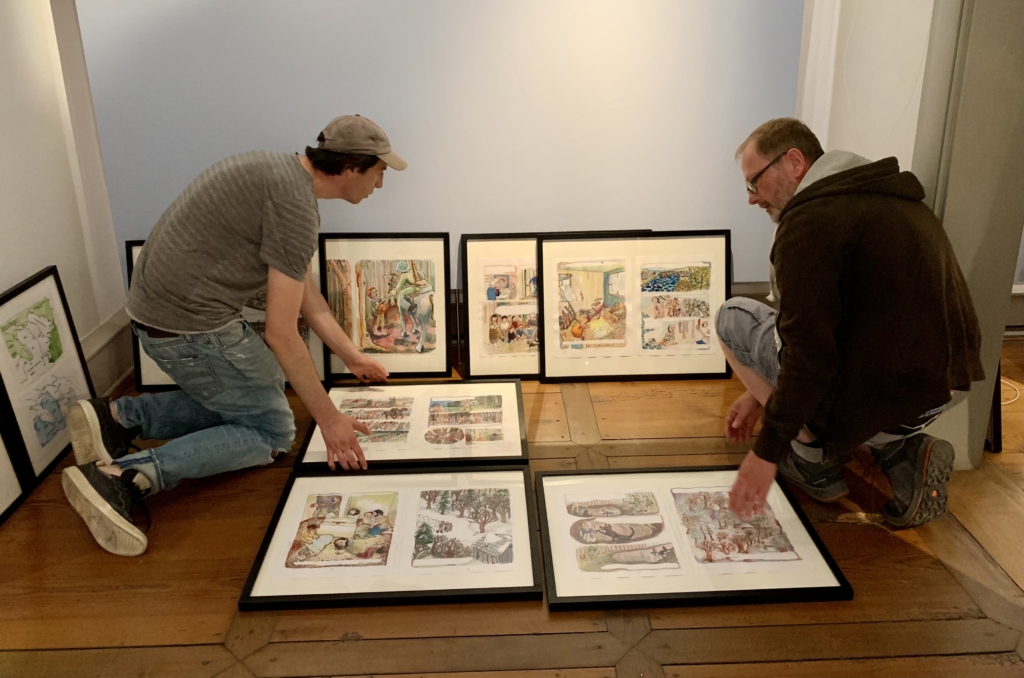
We first considered a traditional approach of showing original artwork. Yet, this is another tricky thing, because original artwork is not necessarily something that is done analog by hand. We got a beautiful mix in But I Live, because Gilad works strictly digitally, but Miriam and Barbara do analog studies. They work nearly completely with analog techniques, including watercolours, which is special. So, it was clear from the beginning that the exhibition had different components, but the main thing was to show original artwork that would give the visitor a strong impression regarding the three stories of the child survivors of the Holocaust.
We also decided to display studies, scribbles, sketchbooks, interviews, and research materials. At the time, the project had already produced three wonderful short films about the artists, and so the films were also shown. Of course, it’s very important to offer the audience some comics as well, a place where they can encounter the book, because it’s all about the book. The aim of the show is that people buy this book, take it home, and read it whole with all its strong components, especially since it’s not a traditional comic book. It also features very interesting essays from historians and so on.
Ghada: You mentioned the audience, and that’s precisely what I have been thinking about as well! Knowing that the exhibition has been in multiple cities, and I will not attempt to say their names because I will not pronounce them correctly. My question is, were there different conceptions for the different exhibits as they went to different places? Did you encounter any differences in public engagement? And finally, did you make any changes or specific adjustments?
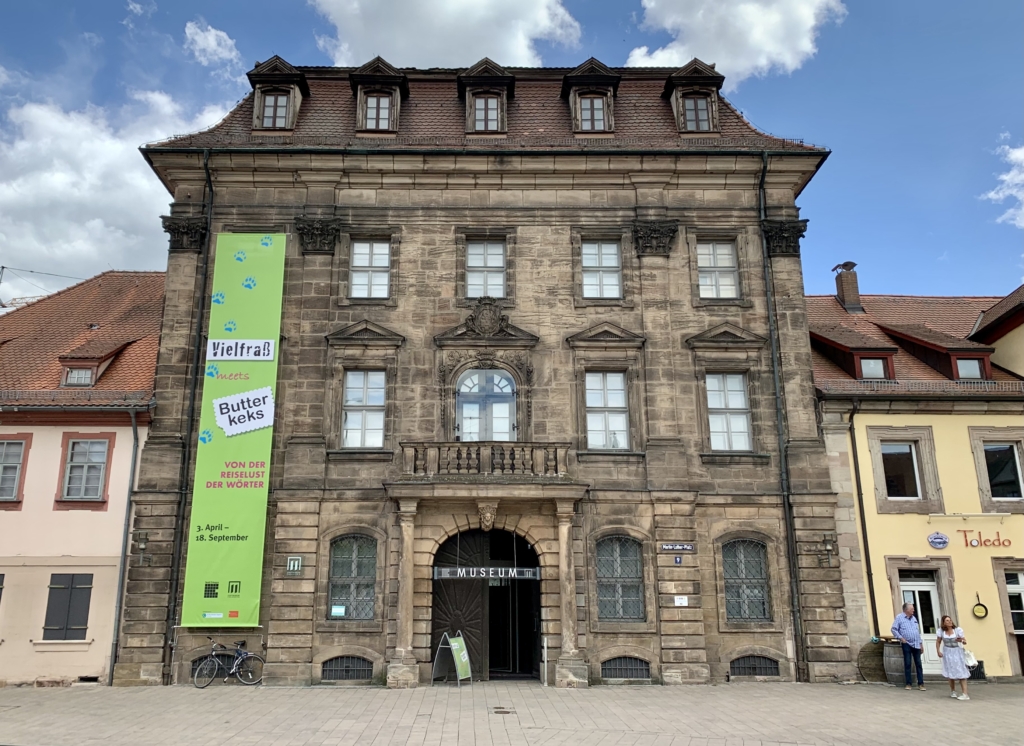
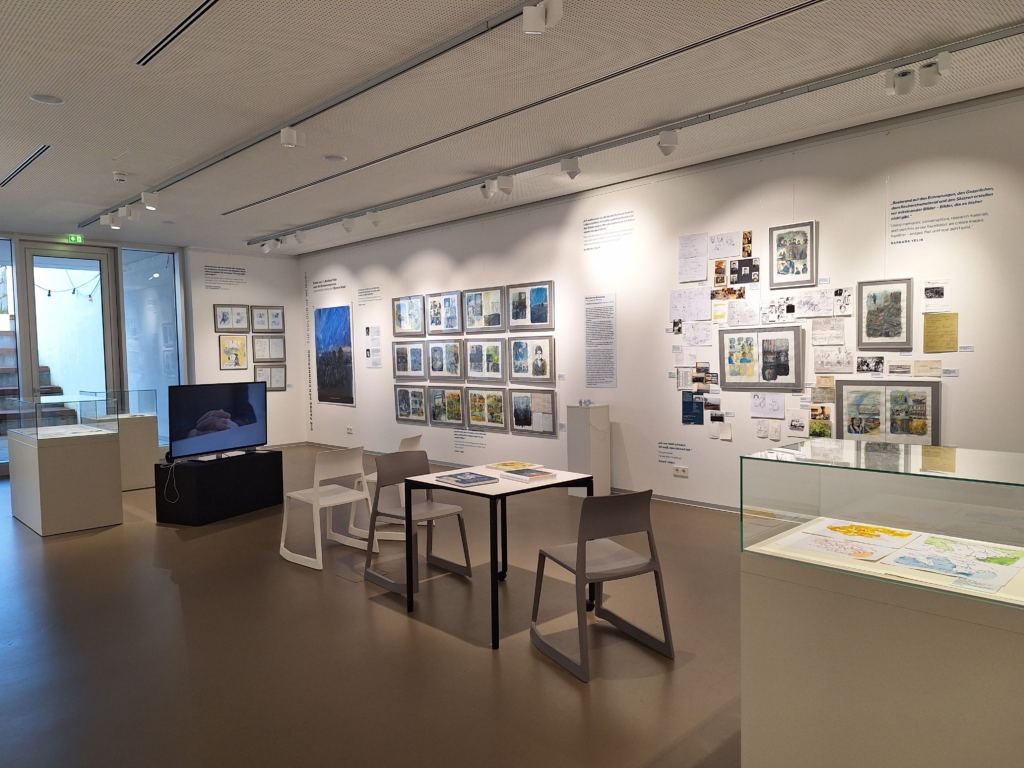
Jakob: Yeah, I can tell there’s a lot to say about that, but I will try to keep it short. When we started planning for the exhibition, it was absolutely customized to the museum in Erlangen, which is a very special but limited place in a 200- or 300-year-old building. We had six very small rooms, and, in total, the space was not more than sixty square meters, which is very small for such an amount of material. But we grabbed the opportunity to classify the different materials accordingly: three rooms went to showcasing the three stories, one for introduction and orientation, another hosted screens to showcase portraits of artists and witnesses along a big map that displayed the itineraries of the survivors, and the last room displayed the network of the project, the epilogue and physical copies of the book.
And at that moment, we still hadn’t even thought about taking the exhibition to another place. But there was an important journalist from Germany, Andreas Platthaus, who wrote about it and said, “This is really something, this exhibition should travel”.
“But I Live” exhibition at the Stadtmuseum Erlangen in Germany, June 16 – August 28, 2022. Photos courtesy of the Stadtmuseum Erlangen and Barbara Yelin.
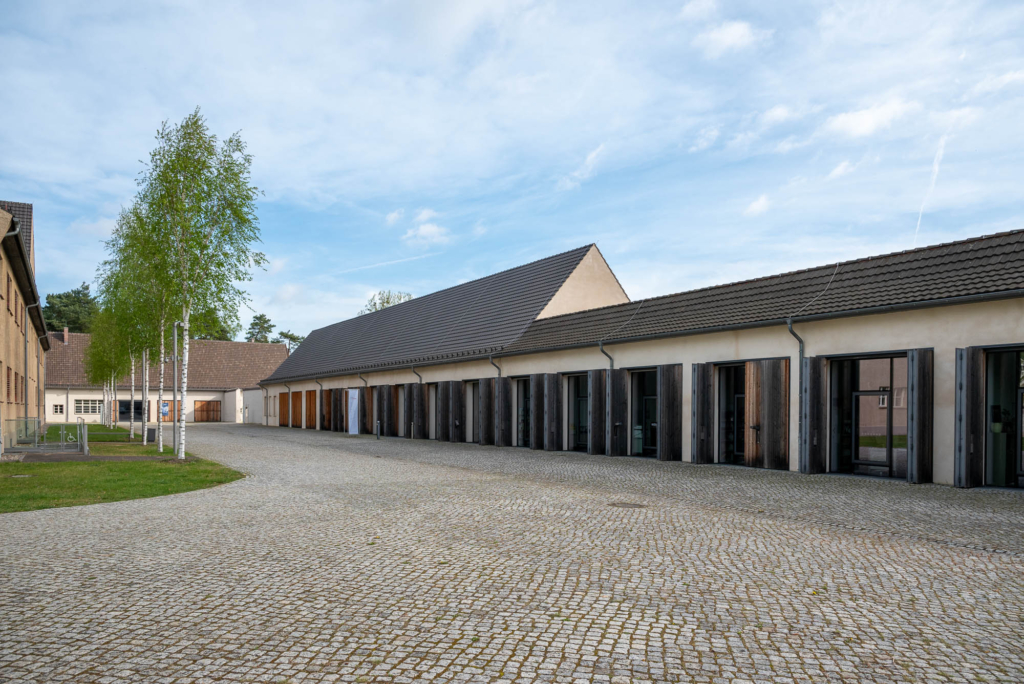
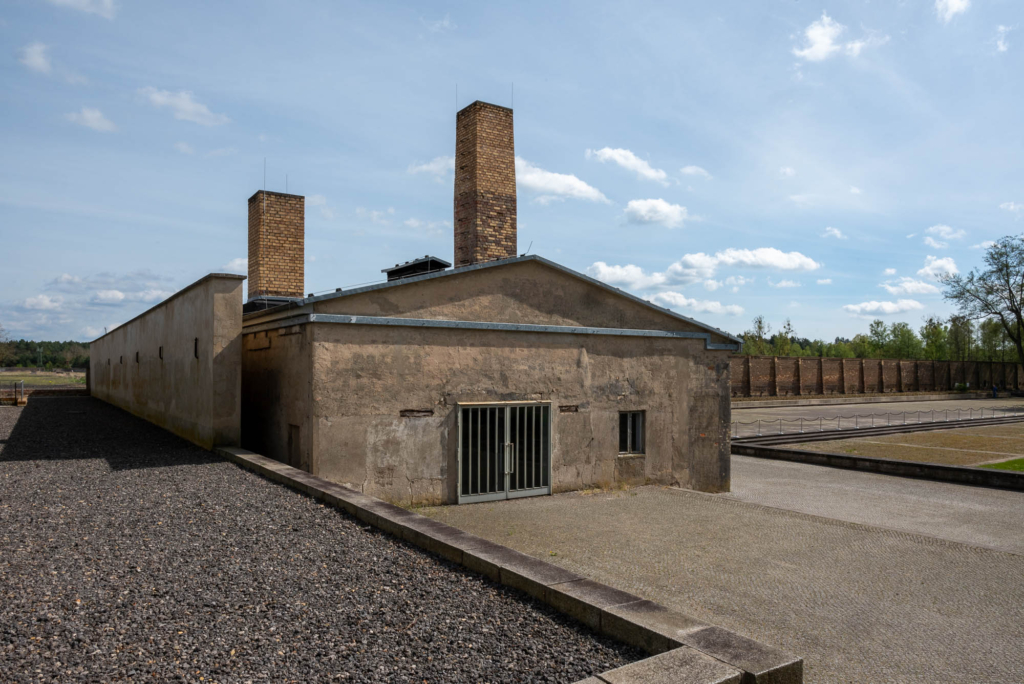
As such, before we even finished the first exhibition, we got two really good requests to show it in other places, and that’s what we did. We showed it in a small comic museum in Dortmund, then in Wiesbaden, which is close to Frankfurt, in a classical museum site. Later, we were asked to display the exhibition at the Gedenkstätte Ravensbrück, a former concentration camp and the very place where Emmie Arbel was imprisoned. This was really something. Then the exhibition was displayed in another comic museum in Bavaria, Erika- Fuchs-Haus in Schwarzenbach.
And now, sharing new information, it will go to Bergen Belsen, the place where Emmie Arbel was liberated. This was the concentration camp where her mother died, and they decided to show it as well. So, as you can imagine, these are two totally different situations—showing the exhibition in a comic museum in the middle of a town with no certain historical background, versus a former concentration camp that was the setting of one of the stories in the book.
Ghada: Very interesting, it somehow gains a new meaning, doesn’t it? When you put the place in the context of the story, you feel that it takes on a new dimension.
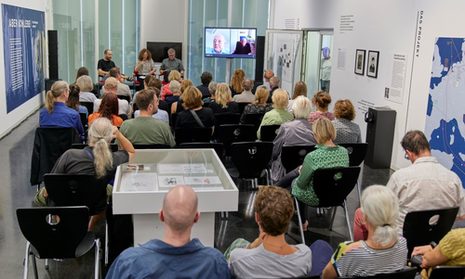
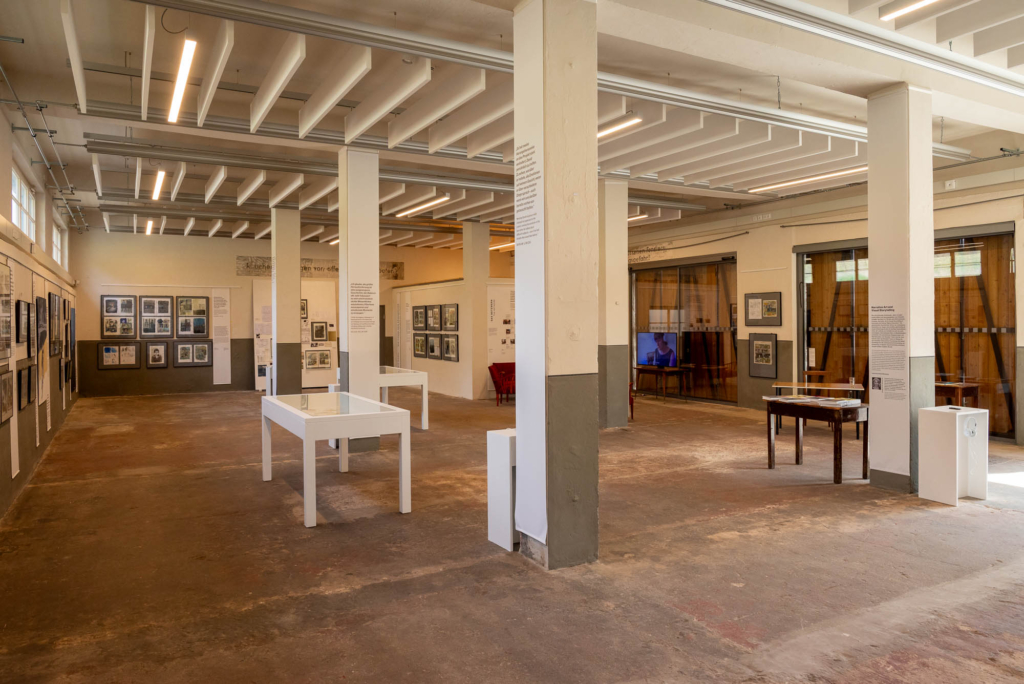
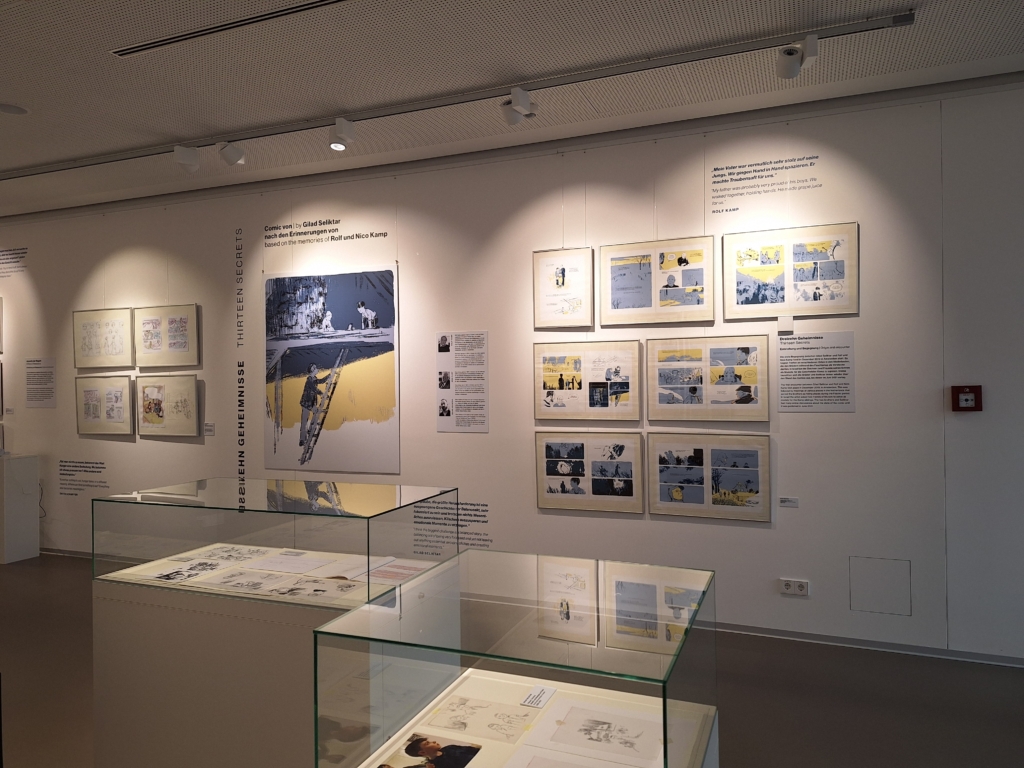
Jakob: Absolutely. The opening in Ravensbrück, the former concentration camp, was on the liberation day of the concentration camp. There were hundreds of people, including former prisoners. It was really frightening in a good way. The context is totally different, but we also try to adapt the exhibition to the exhibitions spaces that are quite different as well. You have a classic white cube in Wiesbaden, which is very easy to play with. And then you have very small old rooms in Erlangen. And then you have the memorial space in Ravensbrűck, where you’re not allowed to put anything on walls, and you must hang everything. These are technical challenges that force us to find new solutions which is very interesting. In “Aber ich lebe” [But I Live] in Ravensbrück, Emmie Arbel was there. In Dortmund and Wiesbaden, we had interviews with the twins [Nico and Rolf Kamp] from the Netherlands whose story was told by Gilad. It keeps changing all the time. We also invite other comic artists, because it’s now a very big thing, doing comics in this way about historical issues.
The opening of the exhibition in Wiesbaden, Germany, September 14, 2023. Photo credit: Patrick Bäuml.
Ghada: This is a beautiful transition to my question on how you envision the role of art and graphic storytelling in preserving and conveying memories of mass atrocities. What goals do you believe we achieve when we use art to address big issues such as social memory, history, group identity, and mass atrocities?
Jakob: It’s a big question, a philosophical one, and my opinion about it changes every day. Sometimes I think it’s the perfect medium to carry things that must be remembered—things that would be lost if we didn’t use art to preserve them. Yet, sometimes I think, no, it did not work. It’s always a process full of doubts. But we got very good responses to these exhibitions.
I guess comics have the advantage of allowing people to reflect on a story at their own pace, at their own speed. This is a difference from film, for example. When you watch a film, you’re totally passive.
Another challenging aspect of But I Live is the fact that it creates pictures of the concentration camps that do not exist yet, because we only have the official pictures by the Nazis, and they don’t show people in gas chambers, or all the killing and the atrocities. The pictures we have are only those taken by the perpetrators.
Comics, and maybe art, offer the chance to show what happened, while making it totally clear that this is not the exact way it happened, but that it could. Comics don’t pretend to present historical truth. Rather, they highlight that history always needs reconstruction, and this means there is nothing like objective truth about what happened.
I think that’s what art can do—bring the audience, like the visitors of an exhibition, to engage with the pictures and the story, but they must play their own role in the process. There is always a relation between the visitor and the objects we display.
Ghada: I may have not mentioned, but I am doing my PhD in philosophy, so these kinds of questions are at the core of my interests in participating in and contributing to this project!
Jakob: Yeah, like this idea for example, is informed by Walter Benjamin, who said that history is always in construction, not reconstruction, but construction. I guess art can make that very clear. Another important idea, which is a common notion about art, and especially comics, is that art makes the process easier, more accessible, when you approach history through pictures.
Ghada: I like to reflect on this informational dimension of art, focusing on the difference between getting information from art versus, for example, news or other formats. I tend to think that art speaks to us in the totality of our existence, that is in thinking, but also in feeling, in imagination and creativity. It taps into different aspects of us all at once.
Jakob: That is true on the one hand, but it’s also dangerous to use art to just put some emotion in a material or issue. Of course, this is something one must be careful about. Among the quality points of these comics in But I Live, is that they keep their distance, because the project is survivor-centered, not about manipulating the audience. It’s about keeping everything centered around the survivor, and how we can stay genuine and authentic about that.
Ghada: Beautiful. You spoke earlier about your work with Barbara, and I understand that there was a lot of collaborative work. I am curious about the role of collaboration in the making of projects like this exhibition. How does the collaborative nature of this work help advance the project?
Jakob: It is absolutely necessary. It’s something that can never be enough, because in such projects, there are tons of information you haven’t read or worked with. And it’s the same with the connections to the artists, or with other people who are involved in the project. There you always have the feeling it’s not enough, but it’s absolutely necessary to get in touch with them, to talk to them and to understand what they do on a personal level as well.
What we did for this exhibition—something I will also do in my upcoming exhibition that involves some people from SCVN— is doing interviews with the artists and bringing them into the exhibition so that you hear from them about their processes and struggles, and how they make their decisions. There are a lot of decisions to make as an artist when it comes to showing things, and this is what I’m interested in.
We work together with some graphic designers, so we always have a digital version of the exhibition. We show it to the artists, discuss it with Charlotte, and eventually we must make the final decision as curators. This is a very democratic way to bring in a lot of perspectives. The collaboration is very close, beautiful, and it’s the most interesting thing about the process.
Pictures from “But I Live” exhibition in Ravensbrück, Germany, April 13, 2024. Photo credit: Eberhard Schorr.
Ghada: Wrapping up our conversation and looking forward, what is next for SCVN in terms of exhibitions? I know that you will be creating an exhibition for the new SCVN project, which moves beyond the Holocaust and includes other genocides and mass atrocities from Rwanda, Iraq, Syria, Canada, Bosnia, and Kosovo. Can you speak about any plans for the next exhibits?
Jakob: An upcoming exhibit will take place in Wiesbaden again, opening on May 21. We open this exhibition with four comic artists, three of whom are involved in the SCVN project: Tobi Dahmen, who worked on Akram’s story from Syria and whose work will be shown for the first time; Nora Krug, who’s working on a project about archives in Yale’s Fortunoff Video Archive, and we will display some work from her book; and there is Birgit Weyhe, who is in the working process for an upcoming comic about a young woman from Iraq. Charlotte will also be invited.
In November, the exhibit is set to travel to another museum in Constance, in the very south of Germany. We have a current discussion about whether it will also go to Erlangen in 2026.
In general, there are eight or nine artists working now on graphic novels about genocides worldwide [on the project]. Fantastic artists dealing with shocking issues. The question is, what will happen to these stories? Will there be anything beyond the fact that they will be published, hopefully in different languages and in different countries? So, Charlotte and the team came up with the idea of creating not a digital exhibition, but a portfolio which can be easily adapted in different places all over the world. Something like a core set of pictures, information, and layouts which can be printed, for example, on location, but in a certain, outstanding quality. The concept aims to, on the one hand, guarantee that there will be a high-profile exhibition or a good-quality exhibition, and on the other hand—the charming argument of course—to enable people and institutions, for example schools which don’t have much money, to display exhibitions in a way that is possible.
I’m very much into organizing events, public readings, and exhibitions, because I love bringing this fantastic artwork to people in a very direct way, to invite the artists and show original artwork. But I also understand the need to make the material more accessible to institutions.
Pictures from “But I Live” exhibition in Erica-Fuchs-Haus, Schwarzenbach an der Saale, Germany | 09.08.2024 (Photos’ credit: Joanna Straczowski)
Ghada: My last question is from a research process perspective. I am wondering how you approach the weight of the material at hand. Despite that we are dealing with comics and artistic material, the content is heavy. How do you deal with this aspect of the project?
Jakob: Oh, that’s hard to say. I usually don’t do it twenty-four hours a day. I have my job, my family, and my nonsense stuff like watching Netflix series or soccer on TV. I also have a lot of friends and family I can talk to throughout the process. This is helpful. I think comics, as I already said, offer you the chance to keep a distance. And the artists I worked with are very considerate not to overwhelm the people they are working with. But to be honest, I cannot answer completely because I don’t know how much impact it [this work] has on me. And I think there is some kind of professional distance I try to keep. Sometimes I distract myself and do other things. Actually, there is a beautiful picture about this in But I Live, in the story of Emmy Arbel, who worked with Barbara. After telling her the most horrible stuff you can think of, she says: “Now it’s time to stop, and I must go to the computer and play my solitaire game.” So, the question is much more an issue for the victims of these tough stories. We are in a comfortable position in not having experienced what they did.
Ghada: These were the questions that I had. Did I miss any question that you wanted to address?
Jakob: Not now. Thank you for these questions. It has been a pleasure. As I already said, it’s not so easy for me to answer in English, because sometimes some words are missing, and you try to paraphrase in an awkward way.
Ghada: It’s also my everyday struggle, so I understand!
Jakob: What is your first language?
Ghada: It’s Lebanese Arabic, which is my first language. Then we learn French as a second language, and English as a third. You can imagine me trying to phrase all those philosophical ideas in English but getting the words in Arabic first. Then I have to translate, but that is not always a practical thing to do.
Jakob: Well, you are into at least two other beautiful languages. I always envy people who can speak French. It’s very hard for me not to be able to speak French, because France is really the best country for comics. Yeah, and Arabic. I don’t understand Arabic, but it sounds very nice. Is it complicated?
Ghada: It is… It is usually considered harder to learn than some other languages, especially let’s say English, French, and Spanish, which share some vocabulary and grammatical structures, whereas Arabic has a completely different structure and a different alphabet. But that’s the beauty of diversity among people and languages!
Jakob: That’s a very good last word, I guess, that beauty of diversity.
Thank you so much for sharing your time and expertise, Jakob, and we look forward to your next exhibit with the project!
In a session titled ‘A Kind of Resistance: Illustrating Holocaust Survivor Stories’ that took place at the Pennsylvania State University on February 25, graphic artist Miriam Libicki discussed the collaborative nature of her graphic narratives. During the event, she showed a detailed deconstruction of the process of building a graphic novel out of interviews and active collaboration with survivors, historians and researchers. She discussed the unique strengths, as well as challenges, of using comics to depict the Holocaust, and to depict subjective memory in the absence of photographic documentation.
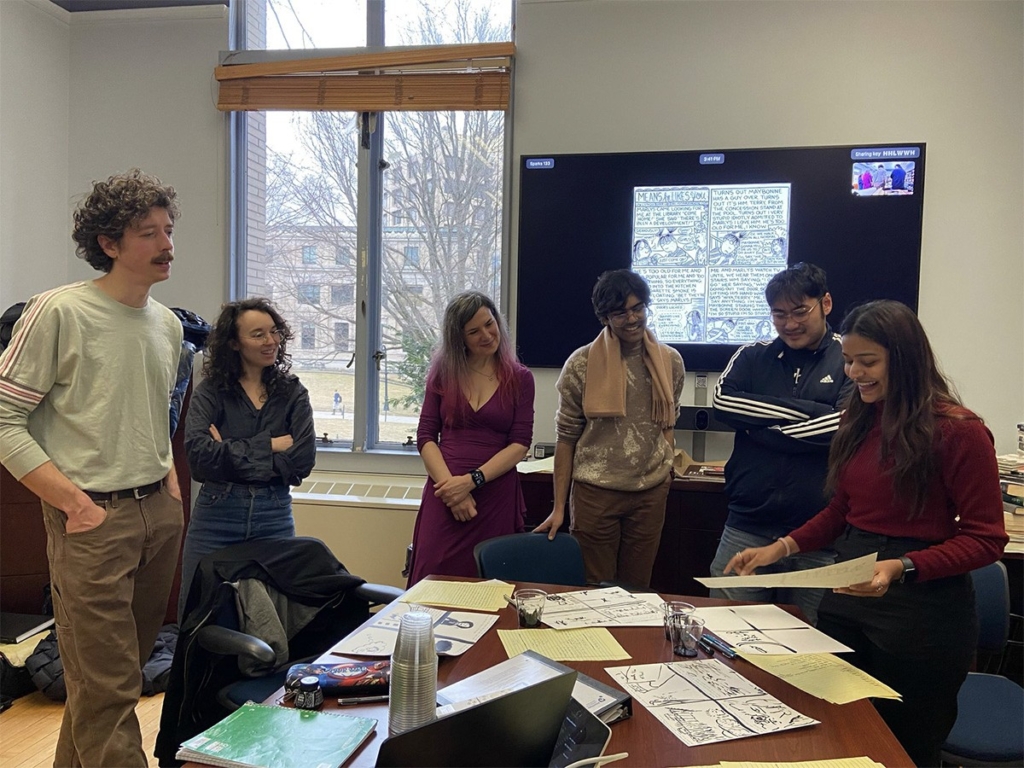
Students engaging with workshop drawings created in session. Photo credit: Kobi Kabalek.
During the follow-up event on February 26, ‘Inking the Unthinkable: A Sense-Memory Writing and Cartooning Workshop’, participants engaged in a drawing exercise to experience the creative process as an act of memory, observation, and communication. According to Libicki, this hands-on memoir comics workshop was inspired by educator/cartoonist Lynda Barry’s theories of creative concentration as “deep play,” and writing as “delivering an image.”
Workshop drawing exercise led by Miriam Libicki. Photo credit: Miriam Libicki and Kobi Kabalek.
Miriam Libicki’s most recent collaborative piece, ‘A Kind of Resistance’, was published in the anthology of Holocaust survivor graphic memoirs But I Live: Three Stories of Child Survivors of the Holocaust which received the Canadian Jewish Literary Award in 2022.
For further reading about the collaborative nature of Miriam’s art and the research behind her graphic narrative featured in But I Live, please click here.
‘A Kind of Resistance: Illustrating Holocaust Survivor Stories’ February 25, 2025 2:00 pm EST W043A Dewey Room Collaboration Commons, Patee Library Pennsylvania State University Event link: https://events.la.psu.edu/event/a-kind-of-resistance/
‘Inking the Unthinkable: A Sense-Memory Writing and Cartooning Workshop’ February 26, 2025 2:00 pm EST College of Liberal Arts – 133 Sparks Building Pennsylvania State University Event link: https://events.la.psu.edu/event/inking-the-unthinkable/
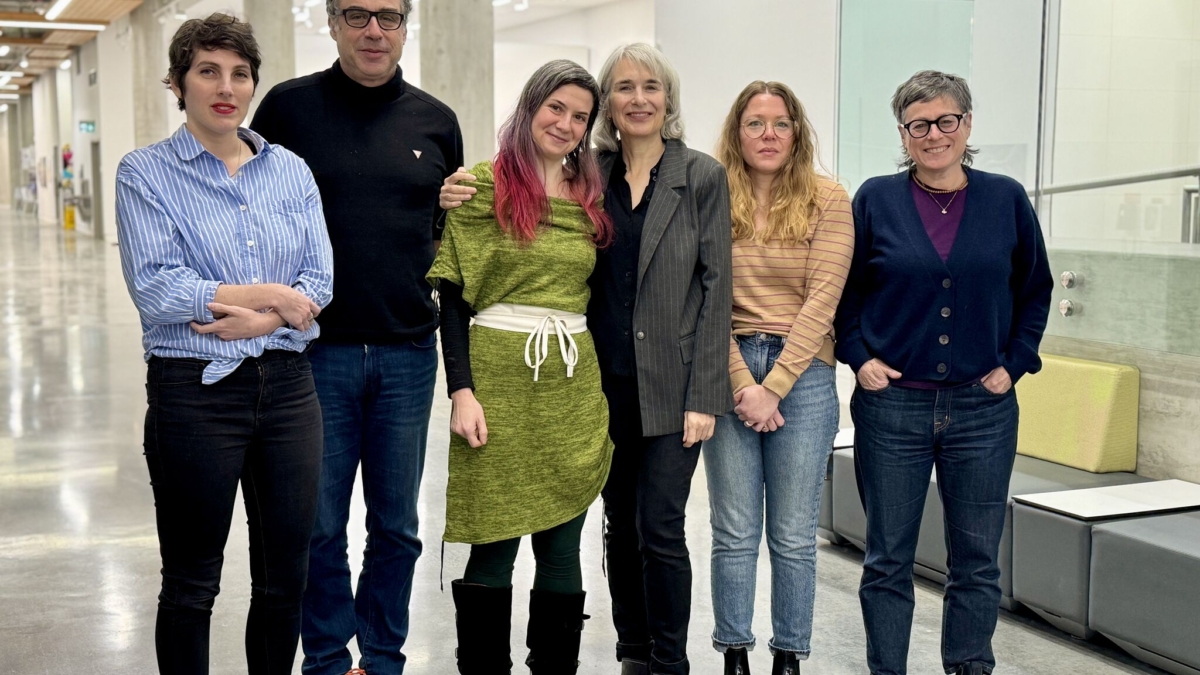
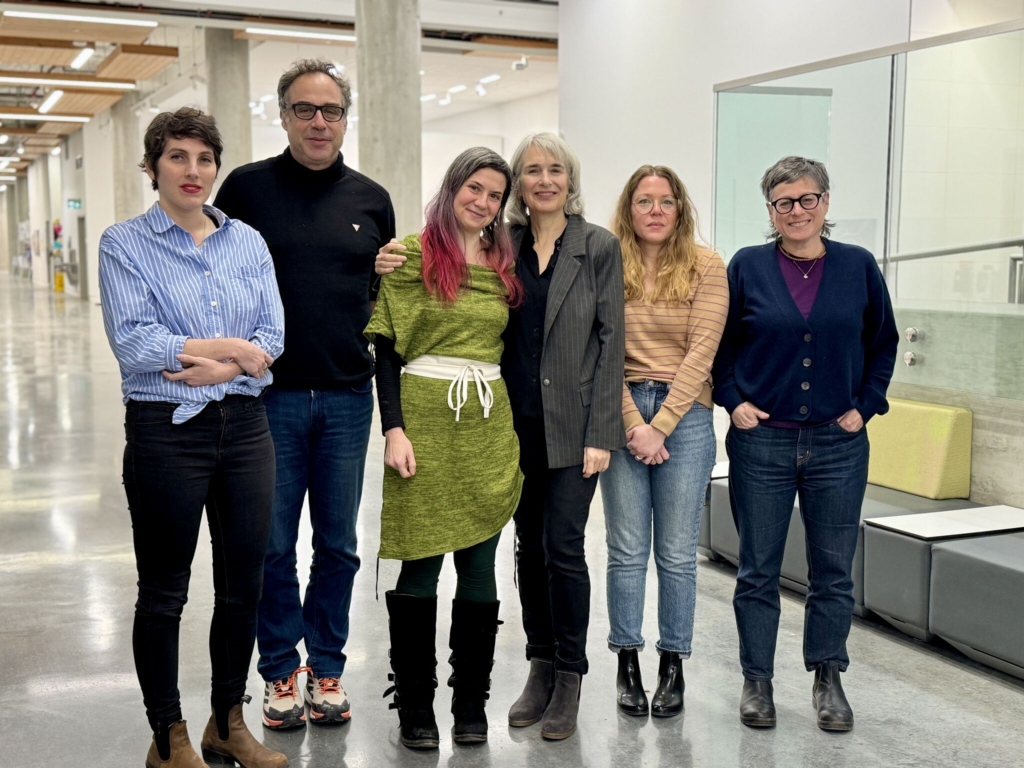
From left to right: Éléonore Goldberg, Alan Goldman, Miriam Libicki, Charlotte Schallié, Lee Gilad and Randy Lee Cutler.
This year’s International Holocaust Remembrance Day (January 27) marked the 80th anniversary of the Auschwitz-Birkenau extermination camp liberation. In commemoration of this event, the Emily Carr University of Art + Design (ECU) hosted a talk to recognize victims of the Holocaust and its impact on survivors. Project Director Dr. Charlotte Schallié was invited to discuss the graphic novel But I Live: Three Stories of Child Survivors of the Holocaust with the ECU community, including students, faculty, and staff.
Dr. Schallié extends her gratitude the the ECU team for hosting the event:
I learned so much from all of you and was deeply touched by the ECU faculty and staff members who reflected on artwork made by Holocaust survivors and their descendants. It’s rare to find such a caring and supportive space of togetherness and belonging, and you created it for all of us! Thank you!
“Remembering the Holocaust: 80 years after the liberation of Auschwitz” February 12, 2025 3:30 – 6:00 pm PST Emily Carr University Boardroom, D2315 520 East 1st Avenue Event Contact: Lee Gilad | lgilad@ecuad.ca
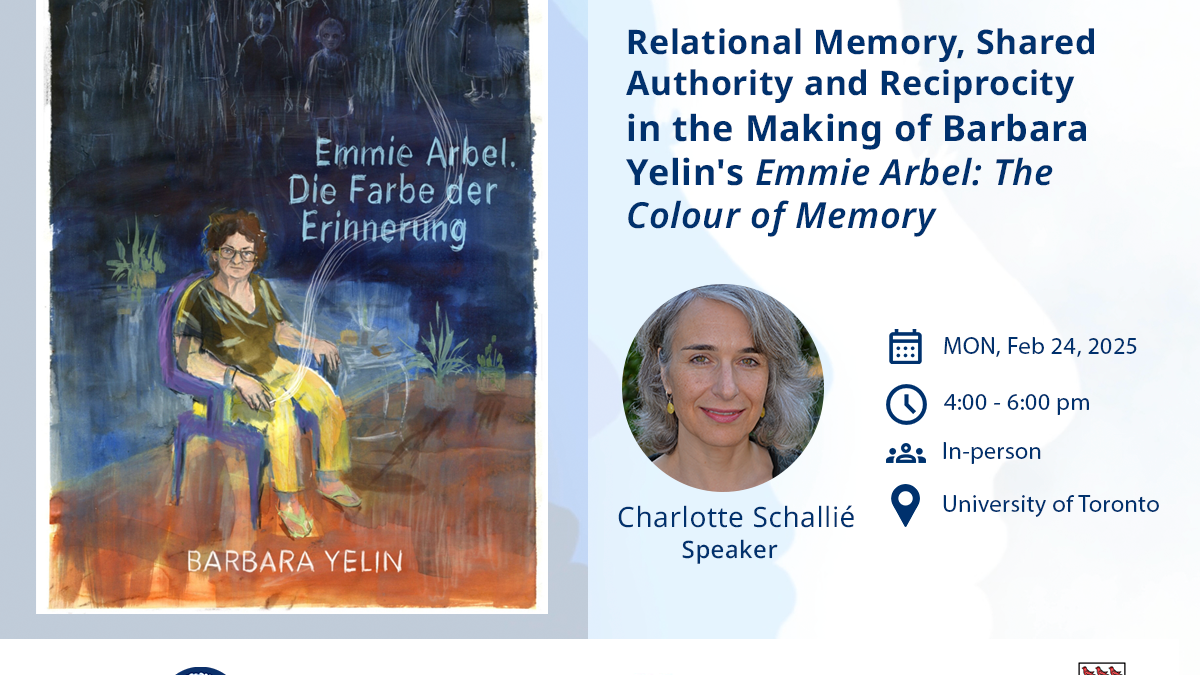
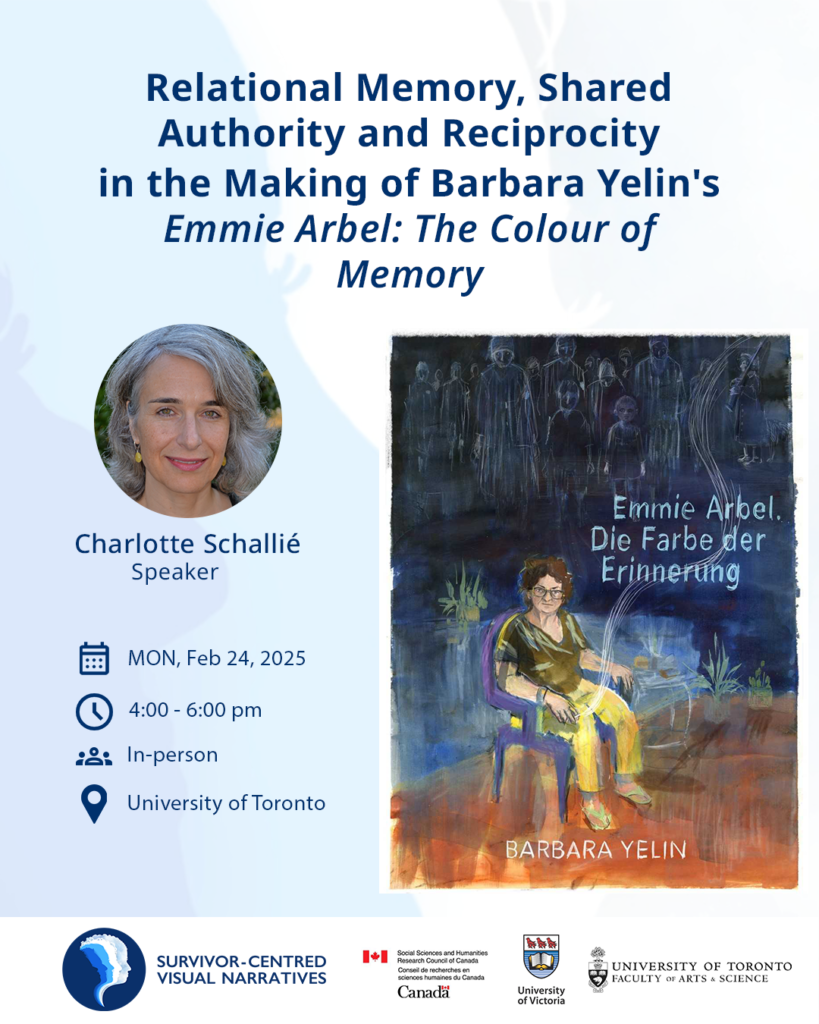
On February 24, Dr. Schallié will visit the University of Toronto to present on ‘Relational Memory, Shared Authority and Reciprocity in the Making of Barbara Yelin’s Emmie Arbel: The Colour of Memory‘.
Event description: In this presentation, Charlotte Schallié discusses her arts-based collaborative research with graphic novelist Barbara Yelin and Holocaust child survivor Emmie Arbel. Their work together resulted in two publications, the most recent one being Emmie Arbel. The Colour of Memory (2023), co-edited with Alexander Korb. Barbara Yelin’s graphic novel expands Arbel’s seven-page witness testimony into a book-length graphic narrative inviting us to reconsider the role of creative practice in gathering and representing living memory. As a published graphic novel, Emmie Arbel. The Colour of Memory is a multi-genre creation. It is a collaborative piece of scholarship based on mutual care and relationship building, an artistic rendering of a life narrative, and an artwork that documents creative practice as research.
When Barbara Yelin met Emmie Arbel for the first time at the Ravensbrück Memorial in 2019, Arbel conveyed to the artist that she remembered very little “from the war.” In traditional eyewitness testimonies, such memory gaps create significant obstacles resulting in an incomplete oral history document. Yet, in Yelin’s artwork, Arbel’s embodied memories and silent interactions are not just made visible, they are inseparably interwoven into the (hi)storytelling. Dr. Schallié will elaborate on how creative renderings of nonverbal expressions of memories in Emmie Arbel. The Colour of Memory may challenge our understanding of testimony, agency, and absence.
“Relational Memory, Shared Authority and Reciprocity in the Making of Barbara Yelin’s Emmie Arbel. The Colour of Memory” Monday, February 24, 2025 4:00 – 6:00 pm PST Room 100 – Jackman Humanities Building 170 St. George Street University of Toronto
On February 14, the Vancouver Holocaust Education Centre(VHEC) is hosting the one-day ’12th Biennial Shafran Teachers’ Conference’. This year’s conference, entitled ‘Teaching the Holocaust: Multiple Perspectives and Best Practices in Holocaust Education’, focuses on providing teachers in various disciplines with new teaching resources to support Holocaust education in the classroom.
SCVN Co-Director Dr. Andrea Webb will be a presenter at the conference and will draw from her experience as a high school teacher, teacher educator, and researcher to support educators’ confidence and engagement in Holocaust education.
Dr. Webb has also developed the Educators’ Resource for the graphic novel ‘But I Live: Three Stories of Child Survivors of the Holocaust’ and is leading the development of the teaching materials and educational resources for all of SCVN’s Research Clusters.
Thank you to the VHEC for hosting this event and we look forward Dr. Webb’s presentation!
Conference Details: Friday, February 14, 2025 8:30 am – 3:30 pm PDT Vancouver Holocaust Education Centre 950 West 41st Avenue, Vancouver 2nd Floor, Dayson Boardroom
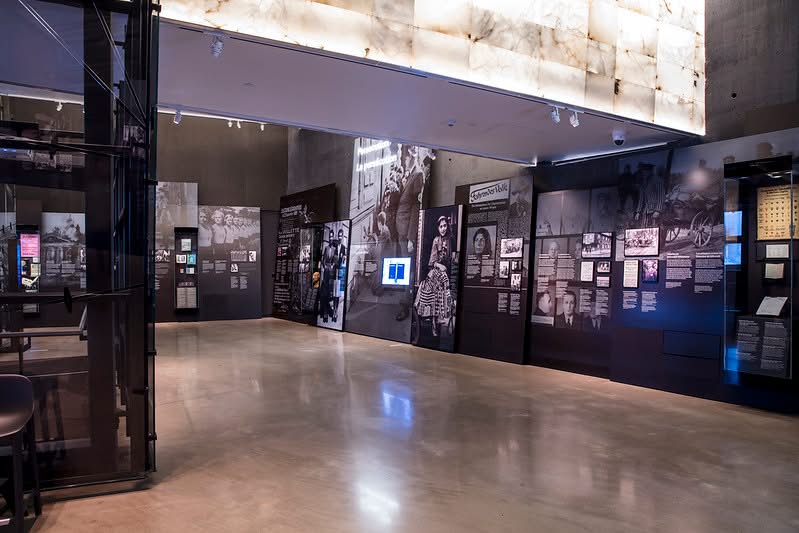
Gallery of ‘Examining the Holocaust’ exhibit at the Canadian Museum for Human Rights. Images courtesy of the Canadian Museum for Human Rights.
In an upcoming webinar on January 29, Co-Director Dr. Andrea Webb will be discussing ways that educators can bring Holocaust education into the classroom with respect and consideration. She is joined by Ashley Groff, Interpretive Program Developer from the Canadian Museum for Human Rights (CMHR), and institutional host of the webinar in collaboration with the Survivor‐Centred Visual Narratives Project. Webinar participants will be provided with resources that support Holocaust education, teaching about genocides, and teaching about human rights. They will also learn where to seek support and leave with tools to help them teach students Holocaust‐related content according to their provincial or territorial mandate.
“Supporting Educators in Holocaust Education” Wednesday, January 29, 2025 12:00 – 1:00 pm PST / 2:00 – 3:00 pm CST