Survivor-Centred Visual Narratives (SCVN) is excited to announce the publication of two articles focusing on methodology by project director Dr. Charlotte Schallié. In these articles, Dr. Schallié articulates the approach that lies at the heart of the SCVN project, underscoring relationality, participation, and ethics of care as key elements in the collaborative process:
The articles are featured on our newly launched Scholarly Resources page, where readers can stay up-to-date on new publications and download PDF versions when available. An introductory text sampled from each article are listed below:
Being in Relationship – A Case Study for Pursuing Creative Practice as Research with Holocaust Survivors
This article presents a case study for pursuing a relational approach to testimony gathering processes with Holocaust survivors. Drawing on insights gained from our multi-year sustained creative collaboration with four Holocaust child survivors and three comics artists, Dr. Schallié highlights how arts-based co-creation foregrounds critical aspects of life writing such as nonverbal communication cues, the lived experience of place, the shifting positionality of the narrator, competing memories, or embodied memories that cannot be expressed in words alone. In traditional eyewitness testimonies, such complex nonverbal representations of memory create significant obstacles resulting in partially rendered or incomplete oral history documents.
Slowing Down and Taking Time: A Proposal for Integrating Care Ethics into Visual Storytelling Research and Practice
This forum contribution discusses an arts-based research project that reconfigures survivor testimony within a relational ethics framework. Highlighting the creative partnership between Utrecht-based comics artist Tobi Dahmen and his research collaborator Akram, a young man who survived the Syrian prison system, the Dr. Schallié proposes to employ comic drawing as an inquiry-based tool and caring practice during collaborative life writing sessions. A commitment to relational storytelling—honouring relationships that are based on mutual trust and shared authority—also fosters a practice of mindful, reflective slow scholarship. Taking time is thus a critical pillar of collaborative storytelling work for the survivors and the artists, as well as members on the research team, as they mutually negotiate the flow, pace, and rhythm of co-narration.
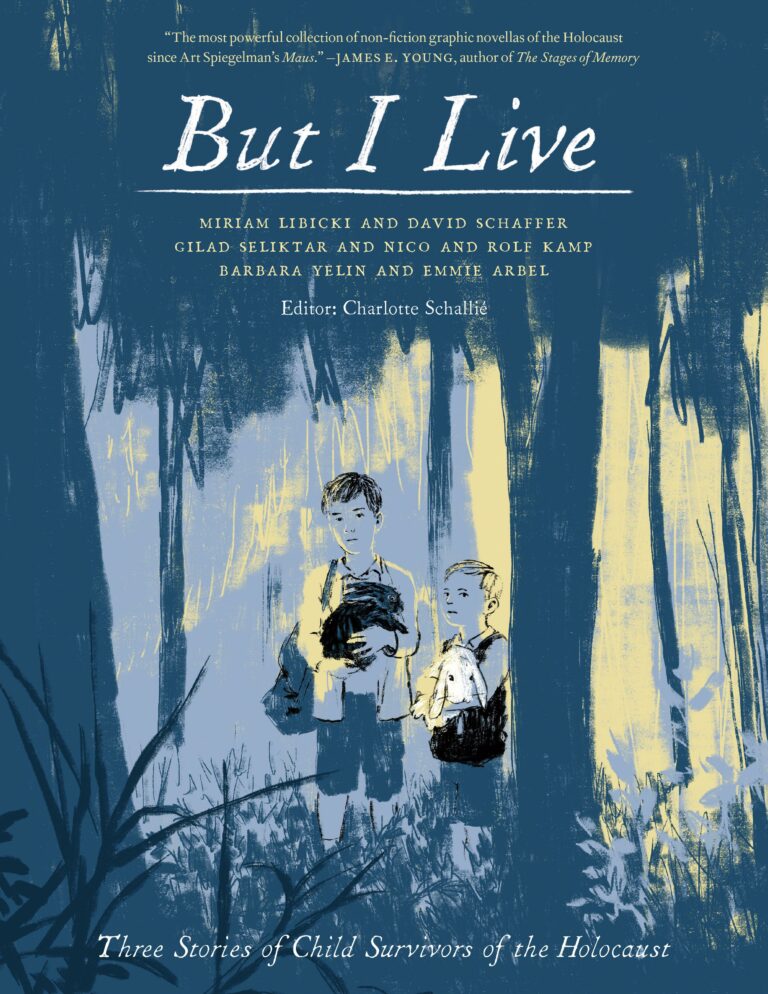
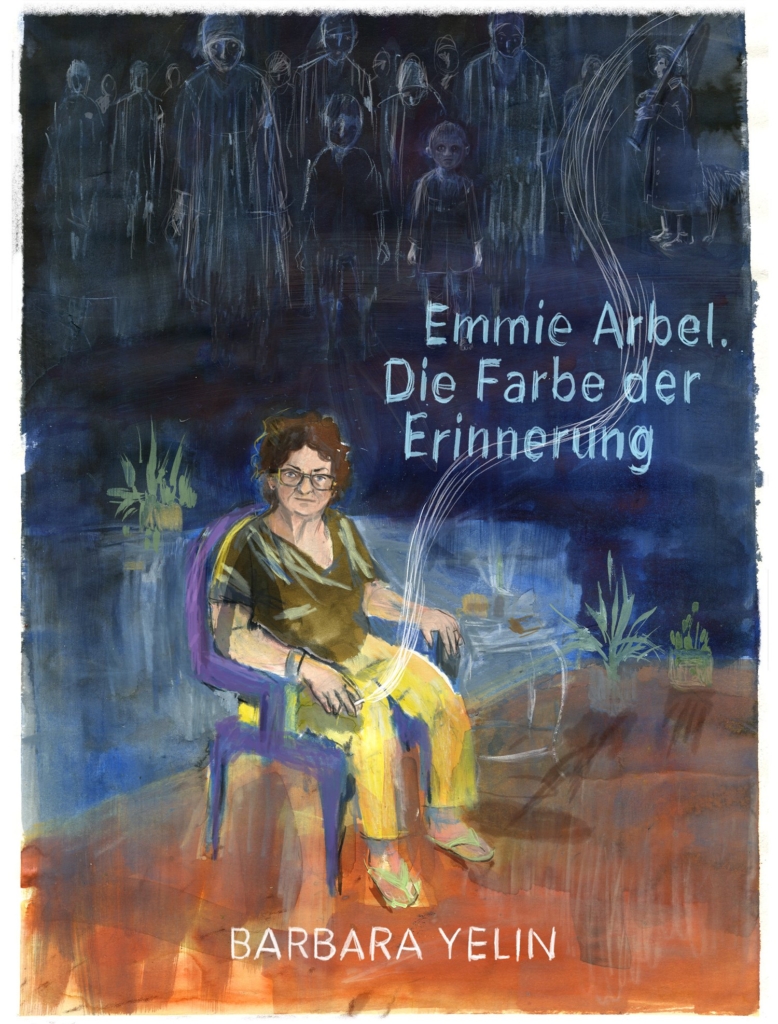
On July 22, Survivor-Centred Visual Narratives (SCVN) Research Assistant Lucie Kotesovska met with Barbara Yelin, an internationally acclaimed artist and author of several book-length visual narratives who was part of the original Partnership Development Grant‘Narrative Art & Visual Storytelling In Holocaust & Human Rights Education’. This grant produced the graphic narrative But I Live: Three Stories of Child Survivors of the Holocaust, and sparked a five-year collaboration with survivor Emmie Arbel. In this interview, Barbara discusses the creation of her graphic novel, Emmie Arbel. The Colour of Memory, and reflects upon what has contributed to its notable critical acclaim and success with readers in several countries.
Lucie: In 2023, you published a graphic novel titled Emmie Arbel. The Colour of Memory. This book is an expansion of the story based on your conversations with Emmie, which was published in the 2022 collection But I Live. Since its release, The Colour of Memory has gained wide critical acclaim. It is now available in four languages. What do you think makes this book so well-received, and what factors might have contributed to its success?
Barbara: The most important factor is Emmie’s voice—her words and her story, which she told me so directly and frankly. These words connect not only with me but they get a direct connection to every reader. Then there’s everything she said without words: with silence, in the breaks between the words, or while smoking a cigarette…. While visually meeting her, her person, her character.
The second factor is me trying to transform all of that into a piece of narration within the format of a graphic novel and with its tools. This element is communicating in several layers, emotionally, and also unexpectedly with the reader.
Emmie’s story has a very strong connection with the present time. While it is, of course, located in the past, she is here today and she tells us about the connection between her memories and the present, and what this connection means to her. Our collaboration and my work was to make that accessible for the reader. Emmie’s story is very important from the historical point of view, and it is important to be heard because there are not many survivors alive anymore. Her voice also speaks for those who did not survive. It is an important voice.
Lucie: This leads me to my next question. In what ways was working on Emmie’s story special for you and different from your work on your other books? How has this collaboration between you and Emmie shaped and changed your approach to storytelling?
Barbara: It was the first time for me to speak directly with the person who told me her story—her childhood memories—in person. I didn’t only research her story in history books, or in archives, or in documents, or through other people who knew her. It was her herself. And she was so generous, giving me much of her time and of herself. She trusted me. I’m deeply grateful for that. Without this trust, the book would not have happened as it did.
It was a constant learning process to understand how strong and fragile Emmie is at the same time. For me personally, it was important to learn about how trauma forms, and how someone like Emmie is dealing with that until today. How violence of the perpetrators has consequences until today and, at the same time, how Emmie did succeed in not remaining a victim.
In this project I found out that drawing, and putting together images and sketches, is more than depicting a narration or depicting a story or depicting history. It is actually a process of memorizing.
We communicated, of course, with words, and Emmie told me her memories in many hours of conversations. After that—sometimes already during our conversations, but mostly after that—I tried to put what she told me into drawings. And by doing that, I found more questions. I understood that there was more to ask. And then I showed her the sketches and then I would ask her new questions. She could tell me, ‘This might be right like this. You can change it to be like this’, or ‘I do not remember that. Please ask the researchers. Ask the historians. They have to find out’. So, this kind of sketching was something that really enriched our dialogues and actually helped her memories become clearer.
Sometimes we included Charlotte [Schallié] or some of the historians on the team. So, it’s a mixture of ‘we’ and ‘I’. It’s a collective work. If we did not know, we had to decide. Maybe there was a memory gap or an empty space of memory or a traumatic space of memory. Sometimes, we tried to fill the gap with documentary knowledge that we could obtain from the historians. Other times, we actually left these… spaces transparently free and empty to show that there is something that is not catchable at the moment.
This was new ground. It changed my understanding not only of telling history or retelling history, but also of what to include in storytelling. This means anything that cannot be said in words but still needs to be shown to be there. The importance of showing what is absent and giving the space to it.
Lucie: We will get to the question of silence. But first, let me ask you another question. You described in detail your process of collaborating with Emmie on her story. How did this collaboration or collaborative relationship evolve? How did it change over time?
Barbara: There was a kind of a direct connection with Emmie from the beginning. And that worked both ways. We got to know each other better as we spent more time together, and a friendship began to grow. I think she knew she didn’t have to make anything lighter for me. She told me the difficult and sad things. But we could also speak about very normal things—we knew what kind of coffee the other liked to drink and things like that. It was important to spend time with each other, and it helped us during the long process.
And Emmie soon understood the medium of the graphic novel and its potential. She saw the results of my work, but she also listened to the reactions of others who read parts of the graphic novel before it was published. It was important for both of us to see what it does to the reader, and that her story gets a kind of accessibility to the reader. There were people deeply impressed by her story, telling her, ‘I didn’t know it like this before’, and that was important for her to trust the medium.
Emmie told me many times that some drawings of her weren’t accurate and she wanted me to change it—which I did. But she was absolutely generous in letting me decide about the dramaturgy—how I built the story and which parts I chose—and how I drew and told the heavy, traumatic memories. I learned that Emmie is someone who really knows about her limits. She told me when she wanted to have a break, she told me when she didn’t want something in the book, she let me know when something was missing, so I could absolutely rely on that. That was very helpful for me. She took on all responsibility for her side of the collaboration.
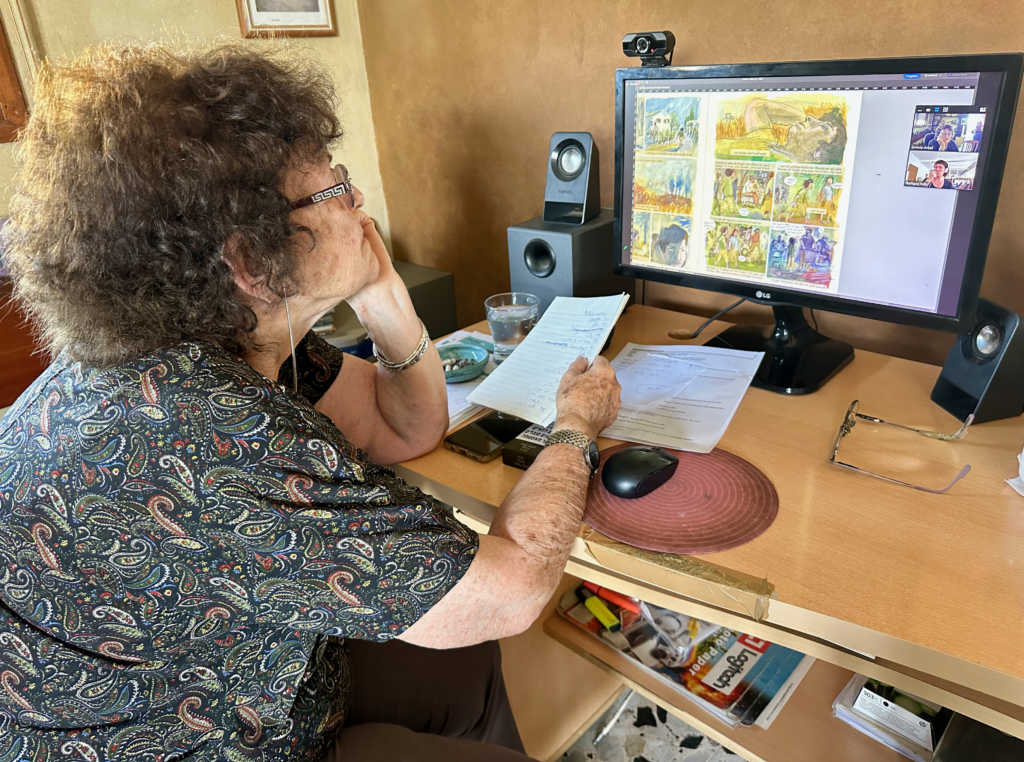
Emmie reviewing pages on Zoom with Barbara. Photo credit: Marion Reis.
Lucie: I notice that you even included these moments in the book when Emmie says, ‘Oh, I need a break’, and she turns to her computer. You made them an important part of the narrative.
Barbara: That was of course something that became relevant. I included these moments in the book because they are special. They were also important for the transparency of the narration and its documentary aspect.
I learned to be silent with Emmie. In the beginning, I remember, I often tried to fill the silence. But later, I did not do that anymore. Now, when I listen to the recordings, I heart it that we could actually be silent together for long minutes. This is even more special for me because normally I speak a lot! But with Emmie, we were able to be calm together.
Lucie: Speaking of silence, how do you work with it visually in the novel? I noticed that you incorporate it quite often. Sometimes, you even make it speak.
Barbara: Yes, I included the parts where Emmie would not speak or when she took a break. This is part of her testimony, and I found visual solutions to show that. There’s the panel, the square in the graphic novel. It is a kind of a frame. It might also hold a silent space. Like this, I can actually show silence, and we can see and feel that there’s silence in between words. I was also focusing on the rhythm of the words when I put parts of sentences in sequenced panels and then had a silent panel. We can, of course, listen to silence—in recordings, in movies, in documentaries. But I think that there is a special kind of significance in presenting it visually—the absence of words. Like this, I could really work with these renderings of silence. Another example: You have speech balloons in graphic novels, and normally you’d fill them with words, but you can also leave a speech balloon empty. It’s a way of showing that someone is not saying anything. And I could include silence in landscapes or in parts where we only see almost abstract forms. There’s nothing really to recognize, to identify, and still this drawing will ‘speak’ to you as a reader.
Lucie: Do you think that there were more moments like this in The Colour of Memory than in your previous visual stories?
Barbara: Yes. For example, I worked with almost black colour when Emmie told me what the colour of memory is. At first, it was a complete abstract drawing. I put black and blue colours on paper, and only afterwards I drew the face of Emmie digitally, her person surrounded by these shapes and forms of abstract colour. And then she speaks about humiliation, and we see that part by part her face, her expression gets invisible. In the end, we can see only the eyes. And only when she lights her cigarette is she visible again.
Page from Emmie Arbel. The Colour of Memory.
Lucie: In The Colour of Memory, Emmie speaks about some traumatic events in her life perhaps for the first time outside of her therapist’s office. You mentioned how she became open and shared things that are not light with you. Could you reflect on some of the challenges of this sharing for you? How did you take care of yourself during this process?
Barbara: When I met Emmie, she had already been working with her memories. She had a ten-year-long therapy in the middle of her life and had been speaking publicly about her memories and about history for decades. I was absolutely not the first one who listened to her, and I was not the first one who asked questions. I’m not an expert in psychology, I’m neither an academic expert in psychology, nor a historian, nor a trauma expert, so I tried to do my best there. I learned about oral history and how to ask questions without going too quick or too far, without doing any damage with my questions, and how not to retraumatize the other person. Then I found out that Emmie knew perfectly what she was doing—when she needed a break, when she did not want to answer, and what she told me in private. And still, of course, it was a very sensitive work that we did together.
Sometimes we cried—sometimes she cried, sometimes me…. I learned that this is part of the work… To memorize, to remember, is work. It’s memory work, like Charlotte said.
I did not only have to learn how much Emmie was affected by everything, but also that it affected me to listen to her story. I needed breaks, and I needed to reflect upon what she told me, and it brought up emotions. Sometimes we had to stop. Sometimes I was very exhausted. Sometimes, of course, she was very exhausted. So, I learned that this is part of this work.
On the other hand, I always wanted to find a way to create narration about her. We had always this book in sight as our future outcome. We had a mission. So we pushed through, and I learned about myself that I need a good balance between listening and really being open there, and then again to keep more distance and take time to process things.
I was glad that I had partners during this process like Charlotte Schallié. I could speak with her. I could speak also with Emmie and Charlotte, the three of us. There were some points when this was necessary. I had a historian, an expert, Alexander Korb and also Andrea Löw, who were amazingly helpful with details about the Holocaust.
I had Matthias Heyl, head of the Education Department at the Ravensbrück Memorial. He is the person who knows Emmie best, and the other way around, she knows him very well. So, it was collaborative work because there were many, many people who also had the interest to bring Emmie’s story into this graphic novel and who helped me. And there were Emmie’s daughters, who also took part in this dialogue several times and who could also read the graphic novel before we published it.
I had trauma experts, I had also my editor from my publishing house, who was helping me with the specifics of the graphic novel. It was a complex dialogue involving many people. I’m truly grateful. I could never have done this work without this support, and I think none of us could have done it without each other.
Lucie: Both But I Live and The Colour of Memory have been published with the support of the Survivor-Centred Visual Narratives project. How did the project help you more specifically as you worked on the two publications? And is there anything that might have been done differently in order to support you better?
Barbara: I think it was an amazing and special support from the start. We all worked on it together. I say ‘together’ now, but Charlotte and her team had already been working on this before I became part of the project. There was a conference at the beginning, even before I had the first longer conversations with Emmie, where I could meet historians and show them my initial approaches. That was incredibly supportive, helpful, and important. So, there was a lot of work done around us, which was very necessary.
And there were other aspects that I especially appreciate: connecting art and research. That is something I am incredibly interested in. What is historical research and what is artistic research? I’m not really sure if ‘artistic’ is the right word—art-related research. Sometimes, these two are actually similar, and it was mind-blowing to understand that and realize that we are enriching each other’s work.
Lucie: Do you feel that this realization is something that the project enabled?
Barbara: Absolutely. The project enabled that, and it also enabled the survivor-centred aspect—the understanding that the survivors do not work for a historical project, but it is the historians and the artists who work to understand the perspective of people like Emmie better.
It was already fixed in the contract that it would be always Emmie’s story, and if Emmie did not agree with what was happening with this graphic novel, then it wouldn’t be published. To really understand who owns the story was an important question that Charlotte asked us. Now we have not only the graphic novel, but there is also a new archive of all the conversations between Emmie and me, the archive of all the documents and all the sources we found and collected.
Who owns that? Who is the owner? Is it the university? Is it the artist? Is it the reader? Or is it Emmie in the end? Or is it the collective? There is no answer. I think the best answer would be Emmie, but it was collaborative work. So, absolutely, that widened my understanding of who’s owning a story. It is important to understand that storytelling is not a work of a solo genius of the past, mostly male, who owns the story. Storytelling like this is a collaborative work. This insight is something that I was really profiting from. In this sense, this project was successful the entire time. It’s not comparable to any other project I know.
And now, the project is expanding, producing more stories from different perspectives, from different times, and for more genocides. That is a truly deep approach.
Lucie: Let’s talk about the exhibition, or a series of exhibitions, based on But I Live that you helped to curate. How important was it for you to be able to take part in this process? Did you feel that you were able to communicate some aspects of Emmie’s story more clearly or effectively in this way?
Barbara: I was very glad that we could do the exhibition. I suggested it to the Comicsalon festival, and I asked Jakob Hoffmann to be my partner during the curation of it. I was strongly interested in showing the project not only as the result, but also in the process of development. We showed sketches, which are not in the book, sources, documents, and the original works, which you do not get to see as a reader of the book. These original paintings included Miriam’s wonderful aquarelles, or my multi-layered dark drawings, or Gilad’s amazing work that was partly analog and partly digital.
Photos from the exhibition at the Bergen-Belsen Memorial, May 11–June 30, 2025.Photo credit:Marion Reis.
Like in the book, we approached the story through all these parts of a memory puzzle. For me, it’s always like a kind of puzzle. You have pieces, and you show these pieces, and there are empty spaces. There are missing parts, and you can be sure that the visitor or the reader will do something with their own concept and imagination to fill these gaps or to think about these gaps. We showed it for the first time in 2022 in Erlangen, for the International Comics Festival, and it was so successful that they wanted the exhibition to travel. So, in the end, we had six locations including the Bergen-Belsen Memorial and the Ravensbrück Memorial. I was glad to accompany the exhibition to most of these locations and to bring the exhibition to these important places of learning about history, but also to locations like Erika Fuchs House, which is a museum specialized in comics, and to confront their visitors with the topic of the Holocaust. It got very positive resonance, and again, it grew out of collaboration with many different people in all these locations.
Photos from the exhibition at the RavensbrückMemorial, April 13 to July 31, 2024.Photo credit:Eberhard Schorr.
Lucie: Last question for you. After the two books and the series of exhibitions, where do you think your steps will lead you now? What are your next plans?
Barbara: I just finished, some months ago, another biographical graphic novel, but it was much shorter this time. It tells the interesting life of Terese Giehse, an actress who lived in Munich. She had to flee the Nazis. She was Jewish and a very politically involved and strong woman. She came back after the war. Another biographical work, which was very interesting. Afterwards, I also felt strongly that I want to take a break and not to go on with further biographical works because repetition is not good. I want to approach history again with a fresh view.
But there will be a new book, and I want to work still with documentary material and do research, but this time I want to focus on present times. I also want to learn more about how I can connect words and images together in a new way. How can I embrace more artistic ways to do that, or poetic ways, or experimental ways? That is something that will always interest me.
SCVN is grateful to Barbara Yelin for her generous time and dedication, both in sharing this insightful conversation with us and in co-creating the phenomenal Emmie Arbel. The Colour of Memory. You can find more information about her project work here.
On November 5, University of Victoria students Ananiah Bartsch and Lily Schaefer interviewed Survivor-Centred Visual Narratives (SCVN) research assistant Lucie Kotesovska. The interview took place online and was conducted as part of a practicum for HUMA 180: Encountering Humanities Research, one of the three courses that make up UVic’s Humanities Scholars program. This is the fourth time SCVN has had the pleasure of welcoming practicum students from HUMA 180. In this interview Lucie reflects on her involvement in the project, the realities of working with difficult stories, and the lessons she learned from her work as a research assistant.
Ananiah: We’ll just start with an easy question. Lucie, how did you become involved with this project and with Charlotte’s work?
Lucie: I was hired in summer 2024 as a research assistant for the project, and it happened through my home department, which is the English department at UVic. My official role was media communication and administration assistant. I think the team was specifically looking for somebody with strong editing and communication skills. They were seeking somebody to help them with the textual production and presentation of the project in textual terms. I was hired as a research assistant on these terms. Besides being an English major, I also had quite a rich previous experience with academic and professional writing, editing, copy editing, reviewing texts and translating. I forgot to mention that my first language is Czech, it’s not English. I’ve been moving between languages my whole life and it’s been a great passion and source of joy for me to be tinkering with words and learning new words and growing into new languages.
Lily: What drew you to the work of this project?
Lucie: That’s a great question. As I said, I’m passionate about working with and through the written and spoken word. That’s my primary tool in exploring the world and making sense of it for myself and others. So, to have this chance to pursue that passion and bring use to a large project was very attractive and meaningful to me.
Second, I was really excited about working as a part of a team, and supporting the team. I have to say that my PhD work was really lonely. It was quite an isolating experience because for a couple of years you’re just focused on this very niche area or super-specific subject. For me it was Irish poetry from the 1960s up to now. You start to miss human connection during this extensive research and writing project. Even though, of course you are connected with the selected poets quite deeply and intimately, but still … It’s natural for us as human beings, and also as humanists, to connect with people. So, I started to really, really miss that kind of interaction. And this was something which I found as a member of the project and this team. What also drew me to this teamwork was the appreciation of all kinds of talents and levels of expertise. The SCVN project hires junior researchers who just entered the field. So, there are team members like you and then senior researchers, professional scholars, who work in the field of trauma, genocide, history, human rights and so on. There’s this vast scale of various abilities and experiences. So, the team aspect was really a huge plus for me.
And third, I could sense a very strong humanistic mission in this project. You probably talked about the 4 pillars of the humanities mission at UVic in HUMA 180?
“Enrich human dignity” is the first one. And that’s very obvious with this project because of its focus on the survivors. It most emphatically contributes to making us feel and appreciate human dignity, especially in places and times when it was tread upon.
“Provoke critical inquiry” is the second pillar. This project has consistently critiqued some of the traditional scholarly approaches to history and memory. It has brought a new perspective, and a new medium because it is primarily visually oriented.
“Engaging myriad voices” the third pillar, is a very fitting one, because this project over a couple of years of its existence, has become global. Starting with Holocaust research, it has now spread to former Yugoslavia, Rwanda, Turtle Island and also Syria and Iraq. It comprises several research clusters while engaging many people globally – researchers, journalists, community members, and artists.
And there’s the fourth pillar, “inspire innovative expression, including the full plurality of media”. This project is really a great example of that. Searching for new ways to communicate messages and research to the wide public, not just the academic community, but to the public worldwide, to people of various generations and ages and milieus.
And I should not forget about the fourth reason that drew me to the project. I felt I could keep learning new things while being a part of it. That was a big one for me as well. I could just keep learning, and I was continually encouraged to do so as I was getting new tasks beyond my initial contract, but we’ll probably talk about that a bit later on.
Ananiah: You’ve touched on this briefly already, but what did your work, and what has your work entailed with the project? You’ve been working on a bunch of things, so could you tell us a little bit about what that’s looked like?
Lucie: As I said, it entailed various tasks, both short- and long-term ones. I think my major initial contribution and something I’m quite proud of still was the editing of transcripts from two webinar series which were organised by the project and the Public Humanities Hub at the UBC as a joint initiative. These were two series of talks with scholars, artists, journalists, and other professionals on the topics of trauma-informed research and art and testimony.
And my main goal was to make these webinars accessible through these transcriptions. These texts were posted online, and I tried to make their formats standardized across all the different episodes, speakers and topics.
Another major undertaking was working with students from HUMA 180 last academic year. Last fall, I was tasked with onboarding three HUMA students and with training them in transcribing while sharing my experience and some of the best practices. They each picked a webinar and transcribed the whole episode which is a substantial amount of work. Beside the transcription, they edited it all through making sure that all the names were spelled correctly, and all the places were correctly identified. It was a wonderful way of sharing what I learned on the project.
I also created content for the project’s blog. I wrote blog posts covering various events like exhibitions and upcoming talks, award ceremonies for artists on the project, film releases, and other things as well. I updated content for three of the project’s research clusters: Rwanda cluster, Holocaust cluster, and former Yugoslavia cluster.
It was my first time tinkering with website design. Speaking of learning things, I was really thrown into deep water here, but I enjoyed it immensely.
Ananiah: You wore all the hats!
Lily: Jack of all trades.
Lucie: Yes! Forrest Gump; that’s what I would say, Forrest Gump. But Jennifer Sauter, my supervisor, would say no, no, it’s like – think about it more like a Swiss knife: versatile and excellent in all circumstances.
Lily: What was something you found difficult while participating in the project?
Lucie: Sometimes it was prioritising, as I was often assigned several tasks at the same time. For instance, I felt very reluctant to break the blog-writing rhythm in order to go and fill in a travel reimbursement form or go and copy edit somebody else’s work, somebody else’s style while drafting my text. As a graduate student, I was constantly busy with other things as well. I tried my best to juggle several jobs at the same time. While I was working on this project as a research assistant, I was hired as a teaching assistant in the English department, and also as a tutor by the Academic Skills Centre, and during this whole time I kept working on my dissertation. Plus, I had a couple of kids at home.
Also, speaking of difficulty, I think it’s quite obviously the sheer amount of human suffering you face working through various materials and media across the project. It’s even more difficult given the fact that violence and social division and victimisation keep going on and on in the world. I’m not the only one saying this regarding work on this project. This is an issue that I notice every team member has to deal with. Historically speaking, we live in a very difficult moment for our world right now. There seems to be no end to the trauma inflicted. Working on this project makes you painfully aware of this fact.
Ananiah: Lucie, how is it that you take care of yourself when you’re involved in a project that has so much human suffering? How are you looking after yourself to make sure that you were not being crushed or consumed by the weight of the project?
Lucie: That’s such an important question. I talked to people on the project about this and it helped sharing these concerns. We were advised to take breaks from the materials, like those transcriptions. We are speaking of dozens of pages of text on very heavy things. We were encouraged to take breaks and talk to other team members or stop working for a week or two in order to process the feelings that were coming up as we needed to. I would say this is also something that I’ve been asking myself as a literary scholar for a long time, because I focus on Irish poetry that was written during the time of The Troubles in the second half of the 20th century.
You’ve probably heard about this conflict in Northern Ireland. It was a very violent one, tearing up families and communities. It is still hard for me to believe that it went on in Europe during my childhood years. So I’ve been thinking a lot about this question and honestly, I came to the conclusion that while we can never completely escape these traumas, personal, generational or cultural ones and stay unharmed, it’s essential that we learn to be aware of our feelings, and also learn to be responsible for the way we handle them; how we express them as well as whether and how we communicate them further.
As I mentioned, I grew up in the Czech Republic in a culture which, as a heritage of the forty years of Communist regime, was emotionally repressive to say the least. I realized this fact only years later in my early adulthood.
To compensate for this, I actively made efforts to learn to feel–not just feel, because this is the part that comes to us naturally–but to be able to notice these feelings, to describe them to myself, label them, and express them safely and, when I am lucky, creatively. Literature has been a tremendous help in this sense. Being a literary scholar, I have been able to see what is going on inside other people and how they handle their emotions. It is not an exaggeration to say that literature helps us stay sane and stay alive.
I’m trying now to share this vocabulary I learned with my kids. For example, we read books on this topic together. One of our favourites is called In My Heart and it’s about a girl naming her emotions and has beautiful illustrations that help children explore big feelings such as anger or sadness. It will say “I’m angry,” and explain visually what that means. I also plan to teach emotional literacy in one of my courses in spring, in the English department.
For me, this is an essential skill for us as human beings, because we’re connected through and in the heart. So, coming back to your question, I think that this emotional self-awareness has helped me greatly when I was dealing with this sensitive and almost soul-crushing material. Another thing has been helpful besides taking long walks in Victoria, which is a great, great town for solitary walks, and that’s reading. While engaged on the project, I did some reading that was really helpful to me.
I’ll mention just one title. I’m reading it right now, actually. I realised early on that there’s a link between my work on the project and how I felt about it, and this reading. The title of the book is Saved from Sacrifice: A Theology of the Cross and was written by S. Mark Heim.
It has helped me to understand the sacrificial mechanism in practically all human civilizations, and also, how truly transformational and revolutionary it is when the victim can find a voice or can be given the voice and also has a name and is remembered through their narrative.
Lily: Self-documentation.
Lucie: Yes, right. And this is exactly what the project has been trying to do all along. So yes, reading also helped me. I’m sorry if this answer was a bit long.
Ananiah: No, no, no, I appreciate it.
Lucie: Just to conclude, I think emotional awareness and self-awareness are super important. That’s the key. As I said, we cannot be safe from harm, [it will happen] probably just by living.
Ananiah: Yeah. Thank you. I appreciate that answer.
Lucie: Thank you for asking these questions. This topic is so important, and it resonates with people, but is not always communicated sufficiently and adequately. And we don’t realise sometimes, entering humanities especially, how big is the part of our own existence and experience we bring in.
Lily: Can you tell us about a moment or memory, positive or negative, that stands out to you?
Lucie: I have a great memory of the interview I did with a German artist, Barbara Yelin. Just to give you some quick information on who Barbara Yelin is and how she’s connected to the project–she did an interview with Emmie Arbel, a child Holocaust survivor, and from this interview came a story titled “But I Live” which was published in 2022. And then she developed this story, which was originally about 40 pages long, into a book-length line visual narratives, titled The Colour of Memory. Emmy Arbel. I interviewed with her in July for the project blog… We talked about the various techniques she uses and the philosophy behind her art. And we also talked about her relationship with Emmie and how it evolved and how in turn this evolution affected Barbara’s approach to visual storytelling. For me, it was really fascinating to listen to how she talked about the limits of verbal expression and verbal memory, about moments where only our body knows the truth of what happened to us. We sometimes lack words to talk about these things, and we might be resisting them because we don’t want to go in there. But something or someone makes us visit them. So how do you do that? How do you recreate it in pictures when you don’t have the words? These questions were immensely interesting.
Barbara said that sometimes she had only colour to work with, she didn’t even have the shapes. That was really fascinating. And there was a moment when she talked about Emmie’s face fading from the page in the book. It was the moment when Emmy tried to remember, I think, the last moment with her mom.
Emmie’s face is fading from the picture. It is lost in this painful remembering, and the visual panel or square is only blue and black. That is all there is on the page. And at that time, Barbara was on the screen because we were on Zoom, and she herself almost became just the mouth and the eyes. And it was dark because it was noon in Victoria and late evening in Munich where she was.
And moments like this would always bring home the essential truth of the project regarding connecting as human beings. It is the undeniable and universal fact that our dignity grows and flourishes through connection, through cultivating relationships, and through genuine curiosity in one another. And, on the contrary, it is endangered and destroyed when these connections are broken as happens in wars and conflicts of all kinds. So that is still my favourite and fond memory.
Ananiah: What is a lesson or an idea that you learned from this project that you’ve carried forward in your career?
Lucie: I would like to mention two things I learned while working on the project. First, I came to feel that there’s hope for humanities in the world today. As long as they are willing to embrace new ways of research, engage new voices, and provide testimonies to untold stories. And the second thing: I believe there’s some hope for humanity in the world today as well. There’s ongoing violence and conflicts escalating all over the world, all around the globe. At the same time, there are distinct voices heard that clearly understand the cost and the damage that’s being done and that’s affecting whole generations. And I think this project is a voice of this hope. It’s a voice that promotes survivors’ and also personal and interpersonal healing.
Ananiah: Thank you, I appreciate that. A lot of the narratives in the world are counter to hope, so I appreciate that insight and that perspective.
Lucie: So true. Yeah, I know. Sometimes it seems like a lost cause altogether. Doing this kind of work, doing this research, and being in the humanities. So many people will be dissuading you, and challenging you and doubting you, but it’s so immensely important, because we’re now wielding various technologies, but who’s going to reflect upon this development? Who’s going to draw the bigger picture here? Humanities bring this wholeness in terms of contextualizing things, and that’s so important. That’s the only way we can really restore hope and faith in anything. So, yeah. Thank you guys for your great questions. I really enjoyed reflecting upon my time on this project. It’s been quite exceptional.
Ananiah: Absolutely. Thank you. Thank you so much. It has been so wonderful to hear from you. And again, I appreciate you making the time with your busy schedule and your international excursions.
SCVN would like to thank Ananiah and Lily for their work planning, conducting, and transcribing this interview. Our blog post about last year’s HUMA 180 practicum can be found here.
On September 26, pages from Tobi Dahmen’s graphic novel Al-Faẓia’ – The Horror: Surviving Syria’s Prisons were included in a one-day scientific experiment in visual journalism. Al-Faẓia’ is about survivor Akram Al Saud’s experiences as a prisoner of the totalitarian Assad regime, and the experiment presented students with panels from his story to review. The experiment, called ‘Voer Voor Je Feed’ (Food For Your Feed), was organized by Winnifred Wijnker and Yael de Haan, researchers at Hogeschool Utrecht, for the 2025 Betweter Festival. Its goal was to understand how young people’s experience of reading the news changed when the stories were presented in the form of comics. Over one hundred people participated in the experiment.
Pages from Al-Faẓia’ used in the experiment. Photo credit: Tobi Dahmen.
The Betweter Festival is a one-day event that celebrates science and art through a mix of presentations, interviews, film screenings, musical performances, interactive scientific experiments, and more. The festival has been held annually at TivoliVredenburg since 2016.
More information about this year’s festival can be found at the Betweter Festival website.
Photos of students from the event reviewing the graphic narratives and pages from Al-Faẓia’. Photo credit: Winnifred Wijnker.
After a successful four-month run at the Kunsthaus Wiesbaden under the title ‘I will not be silent! Drawn Memories in Comics’, curator Jakob Hoffmann’s exhibit is now featured at the Turm zur Katz in Konstanz as ‘Zeitzeichnen. Comic & Erinnerung’ (Drawing Time. Comic & Memory).
For this exhibit, Jakob Hoffmann has brought together internationally acclaimed, award-winning artists Tobi Dahmen, Nora Krug, Birgit Weyhe, and Hannah Brinkmann, all of whom ‘shed light on history through graphic storytelling’. The exhibit features original drawings, sketches, interviews, and research materials from the development of their graphic narratives.
Three of the four artists—Tobi, Nora, and Birgit—are collaborating on upcoming graphic novels with our Survivor-Centred Visual Narratives project. While Nora and Birgit are not presenting work associated with the SCVN project, Tobi’s collaboration with the Iraq/Syria Research Cluster is featured, showcasing panels from Al-Faẓia’ – The Horror: Surviving Syria’s Prisons. It tells the story of Akram Al Saud’s experiences as a prisoner of the totalitarian Assad regime. Al-Faẓia’ will be published by Carlsen Verlag in June, 2026 and University of Toronto Press in fall 2026.
Left: Panels from all artists, title translation: ‘Violence and its representation: What can one endure?’ Right: Panels from Al-Faẓia’. Photo credit: Torben Nuding.
The exhibit opened on November 6 with a panel discussion between Jakob Hoffmann, Birgit Weyhe, and renowned literary and cultural scholar Prof. Dr. Aleida Assmann. Then, on November 16, Birgit Weyhe sat down with Holocaust survivor Ernst Grube to discuss her book Time Heals No Wounds: The Life of Ernst Grube.
Photos from opening night, which included a panel discussion followed by a book signing and viewing of the exhibit. Photo credit: Torben Nuding.
‘Zeitzeichnen. Comic & Erinnerung’ will be open until March 15, 2026. Turm zur Katz offers free public tours on the first Sunday of every month. For more details about the exhibit, visit their website here.
To read about the exhibit’s run at the Kunsthaus Wiesbaden, follow the link to our blog post.
We are pleased to announce that both Barbara Yelin and Emmie Arbel have been awarded the prestigious “Against Forgetting – For Democracy” prize for 2025 by Gegen Vergessen – Für Demokratie e. V. (Against Forgetting – For Democracy). The prize honours their collaborative work on the graphic novel Emmie Arbel. The Colour of Memory.
The award recognizes individuals, initiatives, and/or projects whose outstanding work aligns with the association’s goals of developing appropriate forms of engagement with the past and/or right-wing extremism, and clearly demonstrating democratic values.
Barbara Yelin is being honoured for her artistic achievement and Emmie Arbel for her courage in revisiting and sharing her memories through a four-year creative collaboration. The recognition of this work underlines the power of graphic storytelling in keeping memory alive and fostering democratic awareness.
The award jury, chaired by former President of the Federal Constitutional Court Andreas Voßkuhle, shared this statement as part of the reasons for awarding Barbara and Emmie the prize:
“Barbara Yelin’s drawings convey history vividly and accessibly, in a way that text alone could not. At the same time, they do justice to the multifaceted nature of Arbel’s biography. 80 years after the end of the war, the book thus speaks to people of very different generations.”
Thank you to Gegen Vergessen – Für Demokratie e. V. for this recognition and congratulations to Barbara Yelin and Emmie Arbel for this well-deserved honour. The award ceremony will take place on 22 November 2025 in Berlin. Stay tuned for further updates!
Barbara YelinEmmie Arbel
Find more information on Against Forgetting – For Democracy e.V.’s website here.
We are delighted to announce that graphic artist Barbara Yelin is the winner of the 2025 annual Grand Prize of the German Academy for Children’s and Young Adult Literature (Deutsche Akademie für Kinder- und Jugendliteratur), granted in recognition for outstanding achievements in children and young adult literature.
Barbara Yelin
Grand Prize poster from the German Academy for Children’s and Young Adult Literature (Deutsche Akademie für Kinder- und Jugendliteratur), and Barbara Yelin. Photo credit: Martin Friedrich.
The award highlights her “multifaceted storytelling in the medium of comics – in drawing, dialogue and narrative text” and recognizes the culmination of her SCVN collaboration with Holocaust survivor Emmie Arbel in their initial graphic narrative, ‘But I Live’ and the expanded collaboration ‘Emmie Arbel. The Colour of Memory’.
Through translation, the academy outlines Barbara’s achievements as:
[Her] exceptional gift for biographical storytelling shines through once again – her keen powers of observation, her empathetic approach, and her richly atmospheric imagery. In addition to her artistic talent, Yelin is distinguished, among other things, by her profound social understanding and civic engagement.
Thus, she not only champions biographical remembrance work but also engages in art projects against the exploitation of refugees, antisemitism, hatred, and racism. With her artwork, Yelin makes unseen life stories and tragic events visible to us all.
The award ceremony will take place on November 21st, 2025 in Volkach, Germany, facilitated by Dr. Winfried Bausback on behalf of the Bavarian State Ministry for Science and Art.
Exciting news! Author Duncan McCue and illustrator Mangeshig Pawis-Steckley, from our Turtle Island Cluster, are collaborating with Professor Éléonore Goldberg and Alan Goldman of Emily Carr University of Art + Design—along with their student researchers—to explore how the graphic novel Indians Do Cry can be brought to life through animation. Éléonore has been accepted as a SSHRC Co-applicant on the SCVN project and connected with Duncan on October 28, when he travelled from Ottawa to Vancouver to meet with the local Emily Carr team and Mangeshig. The animation project is still in its early stages, but stay tuned for more on this creative partnership which blends Indigenous storytelling with cutting-edge visual arts.
Students in consultation with Éléonore, Alan, Duncan and Mangeshig (left) and Alan, Mangeshig and Éléonore touring the university (right). Photo credit: Duncan McCue and Asad Aftab.
Survivor-Centred Visual Narratives (SCVN) proudly announces a significant milestone in the project: the signing of a publishing deal with Swift Water Books for Indians Do Cry: A Father-Son Hockey Story. The graphic novel has come out of a partnership between Anishinaabe journalist Duncan McCue and acclaimed artist Joshua Mangeshig Pawis-Steckley, in collaboration with residential school survivor George Kenny and his son Mike Auksi.
This powerful narrative, part of SCVN’s Turtle Island Research Cluster, tells the true story of George and his son Mike, members of the Lac Seul First Nation, and their journey of healing through the lens of hockey and the intergenerational impacts of Indian residential schools.
Two Pages from Indians Do Cry, image credit: Joshua Mageshig Pawis-Steckley.
Indians Do Cry is set for release in Fall 2027. The book explores the profound effects of residential school on George, who was taken from his family at age seven to attend Pelican Lake Indian Residential School in northern Ontario. Hockey became his refuge during those challenging years, offering an outlet for his endurance and spirit. His son Mike faced the ripple effects of intergenerational trauma but found strength in his own hockey journey, eventually playing for the Estonian national team and pursuing a doctoral degree at McGill University. Through their father-son relationship, Indians Do Cry weaves a story of survivance and reconciliation, framed as a sports memoir to resonate with Canada’s hockey-loving audience.
Funded in part by a $57,900 Canada Council for the Arts grant, the project has expanded to over 140 pages, allowing Duncan and Mangeshig to deepen their storytelling through extensive research, interviews, and artwork.
Duncan, known for his work as a CBC journalist and storyteller, began researching the project in Winter 2023, collaborating closely with George and Mike to ensure a survivor-centered approach. “This story is about more than hockey—it’s about survival, healing, and the strength of family ties,” Duncan said. “I’m grateful to partner with Mangeshig and Swift Water Books to share this journey with readers.”
George Kenny, preliminary drawing by Mangeshig Pawis-Steckley, December 2024.
Mangeshig, whose vibrant illustrations have earned accolades in children’s literature, including the Ruth and Sylvia Schwartz Children’s Book Award, brings his distinctive Woodland art style to the project. “Illustrating Indians Do Cry is a deeply personal endeavor,” Mangeshig said. “I’m excited to work with Duncan to visually capture this story of hockey and hope, rooted in our Anishinaabe heritage.”
“Swift Water Books is excited and proud to be publishing this important work,” said David Robertson, an award-winning Cree author and editorial director of Swift Water Books. “Carrying power in its storytelling, in both the realities of intergenerational trauma and the path to healing, Indians Do Cry embodies the spirit that Swift Water strives to share with readers across Turtle Island.”
Swift Water Books, launched in February 2025 under the leadership of Robertson, is dedicated to publishing works by Indigenous writers and illustrators. Indians Do Cry joins a slate of highly anticipated titles set to debut in Spring 2026, reinforcing the imprint’s commitment to sharing authentic Indigenous stories with young readers and beyond.
Dr. Charlotte Schallié, director of the SCVN project, added that “this publishing agreement with Swift Water Books ensures George and Mike’s story will reach a wide audience, fostering empathy and understanding about the impacts of residential schools.”
As this landmark production continues, SCVN invites readers to follow updates on the Turtle Island Research Cluster page.
About Swift Water Books Swift Water Books, an imprint of Tundra Book Group at Penguin Random House Canada, is dedicated to publishing children’s books by Indigenous writers and illustrators. Led by acclaimed author David A. Robertson, the imprint aims to share stories that foster healing, cultural revitalization, and connection for readers of all ages across Turtle Island.
About the Authors Duncan McCue is an Anishinaabe journalist, professor at Carleton University, and co-lead of the Turtle Island Research Cluster. He is the recipient of a Canada Council for the Arts grant for Indians Do Cry.
Joshua Mangeshig Pawis-Steckley is an Anishinaabe multi-disciplinary artist and member of Wasauksing First Nation. His award-winning illustrations, rooted in the Woodland art style, have appeared in numerous acclaimed children’s books, including Mii maanda ezhi-gkendmaanh / This Is How I Know and Boozhoo! / Hello!.
George Kenny is an Anishinaabe poet and playwright from the Lac Seul First Nation who learned traditional ways from his parents before being sent to residential school in 1958. George’s first book, Indians Don’t Cry, was published in 1982, and has been hailed as a landmark in Indigenous literature. He is also a former journalist and editor at Wawatay News. George lives in Thunder Bay, Ontario.
Mike Auksi is a doctoral candidate at McGill University’s Department of Kinesiology and Physical Health. His study on ice hockey in his home community of Lac Seul First Nation is a perfect complement to the graphic novel, Indians Do Cry. Mike also works as a research assistant with the Turtle Island Research Cluster.