Survivor-Centred Visual Narratives

Year: 2025

‘Community Engagement and Intercultural Sensitivity: Ethics, Design and Practice’ – Panel and workshop with Rwanda Research Cluster

On October 13, the Scottish Graduate School for Arts & Humanities hosted a panel and workshop featuring members of SCVN’s Rwanda Research Cluster titled ‘Community Engagement and Intercultural Sensitivity: Ethics, Design and Practice’. It was led by Dr. Fransiska Louwagie and featured three speakers with backgrounds in ethnographic research: Drs. Anna Ball, Erin Jessee, and María Soledad Montañez. The full day event included an online panel in the morning and an in-person workshop in the afternoon, hosted at the Sir Duncan Rice Library at the University of Aberdeen.

The panel focused on how community engagement is an increasingly important academic practice, offering insightful pathways to both the impactful dissemination and collaborative creation of new knowledge.

Anna Ball introducing the morning panel session. Photo credit: Fransiska Louwagie.

It explored the questions: how can we ensure that engagement practices are sensitive to the cultural identities, practices and beliefs of those within the communities with which we work? And how can we design community engagement practices that enhance understanding, dialogue and agency across perceived differences, in ethical ways?

Following the panel, the workshop invited the speakers to share their experiences with safeguarding, consent, positionality, trauma-informed practice and participant agency. They examined what interculturally sensitive community engagement looks like in terms of research design, ethics and practice. They also focused on the use of listening as a methodology for community engagement of various styles, with lessons from academic experts in intercultural fieldwork with varied communities, including survivors of the Rwandan genocide and people navigating the asylum system.

Thank you to the Scottish Graduate School for Arts & Humanities and University of Aberdeen for hosting the panel and workshop.

From left to right: Rwanda Research Cluster Co-Leads Fransiska Louwagie and Erin Jessee, with Advanced Research Fellow, Anna Ball. Photo credit: Fransiska Louwagie.

For more information about the event: https://tockify.com/sgsah/detail/355/1760349600000

Interview with Miriam Libicki for the GraphicMemoirBlog: The art of translating Holocaust survivor stories into comics

In September 2025, Jonathan Sandler, host of the GraphicMemoirBlog and author of The English GI (2022), interviewed SCVN graphic artist Miriam Libicki in a blog feature titled ‘A Conversation with Miriam Libicki: WWII Graphic Memoirs’. They discussed her previous SCVN collaboration with Barbara Yelin, Gilad Seliktar, and Dr. Charlotte Schallié in But I Live: Three Stories of Child Survivors of the Holocaust (2022), and her forthcoming publication Two Roses: A Story of Deception and Determination in Nazi Germany (2026).

Jonathan and Miriam discussed the ways in which graphic novels can be used as research and storytelling tools for Holocaust education and to honour the voices of survivors. As Jonathan highlighted, Miriam worked from transcripts and shaped narratives that stay faithful to the survivors’ words, such as David Schaffer, where “every word in that book is his… the story is his voice.” Through comics, the stories convey information about survivor experiences while providing a safe and supportive learning environment.

In this interview, Miriam also shared her experience working closely with Holocaust survivors and the impact of the narratives on her art, describing her collaborations as “transformative.” To her, David’s story felt like “something out of dark fairy tales”, leading her to develop a watercolour style that would “evoke the living, threatening natural world.”

Inspired by early 20th-century children’s illustrations, she used watercolours “to set apart from the monochrome charcoal styles often associated with Holocaust art.” The illustrations in her SCVN graphic narratives also reflect different influences, ranging from Will Eisner to Japanese manga and Canadian comics, that supported her journey in both projects.

In her narratives, she has been drawn to first-person stories and particular points of view, and believes:

Comics are a powerful tool for empathy. Even if you disagree, you can still be compelled by the perspective.

Thank you to Jonathan for interviewing with Miriam and sharing insights into her artistic process and collaboration with SCVN!

Read the full interview here.

The Wiener Library hosts film premiere of ‘Why We Dance’ and panel with Research Cluster Co-Leads – Oct 23, 2025

On October 23, SCVN’s project partner the Wiener Library is hosting a talk to explore how graphic novels have proven to be a powerful medium for sharing stories of the Holocaust and other genocides and mass atrocities.  

A panel discussion will reveal those lessons are currently being applied in the creation of new survivor-centered graphic novels about the Holocaust and the 1994 genocide against the Tutsi in Rwanda.

Drawing on the expertise of three of the SCVN’s Research Cluster Co-Leads, Dr. Erin Jesse, Dr. Fransiska Louwagie and Dr. Alexander Korb, the talk will showcase the potential of the graphic novel medium to portray survivor stories. The researchers will discuss how the project works with artists and survivors to create new educational approaches.

The evening will include the public premiere of our short film, ‘Why We Dance’, that has been made by filmmaker Marc Ellison about the team’s current co-creative work with Rwandan genocide survivor Jerome Irankunda and graphic novelist Michel Kichka (the son of a Holocaust survivor).

Event Details
Venue: The Wiener Holocaust Library (London, UK)
Date: October 23, 2025
Time: 6:00pm – 8:00pm (GMT+1)

Visit the Weiner Holocaust Library main website for more information and registration:
https://wienerholocaustlibrary.org/event/project-talk-why-comics-telling-survivor-stories-through-graphic-novels

Trailer of ‘Why We Dance’:

‘Why We Dance’ – New trailer from Rwanda Research Cluster

The trailer for the upcoming documentary short film, ‘Why We Dance’, has just been released and is available to view on the SCVN YouTube channel. Filmed and directed by Marc Ellison, it features conversations between Jerome Irankunda, a survivor of the 1994 genocide against the Tutsi in Rwanda, and Michel Kichka, an artist who is currently creating a graphic novel about Jerome’s life and experiences during and after the genocide. The film shows the trust that develops between Michel and Jerome as they discuss Jerome’s experience fleeing his home town when he was only six. Now a community leader and educator, Jerome also speaks about the ordinary acts of resistance that he hopes define his life and will influence the life of his children.

For more information about Jerome and Michel’s collaboration, please visit our Rwanda Research Cluster page. Our SCVN YouTube channel also has more details about the trailer and upcoming film:

Filming with Yezidi Survivor for Iraq Documentary – July 2025

After thoughtful consideration, our Yezidi survivor Jilan (not her real name), decided to participate anonymously in the documentary film about her collaboration with the graphic artist, Birgit Weyhe. The filming took place on July 1 and 2 and Filmmaker Olaf Markmann and Research Consultant Leyla Ferman coordinated and outlined a filming schedule. The first day started with Birgit’s art studio in Hamburg to focus on the process and partnership between graphic novelist Birgit and the Yezidi survivor. The second day was filmed at our project partner, the Bergen-Belsen Memorial site, as it serves as a place of remembrance (see below).


Filming at the Bergen-Belsen Memorial on July 2, 2025. Photo credit: Kjell Anderson.

The challenge was to respect the anonymity of the Yezidi survivor while simultaneously achieving a sense of closeness to the subject and the broader community. The approach to filming included scenes filmed in closed and open spaces, reflecting this duality.

In addition to Olaf and Leyla, Research Cluster Co-Lead, Kjell Anderson joined for off-camera interviews with the survivor, to help us to better understand their experiences and potentially be included in the project archive. 

Filming at the Bergen-Belsen Memorial (top left) and at Birgit’s studio in Hamburg (top right & bottom) and team photo of Leyla Ferman, Birgit Weyhe and Kjell Anderson in July, 2025. Photo credit: Kjell Anderson and Elif Eker.

Learn more about the collaboration and Jilan’s story on the Iraq Research Cluster Page.

In Loving Memory of David Schaffer (1931 – 2025)

David Schaffer z”l

It is with deep sadness that we acknowledge the passing of David Schaffer z”l —devoted husband of Sidi, beloved father of Nathan, Doron, and Ayal, and proud grandfather of Joelle, Dalia, Aaron, Jacob, Paulina, Naomi, Madison, Zachary, and Joshua. Our heartfelt condolences go out to his entire family.


David Schaffer at the first in-person meeting with Miriam Libicki and Dr. Charlotte Schallié, at the Emily Carr University of Art + Design on January 2, 2020. Photo credit: Dr. Charlotte Schallié

We had the honour of getting to know David through the international educational project Narrative Art and Visual Storytelling in Holocaust and Human Rights Education (https://holocaustgraphicnovels.uvic.ca/), led by the University of Victoria and supported by the Social Sciences and Humanities Research Council Canada (SSHRC). One of the most significant outcomes of this project is the now acclaimed collection of graphic novels But I Live: Three Stories of Child Survivors of the Holocaust—a collaborative work between three graphic novelists and four Holocaust survivors. David’s story, A Kind of Resistance, was created in partnership with graphic artist Miriam Libicki. Since its publication in 2022, the book has received five international awards, six award nominations, and wide critical recognition. It has inspired exhibitions and educational programs in both Europe and North America, and its German edition, Aber ich lebe: Vier Kinder überleben den Holocaust, is now available through Germany’s Federal Agency for Civic Education (Bundesamt für politische Bildung). This important recognition ensures that stories like David’s will continue to reach new audiences and deepen understanding of the Holocaust.

When David was first invited to join the project, he hesitated. Although a respected member of the Vancouver Holocaust Education Centre’s survivor community, he had never publicly shared his story as a child survivor. He worried that his experiences might be too many to fit the tight timeframes of traditional survivor presentations.

As we learned more from David about his and his family’s survival, we were introduced to the complex and often overlooked history of Romania and Romanian-occupied Transnistria, with its devastating impact on the local Jews and Roma. His story was filled with nuance and detail, and it took time to fully grasp its depth. But David, with great patience and extraordinary precision, helped us understand—carefully guiding us through the many layers of his experience.

What ultimately convinced him to share his testimony was the realization that the fate of Romanian Jews deported to Transnistria was still largely unknown to the wider public. Through this project, David saw a unique opportunity to educate and raise awareness on an international level.

After David and Miriam’s first meetings in early 2020, they were not able to meet face-to-face again until the book launch. They collaborated through emails, where David was always eager to receive the pages in process, but the most meaningful conversations took place over the phone. Miriam shared her progress sketches with him, and he went page by page, clarifying scenes and giving Miriam additional background information and new context for the stories. A dark joke he made about a Jewish girl in hiding with David’s family having a German name was from one of these informal phone calls and made it into the comic. Another one of Miriam’s fondest memories from these conversations, which did not end up in the book, was a chat they had on the evening of Passover 2020. He recollected that forming bricks and mortar out of straw, mud and debris, as the Israelites are described doing in the Seder, was something his family resorted to in the forests of Transnistria when bartering anything they could to survive.

Over time, through countless meetings, phone calls, rounds of edits, and the exchange of photos and documents, our collaboration with David grew into something profoundly personal and deeply meaningful. Beyond learning about his and his family’s history, we came to know David himself: thoughtful, generous, principled, kind, and deeply human. In the truest sense of the word, David was a Mensch.

David was sharp and diligent, with a brilliant, analytical mind and remarkable memory. His clarity and precision helped shape the vivid illustrations in the novel. One memory stands out: his moving description of the mind-numbing hunger he experienced as a child survivor, likened to the constant grinding of a flour mill—an image Miriam captured powerfully in the book.

One of Charlotte’s most cherished memories is David’s meticulous attention to detail, and his engineering-calibrated brain that ensured that all representations of vehicles in his graphic novel were accurately drawn, and distances between locations on a map were properly measured and acknowledged. (He repeatedly challenged our cartographer!) Only later did it become clear to us that David retroactively asserted control over events that must have seemed completely unpredictable and overwhelming during the Holocaust.

Despite the weight of his story, moments of joy and humour were never far. We fondly remember the laughter when someone pointed out that he still had the same mischievous smile as in a photo of himself at age six—a smile that revealed a playful spirit that David, thankfully, had never lost.

Above all, David had a huge heart. He spoke often and with deep affection about his family—his beloved wife Sidi, a talented artist, his sons and their spouses, and his nine grandchildren. His love and pride for them were tangible and beautifully portrayed in Chorong Kim’s short documentary about his life, which offered rare and intimate glimpses into the world he built after surviving the Holocaust (If We Had Followed the Rules, I Wouldn’t Be Here).

Words fall short in expressing what an honour and blessing it was to know David. His courage, generosity, and unshakable trust in life have left a lasting impact. His story lives on—in print, in memory, and in all those he touched.

With deepest gratitude and immense respect. May his memory be for a blessing.

Dr. Ilona Shulman Spaar, past VHEC Education Director, Vancouver BC, Canada
Miriam Libicki, Graphic Novelist, Vancouver BC, Canada
Dr. Charlotte Schallié, Project Lead, Narrative Art and Visual Storytelling in Holocaust and Human Rights Education, Victoria BC, Canada

Drawing on History: An Interview with Rwanda Research Cluster artists Michel Kichka and Joëlle Epée Mandengue

This interview introduces Michel Kichka and Joëlle Epée Mandengue, the two artists working on the survivor-centered graphic novels within the Rwanda Research Cluster of the SCVN project. In April 2025, they met online for a conversation facilitated by Dr. Anna Ball, an Advanced Research Fellow supporting the Rwanda team based at the University of Aberdeen. Together, they discussed their experiences of working on the project so far; how they are grappling with the weight of history and of their responsibility to the survivors’ experiences they are representing; as well as the personal and professional journeys that have guided them to this work.

Joëlle Epée Mandengue is a Cameroonian comic book artist based in Guinea Conakry. Working under the penname of ‘Elyon’s’, she is the author of the successful series, The Diary of Ebene Duta, and a number of comic works describing, with humour and a pinch of tragedy, slices of the lives of black characters who are living in other territories and experiencing different cultures. She is also the creator and director of the Bilili BD comic festival in Congo Brazzaville, which has branched out to other countries across the African continent, including Rwanda. Joëlle is working with an anonymous survivor of the 1994 genocide against the Tutsi in Rwanda, who was a mother to several young children at the time of the genocide. In its wake, she became the mother of several more orphaned nephews and nieces, who are also represented in the graphic novel.

Michel Kichka is an Israeli graphic novelist of Belgian origin based in Jerusalem, where he studied graphic design and taught at the Bezalel Academy of Fine Arts until his retirement in 2025. Alongside a longstanding international career as political cartoonist and member of Cartooning for Peace, he is the author of several graphic novels, including Second Generation: The Things I Didn’t Tell My Father, about his experience as the son of a Holocaust survivor. Michel is working with genocide survivor Jerome Irankunda, who was just six years old when the 1994 genocide against the Tutsi overwhelmed Rwanda. Michel’s work is also supported by the contributions of Jerome’s wife, Nina Uwera.

Anna: The project that you are working on is concerned with representing the stories of survivors of the 1994 genocide against the Tutsi through the graphic novel form. But I would like to begin by understanding a little more about your own personal histories, and what brought you to find your voice in graphic novels.

Michel: I was born in Belgium 70 years ago to a family of Holocaust survivors. My father lost all his family and was in different camps for three years and survived. And my mother’s family were refugees in Switzerland, but originally they had all come from Poland. My grandparents had emigrated from Poland after the First World War because for the Jewish population the situation there was worse than anywhere else in Europe.

I was born with a talent for drawing. My father wanted to be an artist, and he was very talented, but he was arrested when he was 16 and liberated when he was 19 from the camps in Buchenwald, so he could not accomplish his dream to be an artist. But I could, because I was a baby boomer born after the Second World War. And I was born in Belgium: a kingdom of comics. Here, I grew up on the classic Franco-Belgian comics: Tintin; The Smurfs… These were my heroes when I was a kid. And this is what I wanted to do, and I knew it from the age of six.

In 1986, I first read Art Spiegelman’s graphic novel, Maus. He won the Pulitzer Prize for this work, and it was the first time this had been awarded to a comic. The work was also unique in its way of addressing adult readers, not kids. It was not funny, and there were no heroes. That was real life. I remember when I first read Maus the positive shock that I had. I said to myself – well, if he did it, it means that it’s possible to tell people about your life in comics.


Michel Kichka (Photo credit: Elie Max Kichka).

Joëlle: I was also passionate about comics from a very tender age. I was born in Cameroon, and I grew up there. My parents used to tell me that I was already so caught up with animated features when I was something like four or six months old. You know, for people of African descent, it can be very painful to comb the hair. So, I would sit and watch animations while I had my hair braided, and I would be completely numb to what was going on around me. I knew from a very, very young age that I wanted to tell stories, and to convey messages through drawings. So, I made my first comic book at the age of 7 and even learned how to sew the book together when I was 9. And from then on, I pursued that dream.

I grew up as the first born in my family and as the only girl, it was really difficult for my parents to admit that this could be my full-time job. Both of them were like, “why can’t you find, you know, a decent job?” They both worked in banking and finance. So, I took my degree in English and French, and after that, started working in a French cultural centre. I had to show my family that I could earn money and be independent. But also, I could not miss out on my dream. And so, when I reached the age of 25, a bell really rang in my head, and I realized it’d been a quarter of a century in which I’d done things that were not my core passion in life. I told my parents that I wanted to spend the rest of my life messing it up on my own terms and conditions.

So that’s when I went to study Fine and Graphic Arts in Belgium. And after that, I started to get some jobs, and my parents saw that I could be paid $300 per page as a comic artist. I was invited for a residency in the Caribbean. And so, at that point, my parents told me that I had their blessing because I’d proven to them that there was not just one way of succeeding. And this was really a milestone in my quest as an artist. It has helped me a lot to know that I can dream big and I have my family behind me.

Joëlle Epée Mandengue – Elyon’s (Photo credit: Joëlle Epée Mandengue – Elyon’s)

Michel: I also had a moment when I realized that I needed to take my life in my hands. When I was 19, I decided to emigrate, and I moved from Belgium to Israel. I understood at this age that being born talented is not enough. I needed to study and develop my skills to improve what I had learned by copying comics as a child. So, I was admitted to the Art School of Jerusalem. And I’ve been teaching illustration and comics for 40 years in the same academy in which I studied.

Anna: I’m interested to learn more about your decision to get involved in this project. Neither of you are from Rwanda, yet you have both made a significant commitment to grapple with its history through the stories of survivors of the 1994 genocide against the Tutsi. How do you relate to the content and context of these stories?

Michel: I was invited to Rwanda four years ago by the Israeli Embassy for the commemoration of World Holocaust Day on 27th January.

The Rwandans I met were asking me a lot of questions about the Holocaust because they had a very deep need for their genocide against the Tutsi to be known, to be written about, to have creation around it. And I felt that my personal experience offered something.

So, when this project was proposed to me, it was like a call. I knew very little about Rwandan history, but I can see the connections. And now that Tutsi and Hutu are living together, they are both part of their reconciliation program. There is much to learn at this moment. So, the fact that this project is now on the table is something very special.

Joëlle: My own relationship to this project has obviously been very different from Michel’s. But I have other issues that connect me to it – like the fact that Cameroon has had the same president since I was born. As Cameroonians, we have a history of colonial violence and postcolonial pressure that are still denied. We have archives that we still don’t have access to.

There is a huge part of our hurtful memories that we don’t have access to. I’ve been growing up as a Cameroonian by birth, but my culture is not at peace with its past. So, working on a project like this, where a country is looking at the horror of its past, facing it, trying to work from it, trying to build from it, is really something that resonates at a personal level for me too.

But I feel my link to Rwanda in another way, too. When I was living in Congo, we used to fly with RwandAir to Cameroon, Douala, where I am originally from and where my parents were living. And when I was travelling on these planes, I was flabbergasted, overwhelmed by the quality of the service. I’m really uncomfortable in planes, but these were wonderful. And the Head of Staff began to notice me because I was among the regular clients on that line. So we’d get chatting. And at one point I summoned up the courage to ask one of the Stewards – what happened after 1994? You guys seem like you are thriving. I read about how you’re aiming to be the Singapore of Africa. So our discussions started. And it was that Air Steward who gave me so many stories about what Rwanda is as a society – how complex it is. He explained the difficulties of, you know, having a crush on a girl, then discovering that girl is from the family that murdered your neighbour. How will you reconcile that? I was fascinated. So, when Fransiska wrote to me and asked me to consider embarking on this journey, I didn’t even know how to express it in words. Having the right to work on this project really meant a lot to me.

But I am also aware I’m not from Rwanda. There are so many things I won’t be able to understand. We are all Africans, but we have varied histories. I talked with Erin and Fransiska about this – wondering if I am legitimate enough to work on this subject. But what has really given me peace and focus is the fact that I also have my own unique lens that I bring to the project, as a foreigner – someone who has not had to live that history for 30 years. And it is the following thing that was really emphasized about the project by Fransiska and Erin.

This project is about building dialogue across cultures, and how we search for understanding by connecting with others, as well as through our own experiences.

Anna: What has it been like working with the survivors on this project? What have been the most challenging and enriching aspects of this collaborative process?

Joëlle: The person I am working with was already an adult at the time of the 1994 genocide against the Tutsi. And when I first started to encounter her stories, it was really brutal. Watching documentaries, reading materials on the subject, going to a memorial is something; but having this encounter with her was something else.

During our interviews, we were working with her son, who was also the translator, creating a linguistic triangle in our conversation. That time of translation was very difficult to handle for me because my mind had to process the information that it just got. Then you are awaiting the next translation, and you have this silence where you’re facing the survivor. So, you can have this physical connection in the presence of the survivor, but then there are spaces of disconnection in which you are left to process the deep, horrible information. So, one day during the interview, I asked for permission to digest the information, and I felt really guilty for this. I felt – this is her life; her memory; she went through it. But in this case, it’s the artist who needs a break.

Yet at the same time, I felt really privileged to have this access to things that are so traumatic, but that still need to be told for history not to repeat itself.

Michel: I identify with lots of things that you have just said, Joëlle. You know, Jerome, when you meet him, you can’t understand what he has passed through. He’s so optimistic and full of life and action and positive thinking. And this is the lesson that I would like the reader to learn: how he has rebuilt himself.

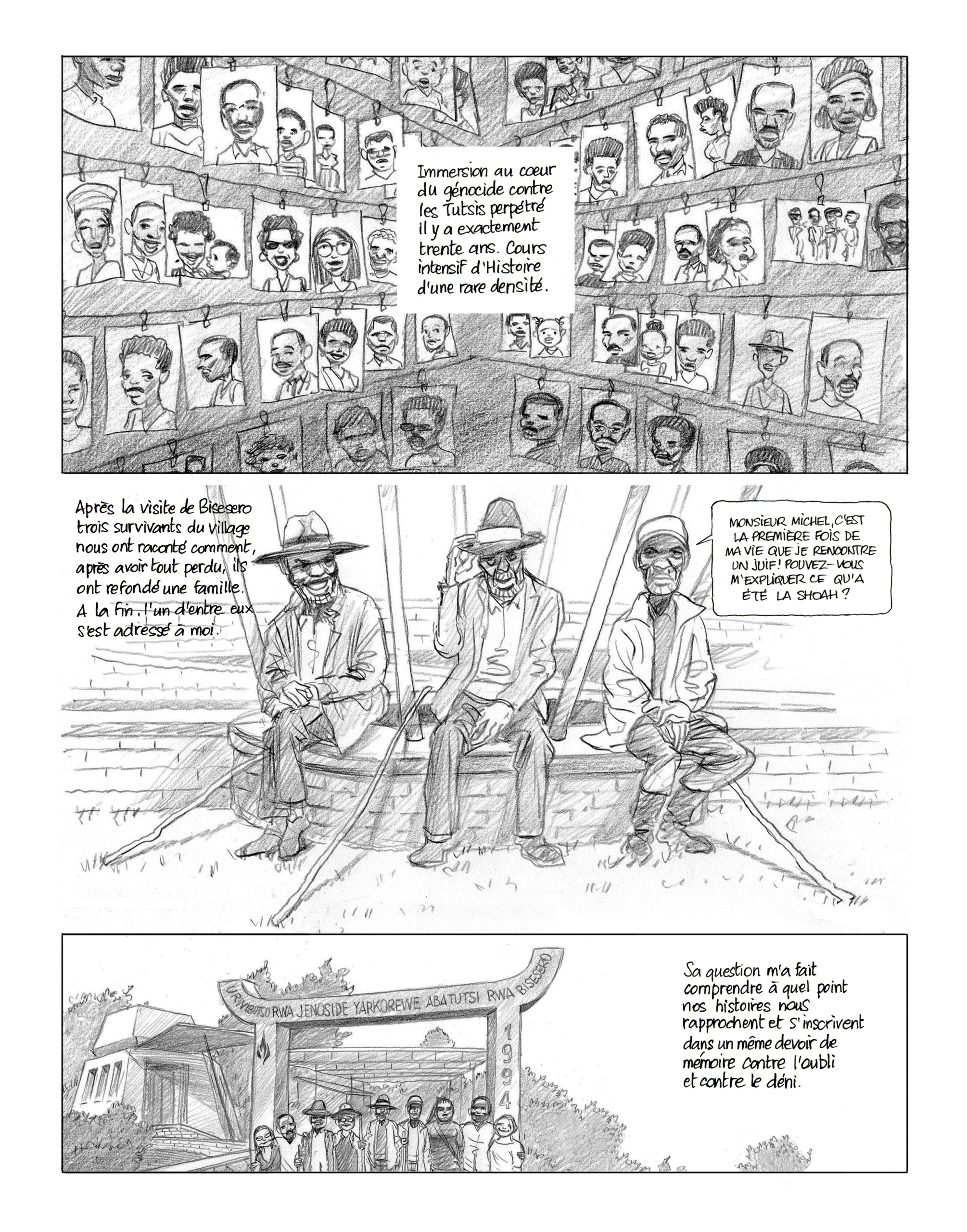
A challenging aspect of working on Jerome’s story is that there are a lot of things in his history that have no visual references. They were all lost. You know, when I visited the memorial in Kigali, there’s a room where photographs are hung, like clothes. Jerome told me he goes there very often to look at the photos because people who find documents bring them to the memorial, and he wonders if one day he will find a photo of a man and woman who could be his own parents. So, during our interview, I asked a lot of questions about what the house was like, the village where he lived, how he dressed at school because he had no photos to show me.

Draft artwork by Michel Kichka, responding to the memorial in Kigali that he visited during his trip to Rwanda, and conversations he had with local Rwandans. Photo credit: Michel Kichka.

Anna: So far, you have both visited Rwanda and interviewed the survivors whose stories you are drawing. In these early stages of contemplating and developing the graphic novels, what ideas, images, and decisions are emerging for you?

Joëlle: So, in my head at the moment, there is this idea of the seed. The survivor with whom I am working has strong faith in God. I too am a Christian – and that gave me the idea of the seed in the Christian faith. We learn that Christ died, and he was buried and resurrected, and brought with him a new way of living. And this lady, she also created life, she had many children. So, there’s this image of the seed getting into the soil and producing a family tree. And that’s why, when we had our interviews, I sketched a tree. She really went through death and came back to life.

And it is also an image of what you produce from your suffering – because you could decide just to feel vengeful. You could fall into a depression. But you can also find a way for something to come of your suffering – to move from the seed to the tree. That is something that has really formed part of my translation of the survivor’s story. It’s also important from a Rwandan cultural point of view, as it highlights the role of the umuko tree. I am also exploring the way I can present graphic imagery, through the umuko flower. The heart shaped leaves, thorns, reddish flower, make the umuko tree a very special element that can be used all through the story.

Draft sketch by Joëlle Epée Mandengue – Elyon’s, showing the motif of the umuko flower that bears symbolic significance in her graphic novel. Photo credit: Joëlle Epée Mandengue – Elyon’s.

Michel: For me, personal history is the best way to access history. So, I find in Jerome’s narrative the possibility to tell people about a big history through his personal history, to better understand people who pass through deep traumas and to better understand humanity and probably themselves in the process. I don’t want to offer simply a lesson in history; I want to tell a personal life experience of someone real who exists.

Anna: It’s clear that both of you feel a tremendous sense of responsibility towards the people whose stories you are collaboratively creating, and to the graphic novels that are emerging because of this collaborative process. What do you hope your work will achieve?

Joëlle: I hope to bring my reader to see the many layers of history and experience there are within the story of my survivor. This is something I always work to create. On the surface, my drawings are very cute and nice, with lots of colours. When people come to my drawings, they do so thinking the work is light – but the more they really get into it, the more they realise this is just a way to get you closer to many more hidden layers. The idea is really to work through contrast. They may think they see the story in the drawings immediately, but they have deeper layers of messaging. There is much more beneath the surface.

Michel: It strikes me that there are many things we can learn from what has come after the 1994 genocide against the Tutsi. You know, Jerome was so young, he was six, when he found himself an orphan. He was brought up as a son by his uncle and aunt. And what is also very interesting is that when he went back to school, “artificial families” of people were created to support one another. It was part of the experience in the classroom. This reconciliation program is unique in the story of the world, and so this will be part of the story that I tell. It will emphasize the process of rebuilding resilience that has taken place in Rwanda.

Recently I saw the short video that Marc [Ellison] shot when we were in Belgium and in Rwanda [‘Why We Dance’]. And at the end of that film, he showed Jerome and his wife Nina dancing, and I watched it with a huge smile.

This is what I would like the reader to experience. I want to bring Jerome to life; I want to show that those who committed the genocide failed in ways that matter. This is the lesson I would like people to remember. 

Many thanks, Joëlle and Michel, for so generously sharing your time and experience with us. It will be wonderful to see how these thoughts emerge in your graphic novels.

To learn more about Joëlle and Michel’s ongoing collaborations with survivors in the Rwanda Research Cluster, check out their page here.
2025 Annual General Meeting in Amsterdam: Mobilizing Knowledge and Conceptualizing Public Engagement

Guest blog feature by Elissa Boghosian

On June 19 and 20, 2025, project partners from the NIOD Institute for War, Holocaust and Genocide Studies and the Iraq and Syria Research Cluster hosted a two-day Annual General Meeting (AGM) in Amsterdam for the Survivor-Centred Visual Narratives project. The AGM was preceded by a public event on June 18: ‘Visualizing Survivors’ Voices: How graphic novels strengthen historical understanding of witnesses’ experiences’. It featured a live reading of the forthcoming Al-Fazia –The Horror: Surviving Assad’s Prisons by Akram al-Saud and Tobi Dahmen with a panel discussion.

This year’s AGM convened eighteen Research Cluster Co-Leads, project partners and researchers from Canada, England, Germany, The Netherlands, Scotland, and Switzerland. The AGM focused on how the five Research Clusters can prepare to “go public” through the publication of their graphic novels and associated public engagement activities. Hosted at the Royal Netherlands Academy of the Arts and Sciences’ (KNAW) Trippenhuis, the AGM provided a forum for participants to consider cross-cluster collaboration opportunities, conceptualize public engagement, share research cluster progress from the last year, and contemplate milestones for the years ahead.

SCVN Annual General Meeting for Year 3: ‘Knowledge Mobilization’ at the Royal Netherlands Academy of the Arts and Sciences’ (KNAW) Trippenhuis. Photo credit: Jennifer Sauter.

Day 1 began with cross-cluster conversations. Each Research Cluster met on a rotating basis with the other clusters to explore connections between their work, share challenges, and consider how insights from other groups could inform their own approaches.

In the afternoon, a facilitated conversation with the Iraq and Syria Research Cluster led by Fransiska Louwagie invited reflection on the cluster’s experiences developing their graphic novels and their public trajectories. The day concluded with a discussion about project planning for 2025 and beyond, including archiving, long-term community engagement strategies, audience conceptualization, graphic novel publicity, and more. Each cluster contemplated these topics and developed preliminary timelines for Year 4 of the project.

Charlotte introducing the AGM: What does it mean to “go public”? (left) and Fransiska Louwagie leading a discussion with the Iraq and Syria Research Cluster’s Leyla Ferman, Kjell Anderson, Kees Ribbens and Uğur Ümit Üngör (right). Photo credit: Jennifer Sauter.

Day 2 started with presentations from four external speakers involved in the development and/or use of graphic novels about mass violence. Steven Stegers (Euroclio) spoke about using visual media in history teaching while Rob Verheijen (Hogeschool Arnhem Nijmegen) presented on using World War II and Holocaust graphic novels in Dutch history education.

Steven Stegers from Euroclio presenting (left) and Rob Verheijen (right + below) leading our team through a workshop engaging with a Holocaust comic for highschool students to identify characters as perpetrators, victims, helpers, bystanders and society.

Sabine Rutar, Franziska Zaugg and Erin Jessee. Photo credit: Jennifer Sauter.

Fransiska Louwagie, Andrea Webb, Shannon Leddy and Elissa Boghosian. Photo credit: Jennifer Sauter.

Following these presentations, Kees Ribbens moderated a conversation with Bas Kortholt (Kamp Westerbork) and Adriaan Baccaert (Kazerne Dossin) about the development and publication of Picturing the Unimaginable: Ten Comic Authors, Ten Stories about the Holocaust and other Nazi Crimes (see below). In addition to speaking about the graphic novel itself, Bas and Adriaan shared about the associated exhibition and other public engagement considerations from the project.

Adriaan Baccaert (Kazerne Dossin) far left, with Bas Kortholt (Kamp Westerbork) presenting, moderated by Kees Ribbens (right). Photo credit: Jennifer Sauter. Cover of Picturing the Unimaginable (right).

The program concluded with status update presentations from each Research Cluster, showcasing moving film trailers and artwork from their graphic novels. It was a formative moment for each Research Cluster to share their progress and journey since their initial gathering at our Year 1 AGM in Glasgow.

We would like to thank our hosts, project partners and all those who contributed to the fruitful discussions throughout the AGM in Amsterdam. We hope the program offered participants meaningful opportunities to learn, share, and connect, and that it laid a strong foundation for the next year of the Survivor-Centred Visual Narratives project.

Webinar and public debut of ‘Two Roses’: Arts Based Storytelling and the Holocaust – July 15, 2025

As noted above, on July 15, the Friends of Simon Wisenthal Center for Holocaust Studies will host a webinar titled “The ‘Two Roses’ Project: Arts-Based Storytelling and the Holocaust”, introducing the forthcoming graphic novel sharing the extraordinary story of Toronto-based Holocaust survivor Rose Lipszyc to the public.

The program will open with an introduction to the Survivor-Centred Visual Narratives project, highlighting its ethics of care framework that centres the voices, agency, and emotional well-being of Holocaust survivors. This will be followed by an overview of Two Roses, including a brief reflection on Rose Lipszyc’s biography and lived experience.

Miriam Libicki will then read selected pages from Two Roses and join Dr. Charlotte Schallié and Dr. Mark Celinscak in a conversation about their collaborative work with Rose. They will discuss the unique potential of comics to convey survivor testimony with emotional depth and visual impact.

The event will conclude with a Q&A session, during which we are honoured to invite Rose to take part in the discussion.

Many thanks to the Friends of Simon Wiesenthal Center for Holocaust Studies for coordinating and hosting this webinar.

To register for this virtual event, please click here.