The Turtle Island Research Cluster has completed filming their short documentary film, ‘Kokum Dorothy’s Story’, directed by Andy Rutter. The film features conversations between residential school survivor Dorothy (Sekan) Visser (nee Whiskeyjack, Cree) and Métis illustrator Natasha Donovan as they discuss their upcoming graphic novel, ‘We Can Still Sing and Dance: Kokum Dorothy’s Story.’ More information and photos from the filming can be found on UBC’s Pop Culture Cluster website here.
Natasha Donovan (Métis, left) showing Dorothy Visser (Cree, right) the final pages (May, 2025).Photo credit: Elizabeth Nijdam.
How Can Visual Narratives Disrupt Traditional Conceptions of Testimony?
From January to November 2024, the University of British Columbia’s Public Humanities Hub co-hosted the Art and Testimony webinar series with the University of Victoria’s Survivor-Centered Visual Narratives project. The series brought together researchers, artists, historians, non-profit directors and other professionals to discuss how different mediums of artistic production can function as a form of testimony.
Building on the conversations, practices, and resources shared during the six webinars, SCVN is excited to announce the Art and Testimony Toolkit based on the webinar series. The toolkit includes recordings and transcripts of each of the six webinars categorized by three thematic clusters: 1) Performance as Testimony; 2) Videotaped Interviews, Graphic Novels and Comics as Testimony; and 3) Teaching through Visual Testimony. The toolkit also includes notes, commentary, illustrations, references and quotes that complement each webinar.
The toolkit is available on the UBC Public Humanities Hub website here.
Art and Testimony Webinar Series
The webinar series explored a wide range of artistic forms from live performance to graphic novels to newspaper comics, the series sought to highlight the power of testimony to tell stories in a unique way. For instance, Dr. Henry “Hank” Greenspan in the webinar ‘Listening, Telling, Showing (and Back)’ underlines how he sought to resist the ‘conventional’ testimonial approach by engaging in dialogue rather than extraction. By returning to the same survivors over months and even years, Hank sought to reconnect and develop the survivors’ stories as they pieced together parts of their memories, often evolving their own narratives.
In a similar vein, several webinars touched on how drawn narratives leave space for imagination and creation, both for those giving the testimonies and the researchers working with them. Barbara Yelin’s collaboration with Holocaust survivor Emmie Arbel demonstrates how drawn narratives function as a tool for engaging with memories that defy easy articulation. Developed initially from just seven pages of notes, their book, Emmie Arbel: Die Farbe der Erinnerung, grew out of what they called “puzzle memory work,” where they sought to hold space for the linearity of memory.
The webinar series emphasized how visual narratives have the potential to disrupt traditional testimony collection practices, which often favour language over image. In response, the toolkit builds upon our expert speakers’ knowledge and resources, and suggests various visual mediums and approaches to arts-based research methodologies for understanding survivor experiences.
SCVN would like to extend a warm thank you to all those who contributed to developing the toolkit. Special thanks to the author, Serikbolsyn Tastanbek; advisors, Heather Joan Tam, Jennifer Sauter, Charlotte Schallié, and Andrea Webb; technical support, Stanley Chia; illustrator, Raey Costain; and transcribers, Lucie Kotesovska, Kate Kristianson, Henri Jefferis, and Claire Fenton. The toolkit would have never come together without the hard work and dedication of the team.
To view the Art and Testimony Webinar Series, please click here.
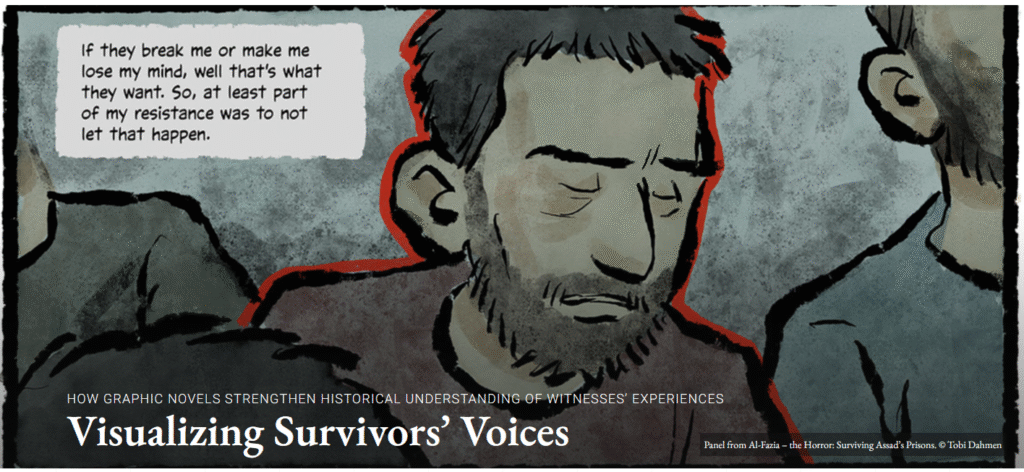
On Wednesday, June 18, the NIOD Institute for War, Holocaust and Genocide Studies hosted a public event at Spui25 in Amsterdam: “Visualizing Survivors’ Voices.” The event featured contributions from Dr. Charlotte Schallié and Dr. Andrea Webb, Co-Directors of the Survivor-Centred Visual Narratives (SCVN) project; graphic artist Tobi Dahmen; survivor of the Assad regime and the narrator of Dahmen’s forthcoming graphic novel, Akram Al Saud; and NIOD historians Dr. Kees Ribbens and Dr. Uğur Ümit Üngör. The event served as a prelude to the SCVN project’s two-day Annual General Meeting in Amsterdam.
At the heart of the public event was the question: How can graphic novels strengthen historical understanding of mass violence survivors’ experiences?
On the Trajectories of Graphic Novels
Kees opened the event with an overview of the evolving uses and public perceptions of graphic novels. He observed that, historically, “there has not always been a recognition of the power of comics”. However, from the late 20th century onward, there has been growing recognition of the medium’s capacity to convey the experiences of survivors of mass violence and human rights violations. Today, Kees offered, we are still realizing the potentials of graphic novels:
“In 2025, we are still discovering what serious graphic novels can express. We are still finding out how they open up new ways of historical understanding. We are still trying to figure out what interpretations, connections, and identifications readers derive from engaging with graphic novels, and also, we are trying to figure out where the limits of the medium’s possibilities actually lie.”
Kees Ribbens introduces the public panel event. Photo credit: Jennifer Sauter.
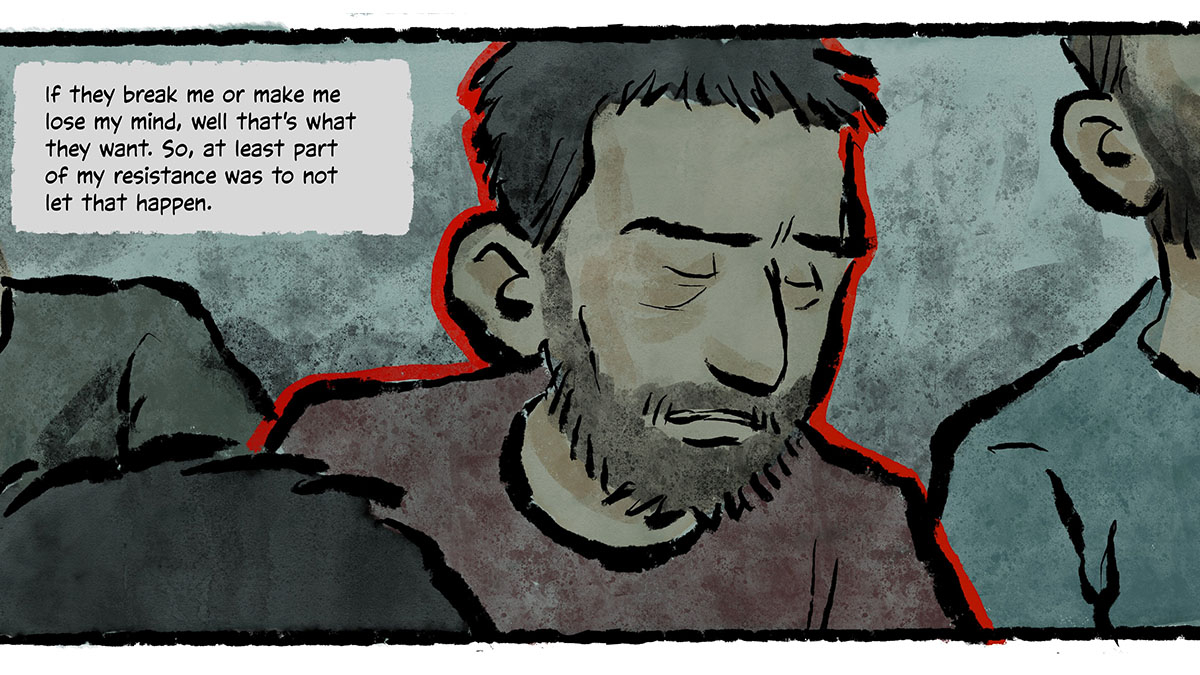
Public Reading: Al-Fazia – The Horror: Surviving Assad’s Prisons
Following the introduction, Akram and Tobi read from their forthcoming graphic novel Al-Fazia – The Horror: Surviving Assad’s Prisons. This reading marked the first time in the project’s history in which a survivor participated in a live reading, and it was the first such time for Akram as well. The moving presentation provided the audience with a glimpse into the manuscript that details Akram’s survival of Assad regime violence and the thoughtful collaboration between Akram and Tobi behind its visual retelling.
From the top left: Akram Al Saud and Tobi Dahmen read an excerpt from the graphic novel, Tobi sharing process sketches, panelists from left to right Charlotte Schallié, Tobi Dahmen, Akram al-Saud, Uğur Üngör, and Andrea Webb. Photo credit: Jennifer Sauter.
Deepening the Dialogue
The reading set the stage for a group discussion between Charlotte, Andrea, Uğur, Akram, and Tobi. The conversation initially focused on the relationship between Akram and Tobi in the graphic novel co-creation process. They reflected on questions such as: What does it mean for an artist and survivor to work together over an extended period of time? How did their creative partnership unfold? Why did Akram decide to share his story? And how did Tobi navigate artistic choices about depicting mass violence?
“What I appreciated in Tobi…[was] that he didn’t stand a distance from my story. No. He was trying most of the time to come closer, trying to, let’s say, collect the fragments.” – Akram
“I tried to get closer to the situation but always be aware that I could never totally depict an experience like that.” – Tobi
“It was a very caring process.” – Akram
Tobi Dahmen and Akram Al Saud in conversation on panel. Photo credit: Jennifer Sauter.
The second half of the conversation shifted to broader questions about the capacities and potentials of graphic novels about mass violence: How can a graphic novel hold the weight of genocide and mass violence? How can the medium be used to depict survivors’ experiences with care and complexity? And how can graphic novels serve as educational resources? Uğur spoke about the power of graphic novels to break through layers of silences surrounding mass violence. In the Syrian context, he identified three interconnected silences this graphic novel helped confront: 1) National silences enforced by over 50 years of violent authoritarian rule under the Assad regime; 2) Secrecy surrounding the prison system in particular; and 3) Personal silences, as few Syrians – inside or outside the country – had been invited to share their stories in such a public way.
Andrea described how graphic novels can activate student engagement with testimonies:
“When we talk to youth and in education, individual stories are powerful. We need to see the scale, but we also need to connect and give meaning for youth, and also prepare for a post-survivor world, so these testimonies are not lost.”
The discussion concluded with reflections on medium’s potential to elevate voices from the recent past that have often been left out of public discourse, offering meaningful and lasting contributions to education, memory, and, perhaps, justice. Following the formal ‘Question and Answer’, audience members continued to engage with the presenters and ask them questions during the event’s reception.
How can graphic novels help us to communicate and understand the past? How can survivors of violence and mass atrocities work in dialogue with graphic novel artists to interpret and record their experiences? How can we share these narratives in meaningful ways? These are some of the questions that will be discussed during the ‘Visualizing Survivor’s Voices’ panel hosted by the NIOD Institute for War, Holocaust and Genocide Studies at SPUI25 in Amsterdam on June 18.
This event will bring together witnesses, artists, and researchers to reflect upon the ways in which personal narratives of mass violence are recorded and shared by visual narratives. It will feature a diverse group of speakers, including Dr. Charlotte Schallié and Dr. Andrea Webb, co-directers of the SCVN project, graphic artist Tobi Dahmen, survivor of the Syrian regime and the narrator of Dahmen’s forthcoming graphic novel Akram al-Saud, and NIOD historians Dr. Kees Ribbens and Dr. Uğur Ümit Üngör.
From left to right: Jared Muralt, Franziska Zaugg, Sabine Rutar, Mirjam Janett, Béatrice Gysin, and Athena Grandis.
The Yugoslav Wars Research Cluster’s Drs. Franziska Zaugg and Sabine Rutar, with graphic artist Jared Muralt, are organizing a panel ‘Images as bridges: Graphic novels as a means of visualizing historical experiences of violence’ on July 9, 2025. This session is a part of the 7th Swiss History Days Conference taking place at the University of Lucerne from July 8 to July 11.
The Swiss Historical Society, the professional association of historians in Switzerland, organizes the Swiss History Days every three years at different locations. This congress brings together hundreds of historians from Switzerland and abroad, and is one of the largest symposia of its kind in Europe. The Swiss History Days invite all disciplines into the dialogue and attract young academics as well as internationally renowned history teachers and researchers.
The theme for this year’s conference is (In)visibility. This focus is predicated upon the fact that visuality is omnipresent in the 21st century. Its aesthetic, technical, and social conditions, and their impacts, require a fresh engagement with its historiographical classification and perspective. The panel proposed and chaired by Dr. Zaugg and Dr. Rutar aims to reflect upon the visualizing power and impact of graphic novels within historical context. Here is the description of the session:
“To this day, historical scholarship is primarily oriented towards written texts, both in terms of its sources and the research literature. With regard to epistemic and experienced violence, the question arises as to how this can be adequately discussed with students and colleagues. For several years now, graphic novels (also called “comics”) have offered a new approach. Art Spiegelman’s “Maus,” which is now considered an icon of this genre, marked the beginning of making history visible through images. Since then, the possible approaches to the history of violence through graphic novels have intensified. Examples include the works of Joe Sacco on besieged Sarajevo in the 1990s and Jacques Tardi on the First World War.
Our panel aims to address this issue by bringing historians and artists into discussion about how violence can be methodically and convincingly visualized in graphic novels. The following questions will be central: How do artists, contemporary witnesses, and historians work together? How does the spoken word—the narrated memory, but also the invisible aspect of epistemic violence—become a narrative in images and words? How does historical expertise enter this story? How does the artist succeed in narrating biographical information in such a way that the memory can be made visible and coherently embedded in a larger historical context? What role do archival sources, both written and, in particular, visual (photos, films), play in the creation of a science-based, artistically compelling graphic novel?”
The panel touches on the research fields of biographical narrative, the history of war and violence, memory studies, visual history, trauma research, and political and historical education.
We also look forward to their insights and experience working with graphic artists and survivors with the Yugoslav Wars Research Cluster.
For further information about the conference program, please click here.
For a more detailed description of the three presentations on this panel, please click here.
‘Images as bridges: Graphic novels as a means of visualizing historical experiences of violence’ July 9, 2025 3:45 – 5:15 p.m. CEST Seminarraum 3B48 University of Lucerne Conference program: https://geschichtstage.ch/frontend/index.php
The graphic novel being written by Gilad Seliktar about the survival of Klaus Zwilsky in the Jewish Hospital Berlin during the Second World War is nearing completion and is scheduled for publication in 2026 or early 2027. In conjunction with the SCVN project, Aubrey Pomerance, Head of Archives at the Jewish Museum Berlin, where the Zwilsky family collection is held, and Charlotte Schallié, Project Lead and Co-Director of the Survivor-Centred Visual Narratives Project, conducted two workshops with university students in the museum’s Academy Building on June 10, 2025.
Aubrey Pomerance presenting various archival materials from the Zwilsky Collection. (Photo credit: Charlotte Schallié.)
The first group came from the Center for Research on Antisemitism at the Technical University of Berlin, the students taking part in a seminar entitled “Emotions and Holocaust Studies.” Alongside a presentation of original materials from the Zwilsky Collection which provided a broad overview of the family’s life in Berlin and their survival at the Jewish Hospital, the students were shown documents and photographs pertaining to Edgar Lax, who in February 1939 at the age of 15 went with a Kindertransport from Berlin to the Netherlands and two months later on a further Kindertransport to England. A third presentation focused on ego documents from various collections from which a wide range of emotional expressions can be gleaned.
The second group of students came from the Free University of Berlin, where they were taking part in the seminar “Linien der Unterdrückung: Graphic Novels erzählen Geschichte” (Lines of Oppression: Graphic Novels Relate History). With this group, the focus was exclusively on the archival collection of the Zwilsky family. Following the presentation of the various archival materials by Aubrey and colleagues from the archives to both groups, Charlotte elucidated the Survivor-Centred Visual Narratives Project and her previous work with graphic novels, and presented numerous examples from Gilad’s work on the Zwilsky story. The presentations were followed by a lively discussion with the students.
Students shared the following reflections about the workshops:
“The workshop with Charlotte Schallié and Aubrey Pomerance was interesting and very informative. I would like to thank them for that. We were presented with an impressive and diverse collection of sources. The focus on family history and the use of first-person documents put the scale of the Holocaust into a perspective that is often lost in view of the magnitude of the event.”
“I have always seen graphic novels merely as a didactic opportunity […] However, it only became clear to me through the workshop that graphic novels are very well suited to adequately taking into account the complexity of memory processes that the Holocaust qua essence entails. And also the production [artistic creation] process, which requires an intensive [focus and] care but above all subjective attention and, in a way, tenderness.”
Thank you to Aubrey Pomerance, and our project partner the Jewish Museum Berlin, for hosting the archival student workshops this summer. We appreciate having in-person workshops for students to engage with the Zwilsky collection, learn about archiving, and gather insights into the process of creating an SCVN graphic novel.
Learn more about Klaus and Gilad’s collaboration here.
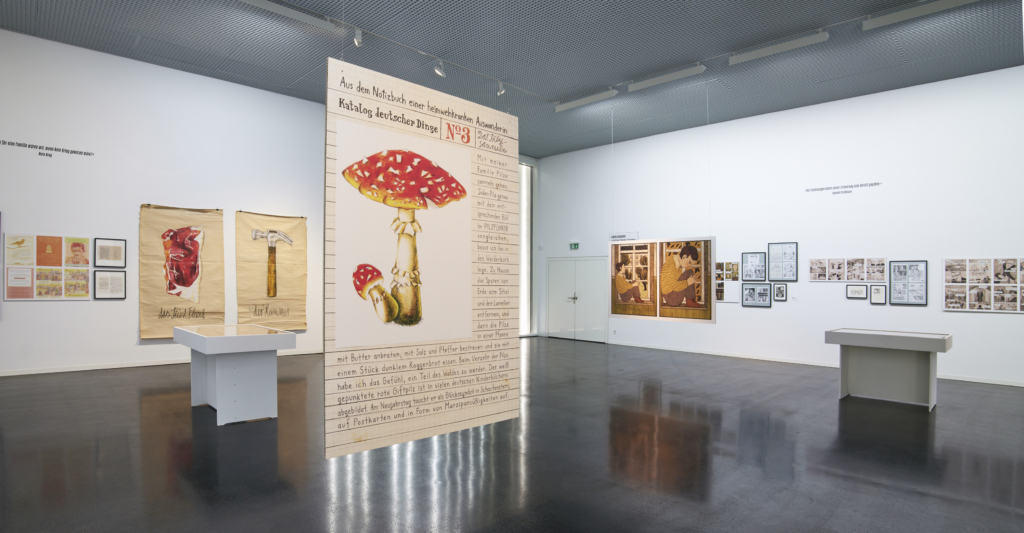
In the article “Comics become mouthpieces for the persecuted” published by Frankfurter Allgemeine on June 8, 2025, Alexandr Jurgs reflects upon the design and impact of the exhibition that brings together the work of four internationally acclaimed artists teeling about persecution and history. As emphasized by Jurgs, the exhibition in Wiesbaden, displaying graphic narratives by Hannah Brinkmann, Tobi Dahmen, Nora Krug and Birgit Weyhe, shows how differently the illustrators proceed in realizing their visual stories and how wide the aesthetic range of this genre is.
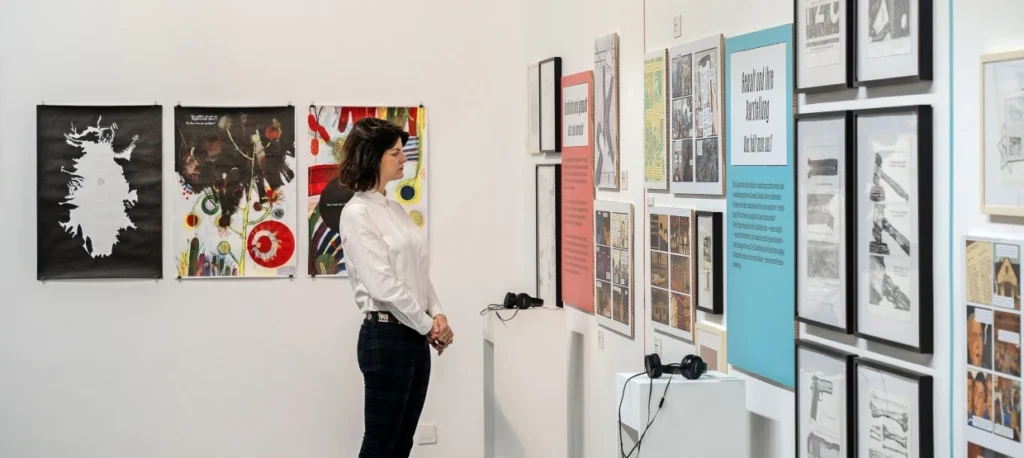
As the article documents in detail, the design of the exhibition offers an immersive experience to its visitors. The oppressive conditions of the imprisonment of Akram al-Saud whose story inspired Tobi Dahmen’s visual novel are vividly evoked. “On the floor of the exhibition space is a square of white adhesive strips, one meter and 80 centimeters long, two meters and 30 centimeters wide. It symbolizes the cell in which Akram al-Saud and 15 other men were imprisoned.”
The exhibition engages the visitors via various media and senses: “At four stations, visitors can listen to interviews via headphones in which the artists provide information about their working methods and the questions that arose when drawing the comics – for example, how to adequately translate the painful experiences of violence that their protagonists had to experience into images. On a monitor, you can leaf through the notebooks of one of the artists.”
As the author concludes, in spite of its immersive nature, it is evident that the Wiesbaden exhibition cannot replace the reading of the comics, and it is not its goal at all. Instead, it reports in detail on the creation of the very different works that deal with issues that remain highly relevant in the world today.
For the original article in Frankurter Allgemeine, please click here.
For our earlier post about the exhibition and the featured artists supported by the SCVN project, please click here.
Starting on May 22, 2025, the Wiesbaden Kunsthaus will host the premiere of the ‘I will not be silent! Drawn Memories in Comics’ exhibition.
Guided tour of the exhibition ‘I will not remain silent! Drawn memory in comics’ with Jakob Hoffman, video by Patrick Bäuml and Kunsthaus Wiesbaden, May 23, 2025.
The exhibition, which runs from May 22 to June 13, showcases four internationally acclaimed, award-winning artists— Tobi Dahmen, Nora Krug, Birgit Weyhe and Hannah Brinkmann — who use graphic storytelling techniques to explore history. Following the success of ‘But I Live. Remembering the Holocaust’ exhibition hosted in 2023, the Kunsthaus continues to focus on its key theme of “Promoting Democracy through Memory Culture.” Curated by Jakob Hoffmann, this exhibition is presented on the 80th anniversary of the end of World War II.
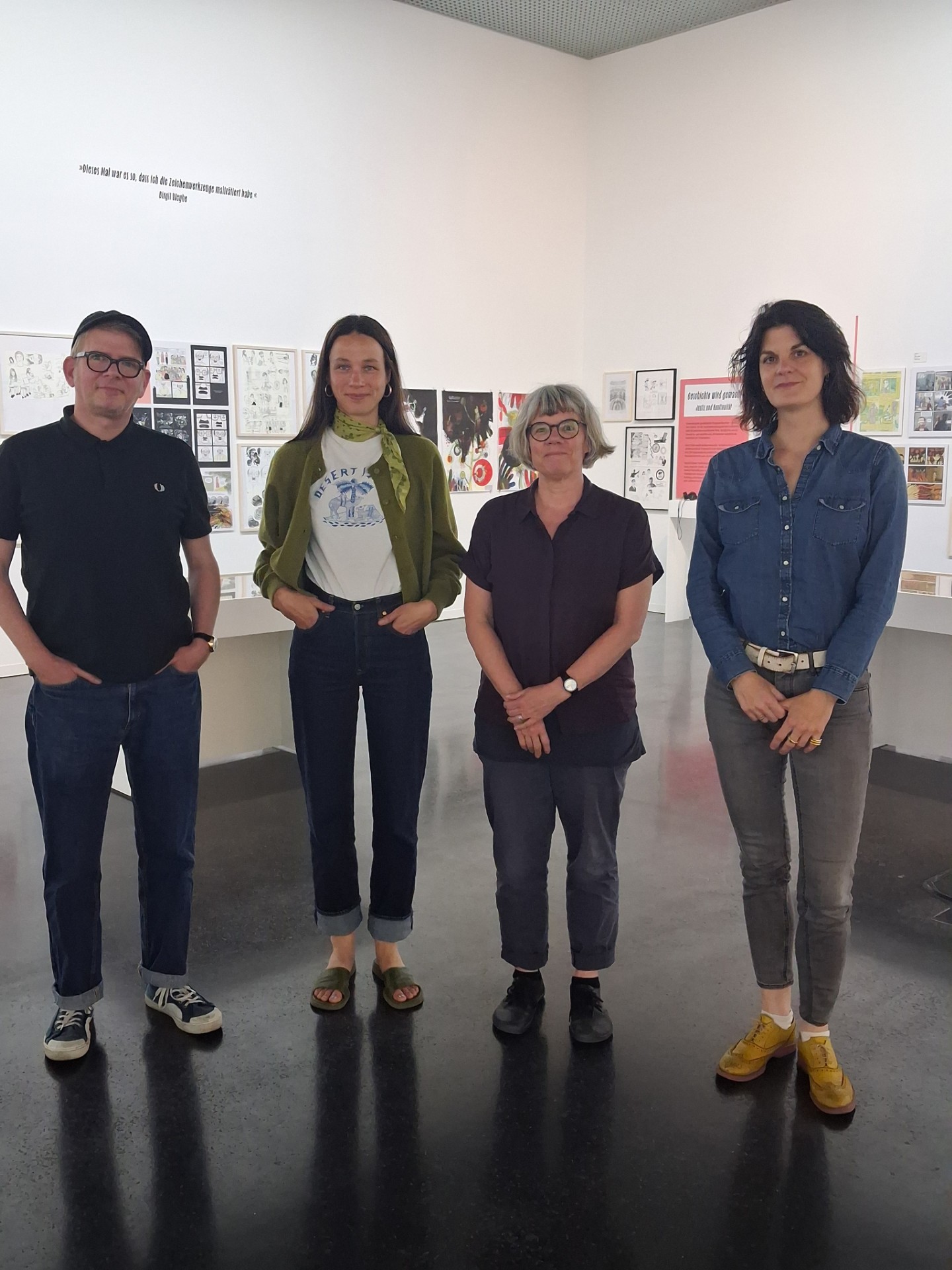
From left to right: Tobi Dahmen, Hannah Brinkmann, Birgit Weyhe and Nora Krug. Photos courtesy of Jakob Hoffmann.
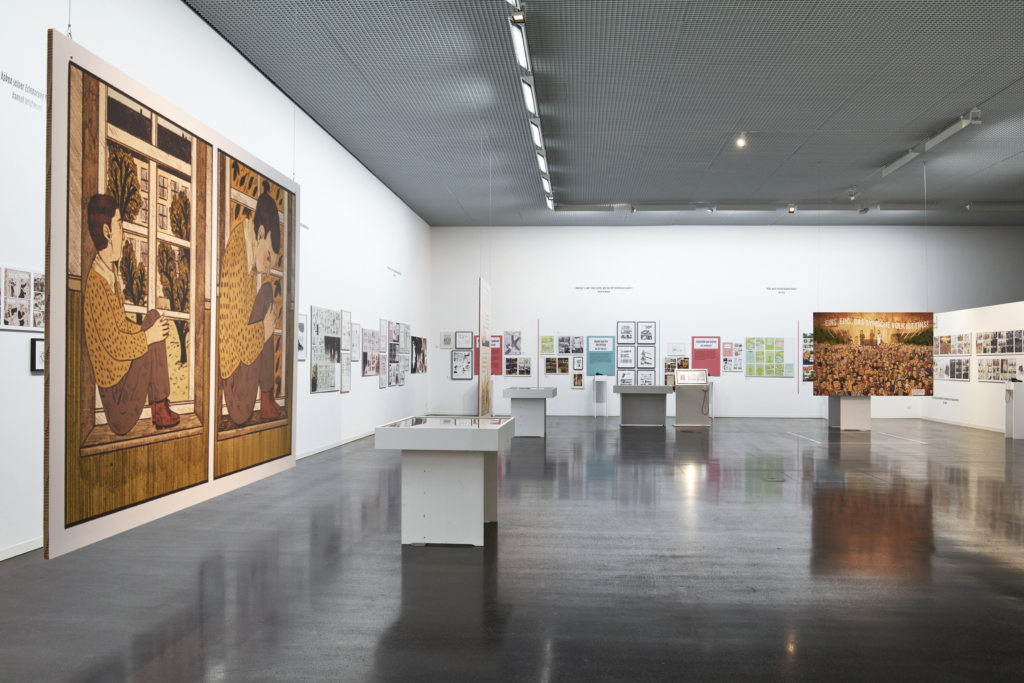
‘I will not be silent!’ centers on life stories that remind us that the past is part of our present, highlighting the importance of democracy and exploring ways of sharing these stories through art. The show features original drawings, sketches, research materials, and interviews. Through the displayed work by the four artists, it demonstrates different aesthetic approaches to visual storytelling and illuminates the creation process of graphic narratives.
The comic art on display at the ‘I will not be Silent!’ exhibition. Photos courtesy of the Wiesbaden Kunstahaus.
Three of the featured artists— Tobi Dahmen, Birgit Weyhe, and Nora Krug—are collaborating with the SCVN project’s Iraq & Syria and Holocaust Research Clusters respectively. While the displayed work by Birgit Weyhe and Nora Krug has been created outside the project, Tobi Dahmen’s featured art has been directly inspired by this collaboration. Visitors will have a chance to see parts of his latest graphic novel titled Al-Faẓia’ – The Horror: Surviving Assad’s Prisons, to be published by Carlsen Verlag in 2026, telling the story of Syrian refugee Akram al-Saud, who survived imprisonment and torture under the totalitarian Assad regime in Syria.
From left to right: Tobi demonstrating the size of Akram’s cell, Birgit Weyhe and Nora Krug examining Tobi’s panels, and Tobi and Akram in conversation. Photos courtesy of Jakob Hoffmann.
Pages from the graphic novel, ‘Al-Faẓia – The Horror: Surviving Assad’s Prisons’, featured at the exhibit. Images by Tobi Dahmen.
The exhibition opened on May 21, 2025, in the presence of Monique Behr, director of the Kunsthaus, and Dr. Susanne Völker, managing director of Kulturfonds Frankfurt RheinMain. During the opening event, the featured artists and witnesses, Ernst Grube and Akram, engaged in a panel discussion, which was moderated by the exhibition curator, Jakob Hoffmann.
The exhibition is supported by the Cultural Fund Frankfurt RheinMain, Democracy Lives in Wiesbaden, and the Heinrich Böll Foundation. An accompanying program was developed in cooperation with the Jewish Community of Wiesbaden and other partners, and features readings, lectures, films, inclusive tours, and workshops for school classes.
For more detailed information about the exhibition, please visit the Wiesbaden Kunsthaus website here.
On the day before the opening of the ‘I will not remain silent!’ exhibition at the Kunsthaus Wiesbaden, the four featured artists, Nora Krug, Tobi Dahmen, Birgit Weyhe and Hannah Brinkmann, met to discuss their creative processes when producing visual narratives. During this workshop, they had an opportunity to discuss their past and current work as well as some of the potential challenges and questions when working in the genre of visual narrative.
The event was moderated by the curator Jakob Hoffmann and featured a keynote speech by Dr. Ole Frahm on the traces of the Holocaust in comics from 1945 to now. Each of the four artists gave a thirty-minute presentation in which they reflected upon their present pieces in a larger context of their work. Nora Krug, currently the artist-in-residence at the Fortunoff Video Archive at Yale, presented on her archival research and offered a glimpse into her work in progress inspired by the recorded testimonies.
After the round of presentations, the artists had a chance to share their thoughts and questions in a discussion with each other. According to Jakob Hoffmann, the debate was very productive and “collegial” as it became evident that “all these artists face similar challenges and questions”. He adds: “Everybody was really thankful for the opportunities this event offered to everyone involved”.
For our earlier post on the Kunsthaus Wiesbaden exhibition, please click here.